
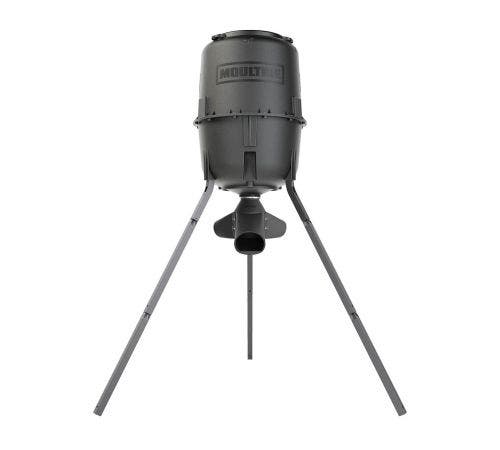
Moultrie vs Boss Buck Deer Feeders
Disclosure: This post contains affiliate links. As an Amazon Associate, I earn from qualifying purchases. Buying through a link on this page costs you nothing extra, and it helps keep this site running. Prices and availability change, so always check the current listing before you order, and confirm the exact model and configuration on that listing.
On this page: Quick Answer | At a Glance | How to Choose | Moultrie, the Brand | Boss Buck, the Brand | The Six Models | Head-to-Head Tables | Model Matchups | Ownership Math | Timers and Accessories | How This Comparison Was Made | FAQs | Verdict by Buyer Type
Quick Answer: Moultrie vs Boss Buck Deer Feeders — Which Brand Suits Which Buyer?
There is no single winner between Moultrie and Boss Buck, because the two brands are strongest at different jobs. Choose Moultrie if you want timed, scheduled feeding with app-friendly, battery-powered control, a wide range of tripod, hanging, and directional feeders, and a Quick-Lock system that lets you change feeder kits on the same hopper. Choose Boss Buck if you want gravity feeding first: free-choice corn or protein pellets, available day and night with no battery, no motor, and no timer to program, in a hopper family that runs from 200 pounds all the way to 1,200 pounds. If your property plan is built around a protein program in spring and summer, Boss Buck’s gravity line is the more natural home for it. If your plan is built around throwing corn at set times, on set days, and controlling how much feed goes out, Moultrie’s timed line is the more natural home for it. Many properties end up using both ideas at different sites, and that is a reasonable outcome rather than a failure to decide.
That short answer needs unpacking, because the brands overlap in one important place and diverge everywhere else. The overlap is gravity feeding. Both brands sell a gravity feeder, and the most useful single comparison in this guide is the Moultrie 250 Gravity against the Boss Buck 200 and 350 gravity feeders. Those three feeders do the same basic job — present feed at ports, on demand, without power — but they do it with different port designs, different flow controls, and different capacities. The divergence is everything above and around that overlap. Moultrie sells a much wider timed-feeder range, including hanging feeders, directional feeders, connected feeders, and small feeders for tight sites. Boss Buck sells a much deeper gravity range, including post feeders and very large hoppers that Moultrie does not match in this comparison. Boss Buck’s hopper family is 200, 350, 600, and 1,200 pounds only. There is no 250-pound or 500-pound Boss Buck feeder, and any listing or article that claims one should be treated as a warning sign that the seller or writer has mixed up two brands or two models.
Before you read further, settle one question honestly: do you want deer to eat whenever they arrive, or do you want feed to appear only at times you choose? Gravity feeding suits the first answer. Timed spin feeding suits the second. Gravity feeding is simpler, has fewer parts to fail, and keeps feed available through the night and between visits, but you cannot cap daily intake with a gravity port alone; deer, and any non-target animals that learn the ports, set the pace. Timed feeding lets you schedule feeds, limit waste on a low-pressure site, and pattern deer around known feed times, but it adds a battery, a motor, a timer, and a spinner plate, and every one of those parts can fail, run flat, or need attention. Neither approach is right for every site, and the brand choice largely follows from that one decision. If you already know you want gravity, most of this guide is about which gravity family fits your capacity and your fill routine. If you already know you want timed feeding, the Moultrie sections matter most, and the Boss Buck sections matter mainly as the gravity alternative you are choosing against.
This is a full two-brand comparison, not a ranked roundup and not a repeat of two narrower articles already on this site. The site’s Moultrie vs Wildgame comparison compares Moultrie with a different brand, and the site’s gravity guide and its single-pair comparison of the Moultrie 250 against the Boss Buck 200 cover one gravity matchup in detail. This article steps back to the brand level: the full capacity families, the feeder types each brand offers, how gravity and spin lineups compare, where each brand is sold, how parts and support work, and how the timer ecosystems differ. The six starting models are the Moultrie 250 Gravity, the Moultrie 30-Gallon Standard, the Boss Buck 200, the Boss Buck 350, the Boss Buck 600 (model BB-1.6.P), and the Boss Buck 1200. Where a model has a verified Amazon link, that link is given. Where it does not, this guide says so plainly and gives no button, because inventing a buy link for the wrong model would be worse than giving no link at all.
A note on evidence, stated up front so nothing later is misread. This site researches feeders; it does not claim hands-on testing of these models, and this article makes no testing claim. Capacities, materials, and features below come from manufacturer pages, the site’s own live articles, and the site’s own research notes, and anything that could not be sourced is either omitted or flagged as unpublished by the manufacturer. That discipline matters most in two places. First, Boss Buck publishes no throw or spread distance, so this article prints none for Boss Buck, even though searchers often ask how far a Boss Buck feeder throws. A gravity feeder has no spinner to throw feed in any case, and a timed Boss Buck conversion must be judged on its own kit listing, not on a borrowed number. Second, no prices are printed in this article. Prices move, listings change configuration, and an undated price is a stale price within weeks. Check the current listing at the time you buy, and treat any article that prints a price without a check date with suspicion.
At a Glance: Moultrie vs Boss Buck Deer Feeders
The table below is the whole comparison in miniature. Read it as a map, then use the sections that follow to check the rows that matter for your property. A blank photo cell is deliberate: rows with no verified exact-model photo are left blank rather than filled with a photo of a different model.
| Model | Best for | Capacity and key spec | Type | Photo |
|---|---|---|---|---|
| Moultrie 250 Gravity | Movable larger site; gravity feeding with a later spin-kit option | 250 lb; 30-gallon hopper; 6-foot fill height; triple-funnel flow; Quick-Lock | Tripod gravity |  |
| Moultrie 30-Gallon Standard | First timed feeder; ground-level filling; simple scheduling | 200 lb of corn; 30-gallon hopper; 5.5 feet tall; up to 4 feeds per day, 1 to 20 seconds each; 4 AA batteries | Tripod timed spin | |
| Boss Buck 200 | Mid-size movable gravity site; protein or corn | 200 lb corn, about 170 lb pellets; three-way flow sleeve; 10-inch ports with drain holes | Tripod gravity | 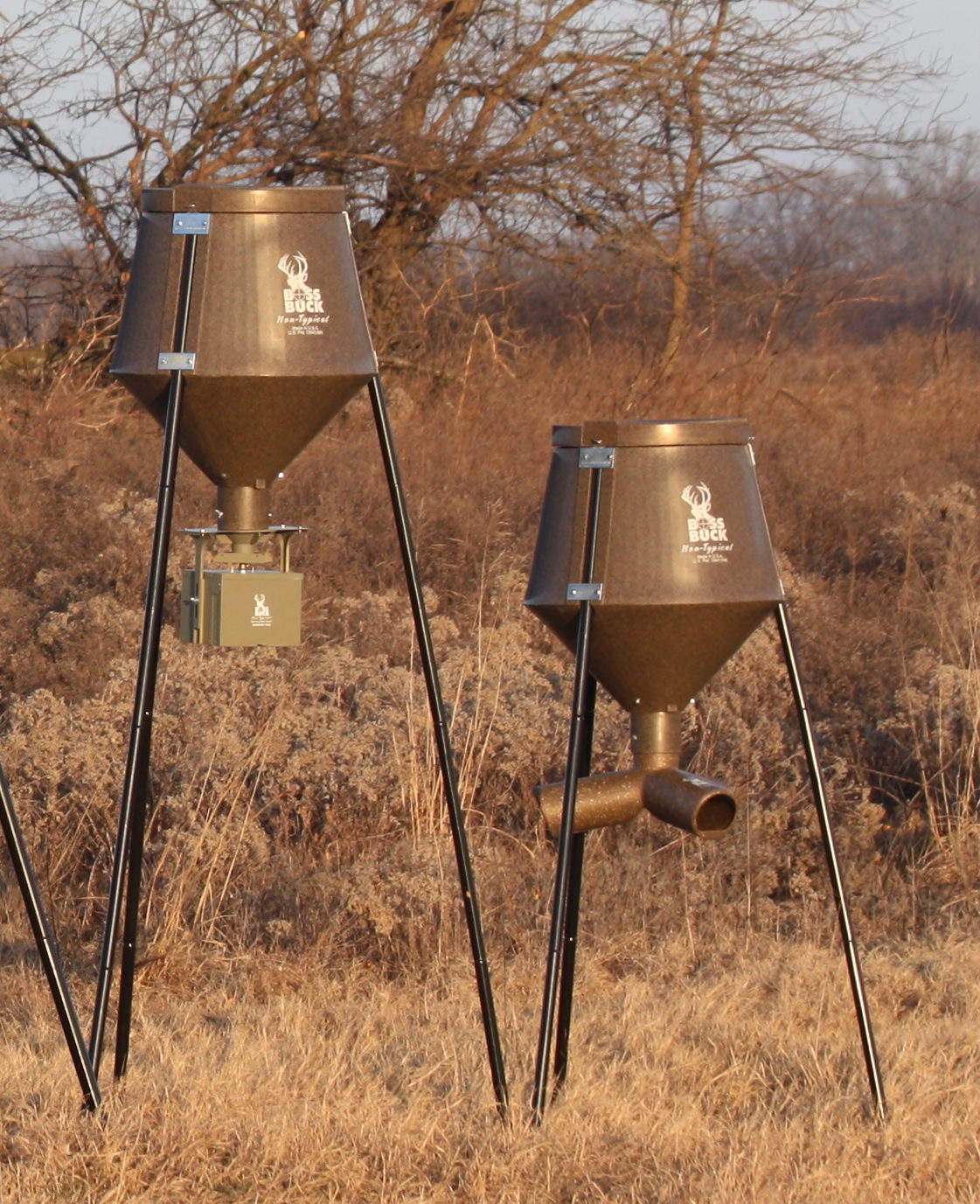 |
| Boss Buck 350 | Protein site or larger corn site | About 350 lb corn, about 300 lb large pellets; three-way flow sleeve; 10-inch ports with drain holes | Tripod gravity | 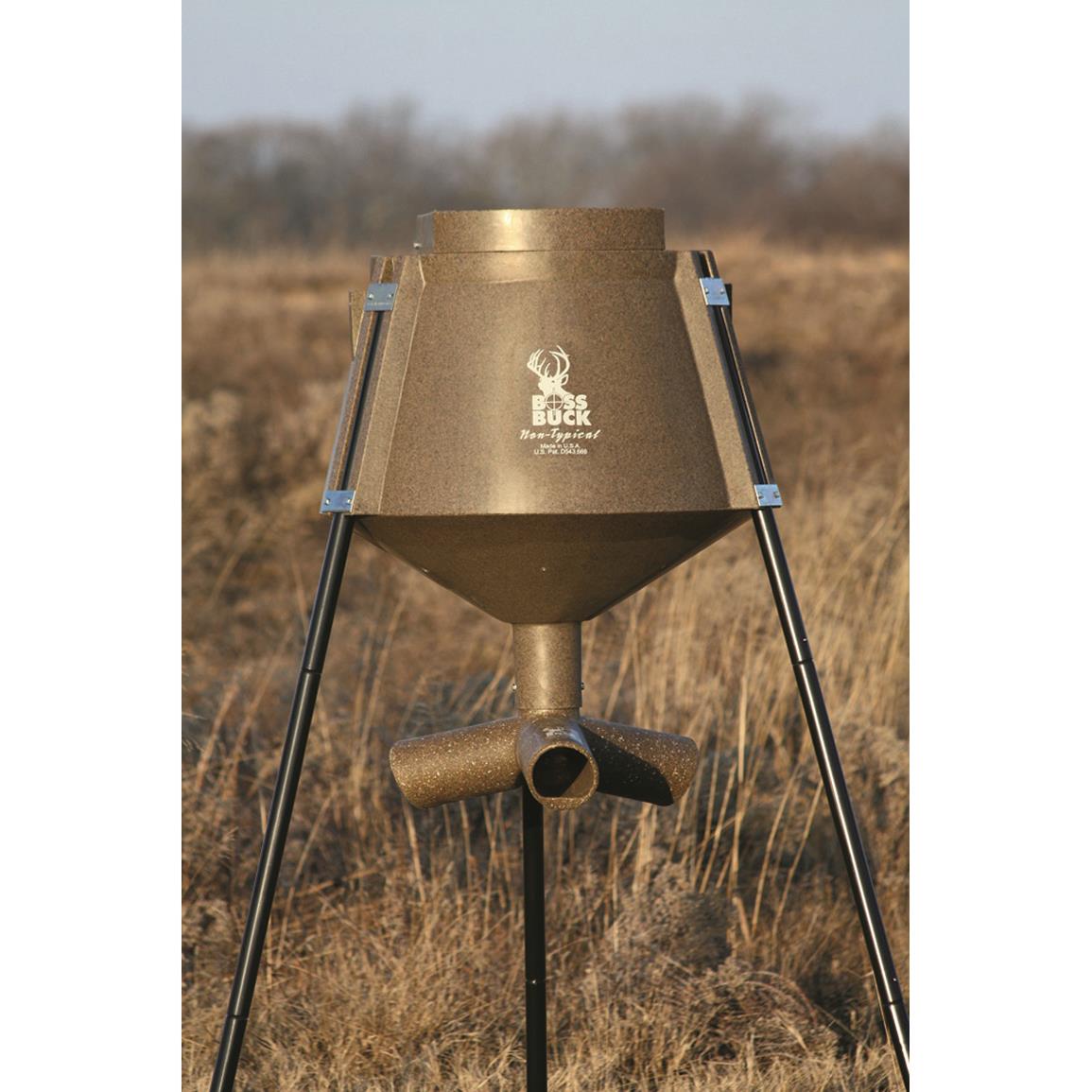 |
| Boss Buck 600 (BB-1.6.P) | Large property; high-use site; long refill intervals | About 600 lb corn, about 500 lb large pellets; four-way head; 81 inches to the lid | Tripod gravity | |
| Boss Buck 1200 | Very large property or bulk feeding program | 1,200 lb family-top capacity; check the dealer listing for the exact port and feed breakdown before ordering | Gravity, bulk |
Three patterns jump out of that table, and they explain most of the brand difference. First, capacity: Boss Buck keeps going where Moultrie stops. Moultrie’s largest feeder in this comparison holds 250 pounds. Boss Buck offers 350, 600, and 1,200 pounds above that. If your refill trip is long, expensive, or infrequent, that ladder matters more than any single feature. Second, control: Moultrie is the only brand in this comparison with a timed feeder in the starting six. The 30-Gallon Standard schedules feed; no gravity feeder in either brand can do that, because gravity feeding is continuous by design. Third, simplicity: the gravity models on both sides need no battery and no programming, which is a genuine advantage on a remote site where a dead battery can mean weeks without feed. The rest of this guide is about weighing those three patterns against your ground, your feed, and your visit schedule.
How to Choose Between Moultrie and Boss Buck
Work through the four questions below in order. The first answer narrows the brand; the later answers narrow the model. Do not start with capacity, tempting as that is, because a large hopper on the wrong feeding system is still the wrong feeder.
1. Gravity or timed: how should feed be available?
If you want feed available whenever deer arrive, including overnight and between your visits, choose gravity. Both brands offer it, and the choice then turns on capacity and port design, covered below. Gravity suits protein programs particularly well, because protein feeding is usually free-choice over weeks: deer eat what they need, when they need it, through antler growth and fawning. Gravity also suits remote ground, because there is no battery to die and no timer to lose its program. The cost of that simplicity is control. You cannot set a daily ration with a gravity port. Flow adjustment slows or speeds presentation, but it does not meter a measured amount per day. If deer numbers are high, or hogs and raccoons have learned the ports, a gravity feeder can empty faster than you planned, and the only remedies are a narrower flow setting, site design such as a pen or barrier, or a switch to timed feeding.
If you want feed to appear at set times, in set amounts, choose timed feeding, and in this comparison that means Moultrie. A timed spin feeder throws feed on a schedule you program, which helps pattern deer, limits daily waste on a site where deer visit briefly, and stretches a hopper across a known number of days. The trade-offs are real: a battery to maintain, a motor and spinner plate exposed to weather, a timer to program correctly, and a power system to keep charged if you add solar. Moultrie’s Standard shows how simple timed feeding can be — four feeds a day, each 1 to 20 seconds, on four AA batteries — but even that simple system needs a battery check on every visit. If you cannot commit to that check, gravity is the safer system for your site, even if timed feeding sounds more precise on paper. For a fuller treatment of the two systems, see the site’s spin vs gravity comparison and gravity vs timed protein guide.
2. Capacity and refill rhythm: how often can you honestly get back?
Capacity is not about bragging rights; it is about the gap between refills, and that gap must be shorter than the time feed stays fresh in your climate. A 200-pound feeder on a site you visit weekly is a comfortable fit. The same feeder on a lease you visit monthly is a feeder that will sit empty for weeks, and empty weeks teach deer to stop visiting. Boss Buck’s ladder — 200, 350, 600, 1,200 — exists for exactly that problem: as the visit gap grows, the hopper must grow with it, or the number of feeders per site must grow instead. Moultrie’s 250 sits between the Boss Buck 200 and 350, which makes it a strong single-feeder answer for a moderate site, but it cannot stretch to a monthly-visit, high-use property the way a 600 or 1,200 can.
Capacity must also be read by feed type, not by headline number alone. Boss Buck publishes separate corn and pellet figures, and the gap is significant: the 200 holds about 170 pounds of pellets against 200 pounds of corn, the 350 about 300 pounds of large pellets against about 350 pounds of corn, and the 600 about 500 pounds of large pellets against about 600 pounds of corn. Plan refills on the pellet number if you feed pellets, or you will overestimate your interval by roughly a sixth to a fifth. Moultrie’s 250 Gravity is listed at 250 pounds for feed generally, and Moultrie describes it for protein in spring and corn in fall, so its planning number does not change with the feed switch in the same way. That is a genuine planning convenience for a mixed program. Whichever brand you choose, write down the planning number for your actual feed, the date you filled, and the date the feeder ran low, for the first two cycles. Those two cycles tell you more about your site’s consumption than any capacity table can.
3. Power and control: what are you willing to maintain?
Count the parts you are willing to look after. A gravity feeder asks you to check a lid, clear drain holes and ports, level the legs, and watch for bridging where feed locks across an opening. A timed feeder asks all of that plus battery, motor, timer, and spinner-plate checks. Moultrie’s ecosystem rewards the buyer who accepts that list: Quick-Lock kits swap on the same hopper, timers program multiple feeds, and a 6-volt solar port on the Standard lets you add a solar panel rather than swapping batteries as often. Boss Buck’s gravity ecosystem rewards the buyer who wants the shortest list: no battery, no motor, no timer, and a conversion kit later if timed feeding becomes desirable. Boss Buck’s own frequently asked questions point gravity owners toward 12-volt conversion kits for that later step, including a directional conversion kit, which means a gravity-first buyer is not locked out of timed feeding forever. The question is whether you want timed feeding now, with Moultrie, or later, as a conversion, with Boss Buck.
Think about failure modes, not just features. A gravity feeder’s worst common failures are wet feed from a poorly seated lid, blocked drain holes, bridging at the port, and a leaning tripod on soft ground. All four are visible on a walk-around and fixable with hands and a few minutes. A timed feeder’s worst common failures are a dead battery, a timer that lost its program, a jammed spinner, and a motor that quit in cold or wet weather. Those failures are silent until deer stop visiting, and they often need a part rather than a adjustment. If your site is visited weekly, silent failures are caught quickly. If your site is visited monthly, gravity’s visible, simple failures are the safer risk profile. That single difference — how quickly you find out something went wrong — should weigh as heavily as any feature list.
4. Mount, fill height, and ground: can you fill it safely, every time?
Every feeder in this comparison is only as good as its fill routine. Tripod feeders need reasonably level, firm ground, and a full hopper is heavy: a 250-pound load, a 350-pound load, and a 600-pound load each demand a vehicle, cart, or ATV close to the site and a safe way to lift feed to the fill height. Fill heights in this comparison run from 5.5 feet on the Moultrie Standard, which Moultrie describes as fillable from ground level, to 6 feet on the Moultrie 250 Gravity, to 81 inches to the lid on the Boss Buck 600. Higher is not worse in itself, but it changes who can fill the feeder alone and what standing surface they need. Boss Buck also sells post feeders in 200, 350, and 600-pound sizes, mounting on a 4-inch by 4-inch post, or a 6-inch by 6-inch post for the 600, which suits a permanent site where a tripod’s footprint or stability is a problem, but which trades mobility for permanence: once the post is set, the feeder does not move without new post work.
Ground conditions deserve a paragraph of their own, because they quietly decide tripod success. Soft, wet, or sandy soil lets tripod feet sink under a full load, which tilts the hopper, unlevels the ports, and feeds unevenly: the low side runs faster than the high side. The site’s existing gravity guide notes a purchaser report of feet sinking under a full Moultrie load, and that report should be read as a general tripod warning, not as a brand-specific defect. Check leg seating after rain and after animal activity, set the feeder on the firmest level ground the site offers, and consider a firmer pad or a post-mounted model if a site is chronically soft. Port height matters here too: the site’s height guide and placement guide cover how height and location interact with deer use, and both are worth reading before you set a feeder you will live with for seasons.
Moultrie, the Brand: Timed Control, Wide Range, Quick-Lock System
Moultrie is best understood as a feeder system, not as a single feeder. The brand’s current lineup, as listed on Moultrie’s own store, includes the 200-pound Deer Feeder Standard, the 250-pound Deer Feeder Pro III, the 250-pound Deer Feeder Pro III Directional, the 250-pound Deer Feeder Connected, the 250-pound Deer Feeder Gravity, the 30-pound all-in-one hanging feeder, 40-pound hanging feeders including a directional version, a 6.5-gallon directional hanging feeder, a block feeder, the Fish and Deer 30-gallon Quick-Lock directional tripod, and the Deer Feeder Pro II 30-gallon tripod. That breadth is the brand’s core advantage. A buyer can start with a simple timed tripod, add a hanging feeder for a tight site or a tree-line spot, try a directional feeder where feed must go one way rather than broadcast in a circle, or step up to a connected feeder where remote control matters. Few other brands in this site’s coverage offer that many mount and control combinations under one kit system.
The system idea is Quick-Lock. Moultrie describes Quick-Lock kits that twist on and off the hopper, so a feeder kit — gravity, timed, directional, or connected — can be changed without replacing the hopper. The 250 Gravity carries Quick-Lock capability, which is why it appears in both the gravity discussion and the system discussion: buy the gravity kit now, and a later change to a spin kit stays within the same hopper platform, subject to confirming kit compatibility for your exact hopper. The Standard’s all-in-one Quick-Lock kit shows the same idea from the timed side: a programmable digital timer that flips down, a metal spin plate, and a built-in funnel in one kit. For a buyer who is unsure whether gravity or timed feeding will suit a site long-term, that upgrade path has real value, because it protects the hopper investment against a change of mind. It does not, however, turn a gravity feeder into a timed feeder for free; the spin kit is a separate purchase, and the buyer should confirm exactly which kit fits which hopper before ordering.
Moultrie’s timed strength is scheduling simplicity at the entry level and more control higher up the range. The Standard programs up to four feeds per day, each 1 to 20 seconds, on four AA batteries, with an external power port for 6-volt solar accessories. That is enough scheduling for most corn programs: morning and evening feeds, a midday feed if desired, and a short spin duration to limit waste. Higher models in the range add directional throwing, connected control, and larger or more capable kits, and the site’s Moultrie brand guide covers those models in more depth. The point for this brand comparison is narrower: Moultrie is the brand to choose when scheduling, direction, hanging mounts, or connected control are part of the requirement, because Boss Buck’s gravity-first range does not offer the same breadth in those categories. Moultrie also brings trail cameras, feeders, and related outdoor gear under one brand roof, which matters for buyers who want one support channel and one parts system across cameras and feeders, though camera integration should never be the reason to choose a feeder that fits the site poorly.
Moultrie brand strengths:
- Widest control choice in this comparison: timed, directional, hanging, connected, and gravity kits.
- Quick-Lock system lets kits change on the same hopper platform, protecting the hopper investment.
- Simple timed scheduling at the entry level: up to 4 feeds per day, 1 to 20 seconds each, on the Standard.
- Ground-level filling on the Standard at 5.5 feet, and a 6-foot fill height on the 250 Gravity.
- Small hanging and directional options for tight sites where a tripod does not fit.
Moultrie brand weaknesses:
- No gravity hopper above 250 pounds in this comparison, so large-property and bulk programs must look elsewhere.
- Timed feeders add battery, motor, timer, and spinner maintenance that gravity feeders avoid.
- Model names and kit configurations are easy to confuse: gravity, spin, directional, and connected kits can share a hopper platform.
- Availability varies by model and channel; the Standard’s own manufacturer page showed out of stock there when checked for this guide, so current availability must be confirmed before ordering.
Moultrie parts, support, and timer ecosystem
Moultrie’s parts story follows its kit story. Because kits twist on and off, the parts a buyer is most likely to need — timers, spinner plates and funnels, feeder feet, leg sections and brackets, hopper tops and lowers, and feed screens — are sold as kit components and accessories rather than as whole-feeder replacements. The Standard’s product page lists compatible parts and accessories alongside the feeder, which is the right place to check compatibility before ordering a spare. That modularity is a genuine ownership advantage: a failed timer does not necessarily mean a failed feeder, and a worn spinner plate does not necessarily mean a new hopper. The counterweight is compatibility discipline. A kit that fits one hopper generation or capacity may not fit another, so the buyer should match the part to the exact model number — MFG-15107 for the 250 Gravity, MFG-13220 for the Standard — rather than to a brand name or a capacity number alone.
The timer ecosystem is where Moultrie most clearly outruns Boss Buck in this comparison, and it deserves a plain statement. Moultrie timers are the control centre of its timed feeders: they set feed times and spin durations, and the site’s timer guide and timer programming guide cover programming in detail. Two accessory timers are relevant here, and they are accessories, not ranked feeders. The Moultrie Timer II is the in-stock option. The Moultrie Timer III is sold out at Amazon, and this guide says exactly that wherever the Timer III is mentioned, so no reader chases a buy button for a timer that is not available there. Timer choice should follow feeder compatibility first and feature count second: a timer that does not fit the feeder’s kit is not a bargain at any feature level. For power, the Standard runs on four AA batteries, allows lithium batteries for longer life, and offers an external port for 6-volt solar accessories, which is a practical middle path between frequent battery swaps and a full solar installation. Battery chemistry, voltage, and solar matching are covered in the site’s battery guide and solar panel guide, and the feeder’s voltage should always be read from its own manual before a solar panel or battery is bought.
Boss Buck, the Brand: Gravity First, Deep Capacity, Simple Ownership
Boss Buck is best understood as a gravity specialist with a conversion path, not as a general feeder brand. The brand’s identity is the patented gravity hopper and its port head: feed flows by gravity to ports around the head, deer eat on demand, and no battery, motor, or timer stands between the hopper and the animal. The hopper family is the whole story in one line: 200, 350, 600, and 1,200 pounds, and nothing else. There is no 250-pound Boss Buck feeder and no 500-pound Boss Buck feeder, and that fact alone clears up a surprising amount of confusion in listings and forums, where a Boss Buck capacity is sometimes misquoted from a Moultrie or another brand’s range. If a listing claims a Boss Buck 250 or 500, the listing is wrong about the brand, the model, or both, and the buyer should stop and verify the model number before proceeding.
Within that family, Boss Buck offers more mount and configuration variety than a first glance suggests. The tripod gravity feeders are the best-known form, with galvanized tripod legs and a gravity head that can later convert to an automatic spinner setup with a conversion kit. The post feeders mount on a 4-inch by 4-inch post in 200 and 350-pound sizes, or a 6-inch by 6-inch post for the 600, with a ventilated, removable lid, a stabilization sleeve, and mounting hardware, and with four removable feed tubes on the post form. The brand also sells a Stand and Fill sled form in the wider market, automatic feeder kits with timers, directional conversion kits, drum-mount kits, and protein delivery and spinner delivery systems for its large feeders. The site’s Boss Buck brand guide and Boss Buck parts list cover the wider range and the replacement parts in detail. For this brand comparison, the point is that Boss Buck’s variety serves the gravity and large-capacity buyer first: bigger hoppers, post mounts for permanent sites, and conversion kits for buyers who want timed feeding later, rather than a wide timed range now.
Boss Buck’s port design is the feature that most separates it from Moultrie gravity feeding, and it is worth describing precisely. The 200 and 350 use a three-way inner sleeve that adjusts flow, with 10-inch ports set at a 10-degree angle, with drain holes and an overhang that sheds rain. The 600 uses a four-way sleeve with 8-inch ports at the same 10-degree angle, also with drain holes. The angle and the drain holes are moisture design, not decoration: a port that holds water wets feed from below, and wet feed cakes, molds, and bridges. The inner sleeve is flow design: turn it to allow more or less feed through, tuned to corn, pellets, or mixed grains, and to the pellet size in use. The deep hatch lid on the gravity tripod form, the roto-molded plastic hopper, and the galvanized hardware complete a design that is deliberately low-tech. There is little to program, little to power, and little to fail, which is the point. The trade-off, stated plainly, is that a gravity port cannot schedule feed, cannot scatter feed across a clearing, and cannot cap daily intake. A buyer who needs any of those three things needs a timed feeder or a conversion kit, not a larger gravity hopper.
Boss Buck brand strengths:
- Deepest gravity capacity ladder in this comparison: 200, 350, 600, and 1,200 pounds.
- Gravity-first simplicity: no battery, motor, or timer to maintain in gravity form.
- Adjustable inner-sleeve flow control, angled ports with drain holes, and rain-shedding port design.
- Tripod and post mounts, plus conversion kits to timed spinner feeding later.
- Protein-program fit: free-choice pellets, day and night, through spring and summer.
Boss Buck brand weaknesses:
- No timed feeder in the starting six; timed feeding requires a conversion kit or a different brand.
- No throw or spread distance is published, so broadcast range cannot be compared on a number.
- Large hoppers demand fill access, lifting, and feed-freshness planning; a 600 or 1,200-pound fill is a project, not a chore.
- Some models are dealer-only or lack a verified Amazon link, so buying may mean a dealer channel rather than a single online checkout.
- Gravity ports cannot cap intake or exclude all non-target animals on their own.
Boss Buck parts, support, and availability
Boss Buck’s parts story is centred on the gravity head, the sleeve, the ports, and the conversion kits. The site’s parts list covers replacement parts and accessories model by model, and it is the right companion to this comparison when a specific part is needed, because part fit follows the exact feeder form — tripod gravity, post feeder, or large bulk feeder — rather than the brand name alone. Conversion kits are the most important parts-category distinction for this comparison: Boss Buck’s own frequently asked questions point owners toward 12-volt conversion kits to turn a gravity feeder into an automatic feeder, and toward a 12-volt directional conversion kit where directional throwing is wanted, plus drum-mount kits for drum-based setups. That means a Boss Buck gravity buyer is not choosing against timed feeding forever; the buyer is choosing gravity now, with a documented conversion route later, and should confirm kit compatibility for the exact gravity model before buying the kit.
Availability is where Boss Buck buying needs more care than Moultrie buying, and this guide is explicit about the reason. Some Boss Buck models are sold through dealers, and an Amazon button is shown only where an exact-model link has been verified. The Boss Buck 200 and 350 carry verified buttons below. The Boss Buck 600 (BB-1.6.P) and the Boss Buck 1200 carry no Amazon button, because no verified ASIN for those exact models was found , and this guide will not invent one. That is not a statement that those models cannot be bought; it is a statement about this guide’s evidence. Check bossbuck.com and authorized dealers for the 600 and 1200, confirm the exact model number and configuration, and confirm whether the listing is a gravity feeder, a post feeder, a complete system, or a conversion kit, because those forms look similar in thumbnails and differ substantially in the box. The same configuration discipline applies to every feeder in this guide, but it matters most for large Boss Buck models, where a wrong-configuration order is also a large, heavy return.
The Six Models, One by One
Each model below gets the same treatment: what it is, what it does well, where it falls short, a pros-and-cons block, a spec table drawn only from sourced figures, and either a verified Amazon button or an explicit statement that no verified button is given. Read the model sections after the brand sections, because a model’s weaknesses often make sense only once the brand’s system is understood.
Moultrie 250 Gravity — Best Movable Gravity Feeder with a Spin-Kit Future
The Moultrie 250 Gravity, model MFG-15107, is a tripod gravity feeder built around a 30-gallon hopper that holds 250 pounds of feed. Moultrie describes it as a no-electronics, no-battery feeder that supports protein feeding in spring and corn feeding in fall, with a 6-foot fill height, six steel leg sections, a black hopper, 360-degree feed coverage, an operating temperature range of 14 degrees Fahrenheit to 140 degrees Fahrenheit, and a one-year warranty. Retailer descriptions add a triple-funnel feed system with adjustable flow for corn, pellets, and mixed grains, and a twist-lock lid that is fully detachable for filling. The Quick-Lock capability is the feature that lifts this feeder above a standalone gravity feeder: a Moultrie spin kit can later be fitted to the same hopper if timed feeding becomes preferable, subject to confirming kit compatibility.
The strengths are simplicity plus a future. No battery means no battery failure on a remote site. No timer means no program to lose. The 250-pound capacity sits usefully between the Boss Buck 200 and 350, which makes it a strong single-feeder answer for a moderate site that does not yet justify a 350-pound hopper. The triple-funnel adjustment is the working control: move the funnels to constrict flow for corn or open it for larger pellets, and recheck the setting at every feed changeover, because a setting that flows corn well may restrict large pellets enough to bridge, and a setting opened for pellets may let corn run too freely. The honest weaknesses are those of any movable tripod. Stability depends on soil and level ground, and the site’s existing gravity guide notes a purchaser report of feet sinking in soft ground under a full load. The 6-foot fill height still requires a safe pouring position above waist height for most people. A full 250-pound load is heavy to transport to a remote site, and capacity is smaller than the Boss Buck 350 and 600 for very high-use sites. None of those weaknesses is a reason to avoid the feeder; all of them are reasons to choose the site and the fill routine before choosing the feeder.
Pros:
- 250-pound capacity in a movable tripod, between the Boss Buck 200 and 350.
- No battery, motor, or timer to maintain in gravity form.
- Quick-Lock compatible for a later spin-kit change on the same hopper.
- Adjustable triple-funnel flow for corn, pellets, and mixed grains.
- 360-degree feed coverage as listed by Moultrie.
Cons:
- Tripod stability depends on soil, level ground, and leg seating after rain.
- 6-foot fill height still needs a safe, stable pouring position.
- Pellet and corn flow need different funnel settings at changeover.
- Smaller than the Boss Buck 350 and 600 for very high-use sites.
| Spec | Detail |
|---|---|
| Model | MFG-15107 |
| Capacity | 250 lb; 30-gallon hopper |
| Distribution | Gravity; 360-degree feed coverage as listed |
| Fill height | 6 feet |
| Legs | 6 steel leg sections |
| Power | None in gravity form |
| Operating temperature | 14 degrees Fahrenheit to 140 degrees Fahrenheit, as listed |
| Warranty | 1 year, as listed |
| Conversion | Quick-Lock capability: yes, as listed |
Check Price on Amazon: Moultrie 250 Gravity Deer Feeder
Before ordering, confirm model MFG-15107 and the gravity kit configuration on the listing, not a spin-kit listing on the same hopper platform.
Moultrie 30-Gallon Standard — Best First Timed Feeder
The Moultrie Deer Feeder Standard 30-Gallon Tripod, model MFG-13220, is the timed counterpart to the gravity feeder above, and the contrast between the two is the clearest illustration of the Moultrie system. Where the 250 Gravity needs no power, the Standard is an automatic broadcast feeder: a 30-gallon hopper holding up to 200 pounds of corn, an all-in-one Quick-Lock feeder kit with a programmable digital timer that flips down, a metal spin plate, and a built-in funnel, tool-free assembly, and a height of 5.5 feet that Moultrie describes as allowing fill-ups from ground level. The timer programs up to four daily feeds, each 1 to 20 seconds in duration, and the feeder runs on four AA batteries, with lithium batteries allowed for longer life, plus an external power port for 6-volt solar accessories. The hopper is UV-resistant tapered polymer, and the kit uses Quick-Lock technology.
The strengths are entry-level simplicity and ground-level filling. Four feeds a day covers morning, evening, and two additional windows without a complex program. A 1-to-20-second spin duration gives a usable range from a short scatter to a longer throw, though this guide prints no distance figure for the Standard, because the manufacturer figures used here describe feed times and duration rather than a throw distance, and a distance should not be borrowed from another model. Ground-level filling at 5.5 feet is a genuine ownership advantage over taller tripods, especially for a buyer who fills alone. The weaknesses are the timed-feeder weaknesses in miniature: a battery to check, a timer to program correctly, a motor and spinner plate to keep working, and a configuration trap, because Moultrie sells multiple kits and capacities that can look alike. Availability is also a live question for this model: at the time this guide was written, Moultrie’s own product page listed the Standard 30-Gallon Tripod as out of stock there. That is a manufacturer-channel observation, checked 2 November 2026, not a claim about every retailer, and it is exactly why this model carries no Amazon button: no verified ASIN for this exact model was found for this article, and the banned ASIN that appears in older data for a Moultrie 200-pound Standard is never used here. Check current availability and the exact model number before ordering, through Moultrie or an authorized dealer.
Pros:
- Simple timed scheduling: up to 4 feeds per day, 1 to 20 seconds each.
- Ground-level filling at 5.5 feet, lower than the taller tripods in this guide.
- Tool-free assembly and an all-in-one Quick-Lock kit with timer, spin plate, and funnel.
- AA battery power with lithium allowed, plus an external 6-volt solar port.
- UV-resistant tapered polymer hopper.
Cons:
- Battery, motor, timer, and spinner all need maintenance that gravity feeders avoid.
- 200 pounds of corn is smaller than the Boss Buck 350, 600, and 1,200 hoppers.
- Kit and model confusion is easy: confirm MFG-13220 and the Standard configuration.
- No verified Amazon button; manufacturer page showed out of stock there when checked.
| Spec | Detail |
|---|---|
| Model | MFG-13220 |
| Capacity | Up to 200 lb of corn; 30-gallon hopper |
| Distribution | Automatic broadcast; metal spin plate |
| Feeds | Up to 4 per day, 1 to 20 seconds each |
| Power | 4 AA batteries (sold separately); lithium allowed; external 6-volt solar port |
| Height | 5.5 feet |
| Hopper | UV-resistant tapered polymer |
| Kit | All-in-one Quick-Lock feeder kit, timer flips down |
| Amazon link | None: no verified ASIN for this exact model |
Boss Buck 200 — Best Mid-Size Gravity Feeder for a Movable Site
The Boss Buck 200 is the entry point to the Boss Buck gravity family and, for many buyers, the right place to start with the brand. It is a tripod gravity feeder holding 200 pounds of corn, or about 170 pounds of pellets, with a three-way inner sleeve for flow control, 10-inch ports set at a 10-degree angle with drain holes and an overhang, 75-inch galvanized tripod legs, a roto-molded plastic hopper, and a deep hatch lid. Boss Buck describes the design as a maintenance-free patented hopper that distributes feed evenly to three round ports, so deer do not feed nose to nose at a single opening. The gravity head converts to a timed spinner setup later with a conversion kit, sold separately or in combo versions depending on the listing, which gives the 200 the same kind of future path that Quick-Lock gives the Moultrie 250, through a different mechanism.
The strengths are port design and flow control. The sleeve lets the owner tune presentation to corn or pellets and to pellet size, the angle sheds rain, and the drain holes keep water from pooling in the ports and wetting feed from below. The site’s existing Boss Buck review notes owner reports that are worth repeating with attribution: reviews for this feeder were mostly positive in that review’s evidence, while the negative reports clustered on squirrels and raccoons chewing into the plastic, in one owner’s case within days. That is not a laboratory finding, and it is not presented as one; it is a reminder that plastic hoppers, on any brand, need a varmint plan where squirrels and raccoons are active, whether that plan is a leg guard, a pen, site design, or a different mount. The weaknesses are capacity and control limits. Two hundred pounds is a mid-size hopper, and on a high-use site or a monthly-visit lease it will need refilling sooner than the 350, 600, or 1,200. Gravity feeding cannot cap daily intake, and the ports cannot exclude all non-target animals on their own. Feed must also be non-salt-based: Boss Buck warns that salt-based mineral supplements may damage its feeders, a restriction that matters for buyers who mix minerals into feed.
Pros:
- Refined gravity port design: three-way sleeve, angled ports, drain holes.
- Free-choice feeding day and night, with no battery, motor, or timer.
- Converts to a timed spinner setup later with a conversion kit.
- Mid-size hopper that is movable and fillable without a large-project fill routine.
- Three ports spread deer around the head rather than crowding one opening.
Cons:
- 200-pound capacity needs more frequent refills than the larger Boss Buck hoppers.
- Gravity cannot cap daily intake or schedule feeds.
- Plastic hopper needs a varmint plan where squirrels and raccoons chew.
- Non-salt-based feed only; salt-based minerals may damage the feeder.
| Spec | Detail |
|---|---|
| Capacity | 200 lb corn; about 170 lb pellets |
| Ports | Three-way sleeve; 10-inch ports, 10-degree angle, drain holes |
| Legs | 75-inch galvanized tripod legs |
| Power | None in gravity form |
| Feed restriction | Non-salt-based feed only |
| Conversion | Gravity head converts to automatic spinner with a kit, sold separately or in combos |
| Throw distance | Not published by Boss Buck; none is printed here |
Check Price on Amazon: Boss Buck 200 Gravity Deer Feeder
Boss Buck 350 — Best Gravity Feeder for a Protein Site
The Boss Buck 350 is the same gravity idea as the 200, scaled up for a protein program or a larger corn site. It holds about 350 pounds of corn, or about 300 pounds of large pellets, with the same three-way flow sleeve, the same 10-inch ports at a 10-degree angle with drain holes, and 78-inch legs. The site’s existing gravity guide describes the 350 as the larger mid-size option in the same family, sized for a protein site or a larger corn site, and that description is the right frame: the 350 is not a different feeder, it is the 200’s capacity answer for a site where the 200 would need refilling too often. The site’s existing Boss Buck review also notes owner reports that the larger Boss Buck keeps feed dry even in constant rain and high humidity, which, read alongside the port design, supports the moisture case for the angled, drain-holed ports, without overstating a single owner report into a guarantee.
The strengths follow directly from capacity plus the shared port design. A protein program runs for weeks, and a 300-pound pellet load stretches the refill interval in a way a 200-pound hopper cannot, which matters most on a lease visited every few weeks rather than weekly. The three-port head still spreads deer around the feeder, and the sleeve still tunes flow to the pellet size in use. The weaknesses are the familiar gravity limits, plus fill effort: a 350-pound fill is seven 50-pound bags in arithmetic terms, and it needs vehicle access, a safe pouring position, and a plan for keeping stored feed dry between fills. A larger hopper also holds feed longer, which is only an advantage if the feed stays fresh for that long in your climate; in hot, humid conditions, a partial-fill strategy — fill less, refill more often — may protect feed quality better than filling to the brim every time. Finally, the 350 shares the 200’s restrictions: non-salt-based feed only, no scheduling in gravity form, and no published throw distance, because Boss Buck publishes none and gravity feeders do not throw feed in any case.
Pros:
- About 350 lb corn and about 300 lb large pellets: a genuine protein-program interval.
- Same refined three-way port design as the 200, with drain holes and angled ports.
- Free-choice feeding with no battery, motor, or timer in gravity form.
- Converts to a timed spinner setup later with a conversion kit.
- Three ports reduce crowding at the feeder on a higher-use site.
Cons:
- Fill effort and transport load grow with capacity; plan vehicle access.
- Longer feed residence time needs a freshness plan in hot, humid weather.
- Gravity cannot cap daily intake or schedule feeds.
- Non-salt-based feed only; salt-based minerals may damage the feeder.
| Spec | Detail |
|---|---|
| Capacity | About 350 lb corn; about 300 lb large pellets |
| Ports | Three-way sleeve; 10-inch ports, 10-degree angle, drain holes |
| Legs | 78-inch legs |
| Power | None in gravity form |
| Feed restriction | Non-salt-based feed only |
| Conversion | Gravity head converts to automatic spinner with a kit, sold separately or in combos |
| Throw distance | Not published by Boss Buck; none is printed here |
Check Price on Amazon: Boss Buck 350 Gravity Protein Deer Feeder
Boss Buck 600 (BB-1.6.P) — Best Gravity Feeder for a Large Property
The Boss Buck 600, model BB-1.6.P, is the large-property step in the gravity family, and it changes the buying conversation from a feeder choice to a site-management choice. It holds about 600 pounds of corn, or about 500 pounds of large pellets, with a four-way head — one more port direction than the 200 and 350 — using an adjustable sleeve, 8-inch ports at a 10-degree angle with drain holes, and 84-inch legs, with 81 inches from the ground to the lid. The four-way head matters on a high-use site: more deer can feed at once, crowding and displacement at the ports fall, and the hopper draws more evenly. The 600 also exists in a post-feeder form mounting on a 6-inch by 6-inch post, which is the right form for a permanent large site where a tripod’s footprint or stability is a concern, and the buyer must confirm which form a listing actually sells before ordering.
The strengths are interval and throughput. A 600-pound hopper stretches refills across a long visit gap, and the four-way head serves more animals per visit. For a large property with multiple deer groups, or a single high-traffic site where a smaller feeder would empty mid-interval, that combination is difficult to match outside the Boss Buck family. The weaknesses are equally direct. Fill height at 81 inches to the lid demands a safe standing position and a lifting plan; a 600-pound fill is a dozen 50-pound bags in arithmetic terms, and it should never be attempted alone without vehicle access and stable footing. Feed freshness becomes a management task, not an afterthought: feed that sits for a long interval in heat and humidity can degrade, so partial fills, lid discipline, drain-hole clearance, and inspection on every visit matter more, not less, as capacity grows. There is no verified exact-model photo for the 600 in this guide, so no photo is shown and none is substituted, and there is no Amazon button in this guide, because no verified ASIN for this exact model was found . Check bossbuck.com and authorized dealers, confirm model BB-1.6.P and the tripod or post configuration, and confirm the feed-type capacity figure for your actual feed before ordering.
Pros:
- About 600 lb corn and about 500 lb large pellets: the longest gravity interval short of the 1200.
- Four-way head serves more deer at once and draws the hopper more evenly.
- Same angled, drain-holed port thinking as the smaller gravity models.
- Tripod and post forms cover movable and permanent large sites.
- No battery, motor, or timer in gravity form.
Cons:
- 81-inch lid height and a very heavy fill demand a lifting and access plan.
- Feed freshness needs active management over long intervals.
- No verified exact-model photo in this guide; none is substituted.
- No Amazon button in this guide; buy through Boss Buck or an authorized dealer after verifying BB-1.6.P.
- Gravity cannot cap daily intake or schedule feeds.
| Spec | Detail |
|---|---|
| Model | BB-1.6.P |
| Capacity | About 600 lb corn; about 500 lb large pellets |
| Ports | Four-way sleeve; 8-inch ports, 10-degree angle, drain holes |
| Legs | 84-inch legs; 81 inches ground to lid |
| Power | None in gravity form |
| Photo | None verified for this exact model; left blank, never substituted |
| Amazon link | None: no verified ASIN for this exact model |
| Throw distance | Not published by Boss Buck; none is printed here |
Boss Buck 1200 — Best Bulk Gravity Feeder for a Very Large Property
The Boss Buck 1200 is the top of the gravity family, and it should be bought only after the property case for bulk feeding is made, not before. Boss Buck’s own frequently asked questions confirm the family structure by naming the larger feeders as the 600 and 1200, alongside the smaller 200 and 350, and the brand’s catalog describes the 1,200-pound form as a bulk feeder with a four-direction feed presentation. Beyond the 1,200-pound capacity itself, this guide deliberately prints no port length, leg length, or pellet-versus-corn breakdown for the 1200, because no such breakdown was verified from a manufacturer page, the site’s own articles, or the master file for this exact model, and inventing one would violate the sourcing rule that governs this whole article. The buyer must read those figures from the current dealer or manufacturer listing for the exact 1200 configuration before ordering, and must confirm whether that listing is a gravity bulk feeder, a protein delivery system, a spinner delivery system, or a combined protein and spinner system, because the large Boss Buck catalog sells those forms separately.
The strengths are the logical extension of the 600’s strengths: the longest refill interval in this comparison, bulk capacity for a very large property or a multi-site program fed from one station, and a gravity design with no battery, motor, or timer in gravity form. The weaknesses are the logical extension of the 600’s weaknesses, at larger scale: fill logistics, lifting, vehicle access, and feed freshness all become program-level planning, not single-visit chores. A 1,200-pound hopper that is filled and then left through a hot, humid stretch without inspection is a spoilage risk, and a bulk feeder on a site that has not yet proven its deer use is an expensive way to learn that the site was wrong. Start with a movable model on an unproven site, prove the location, and scale to bulk capacity only once the site, the visit rhythm, and the feed-freshness plan are known. There is no verified exact-model photo for the 1200 in this guide, so none is shown, and there is no Amazon button in this guide, because no verified ASIN for this exact model was found . Check bossbuck.com and authorized dealers, and verify the exact model and system configuration before ordering.
Pros:
- 1,200-pound capacity: the longest refill interval in this comparison.
- Bulk feeding for a very large property or a high-volume program.
- Gravity simplicity in gravity form: no battery, motor, or timer.
- Four-direction presentation as described for the bulk form.
Cons:
- Fill logistics, lifting, and access planning are program-level, not casual.
- Feed freshness over very long intervals needs active management.
- Port, leg, and pellet figures were not verified for this exact model in this guide and are not printed here.
- No verified exact-model photo in this guide; none is substituted.
- No Amazon button in this guide; buy through Boss Buck or an authorized dealer after verifying the exact configuration.
| Spec | Detail |
|---|---|
| Capacity | 1,200 lb, family-top size |
| Distribution | Gravity bulk form; confirm the exact system on the dealer listing |
| Port and leg figures | Not verified for this exact model in this guide; read the current dealer listing |
| Power | None in gravity form |
| Photo | None verified for this exact model; left blank, never substituted |
| Amazon link | None: no verified ASIN for this exact model |
| Throw distance | Not published by Boss Buck; none is printed here |
Head-to-Head Tables: Capacity, Types, Availability, Parts, and Timers
The tables in this section are the reference core of the article. Each table answers one buying question, and each cell contains only a sourced figure or an explicit statement that the figure was not verified. Where a cell says that, it is not a gap in the article; it is the article refusing to invent a specification.
Capacity families
| Brand | Hopper family | What it means for refill rhythm |
|---|---|---|
| Moultrie | 200 lb (Standard, corn); 250 lb (Gravity, and Pro range hoppers); smaller hanging feeders at 30 lb, 40 lb, and 6.5 gallons | Strong from trial sites to moderate sites; no bulk step above 250 lb in this comparison. |
| Boss Buck | 200 lb; 350 lb; 600 lb; 1,200 lb — and no other sizes | A true ladder: each step roughly doubles or nearly doubles the interval of the step below, up to bulk feeding. |
Read the Boss Buck ladder by feed type, not by headline alone. The 200 drops from 200 pounds of corn to about 170 pounds of pellets. The 350 drops from about 350 pounds of corn to about 300 pounds of large pellets. The 600 drops from about 600 pounds of corn to about 500 pounds of large pellets. A buyer who plans on the corn number while feeding pellets will refill sooner than planned, every cycle, and will eventually conclude the feeder is smaller than advertised, when the real error was reading the wrong column. Moultrie’s 250 avoids that trap for its own model, because it is listed at 250 pounds for feed generally and described for both protein and corn, but the trap returns for any other model where corn and pellet figures differ, so the habit — plan on your actual feed’s number — should be kept for every feeder you ever buy.
Feeder types offered
| Type | Moultrie | Boss Buck |
|---|---|---|
| Gravity tripod | Yes: 250 Gravity, with triple-funnel flow and Quick-Lock. | Yes: 200, 350, and 600 tripod gravity feeders, with sleeve flow control. |
| Gravity post | Not a Moultrie emphasis in this comparison. | Yes: post feeders in 200, 350, and 600 lb, on a 4-inch by 4-inch post, or 6-inch by 6-inch for the 600. |
| Timed spin tripod | Yes: Standard, Pro II, Pro III, and Connected ranges, including directional versions. | By conversion kit from a gravity feeder, including 12-volt and directional conversion kits. |
| Hanging | Yes: 30 lb all-in-one, 40 lb, 40 lb directional, and 6.5-gallon directional hanging feeders. | Not a Boss Buck emphasis in this comparison. |
| Directional | Yes: directional tripod and directional hanging models. | By directional conversion kit for gravity feeders. |
| Bulk | No bulk feeder above 250 lb in this comparison. | Yes: 1,200 lb bulk gravity form. |
| Block feeder | Yes: listed in Moultrie’s current store range. | Not a Boss Buck emphasis in this comparison. |
The pattern is consistent: Moultrie is wide, Boss Buck is deep. Moultrie covers more mount and control combinations at moderate capacity. Boss Buck covers more capacity steps in one feeding system. A buyer who needs a hanging feeder, a directional feeder, or a connected feeder has a Moultrie answer and, in this comparison, no direct Boss Buck equivalent. A buyer who needs 600 or 1,200 pounds has a Boss Buck answer and, in this comparison, no direct Moultrie equivalent. Buyers who need both — a hanging feeder at one site and a bulk feeder at another — should not force one brand to cover both jobs. Mixed-brand properties are normal, and the only cost is learning two kit and parts systems instead of one.
Gravity vs spin lineups
| Question | Moultrie | Boss Buck |
|---|---|---|
| Gravity lineup | 250 Gravity as the gravity anchor, with Quick-Lock conversion to spin later. | 200, 350, 600, and 1,200 gravity family, with conversion kits to spin later. |
| Spin lineup | Full timed range: Standard, Pro II, Pro III, Pro III Directional, Connected, plus hanging and directional spin options. | Spin by conversion: 12-volt conversion kits and a directional conversion kit for gravity feeders; drum-mount kits for drum setups. |
| Power in gravity form | None. | None. |
| Power in timed form | Standard: 4 AA batteries, lithium allowed, external 6-volt solar port. | Per the conversion kit’s own manual; check voltage, battery, and solar requirements for the exact kit before buying. |
| Scheduling | Standard: up to 4 feeds per day, 1 to 20 seconds each. | None in gravity form; scheduling comes with the conversion kit, per that kit’s listing. |
| Throw or spread distance | No distance figure is printed for the Standard in this guide. | Not published by Boss Buck; no distance figure is printed for any Boss Buck model here. |
The throw-distance row deserves emphasis, because it is the most-asked question that this article deliberately leaves unanswered with a number. Search data in the site’s master file shows queries asking how far a Boss Buck feeder throws, and the honest answer is that Boss Buck publishes no such figure, and this article will not borrow a figure from another brand, another model, or a retailer estimate and present it as a Boss Buck specification. For gravity feeders the question is in any case misplaced: gravity feeders present feed at ports and do not throw it. For converted spin feeders, range depends on the conversion kit, the spin plate, the feed type, the spin duration, and the mounting height, and the only honest figure is the one on the exact kit’s listing, read at purchase time. A comparison that prints a confident throw number for Boss Buck would be inventing the very specification its readers most need to be accurate.
Availability: Amazon vs dealer-only
| Model | Amazon button in this guide | Other channel |
|---|---|---|
| Moultrie 250 Gravity | Yes, verified ASIN below. | Moultrie direct and authorized dealers. |
| Moultrie 30-Gallon Standard | No: no verified ASIN for this exact model . | Moultrie direct and authorized dealers; manufacturer page showed out of stock there when checked 2 November 2026. |
| Boss Buck 200 | Yes, verified ASIN below. | Boss Buck direct and authorized dealers, including sporting-goods retailers. |
| Boss Buck 350 | Yes, verified ASIN below. | Boss Buck direct and authorized dealers, including sporting-goods retailers. |
| Boss Buck 600 (BB-1.6.P) | No: no verified ASIN for this exact model . | Boss Buck direct and authorized dealers; confirm BB-1.6.P and tripod or post form. |
| Boss Buck 1200 | No: no verified ASIN for this exact model . | Boss Buck direct and authorized dealers; confirm the exact bulk system configuration. |
Availability language in this article is deliberately narrow. A missing button means this guide found no verified ASIN for that exact model, not that the model is unavailable everywhere, and not that a similarly named listing is the same feeder. Large feeders in particular are sold in gravity, post, complete-system, and conversion-kit forms that share names and photos, and a buyer who clicks the first similar listing can easily order the wrong form. The safeguard is always the same: model number, configuration word — gravity, post, tripod, complete system, or conversion kit — and included components, checked on the listing itself, before payment. That check takes two minutes and prevents the most expensive mistake in feeder buying, which is not choosing the wrong brand but receiving the wrong form of the right brand.
Parts and support
| Area | Moultrie | Boss Buck |
|---|---|---|
| Spare-part logic | Kit-based: timers, spinner plates, funnels, feet, legs, brackets, hopper parts, and feed screens as kit components and accessories. | Head-based: gravity heads, sleeves, ports, and conversion kits, plus model-specific replacement parts. |
| Key compatibility rule | Match the part to the exact model number (MFG-15107, MFG-13220) and kit, not to capacity alone. | Match the part to the exact feeder form (tripod gravity, post, bulk) and model number (for example BB-1.6.P). |
| Conversion route | Quick-Lock kits change on the same hopper platform. | 12-volt conversion kits, including a directional conversion kit, turn gravity feeders into automatic feeders. |
| Where to check parts | The feeder’s own manufacturer product page and its compatible parts list. | The site’s Boss Buck parts list and the manufacturer’s product pages. |
| Support habit that saves money | Keep the model number and kit name with the feeder’s manual; order spares by those identifiers. | Keep the model number and feeder form with the manual; order spares by those identifiers. |
Timer ecosystems
| Area | Moultrie | Boss Buck |
|---|---|---|
| Built-in timing | Yes, across the timed range; Standard programs up to 4 feeds per day, 1 to 20 seconds each. | No timing in gravity form; timing arrives with a conversion kit. |
| Accessory timers named here | Timer II (in-stock option) and Timer III (sold out at Amazon; see below). | Automatic feeder kit timers, per the conversion kit’s own listing. |
| Power for timed feeding | Standard: 4 AA batteries, lithium allowed, external 6-volt solar port. | Per the conversion kit’s manual; do not assume a voltage from another brand’s feeder. |
| Programming help on this site | Timer guide and step-by-step timer programming guide. | Timer guide for general timer comparison; Boss Buck kit manual for kit-specific programming. |
Model Matchups: The Pairs That Actually Decide the Purchase
Brand tables tell you the shape of the choice. Pairs tell you the decision. The four matchups below are the ones buyers actually face, and each ends with the buyer it favours and the reason, so you can stop at the pair that matches your site.
Moultrie 250 Gravity vs Boss Buck 200: the movable gravity pair
This is the closest pair in the guide and the one already covered in depth as a single-pair comparison on this site, so this section states the brand-level lesson rather than repeating that article. The Moultrie holds more feed — 250 pounds against 200 pounds of corn, or about 170 pounds of pellets — and offers Quick-Lock conversion within the Moultrie kit system. The Boss Buck offers finer flow control through its three-way sleeve and a port design built around angled, drain-holed ports with a deep hatch lid. A buyer who visits infrequently, runs protein pellets, and wants to slow flow to cut waste gets more from the Boss Buck 200 despite the smaller hopper, because flow control and moisture handling are used on every visit. A buyer who wants the largest movable gravity hopper for the least complexity, feeds corn for most of the season, and does not mind simpler flow adjustment gets more from the Moultrie 250, because 50 extra pounds of corn capacity means fewer refill trips, and the Quick-Lock path keeps a later spin-kit change inside the Moultrie system. If you visit weekly, the capacity gap matters less than the port design, and the Boss Buck pulls ahead. If you visit monthly, the capacity gap matters more, and the Moultrie pulls ahead. Neither feeder is a poor choice, and the tie-breaker is visit frequency, not brand loyalty.
Moultrie 250 Gravity vs Boss Buck 350: capacity against port refinement
This pair is less close, and that is informative. The Boss Buck 350 holds about 100 pounds more corn than the Moultrie 250, and about 50 pounds more large pellets than the Moultrie’s 250-pound general figure, while keeping the same three-way port design as the 200. The Moultrie keeps the Quick-Lock system advantage and the simpler, battery-free gravity design. A protein-program buyer should favour the 350: the pellet interval is the program, and a 300-pound pellet load against a 250-pound load is a meaningful stretch between refills. A mixed-program buyer who switches between protein and corn, and who values one planning number across both feeds, should favour the Moultrie, because its listed capacity does not change with the feed switch. A buyer who is unsure about long-term feeding style should favour the Moultrie for its spin-kit path inside one kit system, unless the site’s visit gap already demands the 350’s capacity, in which case capacity wins and the conversion question can be answered later with a Boss Buck kit.
Moultrie 30-Gallon Standard vs any Boss Buck gravity feeder: scheduled corn against free-choice feeding
This is not a like-for-like pair, and treating it as one is the most common category error in feeder buying. The Standard throws corn on a schedule; a Boss Buck gravity feeder presents corn or pellets continuously. The Standard suits a buyer who wants to pattern deer around known feed times, limit daily waste, and stretch 200 pounds across a known number of scheduled feeds. A Boss Buck gravity feeder suits a buyer who wants deer to eat whenever they arrive, including overnight, and who accepts that intake is set by visits rather than by a timer. The Standard’s ground-level filling and AA power make it the easiest timed feeder to live with in this guide, but it cannot match a Boss Buck gravity feeder’s capacity above 250 pounds, and it cannot feed protein free-choice the way a gravity head can. Choose by the feeding system first, as the decision guide instructs, and let the brand follow. If you choose scheduled feeding and later want gravity, Moultrie’s own gravity kit on a Quick-Lock hopper is the nearer path than switching brands. If you choose gravity and later want scheduling, Boss Buck’s conversion kits are the nearer path than switching brands.
Boss Buck 600 and 1200 vs the Moultrie range: where Moultrie has no answer
Above 250 pounds, this comparison stops being a contest and becomes a Boss Buck-only category. Moultrie offers no 350, 600, or 1,200-pound gravity hopper in the starting six, and no bulk feeder in its current store range as described here. A buyer who needs 600 or 1,200 pounds because the visit gap is long, the deer numbers are high, or the property is large should buy Boss Buck for that site, even if every other site on the property runs Moultrie timed feeders. That is not a defeat for Moultrie; it is a division of labour. Moultrie covers scheduled, directional, hanging, and connected feeding at moderate capacity. Boss Buck covers gravity feeding at every capacity up to bulk. A property that runs both systems — Moultrie timed feeders near stands where patterning matters, Boss Buck gravity feeders on remote protein sites where interval matters — is using each brand for the job it does best, and that mixed property is often the best-managed property of all.
Ownership Math: Refills, Feed Freshness, and Running Costs Without Invented Prices
Ownership math does not need prices to be useful, because the most expensive feeder costs are not the purchase price: they are refill trips, spoiled feed, and failed components. Start with refill arithmetic, using only the sourced capacities and a plain bag count as an illustration. A 200-pound hopper holds four 50-pound bags’ worth of feed in arithmetic terms. A 250-pound hopper holds five. A 350-pound hopper holds seven. A 600-pound hopper holds twelve. A 1,200-pound hopper holds twenty-four. Those bag counts are not specifications; they are division, shown so the fill routine can be planned: how many bags to transport, how many pours to the fill height, and how long the fill takes with the vehicle and standing surface actually available. Multiply the bag count by your visit gap and your site’s consumption, observed over the first two fill cycles, and you have a refill calendar that no capacity table alone can give you.
Feed freshness is the second ownership cost, and it argues against always filling to the brim. Gravity feed stays in the hopper between visits, exposed to humidity, temperature swings, and condensation, and pellets spoil faster than corn when wet. A large hopper filled completely before a hot, humid stretch can hold feed long enough for quality to fall, while a smaller, more frequent fill keeps feed fresher at the cost of more trips. The right balance depends on climate, visit gap, and deer numbers, and it should be set by observation: check feed condition on every visit, note the date and fill level, and shorten the fill or the interval if feed quality falls before the hopper empties. Lid discipline is part of this math and costs nothing: a lid left ajar after a hurried refill admits rain from the top, blocked drain holes admit water from below, and both failures are routinely blamed on feeder design when the cause was a two-minute check skipped. Clear drain holes, reseat lids fully, and inspect ports for ice after a freeze, because a gravity feeder has no battery to fail in cold but still has ports that can ice shut.
Running costs beyond feed are mostly battery, part, and trip costs, and they differ sharply by system. A gravity feeder’s running costs are inspection time, occasional port or sleeve parts, and refill transport. A timed feeder’s running costs add batteries, and solar if chosen, plus timer, motor, and spinner-plate parts over the feeder’s life. Moultrie’s Standard illustrates the timed side honestly: four AA batteries, lithium allowed for longer life, and a 6-volt solar port for buyers who want to reduce battery swaps. Boss Buck’s gravity side illustrates the opposite: no battery cost at all in gravity form, with conversion-kit and battery costs deferred until timed feeding is actually wanted. Neither side is free; the question is when the costs arrive and whether they arrive as small, regular battery costs or as larger, rarer conversion costs. For a fuller cost treatment, including feed types and seasonal planning, see the site’s protein feeder guide, corn feeder guide, and tripod guide, and keep the site’s main best deer feeders guide as the cross-type reference for any model outside this brand pair.
Timers and Accessories: Useful, Separate, and Never Ranked as Feeders
Timers and conversion kits appear in this guide because they change what a feeder can do, but they are accessories, not ranked feeders, and they are never scored alongside hoppers. Two Moultrie accessory timers are named here with exact availability language. The Moultrie Timer II is the in-stock option. The Moultrie Timer III is sold out at Amazon. That pair of sentences is the whole Timer III story for buying purposes: do not chase a Timer III buy button on Amazon, do not substitute a Timer II listing for a Timer III listing, and confirm timer-to-feeder compatibility for your exact kit before ordering either timer. A timer that fits the wrong kit is not a spare; it is a return. The site’s timer guide compares replacement timers in full, and the programming guide walks through setup step by step, but neither guide changes the compatibility rule: model number and kit first, features second.
Boss Buck accessories follow a different logic. The conversion kits — a 12-volt conversion kit for gravity feeders, a 12-volt directional conversion kit, and drum-mount kits including complete drum-mount kits with battery and solar panel — turn a gravity feeder into a timed system or a drum system, rather than replacing the feeder. That is why a Boss Buck gravity buyer should think of accessories as a second purchase phase: buy the gravity feeder that fits the site now, learn the site’s consumption and visit rhythm, and buy the conversion kit only when scheduled or directional feeding is actually wanted. Moultrie accessories follow the kit logic in reverse: the kit is the feeder’s working end, so timers, spinner plates, funnels, feet, legs, and hopper parts are ordered by kit and model number. In both brands, the same discipline applies to batteries and solar: read the feeder’s or kit’s manual for voltage, battery type, and connector before buying power accessories. A solar panel bought for the wrong voltage, or a battery bought for the wrong kit, is a common and entirely avoidable ownership cost, and the site’s battery and solar guides exist to prevent exactly that mistake.
Check Price on Amazon: Moultrie Timer II (the in-stock option)
The Moultrie Timer III is sold out at Amazon, so no buy button is given for it here. If a listing claims otherwise, confirm the exact timer model on that listing before ordering.
How This Comparison Was Made, and What It Does Not Claim
This comparison was built from manufacturer pages, the site’s own live articles, and the site’s own research notes, in that order of preference. Moultrie specifications for the 250 Gravity and the 30-Gallon Standard were read from Moultrie’s own product pages. Boss Buck family structure was confirmed from Boss Buck’s own frequently asked questions and catalog material, and Boss Buck gravity specifications for the 200, 350, and 600 were drawn from the site’s existing gravity guide research, which itself aggregates manufacturer and retailer specifications. Amazon links were used only where an Amazon buttons below link verified exact-model products: the Moultrie 250 Gravity, the Boss Buck 200, the Boss Buck 350, and the Moultrie Timer II as an accessory. Every other model in this guide is mentioned without an Amazon button, with the reason stated, because an unverified button would be worse than no button.
What this article does not do is equally important. It does not claim hands-on testing, owner experience, or field trials by this site, and no sentence in it should be read as such a claim. Where owner reports are mentioned — the Boss Buck 200’s varmint-chewing reports and the Moultrie tripod foot-sinking report — they are attributed to the site’s existing guides, not presented as new findings. It does not print prices, because no dated price snapshot on file was used for this guide and an undated price would mislead. It does not print a Boss Buck throw distance, because Boss Buck publishes none. It does not print port, leg, or pellet figures for the Boss Buck 1200, because none were verified for that exact model in this guide. It does not substitute photos: rows and models without a verified exact-model photo are left blank. And it does not duplicate the site’s narrower comparisons: the Moultrie vs Wildgame article compares a different brand pair, the single-pair Moultrie 250 vs Boss Buck 200 article compares one gravity matchup, and the Boss Buck 200 vs 350 article compares two sizes inside one family. This article is the brand-level comparison those narrower articles point toward, and it links to them rather than replacing them.
Finally, a word on legality, because feeder buying without a legality check is incomplete buying. Deer feeding rules vary by state, and in some states by county or season, and baiting rules for hunting differ from feeding rules outside hunting season. Texas and Georgia are covered in the site’s state guides, but those guides do not replace a check of your own state’s current rules for your exact location and purpose. Confirm that feeding is lawful where you plan to feed, that the feeder type and feed type you plan to use are lawful there, and that any hunting use complies with baiting rules, before you order. A feeder bought for a site where feeding is restricted is not a bargain at any capacity, and a feeder bought for hunting use where baiting is restricted can create a legal problem that no capacity or port design can fix. Check the rules first, then choose the brand, then choose the model.
Moultrie vs Boss Buck FAQs
Is Moultrie or Boss Buck better for deer feeders?
Neither brand is better in general. Moultrie is better for timed, scheduled, directional, hanging, and connected feeding at moderate capacity. Boss Buck is better for gravity feeding, especially protein programs and large capacities from 350 to 1,200 pounds. Choose by feeding system first — gravity or timed — then by capacity and visit rhythm, and the brand follows from those answers.
Does Boss Buck make a 250 lb or 500 lb feeder?
No. The Boss Buck hopper family is 200, 350, 600, and 1,200 pounds only. There is no 250-pound or 500-pound Boss Buck feeder. A listing that claims one has mixed up brands or models, and the buyer should verify the model number before ordering.
How far does a Boss Buck feeder throw feed?
Boss Buck publishes no throw or spread distance, so no distance figure is printed in this guide. Gravity feeders do not throw feed at all; they present it at ports. For a converted spin feeder, range depends on the conversion kit, spin plate, feed type, spin duration, and mounting height, and the only honest figure is the one on the exact kit’s listing.
Can a Boss Buck gravity feeder become a timed feeder later?
Yes. Boss Buck sells 12-volt conversion kits, including a directional conversion kit, to turn gravity feeders into automatic feeders, plus drum-mount kits for drum setups. Confirm kit compatibility for your exact gravity model before buying the kit, and read the kit’s manual for battery, voltage, and programming requirements.
Can a Moultrie gravity feeder become a timed feeder later?
Yes, through the Quick-Lock system. The Moultrie 250 Gravity carries Quick-Lock capability, so a Moultrie spin kit can later be fitted to the same hopper, subject to confirming kit compatibility for that hopper. Confirm the gravity kit configuration when you first buy, so you do not accidentally order a spin-kit listing on the same hopper platform.
Which is better for protein pellets: Moultrie or Boss Buck?
Boss Buck’s gravity family is the more natural protein home in this comparison, because it offers free-choice pellet feeding at 200, 350, 600, and 1,200 pounds, with adjustable sleeve flow control for pellet size. Moultrie’s 250 Gravity also handles protein in spring and corn in fall, and suits a moderate protein site or a mixed program, but it cannot match the larger Boss Buck pellet capacities. Plan refills on the pellet figure, not the corn figure, for any Boss Buck model.
Which Moultrie timer should I buy, Timer II or Timer III?
Buy the Timer II as the in-stock option. The Moultrie Timer III is sold out at Amazon. Timers are accessories, not feeders, and compatibility comes first: confirm that the timer fits your exact feeder kit before ordering, and use the site’s timer programming guide for setup once the correct timer arrives.
Are Boss Buck 600 and 1200 feeders available on Amazon?
This guide gives no Amazon button for the Boss Buck 600 (BB-1.6.P) or the Boss Buck 1200, because no verified ASIN for those exact models was found . Check bossbuck.com and authorized dealers for those models, and verify the exact model number and configuration — gravity, post, or complete system — before ordering.
Can I use salt-based minerals in a Boss Buck feeder?
No. Boss Buck warns that salt-based mineral supplements may damage its feeders, and this guide repeats that restriction as a buying condition. Use non-salt-based feed in Boss Buck feeders, and check the feeder’s own manual for any further feed restrictions before mixing minerals into feed.
What is the best first feeder for a new property?
Start movable, not bulk. A Moultrie 250 Gravity or a Boss Buck 200 lets you prove the site, learn deer use, and learn your refill rhythm without committing to a post installation or a 600-pound fill. Scale to a Boss Buck 350, 600, or 1,200, or to a Moultrie timed feeder, only once the location, visit gap, and feed-freshness plan are known. An unproven site is the wrong place for a permanent or bulk feeder.
Do I need a battery for a gravity feeder?
No. Gravity feeders on both brands need no battery, motor, or timer in gravity form. Feed flows by gravity to the ports as deer eat. Batteries, motors, and timers enter the picture only with timed spin feeding, whether that timing is built in, as on Moultrie timed feeders, or added later, as with a Boss Buck conversion kit.
Is it legal to use a deer feeder where I hunt?
It depends on your state, and sometimes your county, season, and purpose. Feeding rules and hunting baiting rules are not the same thing, and both must be checked for your exact location before you order or hunt over a feeder. Read your state’s current regulations, and the site’s Texas and Georgia state guides as starting points, but treat the current state regulation as the final word for your property.
Verdict by Buyer Type: Moultrie vs Boss Buck
Budget-first buyer: Start with the feeder that fits the site you can already fill and visit, not the largest hopper you can afford. A Moultrie 250 Gravity or a Boss Buck 200, bought in the correct configuration and filled on a rhythm you can sustain, beats a bulk feeder filled once and neglected. Check the current listing before ordering, because no price is printed in this guide.
Protein-program buyer: Choose Boss Buck gravity. The 350 is the sweet spot for most protein programs, the 600 for large properties, and the 1200 for bulk programs, all with adjustable sleeve flow for pellet size. Plan refills on the pellet figure, keep feed fresh with lid and drain-hole discipline, and use non-salt-based feed only.
Large-property buyer: Choose Boss Buck for capacity, and consider Moultrie timed feeders as companions, not competitors, at stands where scheduling matters. The 600 and 1200 have no Moultrie equivalent in this comparison, and a mixed-brand property that uses each brand for its best job is a sound management choice.
First-feeder buyer: Choose Moultrie if you want scheduled corn feeding and ground-level filling, starting with the 30-Gallon Standard’s simple program, or choose a movable gravity feeder — Moultrie 250 or Boss Buck 200 — if you want simplicity and free-choice feeding while you learn the site. Prove the location first, then scale capacity or add timing.
Remote-site buyer: Choose gravity, on either brand, because no battery means no silent battery failure between monthly visits. Boss Buck’s larger hoppers stretch the interval further, while Moultrie’s 250 keeps a Quick-Lock spin path open for later. Whichever brand you choose, set the feeder on firm, level ground, plan fill access and lifting, and inspect lid, ports, and legs on every visit.
Legality reminder: Confirm that feeding, and any hunting use of a feeder, is lawful for your exact location and season before you order. Check your state’s current regulations, not just a guide summary, and keep that check with the feeder’s manual.
For the next step, read the site’s main best deer feeders guide to place this brand pair among all feeder types, the gravity guide for the wider gravity range, and the timer guide before buying any timer or conversion kit. Then verify the exact model, configuration, and current listing for the feeder you choose, and buy the feeder that fits your ground, your feed, and your visit rhythm — because the best brand is the one whose feeder is still full, dry, and working when deer arrive.
Products mentioned in this guide
Moultrie 250 lb Gravity Deer Feeder
Check Price on Amazon →Confirm price and availability on AmazonBoss Buck 200 lb All In Gravity Feeder
Check Price on Amazon →Confirm price and availability on AmazonBoss Buck 350 lb Gravity Protein Feeder
Check Price on Amazon →Confirm price and availability on AmazonSee this product on Amazon
Check Price on Amazon →Confirm price and availability on AmazonAs an Amazon Associate, we earn from qualifying purchases.


