
Best Tripod Deer Feeders (2026): 7 Stable, High-Capacity Picks
As an Amazon Associate I earn from qualifying purchases.
Choosing between two popular Wildgame tripods? See our Wildgame Quick-Set 225 vs Pro 270 comparison.
Updated November 1, 2026 · by Zia
In this guide
- The short answer
- Tripod deer feeders at a glance
- Which tripod feeder fits your land?
- How we picked
- 1. Moultrie 200 lb Standard — best overall
- 2. Wildgame Quick-Set Pro 270 — best for varmint country
- 3. Moultrie Pro Hunter III 250 — most control
- 4. Wildgame Quick-Set 225 — best value
- 5. Boss Buck 200 Gravity — best gravity tripod
- 6. American Hunter XDE-Pro — budget digital, tallest legs
- 7. Moultrie 30-Gallon Standard — budget AA tripod
- Watch: tripod feeder setup videos
- What a tripod feeder really costs
- How to choose a tripod deer feeder
- Tripod feeder resources
- Tripod deer feeder FAQs
- Final verdict
The short answer
Quick answer: The best tripod deer feeder for most hunters is the Moultrie 200 lb Deer Feeder Standard: a 200 lb hopper, a Bluetooth app timer, a full season on AA batteries and a 5.5 ft fill height, so there is no ladder and no 6V battery to buy. If raccoons work your property, choose the Wildgame Quick-Set Pro 270 with its factory varmint guard.
Quick picks
- Best overall: Moultrie 200 lb Deer Feeder Standard See today’s price
- Best budget: Wildgame Quick-Set 225 View on Amazon
- Best for raccoon and hog country: Wildgame Quick-Set Pro 270 Check price on Amazon
Holiday shopping? See our Black Friday deer feeder deals and gifts for deer hunters.
Every tripod below was picked for what tripod buyers actually worry about: legs that stay put in wind and on slopes, a fill height you can handle alone with a 50 lb sack, and enough capacity to avoid weekly trips. The table compares them fastest; the reviews underneath explain who each suits — and who should skip it. For every feeder type, see our main best deer feeders guide.
Tripod deer feeders at a glance
All seven feeders compared on the specs that decide a tripod purchase. Prices change often, so each button shows today’s price on Amazon.
| Product | Best for | Capacity / key spec | Type | Owner signal | Amazon |
|---|---|---|---|---|---|
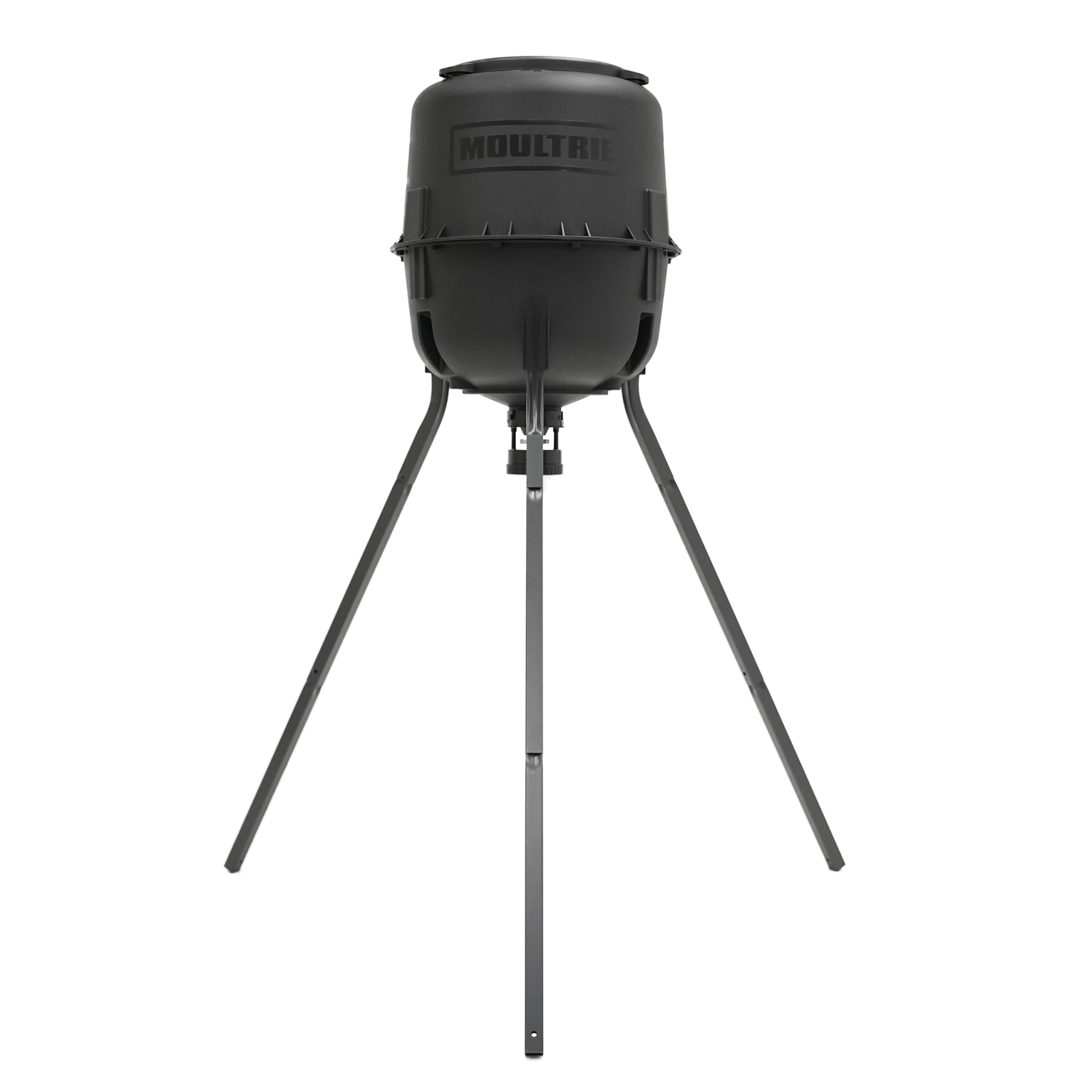 Moultrie 200 lb Standard | Best overall | 200 lb · Bluetooth timer, 4 feeds/day | Spin tripod | App praised; AA throw is shorter than 6V kits | Check price |
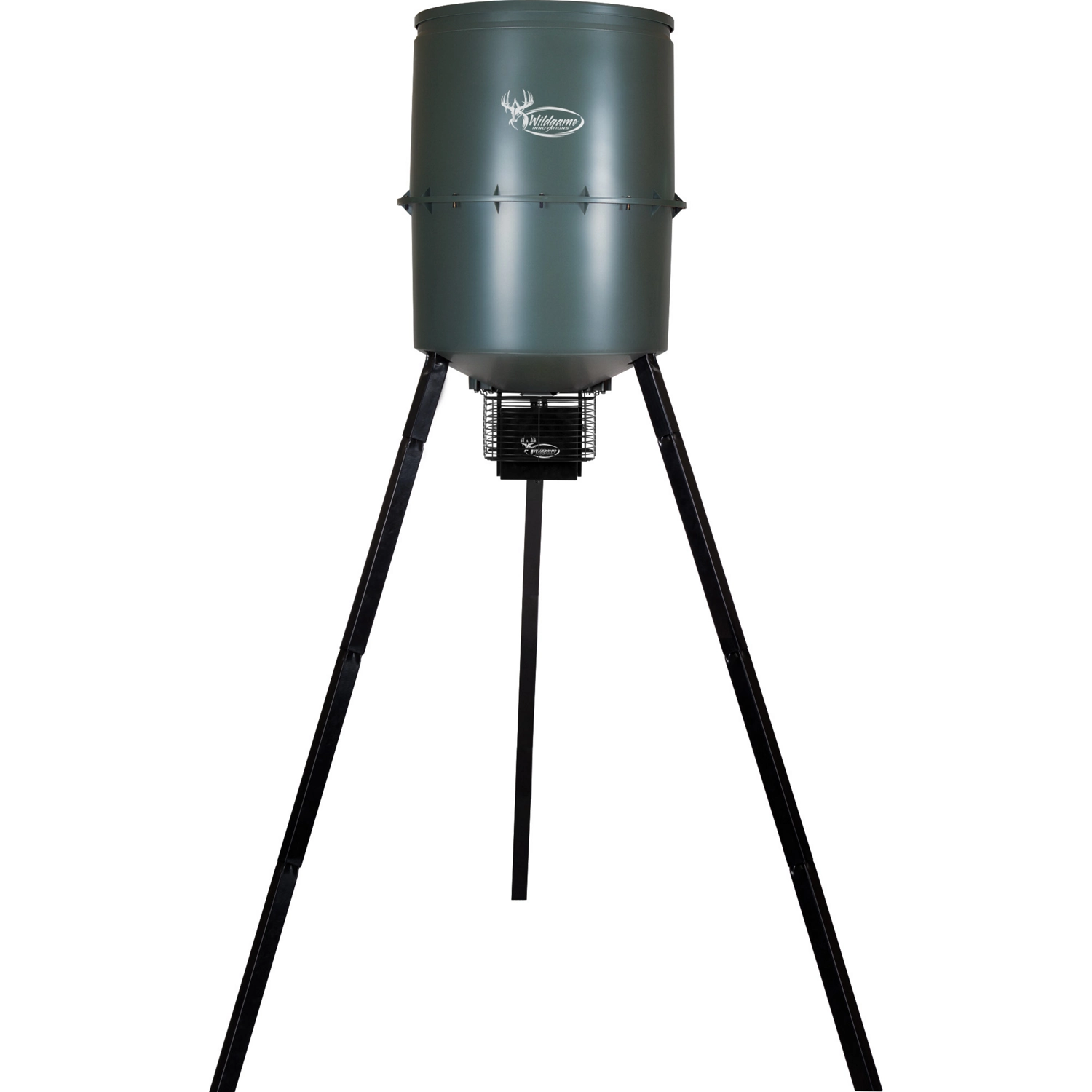 Wildgame Quick-Set Pro 270 | Varmint country | 270 lb · ~50 ft throw, rigid guard | Spin tripod | Guard works; test the timer before season | Check price |
 Moultrie Pro Hunter III 250 | Most control | 250 lb · 10 feeds/day, 1–60 s runs | Spin tripod | New kit; few owner reports so far | Check price |
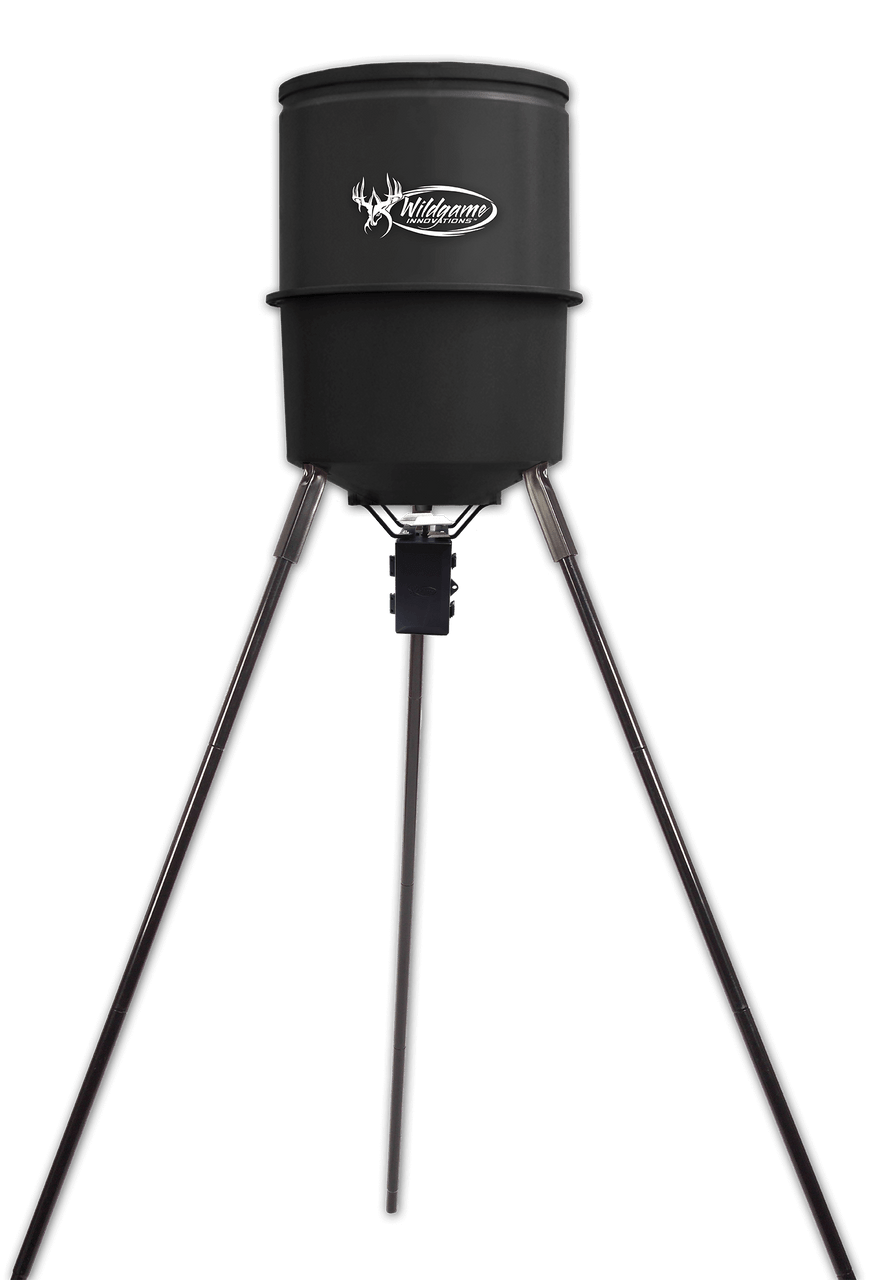 Wildgame Quick-Set 225 | Best value | 225 lb · 4 feeds/day, fixed runtimes | Spin tripod | Easy setup; no varmint guard fitted | Check price |
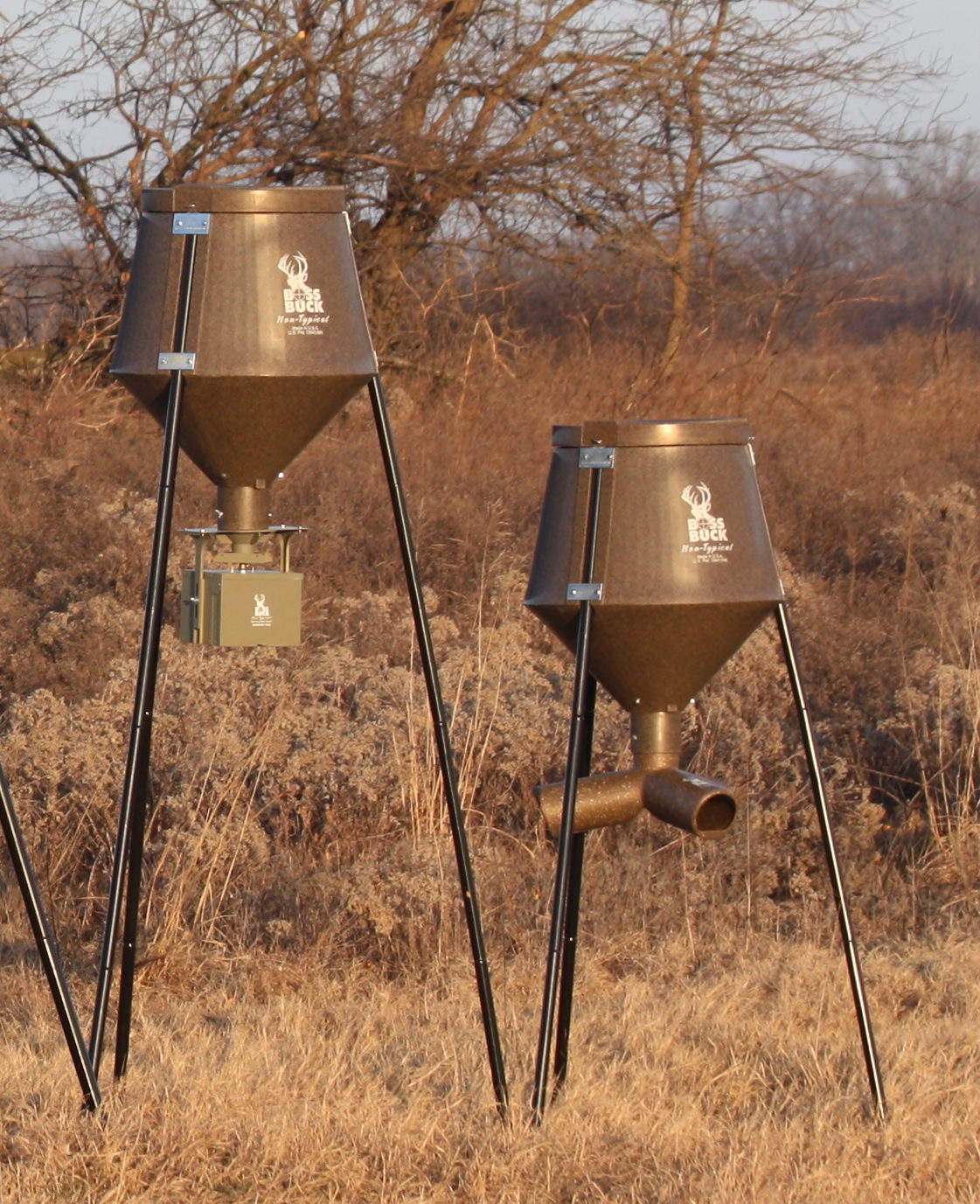 Boss Buck 200 lb Gravity | Best gravity tripod | 200 lb · 3 ports, no power needed | Gravity tripod | 4.4 stars / 748 reviews (Tractor Supply) | Check price |
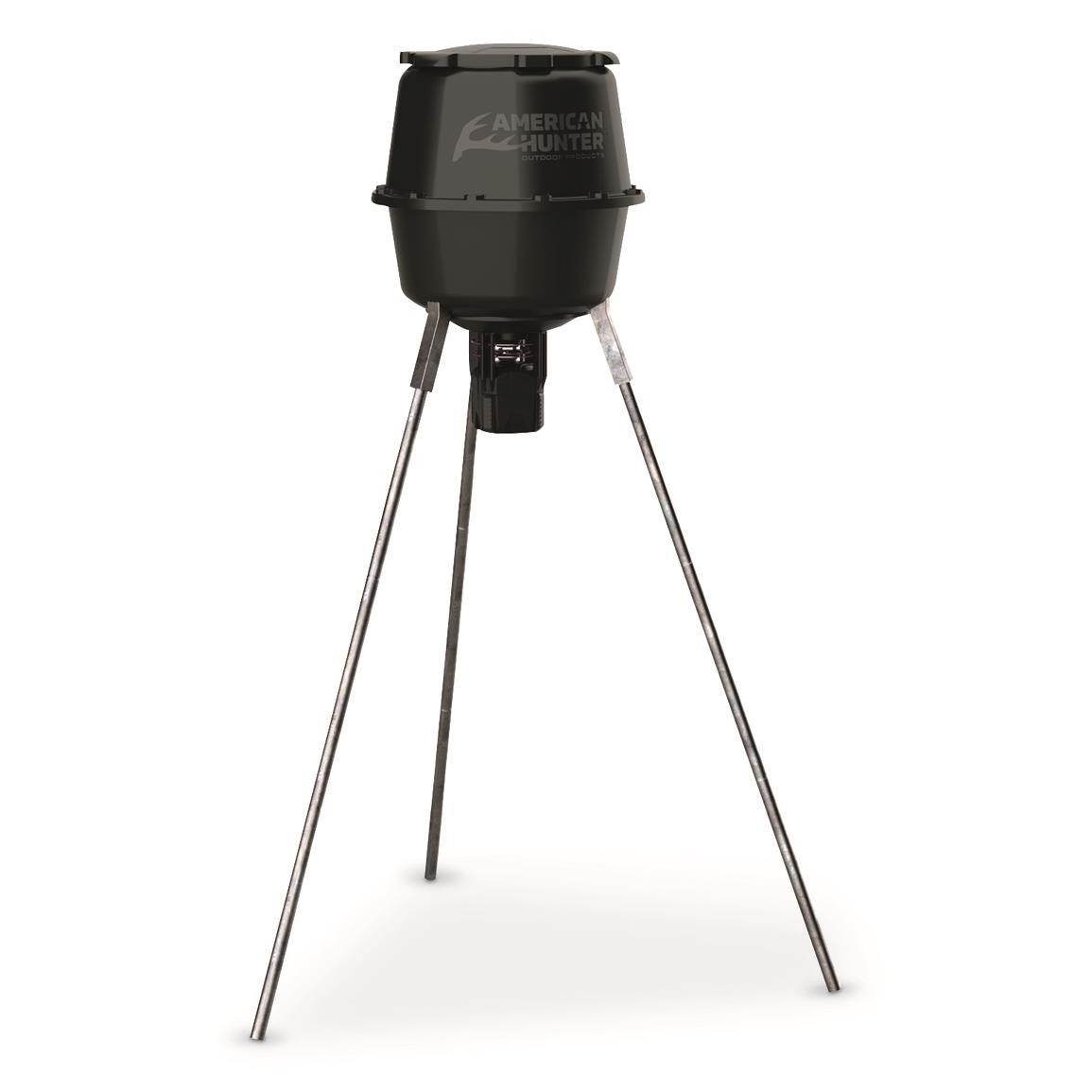 American Hunter XDE-Pro | Budget digital | ~180 lb · 16 feeds/day, 8 ft legs | Spin tripod | 4.1/5 across 23 reviews (Sportsman’s Guide) | Check price |
| Moultrie 30-Gallon Standard | Budget AA tripod | 200 lb · runs on 4 AA batteries | Spin tripod | Mixed reviews; some timer complaints | Check price |
Which tripod feeder fits your land?
Four questions, in order. Answer each one and you will land on the right feeder — most returns and regrets come from skipping question 1 or 2.
Step 1 — How often can you realistically visit?
Weekly or less often means capacity decides everything. A 200 lb hopper throwing two short feeds a day lasts most of a season; a small hanging unit would have you walking in constantly. If you visit monthly, start with the Moultrie 200 or the Quick-Set 225 and size up from there.
Step 2 — Do raccoons, squirrels or hogs work your spot?
If they do, the feeder needs a guard or a sealed design before it needs anything else. The Quick-Set Pro 270 ships with a rigid varmint guard, and the Moultrie 30-Gallon Standard has one built in. Skip this step and a full hopper can be emptied in a weekend.
Step 3 — Corn on a schedule, or protein on demand?
Timed spin feeders pattern deer to shooting light and ration expensive feed. Gravity feeders let deer eat free-choice, which suits protein programs and remote leases. If protein is the plan, the answer is the Boss Buck 200 Gravity — and our guide to the best protein feed for deer covers what to put in it.
Step 4 — How much control do you actually want?
Two feeds a day near dawn and dusk is all most hunters ever run, and every feeder here does that. If you genuinely fine-tune — different days, longer runs, sunrise syncing — the Pro Hunter III (10 feeds a day) or the budget XDE-Pro (16 feeds a day) earn their keep. Otherwise, save the money.
How we picked these tripod feeders
Every pick here comes from manufacturer spec sheets, retailer listings and recurring patterns in owner reviews; any review count quoted in an entry comes from the retailer named. When the same problem shows up again and again in owner reports (chewed parts, a timer complaint, a throw distance that disappoints), we say so plainly, good and bad.
Three things shaped the ranking. Stability gets real weight, because legs that walk in wind or get pushed by hogs are the top tripod complaint. Cost includes the battery, solar panel and first fill, not just the feeder (see the cost section). And this is a comparison built on specs and owner evidence, not a side-by-side field test, so each review says what the owner evidence does and does not support.
Only tripods currently sold in the U.S. with published specs made the cut, scored on the same weights as our main guide: feed control, capacity against refill effort, durability (stability included), ease of setup and value.
The 7 tripod deer feeders, reviewed
Ranked by who they suit, not by price. Every review covers stability and filling first — the two things that decide whether a tripod feeder is still standing, and still feeding, in month three.
1. Moultrie 200 lb Deer Feeder Standard — Best overall tripod
The Moultrie 200 is the tripod we point most hunters at, because it removes the two biggest ownership headaches at once. The included All-In-One II kit connects to the free Moultrie app over Bluetooth, so feed times change from the truck instead of at the feeder, where your scent does the damage. And it runs a full season on 8 AA batteries — no 6V battery, charger or solar panel to buy, forget, or find dead in October. The 200 lb hopper spreads corn a full 360°, and the 5.5 ft fill height lets one person load it from the ground, no ladder.
The honest trade-offs: up to 4 feed times a day at 1–20 seconds covers dawn-and-dusk hunting patterns but not elaborate schedules. The AA kit also throws corn a shorter distance than Moultrie’s 6V kits, so feed lands in a tighter ring — deer do not mind, but traffic concentrates in a smaller area. And the poly hopper has no factory varmint cage: in heavy raccoon country, budget for a guard or pick the Quick-Set Pro below.
Pros
Cons
What owners report
| Spec | Detail |
|---|---|
| Capacity | 200 lb |
| Feed times | Up to 4/day, 1–20 s each |
| Control | Keypad + Bluetooth app (All-In-One II kit) |
| Power | 8 AA for a full season (4 AA minimum) |
| Fill height | 5.5 ft |
| Spread | 360° broadcast |
2. Wildgame Innovations Quick-Set Pro 270 — Best for varmint country
If raccoons have ever spun your thrower plate by hand — and if you hunt the South or Midwest, they have — this is the tripod built for you. The Quick-Set Pro 270 is the only model in Wildgame’s line that includes a rigid varmint guard protecting both the spinner and the power control unit, which is exactly where the damage happens. It also throws the widest pattern here, around 50 ft in a full circle, on square powder-coated legs that sit steadier than round ones. The 270 lb hopper is the second-biggest on this list, and setup takes about 15 minutes.
What it asks in return: a 6V battery, sold separately, and a bit of trust-but-verify on the timer. Owner reports include a few units whose timers misfired or needed warranty help, so run the test cycle daily for a week on the porch rather than discovering a fault in November. There is no app control at any price on this model. Our full guide to keeping raccoons and hogs off a feeder covers the guard-and-placement combination that works best with it.
Pros
Cons
What owners report
| Spec | Detail |
|---|---|
| Capacity | 270 lb |
| Feed times | Up to 6/day, 1–30 s each |
| Spread | ~50 ft, 360° |
| Legs | Square, powder-coated |
| Power | 6V battery (not included) |
| Weight | ~50 lb |
3. Moultrie Pro Hunter III 250 lb — Most control
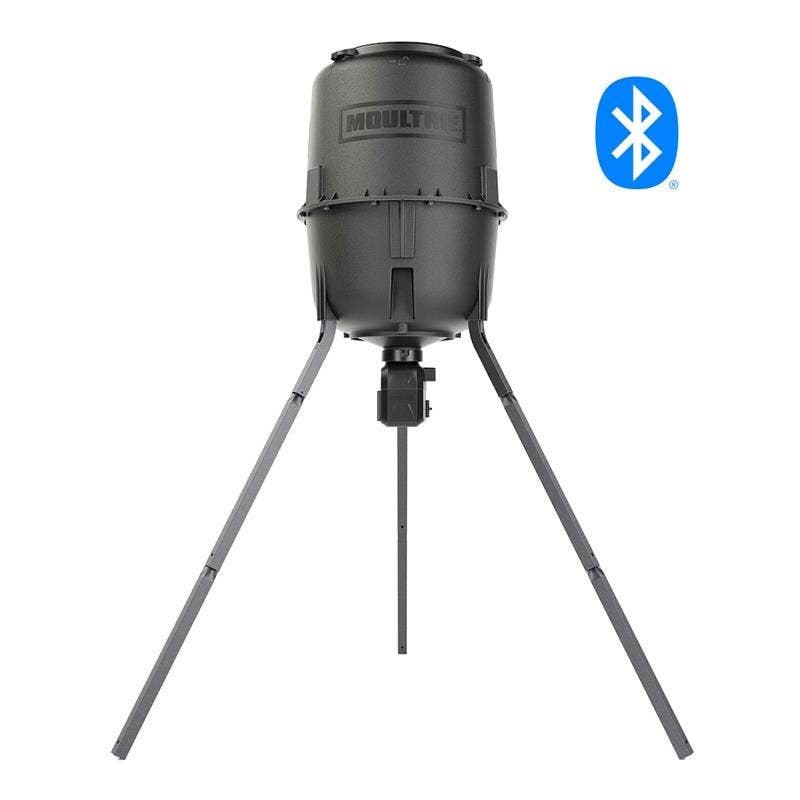
Some hunters genuinely run a feeding program — different times on different days, longer runs before a cold front, sunrise-synced schedules through the season. The Pro Hunter III is the tripod for them: up to 10 feed times a day at 1–60 seconds, programmed from a keypad or the Bluetooth app, in the biggest Moultrie hopper here at 250 lb. The redesigned kit’s hinged door and backlit screen sound minor until you are programming a feeder at dusk; they are the difference between a two-minute job and a torch-in-teeth job. It is solar-ready, and our deer feeder timer guide explains which scheduling features actually change deer behaviour.
The costs are literal as well as figurative. The 6V battery is sold separately and the matching solar panel is another line item, so the real entry price sits well above the sticker. The 6 ft fill height is the tallest of the spin feeders here bar one — manageable, but noticeable when you fill alone. If your program is two feeds a day, every day, the Moultrie 200 above does it for less, with no extra battery.
Pros
Cons
What owners report
| Spec | Detail |
|---|---|
| Capacity | 250 lb |
| Feed times | Up to 10/day, 1–60 s each |
| Control | Keypad + Bluetooth app |
| Power | 6V battery (sold separately), solar-ready |
| Fill height | 6 ft |
| Kit details | Hinged door, backlit screen |
4. Wildgame Innovations Quick-Set 225 — Best value tripod
The Quick-Set 225 is the value benchmark every other tripod gets measured against. A 30-gallon poly barrel holds 225 lb of corn, a built-in funnel helps it empty evenly instead of bridging, and the whole thing goes together in about 15 minutes at roughly 37 lb — genuinely a one-person job, even on the far side of a lease. The timer is deliberately basic: four feed times a day at 5, 10, 15 or 20 seconds. For the classic dawn-and-dusk pattern, that is not a limitation; it is the whole requirement, met at the lowest price per pound of capacity here.
The savings show up in two places. There is no varmint guard, and the plastic bracket under the barrel is exactly what raccoons chew — the most repeated complaint in owner reviews, and the reason the Pro model above exists. And the 6V battery is a separate purchase, so price feeder and battery together before comparing against the AA-powered Moultries. Expect a spread of about 30 ft — clearings and plot edges, not wide-open fields.
Pros
Cons
What owners report
| Spec | Detail |
|---|---|
| Capacity | 225 lb |
| Feed times | 4/day; 5, 10, 15 or 20 s |
| Spread | ~30 ft, 360° |
| Power | 6V battery (not included) |
| Weight | ~37 lb |
| Setup | ~15 minutes |
5. Boss Buck 200 lb All-In Gravity — Best gravity tripod
Every other feeder here has a motor, a timer and a battery between you and a fed deer. The Boss Buck 200 has none of them. Its gravity head feeds three ports angled at 10°, each with a rain overhang and a drain hole, fed evenly by an internal cone; an adjustable inner sleeve throttles flow for different pellet sizes. The roto-molded HDPE hopper will not rust, the double-walled lid limits condensation, and the ports sit about 34 inches up on 75-inch galvanized legs. For protein programs and monthly-visit leases, that simplicity is the entire argument — and it is a strong one. The head-to-head trade-offs are in our spin vs gravity feeders comparison.
Free-choice feeding cuts both ways: feed is available to every animal, around the clock, so a protein bill can climb fast and night feeding does nothing to pattern deer for a morning stand. The plastic can also be chewed by determined squirrels and raccoons — the one recurring theme in its otherwise strong reviews. Should you later want timed corn feeding, the same hopper converts to a spinner with an add-on kit. More gravity options are ranked in our best gravity deer feeders guide.
Pros
Cons
What owners report
| Spec | Detail |
|---|---|
| Capacity | 200 lb |
| Feed access | 3 ports, 10° angle, drain holes |
| Port height | ~34 in |
| Legs | 75 in, galvanized |
| Power | None (spinner conversion kit available) |
| Hopper | Roto-molded HDPE, double-wall lid |
6. American Hunter XDE-Pro 30-Gallon — Budget digital, tallest legs
Start with the warning, because it decides whether this feeder disappoints you: the “225” in some listings is not pounds of corn. American Hunter rates the XDE-Pro by volume — 30 gallons, roughly 180 lb of corn — and buyers who expected 225 lb feel short-changed. Sized honestly, it is a lot of feeder for the money: a digital timer running up to 16 feeds a day at 1–60 seconds (the most scheduling here, including feeders twice the price), two Q-Set preset programs, and 8 ft sectional legs — the tallest here, buying spread distance and raccoon clearance. At about 20 lb, it is also the easiest feeder here to move between spots.
The motor earns a specific mention: it is notably quiet, and a loud spinner is a real spook risk on pressured deer. Against that, the 6V battery is not included, and first assembly has a fiddly streak — sectional legs and hopper alignment reward patience, and the manual will not rescue you if you rush it. Budget an unhurried hour for the first setup, not 15 minutes.
Pros
Cons
What owners report
| Spec | Detail |
|---|---|
| Capacity | 30 gal / ~180 lb of corn |
| Feed times | Up to 16/day, 1–60 s each |
| Legs | 8 ft sectional |
| Power | 6V battery (not included) |
| Weight | ~20 lb |
| Extras | Two Q-Set preset programs |
7. Moultrie 30-Gallon Standard — Budget AA tripod
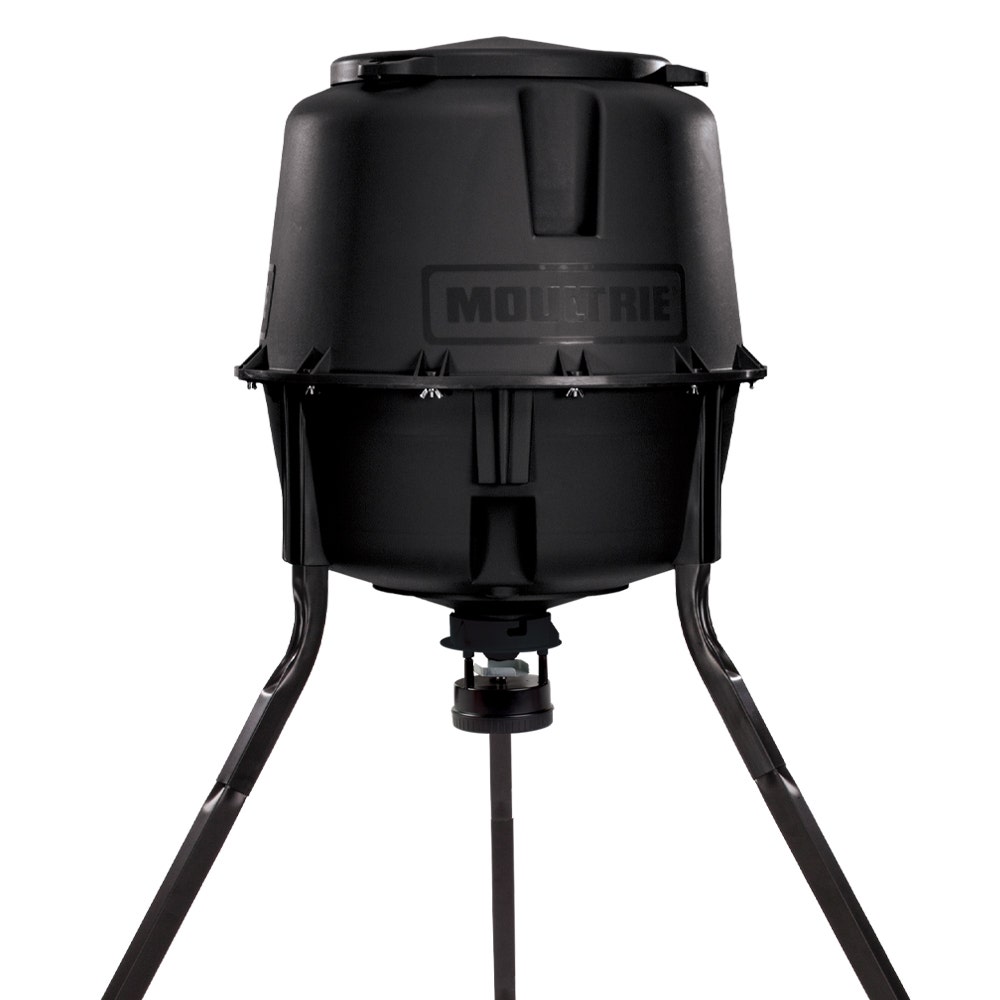
The 30-Gallon Standard is Moultrie’s budget tripod, and its pitch is simplicity with a safety net. A 30-gallon hopper holds about 200 lb of corn at the same friendly 5.5 ft fill height as our top pick, a dawn/dusk photocell runs up to 4 feeds a day at 1–20 seconds, a varmint guard is built in — rare at this price — and the whole unit runs on 4 AA batteries, so there is no 6V battery to buy before your first fill. It is also Quick-Lock compatible: outgrow the basic kit and a Pro Hunter III kit mounts to the same hopper, so the upgrade replaces the motor unit, not the feeder.
Now the caution, because this model carries the weakest owner signal of the seven. Aggregated reviews put it at 4.2/5 across roughly 30 ratings, and the complaints name the timer: reliability reports, plus a few owners describing corn dumped under the feeder instead of broadcast — the classic symptom of a weak spin. Set against our top pick, the honest question is why choose it: the Moultrie 200 adds Bluetooth programming for similar money. The 30-Gallon makes sense at a sale price, or bought as a Quick-Lock starter you plan to upgrade.
Pros
Cons
What owners report
| Spec | Detail |
|---|---|
| Capacity | 30 gal / 200 lb |
| Feed times | Up to 4/day, 1–20 s; dawn/dusk photocell |
| Power | 4 AA batteries |
| Fill height | 5.5 ft |
| Varmint defence | Built-in guard |
| Upgrade path | Quick-Lock compatible (Pro Hunter III kit) |
Watch: tripod feeder setup videos
Three walkthroughs worth your time before setup day — assembly order and leg levelling are much easier to copy than to read about.
Moultrie tripod feeder setup, step by step

Moultrie assembles the 200 lb Standard tripod feeder — the same Quick-Lock style kit used by two feeders in this guide.
Quick-Set 225 assembly
Step-by-step Quick-Set 225 assembly by an owner — watch the leg sections go together before you judge that 15-minute setup claim.
Setting up the Wildgame 225 before the season
A second angle on the 225, this time assembled in the field — useful for seeing how the legs sit on real, uneven ground.
Moultrie 200 lb Standard: an owner review
Boss Buck 200 lb Gravity in real use
What a tripod feeder really costs in year one
The sticker price is roughly two-thirds of a spin feeder’s first-year cost. The extras below are where the budget actually goes — and where most “it cost more than I thought” reviews come from.
| Cost item | What owners report | Notes |
|---|---|---|
| The feeder | Gravity tripods cost the most up front; basic spin tripods the least (see today’s prices on Amazon) | Gravity costs most up front and least afterwards; spin feeders reverse that |
| 6V battery | The most common surprise cost in Quick-Set and XDE-Pro reviews | Needed by 5 of these 7 feeders and included with none of them — price it with the feeder |
| AA batteries | A non-issue in Moultrie reviews; a set lasts the season | Only the two AA Moultries need them (4–8 per feeder) |
| Solar panel (optional) | Owners on remote leases call it the best money after the feeder | Keeps a 6V topped up between monthly visits; see our solar panel guide for sizing |
| First fill of corn | Rarely mentioned in listings, always mentioned in budgets | A 200 lb hopper takes about four 50 lb sacks; a gravity feeder can empty that far faster than a timed one |
| Stakes and anchors | Owners in hog country treat them as mandatory, not optional | A few dollars of rebar or T-post per leg; see the stability FAQ below |
The takeaway: compare feeders on the all-in number. A budget Quick-Set 225 plus its 6V battery lands close to the AA-powered Moultrie 200 that needs nothing extra, and a Pro Hunter III with battery and solar panel is a bigger commitment than its sticker suggests. The dearer feeders are not bad buys; the feeder price is a starting point, not a total. Battery options and runtimes are broken down in our 6V and 12V feeder battery guide.
How to choose a tripod deer feeder that stays standing
Legs first: design, material and staking
Tripods fail at the legs, not the timer. Square-section legs (Quick-Set Pro) resist twisting better than thin round ones; galvanized steel (Boss Buck) shrugs off weather that powder-coat eventually chips under. Sectional legs like the XDE-Pro’s pack flat and adjust section by section, which helps on uneven ground, but every joint is a potential wobble point — tighten and re-check after the first week. Whatever you buy, stake it: drive rebar or a T-post beside each leg and wire them together. In hog country that is not optional, and five minutes of staking is cheaper than a hopper of corn on the ground.
Fill height vs spread: the height trade-off
Taller legs throw corn further and put the spinner higher above raccoon reach — but every extra foot is a foot you lift a 50 lb sack. The 5.5 ft fill height on both Moultries is the sweet spot for one-person filling from the ground. The Pro Hunter III’s 6 ft is manageable; the XDE-Pro’s 8 ft legs earn their height in spread and pest clearance, and filling becomes a two-person or tailgate job. Our guide to how high a feeder should sit works through the spread maths by leg height.
Capacity maths: size the hopper to your calendar
Work backwards from your visit schedule, not forwards from the biggest barrel. A spin feeder throwing two 5-second feeds a day uses roughly 2–3 lb of corn daily, so 200 lb is a two-to-three-month supply — longer than corn should sit in warm weather anyway. Weekly visitors can run a 180–225 lb feeder comfortably; monthly visitors should treat 200 lb as the floor. Gravity feeders break this maths completely, because deer set the pace: the same 200 lb can vanish in a fortnight on a busy lease. Match the feeder to the calendar and most “it was empty when I finally got there” stories never happen.
What separates the best tripod feeders from the rest
Power and protection, in that order. On power: AA kits (both Moultries) delete a whole category of failure and cost; 6V kits throw further and run bigger motors but add a battery to buy, charge and replace. On protection: if your cameras show raccoons, a factory guard (Quick-Set Pro, Moultrie 30-Gallon) beats every aftermarket fix; if they show hogs, staking matters more than any guard. Timers are the third tier — past two feeds a day, extra programs are convenience, not results. Buy legs, power and protection in that order and the timer takes care of itself. Placement matters as much as the purchase: where to place the feeder and how far it should sit from your stand will do more for your season than any single spec here.
Tripod feeder resources
Everything else on the site that helps you buy, place and run a tripod feeder:
- Best Deer Feeders — the full 16-model guide across every feeder type
- Deer Feeder Reviews — the hub for every feeder category
- Best Gravity Deer Feeders — if free-choice feeding suits your land better
- Best Hanging Deer Feeders — for thick cover and steep ground
- Best Corn Feeders for Deer — corn-specific picks and setup
- Best Deer Feeder Timer — timer types compared, analogue to Bluetooth
- Where to Place a Deer Feeder — cover, wind and approach routes
- How High Should a Deer Feeder Be? — leg height and spread explained
- How Far Should a Feeder Be From a Stand? — distances by weapon and terrain
- Best Deer Feeder Batteries (6V & 12V) — what the 6V feeders here actually need
- Deer Feeder Solar Panels — sizing and compatibility checks
- Keep Raccoons & Hogs Off Your Feeder — guards, staking and deterrents
- Spin vs Gravity Feeders — the two tripod families compared
- Best Protein Feed for Deer — what to run in a gravity tripod
- Best Road Feeder for Deer — when wheels beat legs
- Texas Parks & Wildlife Department — season dates and feeding rules for the biggest deer state
Tripod deer feeder FAQs
An empty or half-empty tripod is the vulnerable one — a full 200 lb hopper is its own anchor. The risk window is the first storm after a refill runs low. Square or galvanized legs resist twisting better than thin round ones, and staking each leg (below) removes most of the risk entirely. On exposed ridge-top ground, fill before forecast storms and never leave a tripod standing empty through winter.
Level the ground first — a feeder that starts plumb rarely walks. Then anchor it: drive rebar or a short T-post beside each leg and wire or strap the leg to it. In hog country, where rubbing and rooting do the tipping, staking is mandatory. Check straps after the first hard rain, when softened soil lets anchors shift.
For most spin feeders, a spinner height of 5.5 to 6 ft is the sweet spot: high enough to throw corn 30 ft or more and slow raccoons, low enough to fill without a ladder. Taller legs (the XDE-Pro’s 8 ft sections) spread feed wider and suit big clearings, but filling becomes a two-person job. Gravity ports sit lower, around 34 inches on the Boss Buck, because deer feed from them directly.
Tripods win on capacity, stability and spread — 180 to 270 lb of feed, thrown in a wide circle, on ground you choose. Hanging feeders win on terrain: steep, thick or flooded spots with a strong limb and no flat ground, and they cost far less. If you have reasonably level ground and visit monthly, buy the tripod. If your best spot is a hillside funnel, hang a feeder and accept the weekly refills. Our hanging feeder guide covers that side properly.
On flat ground, the Wildgame Quick-Sets genuinely go together in about 15 minutes. On uneven ground, budget 30 to 45 minutes: most of it goes on levelling — digging the high legs in, shimming the low ones, and checking the hopper sits level so the spinner throws evenly. Sectional legs help, because you can adjust one leg at a time instead of re-siting the whole feeder.
At two 5-second feeds a day — the most common hunting pattern — a typical spinner uses roughly 2 to 3 lb a day, so 200 lb lasts around two to three months. Double the run time and you halve that. Gravity feeders follow no such maths: free-choice deer can empty 200 lb in a couple of weeks. Measure your own feeder’s throw with a bucket test before trusting any estimate.
Metal, for anything semi-permanent. Galvanized steel shrugs off weather, resists chewing and can be staked hard without cracking; powder-coated square legs are a close second for rigidity. Plastic legs keep budget feeders light and cheap — fine if you move the feeder often — but flex more in wind, and determined squirrels and raccoons chew plastic brackets, as Quick-Set 225 owners report. Match the legs to how long the feeder will sit in one place.
Start with hardware, not hope: a rigid varmint guard over the spinner and control unit — factory-fitted on the Quick-Set Pro 270 and Moultrie 30-Gallon — stops raccoons spinning the plate by hand. Add height where you can, grease or cone the legs if they are climbing, and never mount the feeder where a leaning tree gives them a bridge. Our raccoon and hog guide works through the full defence in order.
Weekly visitors: 180–225 lb is plenty — corn should not sit for months in a humid hopper anyway. Every two to four weeks: 200 lb is the practical floor for a spin feeder. Rarely or remote: take the biggest hopper you can fill (250–270 lb) or a gravity model, paired with solar so the battery is never why a feeder sits dead. Bigger than your calendar is wasted money and stale corn.
Yes, within limits. On a gentle slope, set the feeder across the fall line, dig the uphill legs in until the hopper is level, and stake the downhill legs — an unlevel spinner throws lopsided and a leaning gravity head starves its downhill ports. On steep ground, use a hanging feeder or a ground-level stand-and-fill design instead.
Spin tripods are built for corn — pellets broadcast onto wet ground spoil quickly, and some crumble in the spinner. Protein belongs in a gravity tripod like the Boss Buck 200, whose angled, drained ports keep pellets dry and flowing, or in an enclosed timed feeder. If protein is the program, pick the feeder for the feed, not the other way round — and see our guide to the best protein feed for deer for what to fill it with.
Sometimes — the dividing line is what the extra money buys. A varmint guard, app control or a bigger hopper solves real problems if you have raccoons, hate feeder visits, or run a lease. Extra timer programs alone rarely change a season. Budget models like the Quick-Set 225 feed deer perfectly well; their compromises are specific (no guard, a battery to buy, fixed run times). Buy the upgrade that matches your actual problem.
Final verdict
Buy the Moultrie 200 lb Deer Feeder Standard unless your property tells you otherwise. It is the tripod that asks the least of its owner: no battery to buy, no ladder to climb, no scent-heavy programming trips — and 200 lb of capacity covers a monthly visit schedule with room to spare.
The runners-up, by situation: raccoons or hogs on camera — the Quick-Set Pro 270 and its factory guard. A real feeding program with fine-tuned schedules — the Pro Hunter III 250. Tight budget, simple needs — the Quick-Set 225. Protein on remote ground — the Boss Buck 200 Gravity. Maximum scheduling for minimum money — the XDE-Pro. A starter feeder you can upgrade later — the Moultrie 30-Gallon Standard.
One last check before any feeder on this page earns its keep: feeding and baiting rules are set by state and often by county, and they change — sometimes mid-season, especially in CWD zones. Confirm your current regulations with your state wildlife agency before the first fill.
Last updated: November 1, 2026.
Products mentioned in this guide
See this product on Amazon
Check Price on Amazon →Confirm price and availability on AmazonWildgame Innovations Quick-Set 225 Feeder
Check Price on Amazon →Confirm price and availability on AmazonWildgame Innovations Quick-Set Pro 270 Feeder
Check Price on Amazon →Confirm price and availability on AmazonMoultrie Pro Hunter III 250 lb Deer Feeder
Check Price on Amazon →Confirm price and availability on AmazonBoss Buck 200 lb All In Gravity Feeder
Check Price on Amazon →Confirm price and availability on AmazonAmerican Hunter XDE-Pro 30-Gallon Feeder
Check Price on Amazon →Confirm price and availability on AmazonAs an Amazon Associate, we earn from qualifying purchases.


