

How Far Should a Deer Feeder Be From a Deer Stand?
How Far Should a Deer Feeder Be From a Deer Stand? | BestDeerFeeders.com
🦌 Deer Stand Setup Guide
The exact distances used by expert hunters across the U.S. — for bow, rifle, and mature buck setups — backed by field experience, expert quotes, and YouTube-proven tactics
📅 June 2026⏱ 9 min read✍️ BestDeerFeeders.com
📋 In This Article
- The Quick Answer
- Why Distance Changes Everything
- Distance by Weapon Type
- Expert Video: Jeff Danker on Feeder Placement
- The Mature Buck Problem
- Wind and Thermals — The Variable That Overrides Distance
- Expert Video: Feeder Placement on Food Plots
- Stand Access — Getting In Without Blowing the Setup
- Quick-Reference Distance Chart
- 4 Mistakes That Ruin Good Feeder Setups
- Frequently Asked Questions
You spent good money on a feeder, filled it with the right blend of protein and corn, placed it in a solid travel corridor — and you are still not getting daytime buck sightings. Most of the time, the problem is not the feeder or the feed. It is where you put your stand in relation to it. The distance between your seat and that feeder determines whether a mature buck gives you a shot opportunity or circles downwind 200 yards out and disappears before shooting light ends.
This guide gives you the exact distances proven by experienced hunters across the U.S. — for bowhunting, rifle hunting, and mature-buck-specific setups — explains the science behind each number, and includes expert YouTube insights so you can see these tactics applied in real hunting situations. For gear that supports these setups, check our full review of the best deer feeders on the market.
The Quick Answer
✅ Recommended Distances at a Glance
For bowhunting: place your stand 30–50 yards from the feeder. For rifle hunting: 80–150 yards. For targeting mature bucks on pressured properties, consider hunting the approach trail 100–200 yards back from the feeder rather than directly over it.
Those numbers come from Ian, a 23-year whitetail hunter splitting time between a 65-acre lease in Pike County, Illinois and public land in the Missouri Ozarks. He puts a deer feeder 30 to 60 yards from his stand for bowhunting, and 80 to 150 yards for gun season — with 40 yards for bow and 120 yards for rifle as his go-to single numbers when terrain allows no perfect answer. That framework is where the majority of experienced U.S. hunters land after real field testing, and it is what this guide builds on.
Why Distance Changes Everything
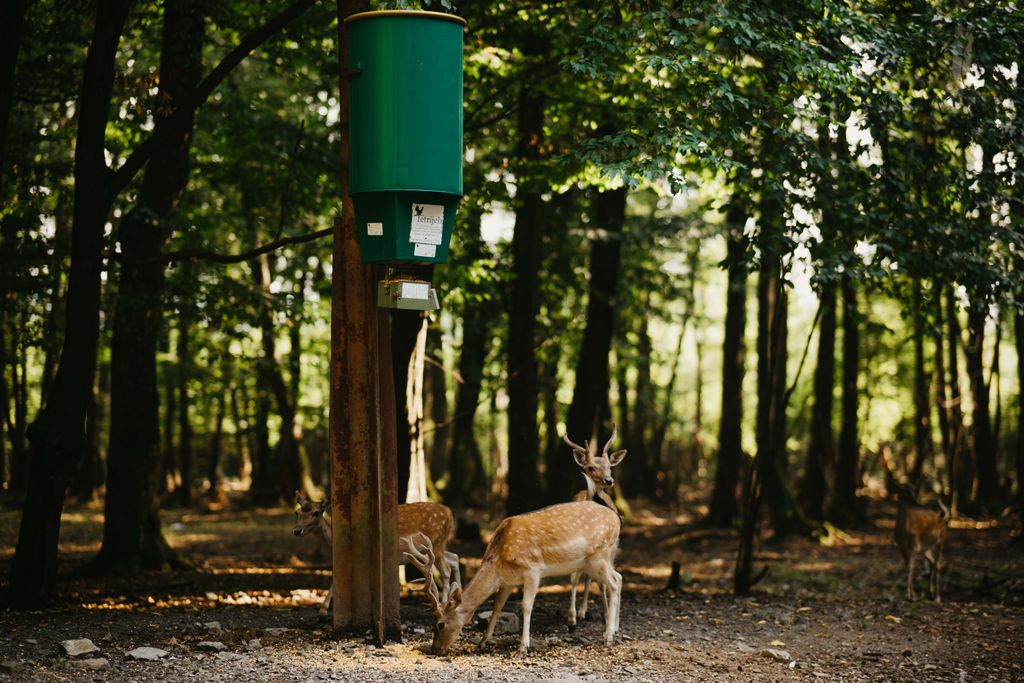
Distance between your stand and feeder affects four critical factors simultaneously, each one capable of ending your season before it starts:
1. Scent detection radius. A mature whitetail’s nose is its primary survival tool, with an estimated 297 million scent receptors. Deer will scent-check areas long before you ever see them — and if they pick up human scent, they will either leave or circle downwind to confirm the threat. The closer your stand sits to the feeder, the more your scent saturates the exact spot a buck investigates hardest before committing to step into the open.
2. Movement detection. If the feeder is too close, deer will detect you the moment you raise your bow or shift your rifle. A feeding deer already operates at high alertness — head up, ears rotating, scanning every few seconds. Any unnatural movement within 30 yards that is not wind-caused will send it running before you complete the shot.
3. Sound disturbance from automatic feeders. Spin feeders activate with an audible motor and the sound of corn hitting the ground. Deer are less skittish around feeders positioned farther from the stand — particularly tripod-based automatic feeders that make activation noise. Distance softens that sound signature and reduces the startle response that can bolt deer out of range before the spinner stops.
4. Entry and exit pressure. The closer your stand is to the feeder, the harder it is to approach without crossing deer travel routes. Over a full season, repeated contamination of the feeder area with foot scent tells every mature deer in the area that this location is human-associated — and they shift to nocturnal visits within two to three weeks.
Distance by Weapon Type
🏹 Bowhunting — Treestand
30 – 50 yds
Close enough for a clean, ethical shot within your effective range, far enough that deer don’t detect movement during the draw. Trim one narrow shooting lane rather than a wide-open window — it conceals your silhouette and gives a defined yardage reference.
🎯 Rifle Hunting
80 – 150 yds
Well inside rifle range while giving deer enough space to feel safe at the feeder. Tower stands on managed Texas operations run 80–120 yards. Ground blinds work at 40 yards when fully enclosed and scent-controlled — a significant advantage over open treestands.
🦌 Mature Bucks (3.5+ yrs)
Hunt the trail
Mature bucks on pressured properties rarely commit to feeders in daylight. Set up 100–200 yards back on the downwind approach trail. Intercept them before they reach the feeder, where their guard is slightly lower and their scent-checking routine brings them directly past your stand.
⛺ Ground Blind
25 – 40 yds
A fully enclosed, well-brushed blind suppresses movement and scent better than an open treestand. Can be positioned as close as 25 yards — but must be set up 2–3 weeks before opening day so deer fully accept it as part of the landscape before your first sit.
Expert Video: Jeff Danker on Where to Place Your Feeder
Jeff Danker is a veteran TV hunting host and former face of Buck Ventures with over two decades of whitetail hunting experience across the U.S. In this Academy Sports-produced instructional video, Danker addresses a topic most hunters overlook: stand position relative to the feeder matters as much as the feeder’s location itself. His core teaching is to position your stand on the downwind side at a distance that lets deer fully commit to the feeder before they check in your direction — giving you a calm, relaxed target rather than a spooked deer running from range.
Deer Hunting | Where to Place Your Feeder — Jeff Danker, Buck Ventures
Jeff Danker walks through his exact feeder placement methodology — including the stand distance relationship that is rarely discussed in mainstream hunting content. Key moment at 2:10 where he maps the downwind stand position relative to the feeder and deer approach routes.
“The main objective isn’t to shoot deer directly under the feeder — it’s to catch them in transit in and around the feeder. I want my stand on the travel corridor where the deer feel least pressured, not parked right on top of the corn.”
Field principle from 1st Light Hunting Journal — applied across 20+ U.S. states on both private and public land
The Mature Buck Problem — Why Closer Is Not Always Better

Young deer and does are forgiving. They walk directly to a feeder, eat, and leave without ever checking the wind deliberately. Mature bucks — particularly deer over 3.5 years old on any property that sees hunting pressure — operate on an entirely different threat model.
In Texas, where feeders exist on nearly every private lease, the older animals have been educated to understand that feeders also have humans nearby. Most mature bucks will usually avoid feeders during daylight unless they are circling downwind searching for receptive does during the rut. On pressured properties, the recommendation is to hunt away from the feeder on the downwind side to have consistent success on older animals.
This is why many of the most successful mature-buck hunters in the U.S. do not hunt directly over their feeders at all. They use the feeder as a congregation tool for does and younger bucks — building regular traffic at the location throughout the season — then position their stand 100 to 200 yards back on the downwind approach trail. When a mature buck scent-checks that trail before committing to the feeder, he walks right past the ambush point.
⚠️ Pressure Warning
Hunting directly over a feeder more than twice per week will educate the mature deer on your property within one to two seasons. Once a buck associates your feeder with human scent and activity, he will only visit after dark — often for the remainder of that season. Limit direct feeder sits to once every three to five days if targeting mature animals.
Wind and Thermals: The Variable That Overrides Distance
Distance is your starting framework. Wind is the deciding factor. If the wind is wrong, the perfect feeder distance does not matter. You have to give deer a reason to feel safe downwind of you — not put them directly into your scent cone every time the feeder fires.
🌬️ Wind and Thermal Strategy by Situation
✅
Ideal setup: Stand positioned so the prevailing wind carries your scent away from both the feeder and the deer’s primary approach trail. Deer walk from bedding to feeder with wind in their face — they never cross your scent cone during the approach.
⚠️
Swirling winds (hill country, draws, ridgelines): In swirling wind terrain like the Buffalo County hills of Wisconsin or Ozark drainages, forget “perfect distance” and focus on positioning your scent so it dumps into a dead zone — a steep cut, an open pasture, or directly over water — rather than toward deer travel routes.
🌅
Morning thermals: As the sun heats the ground in the morning, air at ground level rises — carrying your scent upward and away from deer approaching at ground level. Morning feeder sits carry significantly less thermal scent risk than evenings.
🌇
Evening thermals: When the sun sets and the earth cools, air settles back toward the ground, pulling your scent downward — directly toward deer approaching the feeder from bedding areas. Evening feeder sits demand extra caution and a longer stand-to-feeder distance to compensate for dropping thermals.
📐
The 30–45 degree angle rule: Position your stand so wind carries your scent at a 30–45 degree angle away from the feeder, not straight at it. This creates a scent-free corridor between your tree and where deer will be standing and feeding — giving you the maximum time before detection.
Pro Tip Always carry a wind checker — powder or milkweed — when approaching your feeder stand. Check thermals at the base of your tree before climbing. If air is already dropping toward the feeder at 4:30 PM, either wait for conditions to stabilize or pass on the sit entirely. One contaminated evening sit is worth more in saved future hunts than a marginal sit that burns the location for the rest of the season.
Expert Video: Placing Deer Feeders on Whitetail Food Plots
This field-recorded YouTube video walks through the practical process of positioning feeders on real hunting properties, with specific examples of how feeder location relative to stand placement changes across different terrain types — open fields, timber edges, and funnel corridors. The strategies shown are directly applicable to properties across the South, Midwest, and Southeast U.S. and reflect the same principles discussed by hunting professionals across the country.
Placing Deer Feeders on Whitetail Food Plots — Stand Position Strategy
A practical property walk-through showing how experienced managers position feeders in relation to food plots, travel corridors, and stand locations. The segment on bedding-to-feeder distance is particularly relevant — it directly determines how far back your stand should sit to avoid educating mature deer.
Stand Access — Getting In Without Blowing the Setup
Even a perfectly distanced stand can be ruined by a bad access route. If you walk directly through the deer’s travel corridor every time you approach your stand, you deposit foot scent across the exact path bucks use to approach the feeder. Within two or three sits, that trail will be abandoned during daylight.
Approaching the stand correctly is vital to keep mature bucks in the area where you are hunting. Always approach with wind in your face to prevent human scent from drifting into areas where deer will be approaching from. Design a dedicated access path that comes in from a direction perpendicular to or away from deer travel routes — using creek bottoms, field edges, fence lines, or shallow drainages to mask your movement and keep your scent away from the feeding area entirely.
“Making sure that a deer never hears you, smells you, or sees you as you access your land to hunt is the foundation for making sure you are on your way to capturing the full herd and hunting potential of your property.”
Jeff Sturgis — Whitetail Habitat Solutions | 2,000+ whitetail articles and YouTube videos, small parcel specialist with 40-acre properties in the Midwest
Quick-Reference Stand-to-Feeder Distance Chart
| Hunting Scenario | Recommended Distance | Rating | Key Factor |
|---|---|---|---|
| Bowhunting — treestand | 30–50 yards | ✓ Ideal | One trimmed shooting lane; stand 18–22 ft up |
| Bowhunting — ground blind | 25–40 yards | ✓ Ideal | Brush in 2–3 weeks before season |
| Rifle — treestand | 80–150 yards | ✓ Ideal | Tower stands; use rangefinder for confirmation |
| Rifle — enclosed tower blind | 75–120 yards | ✓ Ideal | Enclosed blind provides added scent control |
| Mature buck — any weapon | Hunt trail 100–200 yds back | Strategic | Intercept on approach before feeder scent-check |
| Under 20 yards — any weapon | Too close | Avoid | Deer detect movement during draw or rifle raise |
| Over 200 yards — rifle | Too far | Avoid | Lose visual confirmation; ethical shot compromised |
4 Distance Mistakes That Ruin Good Feeder Setups
Mistake 1 — Sitting Too Close for Your Weapon
Setting the stand 10 yards from the feeder means seeing dozens of deer but they are nervous that close for that long — and the hunter is at constant risk of being spotted. This is the single most common mistake first-time feeder hunters make. Seeing deer is exciting. Being detected before a shot — night after night — teaches every deer on the property that something dangerous lives at that feeder. Move back to 30 yards for archery, 80 yards for rifle, and you will see a dramatic change in how relaxed deer behave at the feeder.
Mistake 2 — Hunting the Feeder on a Bad Wind
No amount of distance compensates for a wind that blows your scent directly toward the feeder or the deer’s approach trail. Even what seems like a good prevailing wind can shift against you in flat terrain, and in draws or drainages the air swirls in ways no weather app will predict. Check thermals actively at the base of your tree before every climb — not just at setup when you first hang the stand.
Mistake 3 — No Dedicated Access Route
Hunters who walk a direct line to their stand — straight through deer travel corridors — consistently see buck activity disappear within the first two weeks of season. Your access route is part of the overall setup strategy. Map it before hanging the stand, not after you have already contaminated every active trail in the area with foot scent and body odor from repeated entry and exit.
Mistake 4 — Overhunting the Same Feeder Stand
Even a perfectly distanced, correctly accessed stand loses effectiveness when hunted every single sit. Frequently entering and exiting your property will greatly affect deer movement. Your scent, sound, and sight should be kept to a minimum during the hunting season if you expect to consistently encounter mature bucks. Rotate your feeder stand with other locations and give it three to five days of rest between sits to let deer return to their normal, unguarded routine before your next hunt.
Build the Perfect Feeder Setup
Distance and wind strategy only work if your feeder runs reliably through every sit. Our hands-on review ranks every top-rated deer feeder — including low-noise models and adjustable-range broadcast feeders built for pressured-property setups.🦌 See Our Top-Rated Deer Feeders →
Frequently Asked Questions
How far should a deer feeder be from a deer stand for bowhunting?
Place your stand 30 to 50 yards from the feeder for bowhunting. This keeps the feeder within comfortable shooting range while giving deer enough open space to feel safe before you need to draw. Trim one clean, narrow shooting lane rather than opening a wide window — it conceals your silhouette and gives you a defined yardage reference for your rangefinder or sight pins.
How far should a deer feeder be from a rifle hunting stand?
For rifle hunting from a treestand, 80 to 150 yards is the proven range. Managed hunting operations in Texas — where feeder hunting is most refined — typically run tower stands 80 to 120 yards from the feeder. This distance prevents deer from detecting your movement when you raise the rifle and keeps them relaxed enough to remain in range during legal shooting light.
Should I hunt directly over my deer feeder for mature bucks?
For mature bucks over 3.5 years old on pressured properties, hunting 100 to 200 yards back on the downwind approach trail consistently produces more daylight encounters than sitting directly over the feeder. Mature bucks rarely commit to feeders in daylight on heavily hunted land — but they do walk those approach trails regularly while scent-checking the area before committing, bringing them right past a well-placed ambush stand.
Does wind direction matter more than stand distance from a feeder?
Yes — wind is the overriding variable at every distance. A stand at the perfect 40-yard bowhunting distance will produce zero results if the wind blows your scent toward the feeder or the deer’s approach route. Choose your sit based on wind first, distance second. If conditions are not favorable, skipping the sit almost always produces better long-term results than hunting on a marginal or bad wind and contaminating the location.
How often should I hunt a feeder stand before deer go nocturnal?
Limit direct feeder stand sits to once every three to five days for mature buck setups. Hunting the same feeder stand multiple times per week will educate mature deer within two to three weeks, pushing them to visit exclusively after dark for the remainder of the season. Higher frequency is acceptable early season or when targeting does and younger bucks, but if your trail camera shows the mature bucks going nocturnal, the first adjustment to make is reducing sit frequency before changing any other variable.
Can I hunt a deer feeder from a ground blind at close range?
Yes — a fully enclosed, well-brushed ground blind is more forgiving on stand distance than an open treestand because it suppresses movement, silhouette, and some scent. Ground blinds positioned 25 to 40 yards from a feeder work well when the blind has been set up at least two to three weeks before the first sit, allowing deer to fully accept it as a permanent part of the landscape. A new, unbroken blind placed the day before a hunt will almost always spook deer, particularly mature bucks.
Bottom Line
For bowhunting, 30 to 50 yards is the proven sweet spot. For rifle hunting, 80 to 150 yards keeps deer comfortable and puts them well within ethical range. For mature bucks on pressured properties, the most effective move is abandoning the direct feeder sit entirely and hunting the downwind approach trail 100 to 200 yards back.
None of it works without a clean wind, a low-pressure access route, and a disciplined sit rotation that gives the location time to reset between hunts. Get those three variables right, and the distance recommendations above will consistently put you in position for daylight buck encounters on properties of any size.
Once your stand strategy is dialed in, make sure your feeder is reliable enough to hold the setup night after night through every weather condition. Our full guide to the best deer feeders covers every model that U.S. hunters trust for consistent, low-maintenance operation across every terrain type and budget level.


