
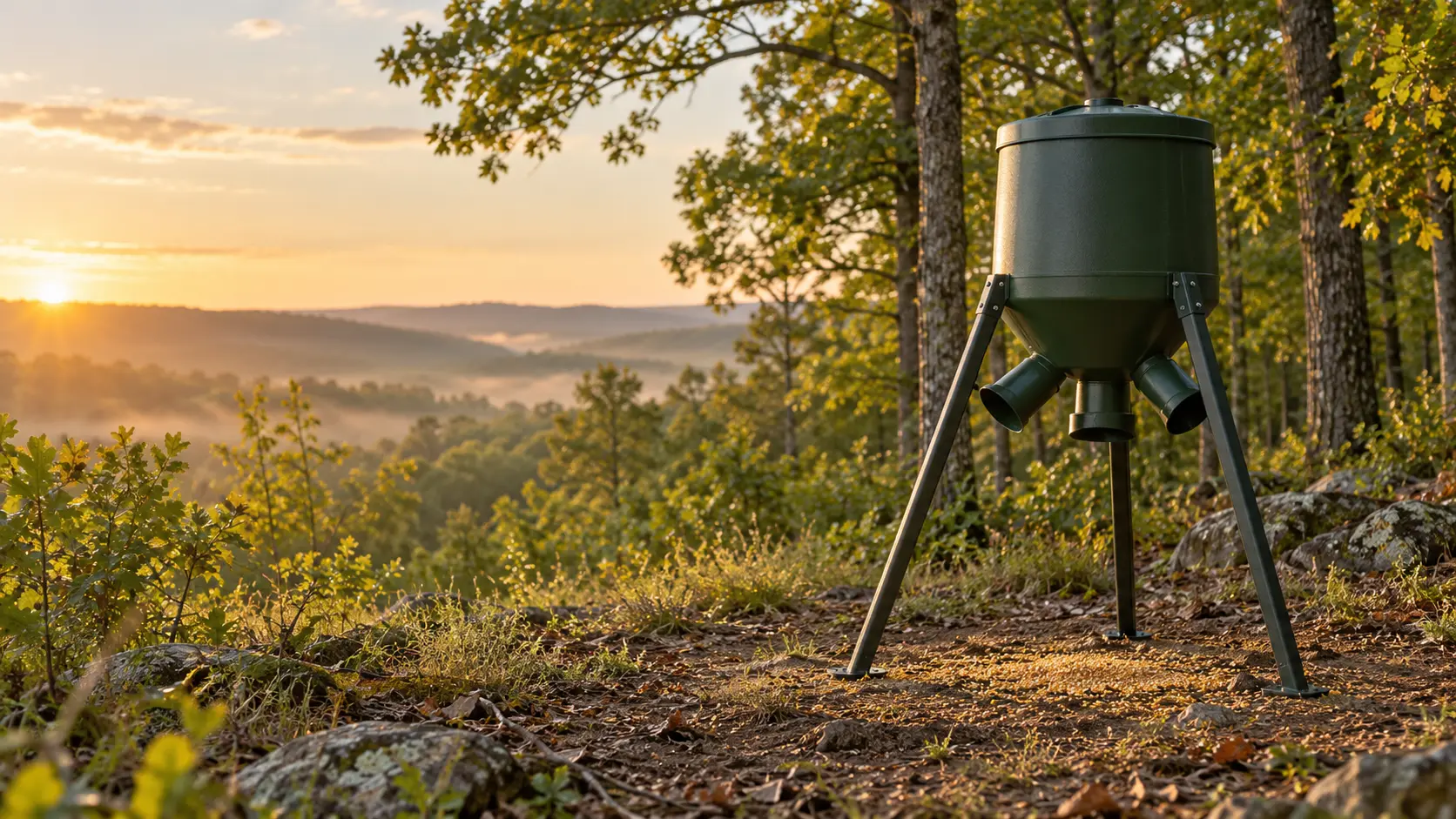
Best Gravity Deer Feeders (2027): 10 Models Compared
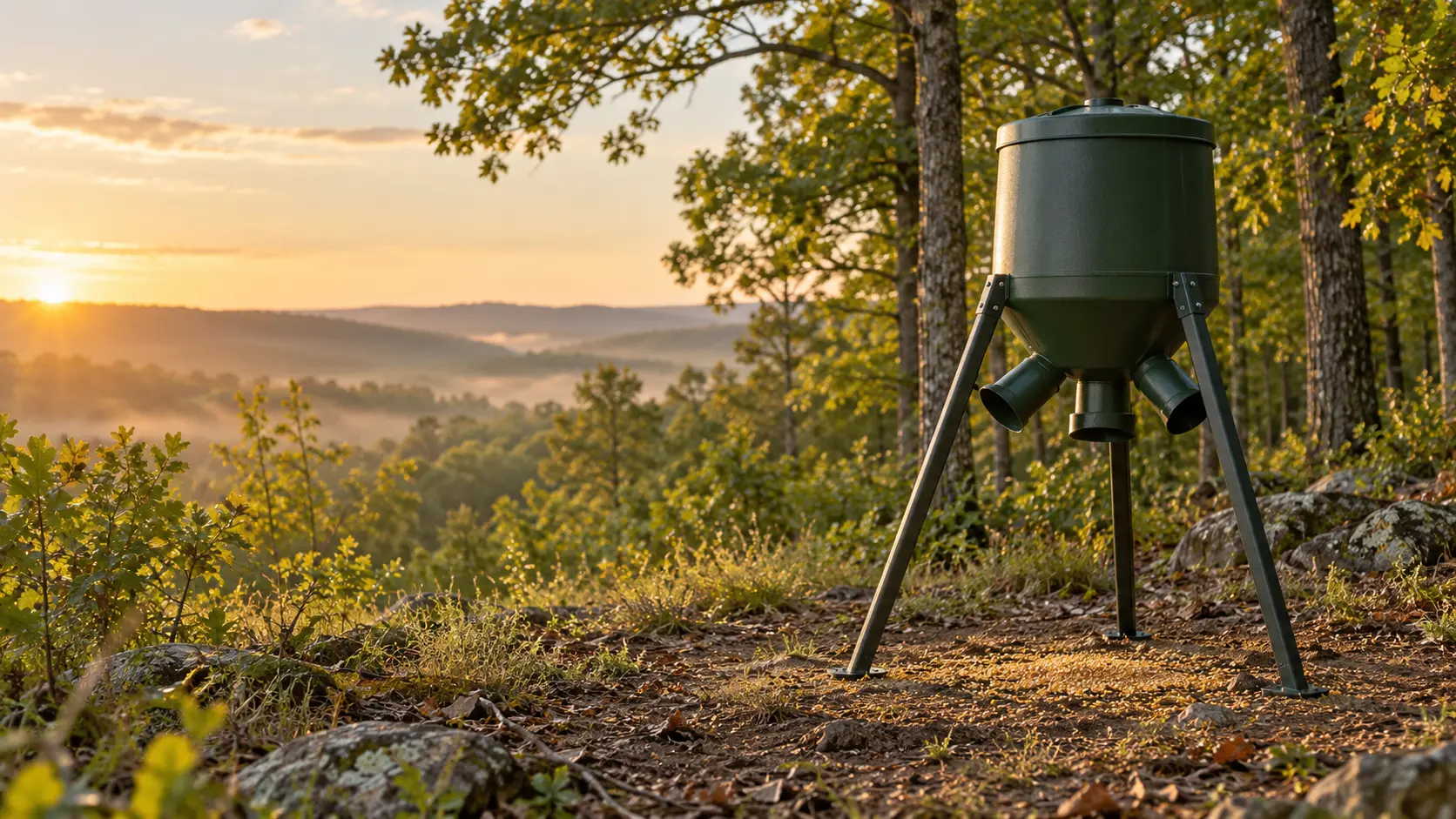
2027 US buyer’s guide • 10 gravity models • researched September 2026
Which Gravity Deer Feeder Fits Your Property?
Start with the table, open a review for its owner reports and limitations, then use the field tools if you need a closer comparison.
Three fast choices
Pick by your setup. Read the trade-off before opening the retailer.
Disclosure: Some shopping links may earn us a commission at no additional cost to you. As an Amazon Associate I earn from qualifying purchases.
Banks Feedbank 300
300-lb hopper and four adjustable ports. Requires a separately purchased, correctly installed 4×4 post.
Consider if refill trips are costly; check the post work first.
Moultrie 250LB Gravity
Battery-free freestanding option. A purchaser reports feet sinking in soft ground under a full load.
Consider if you need to relocate a station; assess your soil.
Banks Feedbank 40
40-lb compact station. One owner liked its build but found a T-post unstable around hogs.
Consider when frequent refills are easy; choose a sound mount.
These are use-case starting points, not claims of firsthand testing. The portable Treehugger is discussed below with both its convenience and a reported strap failure.
Compare all 10 gravity deer feeders
Compare the mount, feed capacity and exact-model offer. Tap a model name for the evidence and drawback. Capacities are maker claims, not measured refill intervals.
| Product or configuration | Advertised capacity | Mount | Best use to consider | Retailer offer |
|---|---|---|---|---|
| Moultrie 250LB Gravity | 250 lb | Tripod | Movable larger site | Check price |
| Banks Feedbank 300 | 300 lb | Single post | Permanent site | Check price |
| Wildgame Treehugger | Up to 100 lb | Tree bag | Trial site | Check price |
| Banks Feedbank 40 | 40 lb | Tree / post | Small station | Check price |
| Banks Feedbank 150 | 150 lb | Single post | Moderate fixed site | Check price |
| Banks Timber 250 | 250+ lb | Ground | Ground access | Check price |
| Boss Buck 200 gravity option | 200 lb corn / ~170 lb pellets | Tripod variant | Conversion flexibility | Check price |
| Boss Buck 350 gravity option | ~350 lb corn / ~300 lb pellets | Tripod variant | Mid-size protein site | Check price |
| Boss Buck 600 gravity option | 600 lb class; verify feed type | Tripod variant | Large property | Check price |
| On Time 80lb T-Post | 80 lb | T-post / tree | Narrow mounting area | Check price |
Pick a mounting route in 30 seconds
Start with what the site can support. Then compare capacity and the exact gravity configuration in the table above.
Yes: compare Banks 150 and 300; confirm post costs and port height.
Explore fixed posts →Yes: compare the Moultrie tripod and portable Treehugger; inspect soil and straps.
Explore movable models →T-post: On Time 80 or selected Banks 40 setup. Ground access: Timber 250.
Explore other mounts →This is a selection path, not an approval of any site or baiting practice. Check local rules before installation.
Moultrie 250LB Gravity · Tripod mounting concept. Confirm your exact SKU and supplied components at checkout.
Moultrie 250LB Deer Feeder Gravity: for a movable setup
Our take: This is the straightforward choice when you want a freestanding gravity feeder without a timer or battery. Moultrie specifies a 250-lb capacity, six-foot fill height, steel legs, and compatibility with corn and protein feed. A six-foot fill height is a practical detail: think about how you will lift each bag before choosing a location.
Read field evidence, trade-offs and setup notes
Also check the box before driving to the property: another purchaser reported missing assembly hardware on this listing. Count nuts and bolts at home, especially if the feeding site is far from a store.
Related video: gravity attachment mechanism (different model)
The Amazon video below demonstrates a Moultrie gravity attachment, not the complete 250LB MFG-15107 feeder. Watch it to understand the gravity feed concept; do not use it as evidence of this tripod's leg stability, capacity, or long-term durability.
See the labeled demonstration in the video library.
Open the Moultrie attachment video if the embed does not play. Verify full-feeder specifications at Moultrie.
Buy if: you need a relocatable, high-capacity, battery-free feeder and can prepare firm ground. Pause if: access to the six-foot opening or securing the legs will be difficult.
Banks Feedbank 300 · Post mounting concept. Confirm your exact SKU and supplied components at checkout.
Banks Outdoors Feedbank 300: for a fixed feeding station
Our take: Banks lists 300 lb of feed, four adjustable ports, a 42-inch feeding height, and mounting on an eight-foot 4×4 set three feet in the ground. The post is not included. This design may suit a site you expect to keep for years; budget for the post, digging and installation as part of the purchase.
Read field evidence, trade-offs and setup notes
Video: an independent Feedbank 300 review
The Outdoor Source identifies this video as an independent review of the Feedbank 300 and says it was not sponsored. Use the video to inspect the actual unit and installation discussion; it does not replace evidence from your own site or guarantee the same results.
See the labeled demonstration in the video library.
Watch the review on YouTube · Check the exact model with Banks Outdoors.
Buy if: the site is permanent and the single-post layout matters to you. Pause if: you need to relocate the feeder frequently or cannot safely set the specified post.
Wildgame Treehugger · Tree mounting concept. Confirm your exact SKU and supplied components at checkout.
Wildgame Innovations Treehugger TRUBark HD: for testing a new spot
Our revised take: The bag solves a specific carry-in problem, but its risk is attachment durability. The maker lists integrated straps and a buckle, while the Amazon listing describes up to 100 lb. A Walmart listing for the model displayed 1.8/5 across 20 ratings when checked. Because review pools vary across retailers, do not compare star averages as controlled tests; inspect the dated complaint details and the exact version before buying.
Read field evidence, trade-offs and setup notes
Video: Treehugger setup demonstration
See the labeled demonstration in the video library.
Open the Treehugger video if the embed does not play · Inspect the current Amazon listing and buyer reviews · Check the maker's model page.
Consider only if: portability and a short monitored trial matter more than long unattended service. Skip or research further if: the station is remote, exposed to weather, or likely to be left loaded for weeks; the seam-failure report deserves attention.
Seven additional models: what the evidence can and cannot tell you
The initial three entries address common site setups; the seven entries below add smaller post, ground, T-post and high-capacity alternatives. Several have traceable owner accounts, while others currently have only manufacturer details. Each section identifies its evidence level and the specific question a buyer should resolve before ordering. Each product has a direct manufacturer link so you can inspect the exact current configuration. No unrelated model video is embedded as proof.
Banks Feedbank 40 · Tree mounting concept. Confirm your exact SKU and supplied components at checkout.
Banks Outdoors Feedbank 40
Best use to examine: Compact rigid feeder for a small station · Maker-listed capacity: 40 lb
Read field evidence, trade-offs and setup notes
What the manufacturer specifies: two feed ports and mounting on a tree, fence post, T-post or 4×4. Check the maker's current product page.
Why it is on this list: Unlike a fabric bag, this is a rigid unit with adjustable ports. That can make a small, repeatable station easier to inspect without committing to a much larger post-mounted hopper.
The trade-off: A 40-lb fill can disappear quickly on a busy property, so this is easier to justify when you already visit frequently.
What owners reveal: Ronn says they switched to this feeder after squirrels chewed through two thin plastic units. Another owner says the feeder worked but the loaded unit was not stable enough on their T-post when hogs rubbed it; they planned a 4×4 instead. Those accounts do not prove it is chew-proof or that every T-post fails. They tell you to evaluate the mount and animal pressure as carefully as the rigid hopper. Read the sourced Banks 40 comments. Before purchase: Check included mounting parts and the support available on your site.
Video evidence: A matching creator video appears above where one could be identified. For other exact variants, consult the linked maker page and do not use a spin-feeder video as evidence of gravity performance.
Banks Feedbank 150 · Post mounting concept. Confirm your exact SKU and supplied components at checkout.
Banks Outdoors Feedbank 150
Best use to examine: Mid-size fixed post choice · Maker-listed capacity: 150 lb
Read field evidence, trade-offs and setup notes
What the manufacturer specifies: four adjustable ports, a stated 42-inch feed-port height and an eight-foot 4×4 post mounted three feet into the ground. Check the maker's current product page.
Why it is on this list: It occupies the middle ground between the small Feedbank 40 and the larger Feedbank 300 while using the same general single-post approach.
The trade-off: The post is an additional purchase and installation job. It is not the quick option for a temporary site.
What owners reveal: A reviewer whose comment is syndicated from Sportsman’s Guide says this was their fourth Banks feeder and reports fewer hogs and turkeys using feed after switching. This is their account, not proof of exclusion on your property. A separate favorable Walmart comment is explicitly marked incentivized; we do not treat that as independent confirmation. Inspect the Banks 150 reviews and incentive labels. Compare 150 versus 300 using your refill schedule and total installation cost.
Video evidence: A matching creator video appears above where one could be identified. For other exact variants, consult the linked maker page and do not use a spin-feeder video as evidence of gravity performance.
Banks Timber 250 · Ground mounting concept. Confirm your exact SKU and supplied components at checkout.
Banks Outdoors Feedbank Timber 250
Best use to examine: Ground-level gravity format · Maker-listed capacity: 250+ lb
Read field evidence, trade-offs and setup notes
What the manufacturer specifies: a ground-based 250+ lb design with four feed openings that dispense on the ground as the hopper empties. Check the maker's current product page.
Why it is on this list: The Timber format avoids setting a tall post or tripod. That difference may matter where digging or lifting bags high is impractical.
The trade-off: Feed on the ground requires particular attention to wet feed, debris and which animals have access. It does not solve the same problem as an elevated feeder.
Before you purchase: Check how the lid is reached, whether the ground drains, what happens to feed after a storm, and whether the site permits feeding.
Video evidence: A matching creator video appears above where one could be identified. For other exact variants, consult the linked maker page and do not use a spin-feeder video as evidence of gravity performance.
Boss Buck 200 gravity option · Tripod mounting concept. Confirm your exact SKU and supplied components at checkout.
Boss Buck 200 lb feeder with gravity head
Best use to examine: Smaller convertible Boss Buck option · Maker-listed capacity: ~200 lb corn; ~170 lb pellets
Read field evidence, trade-offs and setup notes
What the manufacturer specifies: a gravity protein head with three adjustable feed ports and an option to convert to an automatic setup. Check the maker's current product page.
Why it is on this list: If you expect to change from gravity access to a timed mechanism later, a compatible conversion path may be useful. Confirm the exact configuration and accessory costs.
The trade-off: The maker page showed this configuration out of stock when researched. Capacity also changes with the feed type.
Cross-model caution: A different Boss Buck 200-lb post feeder has a retailer complaint about feed arms sagging and another owner says deer took two to three months to get comfortable with that installation. Those reports are about the post variant, not this All-In tripod; they identify questions to ask, not a verdict on this model. See the separate post model’s owner reports. Check stock and ensure the selected All-In variant includes the gravity head.
Video evidence: A matching creator video appears above where one could be identified. For other exact variants, consult the linked maker page and do not use a spin-feeder video as evidence of gravity performance.
See current Boss Buck 200 lb feeder with gravity head offers
Boss Buck 350 gravity option · Tripod mounting concept. Confirm your exact SKU and supplied components at checkout.
Boss Buck 350 lb feeder with gravity head
Best use to examine: Mid-size protein-oriented configuration · Maker-listed capacity: ~350 lb corn; ~300 lb large pellets
Read field evidence, trade-offs and setup notes
What the manufacturer specifies: a three-way adjustable gravity head, drain holes at feed ports and an HDPE hopper. Check the maker's current product page.
Why it is on this list: Its different capacities for corn and pellets make it particularly useful to compare if you change feed by season. The maker describes a ventilated lid; field performance at your site still needs checking.
The trade-off: The maker sells multiple leg and delivery-system options on one listing. Compare the actual gravity selection at checkout.
What owners reveal: A verified Tractor Supply owner in Oregon says their sweet-feed pellets filled the hopper at about 250 lb, below the maker’s approximate 300-lb large-pellet rating and its 350-lb corn figure. The same owner reports dry feed in a humid, rainy location. Another reviewer says their newer unit’s interior attachment seemed to separate and feed flowed less freely than an older version. Both are individual reports; feed density and product revisions can matter. Read the owner accounts. Verify the selected gravity configuration, legs and delivery costs.
Video: Boss Buck 350 gravity feeder
See the labeled demonstration in the video library.
Open the Boss Buck 350 video. The indexed title identifies the 350-lb gravity feeder; the available description does not establish a long-term test, so we make no durability claim from this clip.
Video evidence: A matching creator video appears above where one could be identified. For other exact variants, consult the linked maker page and do not use a spin-feeder video as evidence of gravity performance.
See current Boss Buck 350 lb feeder with gravity head offers
Boss Buck 600 gravity option · Tripod mounting concept. Confirm your exact SKU and supplied components at checkout.
Boss Buck 600 lb feeder with gravity head
Best use to examine: Large-capacity gravity option · Maker-listed capacity: 600 lb class
Read field evidence, trade-offs and setup notes
What the manufacturer specifies: a high-capacity HDPE hopper and a gravity configuration with feed ports and drain holes. Check the maker's current product page.
Why it is on this list: It is an option for a site with documented heavy feed usage or infrequent access. A 600-lb label does not prove that it will need one-third as many visits as a 200-lb unit on every property.
The trade-off: Large capacity increases the importance of safe filling, stable placement, freight or delivery costs and the amount of feed that could spoil if a problem goes unnoticed.
Evidence gap and purchase test: We found maker specifications but no independently accessible exact-configuration season-long account. If 15 lb disappears daily, a theoretical 600-lb fill lasts 40 days and a 300-lb fill 20 days before waste or inaccessible residue; if only 3 lb disappears, the theoretical 600-lb interval is 200 days, which may be too long to leave feed unattended. Those are calculations, not field results. Confirm the gravity head and safe filling method before spending on extra capacity.
Video evidence: A matching creator video appears above where one could be identified. For other exact variants, consult the linked maker page and do not use a spin-feeder video as evidence of gravity performance.
See current Boss Buck 600 lb feeder with gravity head offers
On Time 80lb T-Post · Tpost mounting concept. Confirm your exact SKU and supplied components at checkout.
On Time 80lb T-Post Gravity Feeder
Best use to examine: T-post or tree-bracket option · Maker-listed capacity: 80 lb
Read field evidence, trade-offs and setup notes
What the manufacturer specifies: a rigid UV-resistant polyethylene container, covered downspout and mounting to a standard T-post or tree bracket. Check the maker's current product page.
Why it is on this list: A narrow T-post-compatible mount may suit a property where you do not want to dig a large wood post or depend on a conveniently placed tree.
The trade-off: An 80-lb hopper may call for more frequent fills than a 150- or 300-lb model. The mounting support still requires correct installation.
Before you purchase: Consult the product instructions for the exact #71800 model, verify the chosen mounting method and check whether wind or animal pressure calls for additional manufacturer-approved support.
Video evidence: A matching creator video appears above where one could be identified. For other exact variants, consult the linked maker page and do not use a spin-feeder video as evidence of gravity performance.
See capacity at a glance
Capacity chart: advertised pounds, not tested refill intervals
Chart basis: maker-listed maximums. Boss Buck 200 and 350 bars represent approximate corn capacity, not their lower pellet ratings. The Timber 250 is listed as 250+ lb, so its bar uses 250 as a conservative display value. Boss Buck 600 is a product class and must be matched to the chosen gravity configuration. This is a capacity comparison, not a quality rating, price chart or estimate of days between fills.
Watch the equipment before you compare prices
These are source-labeled videos, not footage produced by this site. Two show the named full feeder, one demonstrates the named bag, and one demonstrates a related Moultrie attachment. Open a video, then read what it can and cannot prove. We embed only identifiable video sources; we will not fill gaps with videos of a different model.
Exact-model independent creator reviewBoss Buck 350
Model-titled creator videoWildgame Treehugger
Amazon-hosted creator demonstrationMoultrie gravity attachment
Related part, not complete 250LB model
Banks Feedbank 300: check the post layout
The Outdoor Source's video identifies the Feedbank 300 and states it is unsponsored. Watch how the unit occupies space around a single post. The video cannot tell you whether the feed will remain dry on your property for an entire season.
Video loads only when you choose to play it.
Boss Buck 350: inspect the gravity format
The creator's indexed title identifies a Boss Buck 350 gravity feeder. The accessible description does not establish a season-long test. Use it as a visual introduction and give more weight to the exact-model owner reports about pellet fill and feed flow.
Video loads only when you choose to play it.
Treehugger: see the hanging setup, then check the seams
The Amazon-hosted creator demo shows the general setup. It does not settle a separate buyer's complaint that straps tore from the seams. Amazon may block its video inside WordPress; the link below is the fallback.
Amazon hosts this creator demonstration. Open it using the video link below; Amazon may block embedding on other sites.
Moultrie gravity attachment: mechanism only
This video is about a gravity attachment, not the complete MFG-15107 tripod. It helps illustrate the feed mechanism but is no evidence about the 250LB model's legs, filling height or durability.
Watch the related-part demonstration · Read exact-model buyer reports
The two-feeder decision lab
Choose any two models and enter your actual observed feed disappearance. The comparison adjusts for the feed you use and the number of dedicated trips. This is a buying calculation, not a product rating. It names what we do and do not know about each model.
For feed with an unverified pellet capacity, this tool uses the corn maximum as a clearly labeled upper bound, never a pellet guarantee. Enter a lower usable capacity in your own spreadsheet or field log after measuring it. It does not include the feeder's purchase price, post, shipping, spoiled feed, or wildlife other than deer.
Keep a private feeder log and learn your real refill interval
This field notebook stores entries only in this browser. Enter the feed left before each new fill. For two consecutive visits to the same feeder, it calculates (feed left at the previous visit + feed added then − feed left now) ÷ elapsed days. The result measures feed disappearance, including spills, spoilage and other animals; it does not measure deer intake. Export the log as CSV before clearing browser data.
Example: On October 1, record 0 lb left and 100 lb added. On October 11, record 40 lb left before adding more. The log shows 60 lb disappeared in ten days, or 6 lb/day. It does not assign those pounds to deer alone.
| Date | Feeder | Added | Left before fill | Days since last visit | Previous fill disappeared/day | Notes |
|---|
This is an illustrative planning tool. If a visit is missing, the calculated rate spans a longer period. If the previous visit’s total available feed is smaller than the amount recorded left at the next visit, the result is flagged for checking rather than displayed as a negative use rate.
Printable backup when scripts or local storage are unavailable
| Date | Model | Pounds added | Pounds left before refill | Days since prior visit | Weather / animal notes |
|---|---|---|---|---|---|
| ____________ | ____________ | ____________ | ____________ | ____________ | ____________ |
| ____________ | ____________ | ____________ | ____________ | ____________ | ____________ |
| ____________ | ____________ | ____________ | ____________ | ____________ | ____________ |
Check feeding rules before clicking “Check price”
A feeder can be sold in your state while feeding or hunting over feed is restricted in your county, season, public-land unit or chronic wasting disease area. This directory provides official starting points, not a legal yes/no answer. Check the specific location and date with your state agency.
Select a state. Confirm local rules before installing any feeder.
Association of Fish & Wildlife Agencies: directory for all US state agencies. Wisconsin's baiting and feeding page illustrates why county restrictions matter; Pennsylvania's wildlife feeding guidance illustrates why a single national rule cannot answer this question.
Evidence matrix: what is known for each model?
This table separates maker specifications from actual user accounts. A video shows the setup it names; it cannot substitute for a full-season durability test. “Limited” means we found no sufficiently specific independently accessible owner account for that exact configuration, so its section is a buyer checklist rather than a hands-on review.
| Exact model/configuration | Maker specification | Owner or video evidence | Key unresolved question |
|---|---|---|---|
| Moultrie 250LB Gravity | Maker | Exact-model owner reports; related-model video labeled | Stability on your soil and actual feed flow |
| Banks Feedbank 300 | Maker | Exact-model video; owner account | Your post installation and long-term feed condition |
| Treehugger TRUBark HD | Maker | Conflicting owner experiences including strap failure; creator demo | Strap durability at your site |
| Banks Feedbank 40 | Maker | Mount-stability and squirrel reports | Which support holds under animal pressure? |
| Banks Feedbank 150 | Maker | Repeat-owner account; incentive label on another review | Does smaller capacity save money versus 300? |
| Banks Timber 250 | Maker | Limited exact-model owner evidence | Feed condition where it dispenses on ground |
| Boss Buck 200 All-In gravity | Maker | Related post-variant reviews are labeled separately | Exact gravity configuration and stock |
| Boss Buck 350 All-In gravity | Maker | Two useful owner accounts; model-titled video | Usable pounds with your actual pellet blend |
| Boss Buck 600 gravity | Maker | Limited exact-configuration season-long evidence | Does larger capacity truly avoid trips? |
| On Time 80lb T-Post | Maker #71800 | Limited exact-model independent accounts | Stable mounting at your site |
What changed after checking actual buyer reports
Our provisional top fit is the Banks Feedbank 300 for a permanent site, the Moultrie 250LB for a movable large hopper, and the Banks 40 for a compact rigid feeder. The Treehugger remains a portable trial option, but we no longer treat it as a blanket best-value recommendation: a Walmart listing for the exact bag model displayed 1.8/5 across 20 ratings when checked, alongside a report that the strap seams failed in less than half a season. Amazon's listing shows a different overall rating, illustrating why one platform score should not be turned into a universal verdict. Check recent model-specific comments on both before buying.
| Field problem | Traceable owner observation | Decision you can make |
|---|---|---|
| Soft ground | A Florida purchaser of the exact Moultrie 250LB says a full hopper’s legs sank into soft soil. | Plan firm placement; inspect under load before filling completely. |
| Bag attachment | A Treehugger reviewer reports both straps separating from seams before half a season. | Use as a monitored trial, inspect seams, and weigh a rigid alternative for a remote permanent station. |
| Post stability | A Banks 40 owner liked the unit but said a T-post was unstable when hogs rubbed it. | Consider a sturdier mount for that kind of property. |
| Pellet capacity | A Boss Buck 350 owner reports fitting about 250 lb of their sweet-feed pellets. | Budget refills using the feed you actually buy, not the 350-lb corn headline. |
| Port wear | A Boss Buck 200 post variant reviewer says its arms sagged within a season. This is a different configuration from the All-In tripod in the list. | Inspect replaceable tubes and warranty terms; one report is a flag, not a defect rate. |
These are attributed individual accounts, not our own tests. See the linked retailer pages in the sections below for their wording, dates and any incentive markers.
Refill trips: a worked comparison, not a wildlife forecast
Suppose the same site loses 10 lb of feed daily and you actually use every pound of the rated capacity. A 40-lb fill gives about four days, 150 lb about 15 days, 300 lb about 30 days, and 600 lb about 60 days. In a 60-day period, that is roughly 15, four, two and one fills. On a property requiring a dedicated two-hour round trip, the number of journeys can dominate a lower purchase price. If the property is visited daily anyway, it may not. Wet feed, other animals and different pellet density shorten or change these intervals.
| Rated fill | Days at 10 lb/day | Fills in 60 days | What the figure misses |
|---|---|---|---|
| 40 lb | 4 | 15 | Good only if frequent visits are convenient |
| 150 lb | 15 | 4 | Post installation is an additional cost |
| 300 lb | 30 | 2 | May leave feed exposed longer |
| 600 lb | 60 | 1 | Filling and freshness become bigger concerns |
The pellet-capacity trap: Boss Buck describes its 350-lb model as holding approximately 350 lb of corn or 300 lb of large pellets. One verified purchaser reports about 250 lb of their sweet-feed pellets. At an illustrative 10 lb/day, those three inputs yield 35, 30 and 25 days. The owner report is one feed blend on one property, not a corrected universal specification. It shows why a useful review names the feed, rather than repeating the biggest number printed on a hopper.
How long will a fill last?
Use usable pounds of feed ÷ pounds disappearing per day. If 150 lb is usable and 10 lb disappears each day, your starting estimate is 15 days. This is arithmetic, not a prediction about deer: raccoons, weather, feed flow and local deer traffic can change the result. Weigh or record the first two refills, then adjust the estimate for your property.
- Exact model number and gravity-fed mechanism
- Rated capacity, outlet access and fill height
- Mounting hardware included or excluded
- Replacement lid and parts availability
- Return policy and current shipping restrictions
- Rules from your state wildlife agency for this location and season
Common questions from US buyers
Is a gravity deer feeder better than a timed feeder?
Gravity provides continuous access; a timed feeder dispenses at chosen times. Pick based on your feed budget, the behavior you want to observe and local rules. Neither is automatically better for every property.
Will 250 lb of capacity save refill trips?
Potentially, if your actual feed use makes a smaller hopper run out between visits. Calculate from your refill log and consider whether a full feeder is safe to mount and convenient to fill.
Can I hunt over a gravity feeder?
Rules vary by state, management zone, season and disease restrictions. Consult your state wildlife agency's current feeding and baiting rules before placing feed or hunting nearby.
Are these hands-on tests by BestDeerFeeders.com?
No. This edition compares published manufacturer specifications, identifiable owner comments and videos by other creators. We attribute observations to their sources and do not claim to have used these products ourselves.
Three buying cases: match the feeder to the work you will actually do
A 300-pound headline tells you how much a hopper might hold under a manufacturer's test conditions. It does not tell you whether your vehicle can reach the station after rain, whether one person can fill it safely, whether deer will use the feed before it deteriorates, or whether the ports will work with the feed you buy. Use these examples as decision exercises. They are hypothetical and are not presented as our own field trials.
Case one: the distant lease with a reliable service route
Imagine a 90-minute drive to a lease with firm access, a landowner-approved permanent post location and a previous season's receipts showing roughly 300 pounds of feed purchased every six weeks. A small 40-pound feeder would require too many fills if the same consumption continued. A Banks Feedbank 300 starts to make practical sense because the site can support a permanent mount and infrequent service has value. But first account for the actual 4×4 post, digging or setting it according to the manufacturer's installation instructions, feed handling and the possibility that a full hopper sits too long during a low-traffic period. If the historical consumption estimate is uncertain, fill only partway at first and measure the change rather than assuming capacity equals a service interval.
Case two: a trial location near the house
Imagine a landowner exploring two locations on a property they visit twice weekly. They are uncertain whether the deer use a shaded edge, and a permanent post at the wrong location would be wasted work. A smaller mount or portable bag allows them to compare locations without paying for a large installation. The Treehugger's easy relocation has an evident appeal, yet the reported strap and seam complaint makes its attachment a planned inspection item. The Banks 40 costs less carrying effort than a large hopper and uses a rigid housing, but its mount still deserves scrutiny where animals rub against a support. Count actual visits, record feed disappearing and inspect the mounting each time. If the location proves productive, revisit the capacity decision after you know daily consumption.
Case three: a protein site with inconsistent feed sizes
Imagine a property manager buying pellet feed from two local mills. Both sacks may say protein feed, but pellet diameter, length and bulk density vary. A Boss Buck 350's corn and pellet capacities are listed separately for good reason: pounds of one material need not occupy the same hopper volume as pounds of another. An individual owner reported about 250 pounds of their sweet-feed pellets in a hopper whose maker gives about 300 pounds for large pellets. That is a useful caution, not a universal capacity correction. Purchase a small quantity of the actual feed, check whether it flows through the selected gravity head, and write down the amount that fills your exact setup without forcing the lid. If the pellets bridge, follow the maker's instructions before changing feed or port settings.
Refill math you can audit with a receipt and a notebook
Start with a measured interval rather than a guessed number of deer. If you added 120 pounds on day one and found 30 pounds remaining after ten days, estimated disappearance is (120 − 30) ÷ 10 = 9 pounds per day. “Disappearance” includes any wildlife consumption, spillage and theft; it cannot establish how much deer ate. If you filled an already partly full hopper, add its starting remainder to the new feed before doing the subtraction. Record dates, remaining feed, pounds added, feed type, rain and visible spill. The private field log in this article helps organize those entries and exports a CSV you can keep.
| Illustrative daily disappearance | 40-lb hopper | 150-lb hopper | 300-lb hopper | What to check |
|---|---|---|---|---|
| 3 lb/day | About 13 days | About 50 days | About 100 days | Will feed remain sound for that long? |
| 9 lb/day | About 4 days | About 16 days | About 33 days | Can you service the small unit this often? |
| 18 lb/day | About 2 days | About 8 days | About 16 days | Are non-target animals taking feed? |
Each figure is a theoretical full capacity divided by a constant disappearance rate, rounded down. These are arithmetic examples, not field-tested intervals, feed-preservation advice or predictions about wildlife. Actual fill volume, pellet density, unusable residue, weather and animal traffic change the result.
For a useful service schedule, build in an inspection interval independent of the calculated empty date. A 300-pound hopper at 3 pounds per day produces a theoretical 100-day figure; that is not a reason to ignore it for 100 days. Check feed condition, mount, lid, ports and surrounding ground during the period. If the consumption rate suddenly doubles, investigate a leaking port, fallen feed, hog activity or a changed pattern before ordering a larger hopper. If it falls near zero, check for bridging, blocked ports or stale feed before assuming deer abandoned the site.
The break-even question for a bigger hopper
Suppose a larger setup costs $180 more after including its mount, and each avoided service trip costs you $30 in fuel and your own time estimate. It would need to save six trips to offset that extra $180 under those assumptions. That calculation excludes spoilage, replacement parts and any benefit you place on the ability to move the smaller feeder. A large hopper may save no trips if you already visit the property weekly for other reasons. Use your own totals, and compare the same feed type and actual configuration rather than sticker prices alone.
Before the first fill: a 20-minute inspection that protects the purchase
Start with the ground. Walk the planned approach while carrying the amount of feed you normally transport, or at least plan the route honestly. Note mud, washouts and whether a truck or cart has room to turn. Position the feeder only where you have permission, where the installation instructions permit it and where the ground supports the mount. For site strategy beyond this equipment review, read our feeder placement guide. If you hunt nearby, our stand-distance guide discusses how the approach route and stand relate; verify its suggested distances against your terrain rather than treating them as universal measurements.
Dry fit before filling. Assemble the actual legs, post bracket or straps according to the included instructions. Check the lid closes fully and each port sits as designed. Compare the components in the box against the product listing. In particular, Boss Buck offers distinct delivery heads and leg configurations under similar capacity names, so a photograph of the hopper by itself does not prove that the selected listing includes a gravity head. With a post-mounted unit, budget for the separately purchased support if required. With a tall tripod, decide whether you can reach the lid with your own safe filling method before you buy a season's worth of feed.
Use a modest first load. Put in enough of your actual feed to check the outlets and the mount without committing to a full hopper. Photograph the ports and surrounding ground on the first day. On the next visit, repeat from the same spot so a wet patch, a growing spill area or a shifted support becomes easier to see. Do not rely on a video of a different feed or different model to claim that yours is working. If squirrels or other animals repeatedly gain access, our squirrel exclusion guide offers a focused follow-up; record which species you actually observe before making changes.
Stop for the legal check. A feeder can be physically appropriate and still violate a location-specific baiting rule. Verify the state agency's current rules, wildlife disease zone, property type and hunting dates before filling it. Our Texas explainer and Georgia explainer provide local starting points; the official agency link finder above should be your final check, especially for 2027 changes.
Six photographs that make a future review genuinely useful
If you own the feeder, capture: (1) the exact model label or receipt with personal details removed; (2) the assembled feeder and its mount; (3) each feed port with a ruler; (4) the feed bag label and weighed amount added; (5) the ground and ports after rain; and (6) the same view after a dated service interval. Pair those images with dated notes on flow, animal access and any parts replaced. These are editorial prompts for a real, attributable test that the site owner can perform; they are not substitute evidence for a test that has not happened.
What a problem at the feeder tells you to inspect
| What you observe | First checks | Buying lesson |
|---|---|---|
| Feed disappears much faster than expected | Look for spilled grain, open ports, tracks and camera images; weigh the next refill. | A larger tank alone may magnify waste rather than solve access. |
| Feed remains but ports seem empty | Check for damp feed or bridging; consult instructions before clearing a blockage. | Test your actual pellet dimensions and protect feed from moisture. |
| Tripod tips or feet sink | Stop filling, inspect soil and assembly, and follow the maker's approved support guidance. | Soil and leg configuration belong in the model comparison. |
| Bag or strap shows wear | Unload safely and examine attachment, seams and nearby branches. | Portable convenience requires regular attachment checks. |
| Camera sees visits but feed use is low | Review timestamps and species, compare feed condition, and inspect outlet height. | Do not infer feeder failure from one metric or buy a replacement immediately. |
Do not put hands into a loaded opening or attempt a structural repair against manufacturer instructions. Document the model, date and visible defect before contacting the seller or maker about replacement parts or warranty coverage. A photo series and an accurate feed log make a much stronger warranty inquiry than “the feeder doesn't work.”
The real cost of a deer feeder over one season
Comparing only the price on the product card is easy and often wrong. Your cost is the feeder plus mounting materials, replacement parts, feed, wasted feed, fuel and time. For a fixed 300-lb hopper, include the post and installation. For a tripod, include any permitted stabilization materials and your filling setup. For a tree-mounted bag, include the possibility of more frequent inspections if the site is remote or weather-exposed.
Here is an illustration, not a claim about deer consumption. Suppose two legal, equally suitable locations each use an observed 10 lb of feed per day. A 100-lb usable fill lasts about 10 days; a 250-lb usable fill lasts about 25 days. Over 100 days, that suggests roughly ten fills versus four. Now add the actual round-trip travel cost. If each dedicated trip costs you $20 in fuel, six avoided visits represent $120 in fuel before counting your time. If visits are part of other property work, the extra travel cost might be close to zero. That one difference can reverse which hopper is the better value.
Write down usable capacity rather than blindly using the advertised maximum. Some feed may be left below a working outlet, and you may choose not to fill to the brim. Divide your own observed usable pounds by your own measured pounds disappearing per day. Build in a margin so a delayed trip or unexpected rain does not become a spoiled-feed problem. If you are buying for your first season, make a provisional plan and revise it after two full refill cycles.
For a clear calculation, make five columns in a notebook or spreadsheet: date, pounds added, pounds remaining before refill, apparent pounds used, and observations. Add a sixth column for unusual weather or animal activity. If you added 100 lb and found 25 lb left after ten days, apparent use was 75 lb, or 7.5 lb per day. That is the total disappearance from that feeder; it does not tell you how much deer alone consumed. A camera and inspection of spilled or spoiled feed help explain the difference.
Do not publish an exact “cost per deer” based only on hopper depletion. A single buck photographed twice is not two different deer; deer may visit other food sources; and feed may be taken by other species. A more honest metric for household budgeting is dollars of feed placed at this station per month. If you have invoices or receipts, record that number and compare it with your travel and maintenance costs.
| Cost item | Question to answer | How to verify |
|---|---|---|
| Feeder | What is the exact model's current checkout price? | Retailer checkout, including shipping |
| Mount | What hardware or post is excluded? | Maker's parts list and installation guide |
| Feed | How much disappears between visits? | Two or more dated refill records |
| Loss | Is feed spoiled, spilled or taken by other animals? | Outlet inspections and camera observations |
| Trips | Are refills dedicated journeys? | Actual fuel and distance records |
Setup details that matter after the box arrives
Before assembly
Compare the model number on the box with the page you used to make the purchase. Manufacturers sell gravity, spin and connected versions under similar family names. A video about a spin model cannot answer questions about a gravity model's outlet. Lay out the parts and count the hardware against the instructions on a clean surface. This is particularly worthwhile after the Moultrie buyer report of missing fasteners. If something is absent, document it and contact the seller or maker before improvising a structural connection.
Scout the approach path with the weight of a feed bag in mind. A site that is easy to walk to empty-handed can be inconvenient in rain. Avoid a spot that requires stepping over a ditch or climbing under branches while carrying feed. Look at drainage after a storm, nearby trees that might provide climbing access to the hopper, and the ground that must hold the loaded feeder. Place and operate equipment according to the manufacturer's instructions and applicable land-use rules.
Post-mounted installation
The Banks product page specifies an eight-foot 4×4 with three feet set in the ground and says the post is not included. Follow the current manual for the precise installation; do not treat a product-page summary as a substitute for instructions. Before digging, confirm that you can do so on the property and check for buried utilities using the appropriate local process. Imagine the full hopper on the post, not the empty product in a photo. A leaning post can make both filling and access awkward.
After mounting, examine the lid and each feeding port while the hopper is still empty. Check that the cover seats properly and the port adjustments move as designed. Begin with a modest quantity of the feed you intend to use and return soon to observe flow. This small first fill helps identify an issue before it affects hundreds of pounds of feed. Record the setting you used so you can change one factor at a time if the result disappoints you.
Tripod installation
For the Moultrie, assemble the leg sections in the order specified, check all connectors and assess whether the empty unit stands level. Fill incrementally and recheck the feet. Soft ground can settle differently under one leg, especially after rain. If you plan to use any pads, anchors or modifications, check that they are compatible with the manufacturer guidance and the site. Do not represent a home modification as an included feature or a tested safety fix.
Before filling, practice opening and closing the lid without carrying a bag. Test whether you can keep a secure stance, see inside the hopper and close the lid completely. If you cannot, change your method or get assistance. This matters more than a marketing phrase such as “easy fill.” Also watch for feed falling outside the hopper while pouring; spillage can attract animals directly to the legs or create an inaccurate impression of feeder use.
Tree-mounted installation
For the Treehugger, select a tree that supports the straps and lets you reach the closure safely. Follow the maker's attachment instructions and inspect the bark and strap path. A sharp projection can abrade a bag over time. Ensure the roll-top closure is complete after each fill. Because a tree can grow and move, recheck the strap tension during routine visits. The portable design is most useful if inspection and relocation remain easy in the real setting.
Take a photo immediately after installation from the same angle you will use later. It helps you spot a shifted bag, sagging strap, leaning tripod or changed post position. Photograph the date and outlet condition as well. These records make your own experience much more useful than a vague statement that a feeder “worked great.”
Corn, pellets, moisture and feed flow
A gravity feeder relies on material moving toward an outlet as animals remove it. That sounds simple, but the feed's shape and condition matter. Dry whole corn behaves differently from pellets with dust and broken pieces. Small particles can collect in a chute; damp material can clump; irregular kernels can bridge an opening. Manufacturers' compatibility statements are a starting point, not a promise that any bag from any supplier will flow identically.
When trying a new feed, use a small amount first. Observe whether material moves to the port naturally. Photograph the opening before you leave and when you return. If a hopper looks full but no feed is accessible, inspect for bridging and moisture. Do not reach into a full hopper in an unsafe way. Follow the maker's procedure for clearing obstructions, and remove spoiled feed rather than trying to force it through an outlet.
Rain protection deserves attention even when a lid is described as watertight. Look for gaps around the opening, water dripping from nearby branches, and splash from the ground. The place where animals reach the feed can be more exposed than the hopper interior. After a rain event, inspect both the top and the outlet. Photograph any clumping or mold and record whether the issue followed wind-driven rain, condensation, an incomplete lid closure or old feed. Without those details, it is too easy to blame the wrong product feature.
Do not leave feed sitting indefinitely just because a hopper can hold a large amount. Buy and store feed in a way that follows the feed supplier's directions, then match fill size to actual use. A small, regularly refreshed fill can be better for a low-traffic location than a full large hopper that remains unused for weeks. This is another reason a rated capacity is a ceiling, not a target you must meet at every refill.
If you want to compare products fairly, use the same feed from the same batch, note the weather, and measure the period between fills. One feeder in full sun and another under overhanging branches do not experience the same conditions. Neither do a winter test and a humid summer test. A useful owner review explains these differences instead of treating one property's result as universal.
Feeders, deer behavior and local rules
A deer visiting a station once is encouraging if your goal is to observe wildlife, but it does not tell you that the feeder improved herd health or hunting success. Deer may approach more slowly in a new setting; other animals may reach feed first; seasonal food sources can change visitation. Keep claims tied to the observation. “The camera recorded deer feeding on two evenings” is useful. “This feeder guarantees more mature bucks” would require evidence that a short creator video and a product listing cannot provide.
US feeding and baiting rules differ widely. They can change across state lines, between public and private land, by season, and in response to disease-management measures. Check the wildlife agency for the exact state and management area where the feeder will stand. Do it before setting up the equipment and again before hunting. A product sold online nationwide is not an indication that placing feed is permitted at every destination.
When comparing installations, consider how you will maintain a clean station. Spilled or wet feed can gather on the ground; continual accumulation makes it harder to know how much animals actually consumed. Follow local wildlife guidance on feeding practices and keep the area accessible for inspection. If your intended use is photography or wildlife viewing rather than hunting, local rules may still apply to feeding itself.
We deliberately avoid presenting a state-by-state legality table in a guide that might remain live for months. A static table becomes unreliable when a regulation changes. A separate article can cover an individual state with a dated link to its agency and a clearly stated scope. The buying decision here is to identify the rule that governs your exact site before spending money.
A practical maintenance schedule
At every refill
Check the lid or roll-top closure, feed at the outlet, and the ground beneath the station. Look for damp feed, unusual powder, a blocked port, broken straps, loose fasteners or leaning legs. Record how much feed remains before adding more. A quick photo of the same spot on each visit makes slow changes easier to see. If the site is remote, bring the correct tools and the manufacturer's contact information so a minor problem does not force another trip.
Read the feed bag before changing diets or mixing products in the hopper. If old feed has become damp, remove and dispose of it appropriately instead of covering it with fresh feed. Reset a port only after recording the previous position. Otherwise you cannot tell whether a change in consumption came from the port, the season or animal traffic.
After heavy rain or wind
Visit sooner when practical. Examine whether the cover is still seated, the post or tripod is upright, and the outlet contains dry feed. Check the Treehugger strap and closure for displacement. A feeder surviving one storm in an online review is encouraging but does not replace an inspection of your own installation. Wind exposure, ground conditions and setup quality vary too much.
At the end of a feeding period
Empty and clean the unit following its instructions, inspect wear points, and store removable parts so you can find them next season. Review your log: Did the feeder meet the planned refill interval? How many visits were made only for feed? What equipment needed repair? These answers determine whether the same model remains a good value for your site, and they provide the kind of first-person evidence readers can trust if you decide to share it.
If you publish an update, include both successes and failures. A note such as “we checked this unit six times between March and May; the lid stayed dry, but one strap needed adjustment” helps far more than a generic five-star verdict. Identify the exact product and location conditions without exposing private property details.
Continue with the right next question
This page compares gravity models. For the broader category, see our all-type deer feeder guide. To decide whether continuous gravity access or timed distribution fits your site, see spin versus gravity feeders. Then return here to compare exact gravity models and owner reports. These are different decisions; we do not repeat the whole all-type list on this page.
Four mounting styles, pictured
Original schematic illustrations show the main physical differences. They are not manufacturer product photos or proof of dimensions.
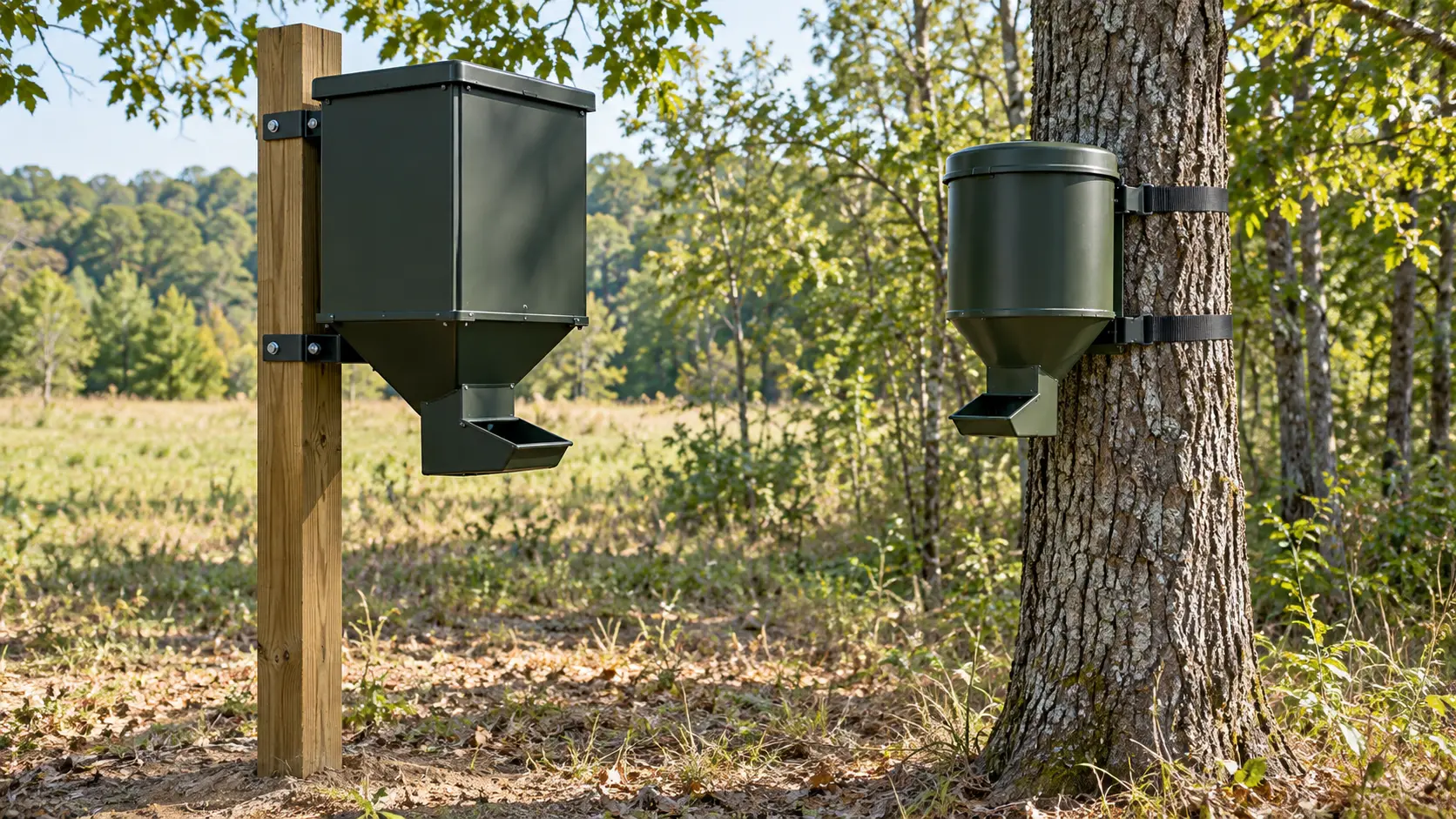
Check the required support and post setting.
Check leg stability and fill height.
Check straps, tree fit and access.
Check animal access and cleanliness.
Products mentioned in this guide
Amazon product B078NH92BZ
Check on Amazon ↗ASIN B078NH92BZ · Confirm price and availability on AmazonAs an Amazon Associate, we earn from qualifying purchases.


