
Best Protein Deer Feeders: 7 Models, Evidence & Buying Trade-offs
Match the feeder to the feed, the site and the refill routine.
Start with a confirmed pellet load and a service routine you can maintain. Compare seven gravity and timed configurations below, then inspect the evidence, access requirements and exact Amazon offer.
For a side-by-side look at two popular free-choice models, read our Boss Buck 200 vs 350 gravity protein comparison.

As an Amazon Associate I earn from qualifying purchases.
Updated November 1, 2026 · by Zia
Quick answer: For most landowners running a free-choice protein program, the Texas Hunter Xtreme Protein 1,200 (XPF1200) is the pick: six gravity feed stations, no battery or motor, and a hopper big enough to cut refill trips. Starting smaller? The Boss Buck 350 Protein holds about 300 lb of large pellets, per Boss Buck.
Best protein deer feeders: start with the site problem
Start with your operating constraint: storage, manageable filling, or scheduled dispensing. Each shortlist entry gives a reason to consider it and a limitation to resolve before ordering.
Texas Hunter Xtreme 1,200
Six 6-inch feed ports and adjustable baffles; a rotomolded hopper and no motor to maintain. The six feeding positions may matter on a high-traffic station.
Trade-off: freight delivery, a high upfront cost and no evidence that every herd will consume its full supply.
1,200 lb ratedNo batteryBoss Buck 350 Protein
Three-way gravity head, adjustable feed sleeves and HDPE hopper. Its simpler design can suit a first feeding station where you can refill more often.
Trade-off: verify leg and head configuration, shipping cost and the complete delivered offer.
350 lb rated3 portsAll Seasons 600 Electric
Timed protein tray, up to six feed events, motor-control timer and a 12V solar/battery package. Consider when scheduled dispensing is a specific requirement; savings must be measured.
Trade-off: 600 lb is corn-based capacity; the maker lists just 75 lb in the protein head, and actual pellet capacity must be checked for the selected feed.
TimedPower includedAmazon links are affiliate links. “Search this model on Amazon” buttons open Amazon search results for that model. Check capacity, feed type and configuration before buying.
Which protein feeder fits your property?
Start with delivery type and actual pellet capacity. A corn capacity rating does not tell you how many pounds of protein pellets will fit.
On a narrow screen, swipe the table sideways. Model names stay visible.
| Feeder / delivery | Capacity to plan around | Consider it for | Amazon US |
|---|---|---|---|
| Texas Hunter XPF600Four-port gravityRead model analysis → | 600 lb ratedPellet fill weight not confirmed | A medium-capacity gravity station | View on AmazonMatched model listing. Check configuration and availability. |
| Texas Hunter XPF1200Six-port gravityRead model analysis → | 1,200 lb ratedVerify the weight of your pellets | More feeding access points | View on AmazonMatched model listing. Check configuration and availability. |
| Boss Buck 350 ProteinThree-port gravityRead model analysis → | 350 lb ratedAbout 300 lb large pellets, per maker | A smaller gravity station | View on AmazonMatched model listing. Check configuration and availability. |
| Boss Buck 1200 ProteinFour-port gravityRead model analysis → | 1,200 lb cornAbout 1,000 lb large pellets, per maker | Larger pellet storage | Browse alternativesOpens Amazon search for this model. |
| All Seasons 600 ElectricTimed trayRead model analysis → | 600 lb corn-basedSupplier states up to 18.5% less with protein | Scheduled feeding windows | Browse alternativesOpens Amazon search for this model. |
| Texas Hunter PF300Three-port gravityRead model analysis → | 300 lb corn250 lb protein, per maker | A smaller barrel feeder | Browse alternativesOpens Amazon search for this model. |
| Texas Hunter XPF600FLow-port gravityRead model analysis → | 600 lb rated17-inch port height; verify pellet weight | Lower feeding-port access | Browse alternativesOpens Amazon search for this model. |
Before ordering: confirm pellet compatibility, selected capacity, seller, freight and delivery access. Alternatives searches may show different models. Prices and availability are shown on Amazon. As an Amazon Associate I earn from qualifying purchases.
Capacity references: manufacturer specifications discussed in each model analysis. No live price or stock claim is made in this comparison.
Choose the feeding system before choosing a brand
Gravity protein feeder
Pellets remain accessible through feed ports around the clock. No battery, motor or timer is required, but hogs, raccoons and cattle may consume feed unless access is controlled. Choose for an established nutrition program, not just convenience.
Timed protein feeder
A motor meters pellets into a protected tray at programmed intervals. You can limit exposure while adding a battery, timer and motor to maintain. Never confuse hopper’s corn rating with the smaller protein head’s capacity.
Roofed trough or barrel
A covered, anchored trough can test pellet acceptance at low cost. It needs frequent cleaning and protection against rain, animal contamination and overturned hardware; it is not automatically comparable to a sealed commercial hopper.
Seven best protein deer feeders: pros, cons and who should buy each
Product photos are manufacturer references. Confirm model, stock, availability and total delivered cost before ordering.
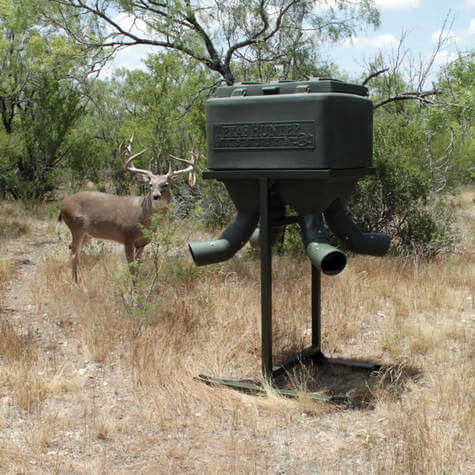
Texas Hunter Xtreme Protein 600
600 lb gravityA rotomolded gravity feeder with four 6-inch feeding ports and adjustable feed-flow baffles, per the current Texas Hunter XPF600 model page. The standard version has a taller stand than the XPF600F Fawn model. Check the loading height, trailer delivery and access roads.
Pros
No battery, four 6-inch feed ports and adjustable baffles.
Cons
Freight cost, no validated pellet-weight capacity and whole-system pest exposure.
Retail listings may mix versions and capacities.The Amazon US link matches this model. Check the selected configuration, seller, shipping and availability on Amazon before ordering.
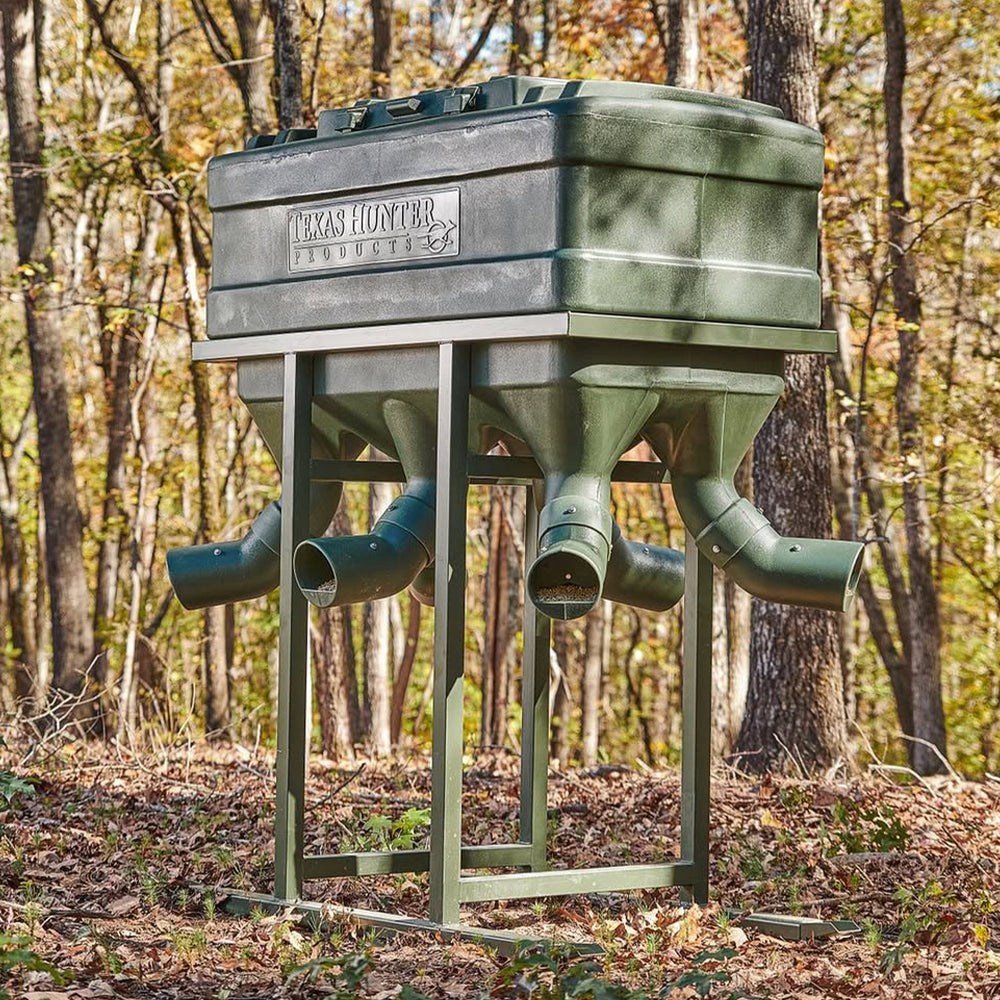
Texas Hunter Xtreme Protein 1,200
XPF1200 • six portsThe XPF1200 maker specification includes six large feed ports, adjustable feed-flow baffles, a roto-molded hopper and a stand with skids. It costs substantially more up front and ships by freight.
Pros
Six stations, no motor and baffle-controlled feed access.
Cons
High delivered cost, significant size and no published pellet weight.
Retail listings may mix versions and capacities.The Amazon US link matches this model. Check the selected configuration, seller, shipping and availability on Amazon before ordering.
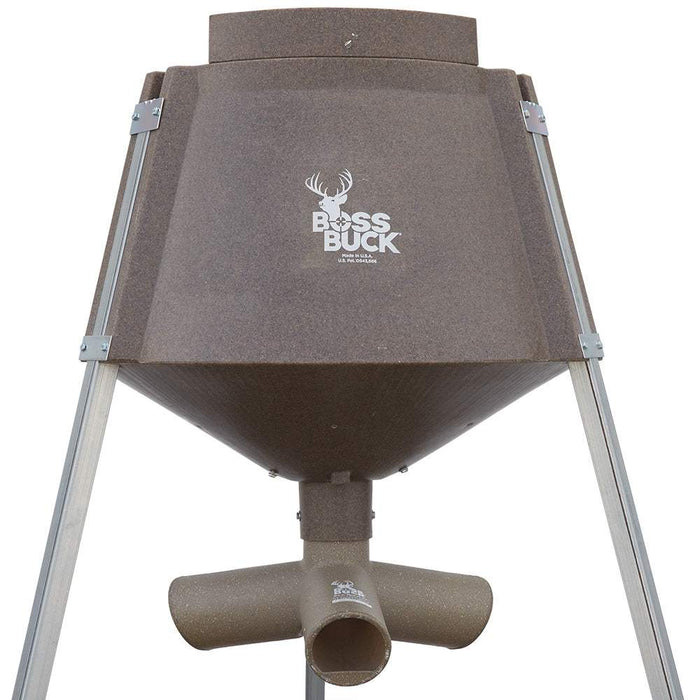
Boss Buck 350 Protein
350 lb rated • three-portA practical first commercial gravity feeder for landowners establishing a pellet station. The manufacturer’s 350-lb hopper is rated for approximately 300 lb of large protein pellets, a useful distinction when estimating refills. Price comparisons should include shipping and local dealer terms.
Pros
Moderate first purchase, no electronics and multiple feeding positions.
Cons
Less stored feed than bulk systems, mounting stability and uncertain specific pellet capacity.
Retail listings may mix versions and capacities.The Amazon US link matches this model. Check the selected configuration, seller, shipping and availability on Amazon before ordering.
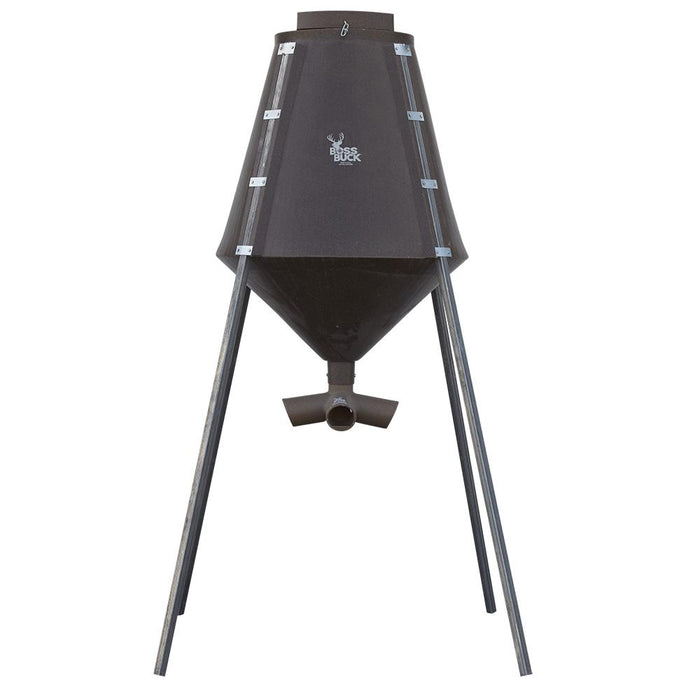
Boss Buck 1,200 Protein
1,200 lb corn ≈ 1,000 lb large pelletsBoss Buck explicitly distinguishes approximate 1,200 pounds of corn from approximately 1,000 pounds of large protein pellets. Its four-way head features angled feeding ports, drain holes and adjustable flow. Manufacturer listing was out of stock when checked.
Pros
Published pellet-capacity conversion, large hopper and adjustable four-port head.
Cons
40-inch protein feed height, costly installation and variable availability.
Retail listings may mix versions and capacities.The button opens Amazon search results for this model; check feed type, capacity and configuration before ordering.
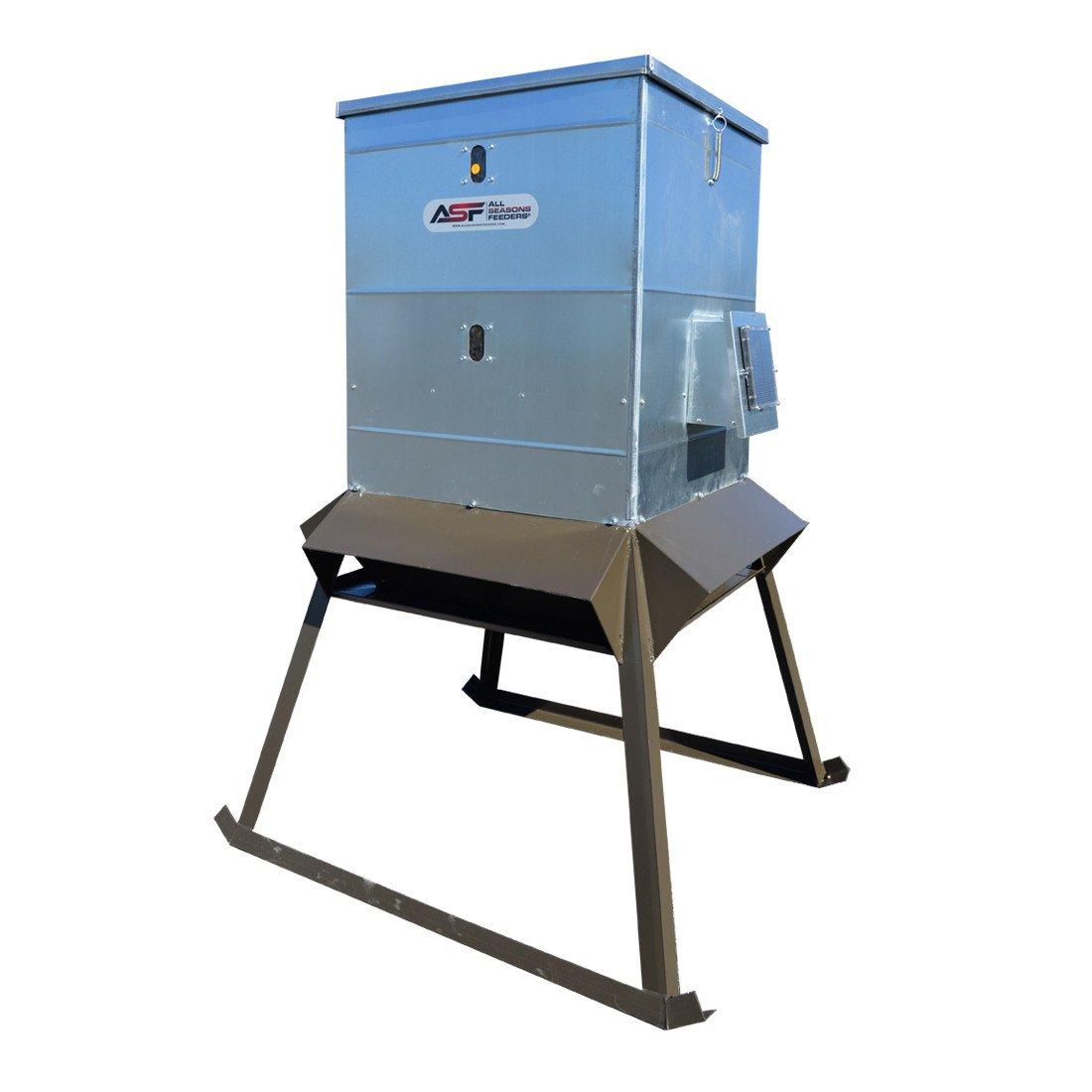
All Seasons Electric Protein 600
Timed • 75 lb protein headA different design from always-open gravity feeders: six scheduled feeds per day, up to 75 pounds in the protein head, a tray 25.5 inches above ground and 12V battery and solar equipment included. Maker says protein may weigh 18.5% less than headline corn capacity.
Pros
Ground-level filling, defined feeding windows and included power components.
Cons
Electronic service requirements, modest head capacity and sold-out status at maker.
Retail listings may mix versions and capacities.The button opens Amazon search results for this model; check feed type, capacity and configuration before ordering.
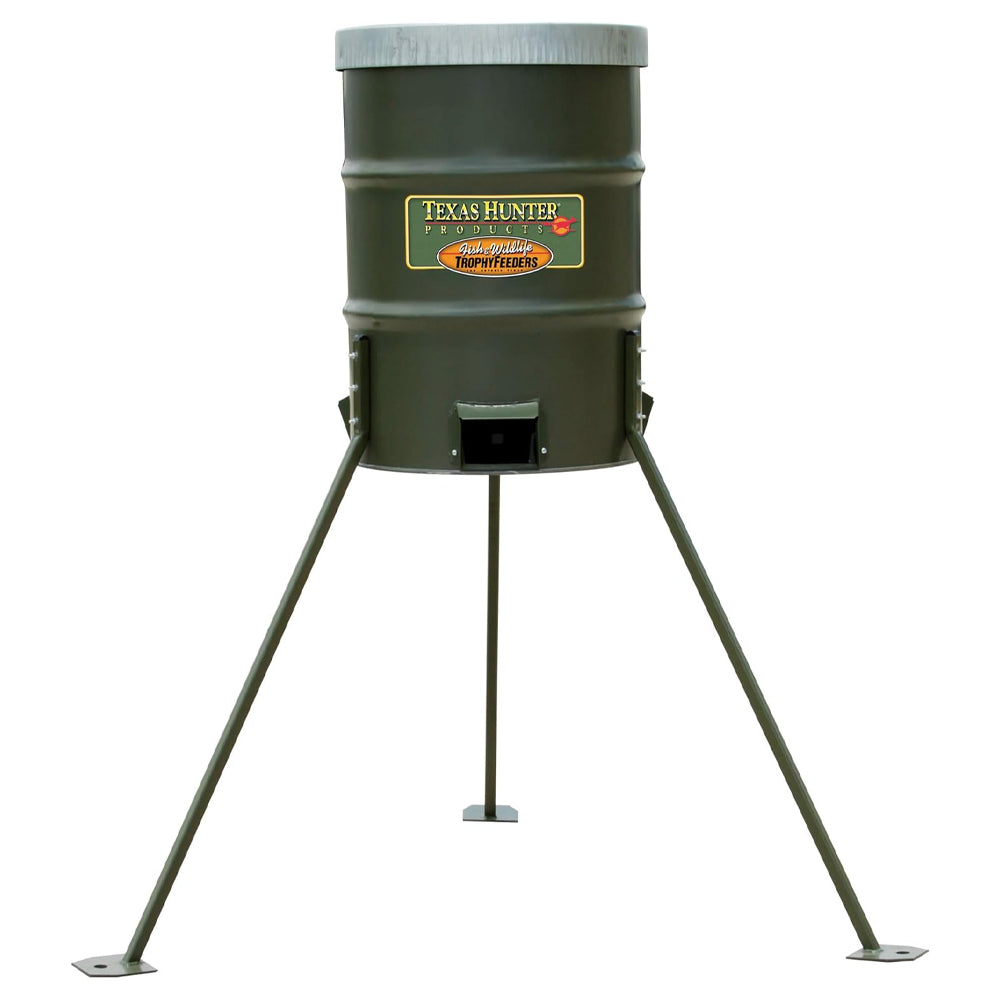
Texas Hunter Protein Barrel 300
300 lb corn; 250 lb proteinOne of the most useful capacity disclosures for a first buyer is its separate 250-pound protein rating. That permits a more realistic refill estimate than blindly using the barrel’s 300-pound corn headline.
Pros
Explicit protein number, modest scale and simple gravity feeding.
Cons
More frequent trips and exposed support/leg system to protect.
Retail listings may mix versions and capacities.The button opens Amazon search results for this model; check feed type, capacity and configuration before ordering.
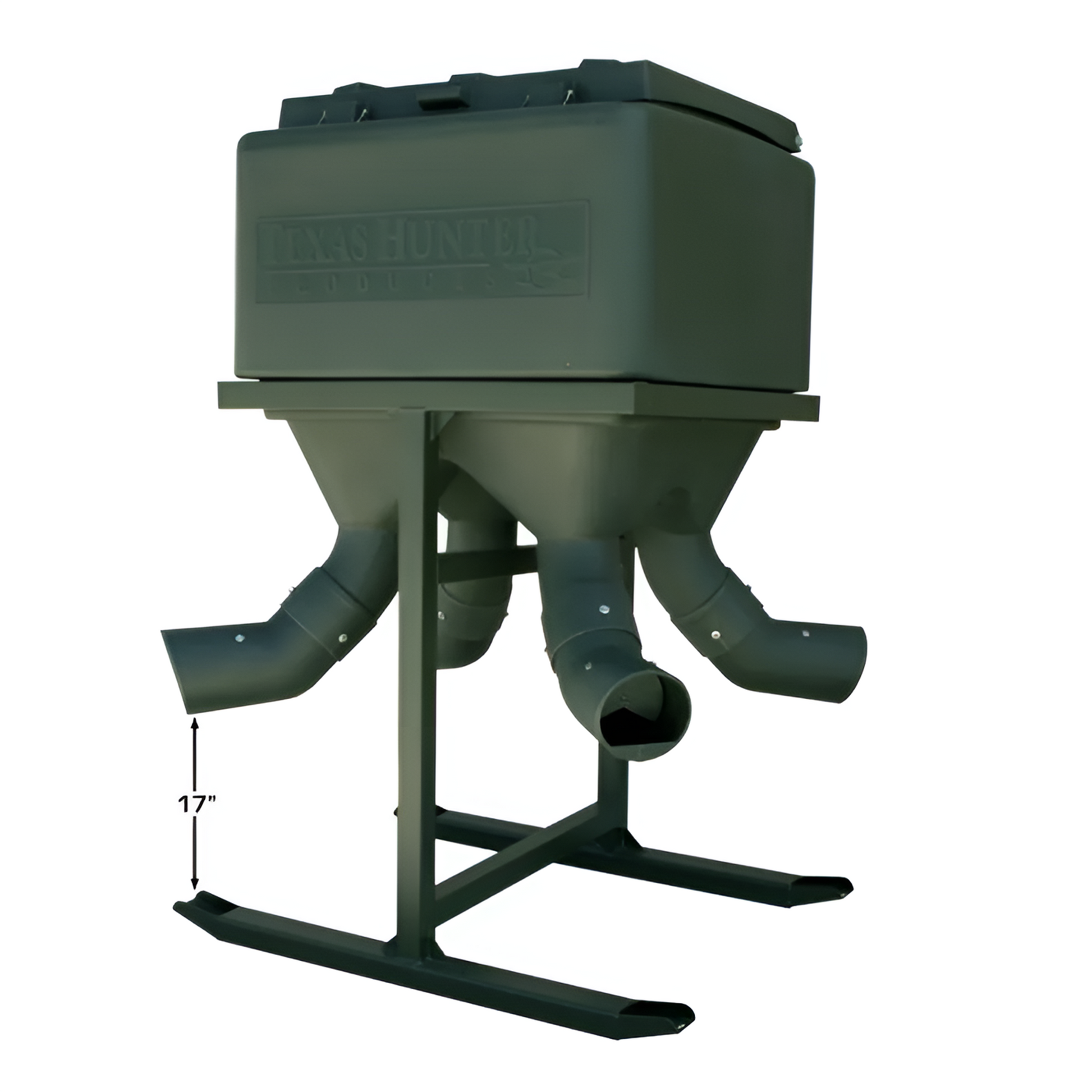
Texas Hunter Xtreme Fawn 600
XPF600F • low ports 17 inches • four stationsThe Texas Hunter XPF600F is the low-profile Fawn version, with feed ports 17 inches above ground. The maker’s specifications list four feeding stations, although its overview text inconsistently says six. The pictured product matches the Fawn-style model. Lower access may also increase unwanted animal access.
Pros
May address an observed access issue and uses gravity feed delivery.
Cons
Can expose feed to unwanted animals; requires exact model verification.
Retail listings may mix versions and capacities.The button opens Amazon search results for this model; check feed type, capacity and configuration before ordering.
Protein deer feeder capacity calculator: corn rating versus actual pellets
Published “capacity” numbers are often the number of pounds of corn fitting into the hopper, not the weight of a protein pellet blend. Pellet diameter, density, fines and moisture can make the same container hold less. The Boss Buck 1,200 explicitly states approximately 1,000 pounds of large protein pellets, while Texas Hunter 300 lists 250 pounds of protein; All Seasons warns the difference can reach 18.5% on its models. These disclosures are model-specific, not a universal rule.
Capacity difference at two documented examples
Source: manufacturer’s product statements. This does not imply all protein blends have exactly the same volume-to-weight factor.
Your own planning estimate
Based on your chosen density assumption.
Calculated from the example intake, not a forecast of actual deer behavior.
Example: 25 deer × 1.5 lb/day = 37.5 lb/day. At 500 lb capacity and 10% reserve, refill in about 12 days.
Protein percentage alone does not prove a feeder will grow bigger antlers
Texas Parks and Wildlife’s historical Supplemental Feeding of Deer bulletin (J. R. Perkins, 1991; first printed 1979) discusses adult deer protein needs of roughly 13–14% and higher needs for developing fawns. It describes 20% protein supplements as a possible part of an antler-growth and lactation feeding program, not a complete substitute for forage. These are historical educational figures, not a customized ration or proof that all herds benefit.
Later field work summarized by the Caesar Kleberg Wildlife Research Institute (1997 bulletin, based on earlier south-Texas observations) found that a controlled-time covered-trough approach could limit wasted feed under particular study conditions. It reported approximately 90–95% feed efficiency and emphasized moisture protection, costs, and establishing pellet acceptance. The research did not establish that every new timer model outperforms every modern gravity feeder.
Historical adult-protein reference
Older Texas wildlife material discusses this broad crude-protein context; natural forage, body condition and location still matter.
Common supplement strength
A percentage on the feed bag is only one part of a nutritional plan; inspect ingredients, mineral profile and feeding directions.
Study-reported efficiency
Context-limited historical result from a controlled-time trough feeding study, not a claimed efficiency for the seven commercial products here.
Refill schedule examples: 25 deer, three scenarios and two hoppers
The numbers below are transparent planning scenarios, not observed consumption from your property. The cited sources below trace 0.5 lb, 1.5 lb and approximately 3.32 lb of supplement per deer per day to separate historical research or feeding-label contexts. Treat the high example as a stress test for costs rather than an expected average.
| Scenario | Assumed deer | Each deer/day | Total feed/day | 500 lb usable | 1,000 lb usable |
|---|---|---|---|---|---|
| Low | 25 | 0.5 lb | 12.5 lb | 40 days | 80 days |
| Middle | 25 | 1.5 lb | 37.5 lb | 13.3 days | 26.7 days |
| High | 25 | 3.32 lb | 83 lb | 6.0 days | 12.0 days |
Table uses entire stated usable capacity, no reserve, no waste, and fixed illustrative consumption. Calculator above offers a reserve. A feeder serving multiple stations should be measured separately if usage differs.
A refill decision in four steps
Estimate the number of deer actually using this particular feeder, not the entire property population.
Measure a week’s pellet disappearance and document non-target animal visits.
Recalculate with a reasonable safety margin before all feed disappears or spoils.
Bundle inspection, sanitation, leg/port checks and camera maintenance into each visit.
Hogs, raccoons, cattle and wet pellets: protect the whole system
Photos of a feeder in a clean studio cannot tell you whether your station will survive months of feeding. A rigid hopper is not equivalent to an animal-proof installation; equally, a timed tray does not prevent pests from taking spilled feed. The feeder’s real-world result depends on access, soil, feed quality and how the property is managed.

| Observed problem | What to investigate | What matters when buying |
|---|---|---|
| Wet, clumped pellets | Feed has absorbed moisture; inspect the lid seam and feed-port drainage. Discard compromised feed according to safe feed-handling guidance; don’t hide it under fresh bags. | Moisture-resistant lid, sheltered port and scheduled inspection. |
| Hogs or cattle empty the feeder | Install a permitted, securely built enclosure appropriate for the site; check that fawns and non-target wildlife are not inadvertently trapped or injured. Camera footage can reveal which animals reach the openings. | Guard or pen design and a wildlife-safe access strategy. |
| Raccoons chew plastic | Look for access from legs, adjacent branches and lid edges. An electronic varmint cage around a spinner doesn’t protect an entire gravity barrel. | Whole-system barriers; inspection after first animal visit. |
| Deer don’t use pellets | The site may be too exposed; deer may need an acclimation period, while local rules may restrict feeds. Consult a wildlife expert before changing feed blends or putting new food on the ground. | A low-cost protected trial and camera observation. |
| Feed disappears too fast | Count actual non-target visitors and test pellet intake before assuming every deer eats a high daily allotment. Compare a timed alternative only if it aligns with wildlife-management goals. | Measurement and a more realistic refill budget. |
| Feed bridges or stops flowing | Pellet size, fines, funnel angle or moisture may obstruct ports. Shut off any powered equipment before inspecting and follow manufacturer cleaning instructions. | A model with adjustable flow and accessible service parts. |
| Port height seems wrong | Don’t copy another hunter’s favorite height. Study deer approach and reach on a camera and check published model dimensions. Low ports may also increase hog access. | Choose placement using real animals and legal limits. |
| Price seems unbelievable | Verify whether a listing includes only the hopper, a gravity-head kit, legs, motor conversion or a complete feeder. Add shipping, feed tax and any installation. | Exact SKU and total delivered price comparison. |
Before installing hog panels or a wildlife exclusion fence, check applicable wildlife and agricultural rules. Design clear entrances and avoid dangerous sharp edges or traps. For a herd in a known CWD management area, understand restrictions on supplemental feeding before dispensing any pellets.
Why protein feed often costs more than the feeder itself
Example A: a short test program
At 12.5 lb/day (25 deer × 0.5 lb), 60 days requires 750 lb before loss and reserve. At a hypothetical $0.30/lb, the feed costs $225. You have not yet paid freight, fuel or maintenance.
Example B: a heavier sustained program
At 37.5 lb/day (25 deer × 1.5 lb), 60 days requires 2,250 lb. At an assumed $0.30/lb, the feed alone costs $675. Even a large hopper needs more than one fill.
Both examples are transparent arithmetic, not current feed-market quotations. Prices vary sharply by feed composition, season, bag size, freight and location.
Evidence matrix
| Source type | Useful evidence | Limit |
|---|---|---|
| Manufacturer documentation | Named model, capacity basis, delivery configuration. | Specifications and promotional claims are not independent field results. |
| Boss Buck All-In owner reviews (Tractor Supply) | Model-specific user observations about feed fit and operation. | Individual reports; feed and product versions can differ. Some entries carry incentive labels. |
| Camron Stover: XPF600 review | First-person ownership discussion, including filling and transport. | Affiliate-funded publication; not a controlled comparison. Use manufacturer specifications to resolve conflicting port counts. |
| Calculators in this guide | Transparent arithmetic using stated inputs. | Not a prediction of wildlife behavior, feed condition or equipment reliability. |
Protein deer feeder buying checklist: ten steps to prevent expensive mistakes
Confirm it is a protein configuration
A 1,200-pound spinner feeder is not automatically the gravity protein head you want; check the exact order code and included parts.
Record feed type and capacity
Ask whether the headline lb is corn or your actual pellet blend, and obtain a model-specific conversion where available.
Compare feed port heights
Measure intended access against your property and camera observations; beware of unwanted hog or livestock access.
Plan weather protection
Inspect lid seals, port overhang, drainage and cleaning access for humid and rainy environments.
Calculate the first sixty days
Price pellets, animal estimates, fuel, loss reserve and repeat visits before judging value.
Review how the feeder arrives
Freight delivery, unloading, liftgate access and difficult terrain can add real costs.
Check warranty exclusions
A timer’s five-year coverage may not be a five-year warranty on the hopper; save the exact terms.
Check legal feeding restrictions
Confirm regulations on public/private land, seasons, baiting and CWD management zones.
Inspect wildlife safety
Choose stable legs and permitted enclosures without trapping animals or creating harmful sharp edges.
Commit to a short observation cycle
Photograph the initial fill weight, watch the ports with a trail camera, inspect rain damage and adjust the plan after measured consumption.
See the delivery mechanisms
Players load only when selected. Use the source descriptions to distinguish a demonstration from an independent test.
Texas Hunter gravity feed flow
Official product-family demonstration linked by Texas Hunter. Shows the gravity concept, not an independent pellet-capacity or durability test.
Open the original video ↗All Seasons electric protein feeder
Manufacturer-linked electric protein presentation. Not an independent field comparison.
Open the original video ↗Best protein deer feeders: fifteen buyer questions answered
Which feeder is best for a property with no electricity?
Unpowered gravity feeders avoid electrical upkeep. Texas Hunter and Boss Buck offer different port and capacity configurations, but the best choice depends on protected access and reasonable refill costs.
What does a 1,200-lb protein feeder actually hold?
Boss Buck states its specific 1,200-lb hopper holds about 1,000 lb of large protein pellets; a different brand or pellet size may have a different ratio.
Do deer need 20% protein supplements?
Not invariably. Historical guidance discusses 20% supplements in certain programs, but native forage, herd density, age class and veterinary/wildlife advice matter.
Are gravity feeders better than timed feeders?
Gravity offers continuous access with fewer powered parts; timed systems can meter feed but need service and may have different accessible protein-head capacity.
How high should the ports be?
No universal height was established by the mixed historical research. Check manufacturer dimensions, camera observations and risks from unwanted animals.
Can protein pellets spoil?
Yes. Moisture can lead to clumping or mold. Protect the feed, inspect routinely and remove compromised pellets rather than adding new feed on top.
Does protein feeding guarantee larger antlers?
No. Age, genetics, range condition, stocking density, climate and overall management all influence outcomes.
How many feeders should I install on 200 acres?
Acreage alone cannot establish the right number. Consider how deer actually use the property, disease and feeding rules, forage and access.
Are feeder ports raccoon-proof?
No. Guard designs can reduce one access path but don’t stop animals damaging a lid or climbing the stand. Inspect all access routes.
Can I put protein pellets in a corn spinner?
Only if the exact model permits it. Pellet size, fines and moisture can change flow and jam mechanisms designed for corn.
Is a 2,000-lb feeder worth buying first?
Only where sustained consumption, delivery and service justify it. Consider a trial before financing bulk storage.
Do low ports help fawns?
They may improve access for some smaller animals, but also can admit hogs and others. Confirm the actual need and protections.
Do I need a solar panel?
Not for gravity-only designs. A timed electronic feeder needs correct power; some include a battery and panel while others do not.
Are protein feeders legal everywhere?
No. State, season, property type, disease area and baiting regulations differ. Consult current wildlife-agency sources.
What are the most important hidden costs?
Pellets, freight, installation, repeat refill trips, pest losses, cleaning, repair parts and suitable animal-exclusion fencing.
Find the best protein deer feeders by five property questions, not fake star ratings
Two landowners buying the same feeder can have opposite outcomes. One has level ground, good vehicle access, an established protein program and no livestock. The other has three kinds of non-target animals, a long muddy access road and an uncertain deer population. A “4.9/5 overall” verdict without documented testing would conceal those differences. Use this score-free decision lab before choosing from the seven models.
| What your field log says | More promising option | What would change that recommendation? |
|---|---|---|
| Only one or two deer visit the proposed site regularly | Trial-size barrel or modest gravity station | Camera logs showing growing regular use, plus protected access |
| Several animals need to feed at once | Multiple gravity ports, e.g. Texas Hunter Xtreme | Actual evidence of competition or crowding rather than a guess from population estimates |
| A landowner must lift heavy feed bags alone | Low-profile barrel or ground-fill timed model | A safe loading platform and physical assistance might make a taller option workable |
| Feed is repeatedly taken by hogs or cattle | Fix permitted exclusion first; then reconsider model size | Trail-camera evidence that the animals are excluded without creating new wildlife hazards |
| Daily pellet use is known and service visits are costly | A larger documented-pellet-capacity hopper | Shipping, feed waste, access roads and the time to safely refill |
| A timer is essential to the program | Purpose-built electric protein tray | Whether the scheduled ration supports the program’s nutritional goal |
Scenario 1: newly purchased 100-acre property
Assume you have not yet seen deer eating commercial protein pellets. The lowest-risk test may be a portable, protected barrel rather than a permanent one-ton hopper. Purchase a modest amount of feed, record its bag weight and date, and use a trail camera to learn whether deer or other animals consume it. In a location where feeding is legal, this short trial generates evidence before you make a large investment. The exact acreage alone does not determine feeder count.
Scenario 2: remote deer-management ranch
Suppose a known high-use feeding station takes 1,000 pounds of large protein pellets at a fill and a caretaker drives 140 miles round-trip. In that case, a large hopper such as Boss Buck 1,200 may reduce refill frequency. But a claimed four-week service interval is still only arithmetic until the site has measured intake, dry feed, sound supports and protection from hogs. Record battery or trail-camera service on the same visits to avoid additional trips.
Scenario 3: rain, pests and difficult loading
A coastal or humid site may need excellent port drainage, easy inspection and a low-risk method of lifting feed. Here, a purpose-built ground-fill design can be worth considering even if its motor adds maintenance. The purchase is not automatically justified by the manufacturer’s claim of reduced waste: you need to measure whether a controlled tray actually solves the site’s problem, and whether the chosen feed resists moisture damage.
Our analysis favors matching a feeder to the site, not naming one universal winner. If the same photos and marketing copy persuade you that all three scenarios require the most expensive model, the comparison has failed its purpose.
What happens after delivery matters as much as the model name
Most large protein feeders arrive as substantial equipment rather than a small parcel. Ask the seller whether the shipment is boxed, palletized or delivered by motor freight and whether you must unload it. Check the approach road, liftgate options, safe handling of a heavy hopper and the stability of the location before a driver arrives. A unit that takes hours to unload or must be moved after filling has already created avoidable expense.
Warranty language also deserves careful reading. A manufacturer’s statement that its timer carries multi-year coverage does not necessarily extend to the hopper, motor, solar panel, powder coating, legs, lid or damage from animals. Boss Buck’s FAQ distinguishes terms for different parts and specifically warns that salt-based feed blends through its electric control system can corrode equipment and affect warranty coverage. All Seasons Feeders lists different warranties for motors, solar panels and timers. Request the actual terms tied to your purchase SKU, record serial or part numbers, and save dated photographs of the initial assembly.
First refill inspection: a real checklist
- Check the lid closes fully and that new feed is dry and has no visible spoilage.
- Look underneath the hopper for displaced legs, soil movement and damaged port joints.
- Examine the ground and camera footage for hog, raccoon and cattle visits.
- Measure feed remaining against bags originally added and days elapsed.
- Record wet weather, heat and pellet bridging rather than assuming the hopper is empty.
- For timed designs, safely test control settings, battery, solar connectors and the actual portion delivered.
Don’t replace healthy components
When pellets stop flowing, a blocked port, wet feed or misadjusted flow sleeve may be the cause; an expensive new feeder is not automatically the right answer. When a timed system does not dispense correctly, disconnect power and consult the model manual before checking the motor, spinner or wiring. Never reach into a powered dispensing mechanism or attempt to free a blockage while the motor is energized.
A cleaning kit, compatible battery and simple field log may contribute more to a well-run station than an extra accessory purchased because it appears in a shopping carousel.
Sources, review standard and limitations
- Texas Hunter protein feeders — model types, listed pricing and capacity claims (checked October 2026).
- Texas Hunter XPF1200 — six feed stations, material, baffle adjustment and shipping details.
- Boss Buck 1,200 — corn/pellet capacity distinction, port details, dimensions and warranty caution.
- All Seasons 600 Electric — protein head, timed feed output, battery/solar inclusions and pellet-density warning.
- Texas Parks & Wildlife, Supplemental Feeding of Deer (1991) — historical wildlife nutritional and feeding context.
- Caesar Kleberg Wildlife Research Institute management bulletin (1997) — historical timed-trough study and lessons about waste.
Review process: primary manufacturer claims are attributed, historical wildlife findings retain their dates, and neither “hands-on tested” nor invented star ratings are claimed. Financial calculations are labeled illustrative. Check manufacturer pages, local law and delivery terms at purchase.
Build a shortlist you can defend
A useful shortlist starts with a requirement, not a ranking. Write down the amount of protein feed you need between realistic visits, how you will reach the fill opening, and whether the feeding objective calls for passive access or scheduled dispensing. The seven models in this article illustrate different configurations. Their presence together does not mean that every model is an equally suitable substitute for the others.
Give each candidate a reason to remain on the list and a reason it might be excluded. For a large gravity feeder, the reason to keep it may be storage and multiple access points; the exclusion may be an impractical delivery route or fill procedure. For a timed feeder, the reason may be a genuine scheduling requirement; the exclusion may be an inability to maintain the powered equipment. This exercise makes the trade-off visible before purchase.
Do not use the manufacturer's headline capacity to settle a pellet-loading question unless the feed type is specified. An unknown pellet figure remains unknown even when the model number contains a familiar weight. The comparison table deliberately distinguishes those cases instead of giving every product a precise refill interval that the evidence cannot support.
The decision becomes clearer when you identify the expensive mistake you are trying to avoid. That might be buying insufficient usable capacity, receiving the wrong delivery head, paying freight for an awkward installation or storing far more feed than the station needs. A product that prevents your actual mistake may be a better fit than the one with the most features.
Review the offer, not only the product family
Before following a shopping button, note the exact model and intended configuration from the review. At the marketplace, compare the title, selected variation and included components with that note. A family name can cover several capacities or delivery options. An accessory, conversion head or replacement hopper should not be mistaken for the complete feeder discussed in the article.
Read the delivery details with the same attention as the hardware description. Freight access, unloading arrangements and the route to the installation site can determine whether a large system is practical. If a seller's description leaves those points unclear, resolve them before ordering. A low initial price does not compensate for an unsuitable delivery arrangement.
The Texas Hunter XPF600, XPF1200 and Boss Buck 350 buttons open those exact Amazon listings. The other buttons open Amazon search results for the named model, so check the seller, configuration, stock and delivery date before you order.
Manufacturer and retailer source links have a different role. They allow readers to inspect specifications and attributed owner experiences. They remain evidence citations rather than shopping buttons. This separation protects the reader from confusing a source document with the offer being recommended and keeps the affiliate purpose of the actual Amazon buttons clear.
How much weight should an owner report carry?
Start with the specificity of the account. A report that identifies the product, feed and operating problem is more useful than a brief declaration that a feeder is perfect or useless. Check whether the reviewer describes the same configuration and whether the page combines several variants. Product revisions can also limit how directly an older account applies to the current offer.
A report can be valuable without being representative. A single filling difficulty can prompt you to inspect access before buying. A measured pellet load can prompt you to weigh your own feed. Neither establishes a general defect rate or proves that all units will behave the same way. Keep the observation and your buying interpretation distinct.
Look for incentives and source attribution. A retailer may syndicate reviews from another site or mark an account as a sweepstakes entry. Such labels do not automatically make the experience false, but they belong in an assessment of independence. Do not combine an incentivized account and an unverified comment into an invented average of customer satisfaction.
Conflicting evidence is especially useful when it identifies a question to resolve. Two owners may use different feed, different settings or different versions. Instead of selecting the more convenient review, ask which conditions matter to your purchase. The strongest buying advice sometimes ends with a precise verification task rather than a definitive verdict.
Use the first month to test the buying assumptions
Record the exact model and the components delivered before installation. Compare them with the order and manual, and note any missing or damaged parts. This keeps shipping or configuration problems separate from performance judgments. An incomplete system is not a fair test of the equipment described by its specifications.
Start with a known feed weight and record the feed type. Confirm operation using the manufacturer's procedure, then inspect during the first operating interval. Document actual pounds added and remaining rather than estimating success from a camera image of animals near the feeder. The image shows a visit; it does not establish the amount consumed.
Keep a record of maintenance and access as well as feed use. How long did a fill take? Was the opening reachable with appropriate equipment? Was the delivery area clear? Did the station remain serviceable under the conditions encountered? These observations directly test whether the product fits the property.
At the review point, compare the record with the original reason for choosing the feeder. If the main constraint remains unsolved, decide whether an approved adjustment, a different location or a different system is needed. Expanding the installation before resolving that mismatch risks repeating the same problem at a larger scale.
A final comparison before checkout
Put the two strongest candidates side by side and answer five questions in writing: which exact feed can each handle, what usable load is confirmed, how will each be filled, how will each be serviced, and what does each complete delivered installation cost? A blank answer should prompt a question to the seller rather than a guessed number.
Then describe the limitation you are accepting. Perhaps one candidate requires more frequent refills but is easier to access. Perhaps another has a larger supply but more demanding delivery requirements. A timed option may provide the control you need while adding power maintenance. Accepting a known trade-off is different from overlooking it.
Avoid treating a source-labeled video as a substitute for those answers. A manufacturer demonstration can explain the mechanism, and an owner video can reveal practical details, but neither automatically settles all configurations or long-term outcomes. Use the video to sharpen the checklist and the manual to confirm the exact installation.
The best purchase is the one that matches the verified requirements and the service routine you can maintain. The article provides a structured comparison and evidence trail, not a promise that supplemental feeding is appropriate everywhere or that any feeder guarantees a wildlife outcome. Confirm local conditions and restrictions, then make the equipment decision with the remaining uncertainties visible.
The best protein deer feeder is the one that fits your pellets, animals and refill budget
For an established free-choice program, Texas Hunter Xtreme 1,200 offers six ports, while Boss Buck 1,200 supplies a useful documented large-pellet capacity. For a smaller first station, compare Boss Buck 350 and the Texas Hunter 300 barrel. For metered dispensing and safer filling, consider the All Seasons 600 Electric—subject to stock and planned electronic maintenance.
None of these products eliminates the need for sound habitat management, clean feed, regular inspection or local regulatory compliance. Start by measuring your true consumption and protecting the station from animals you aren’t intending to feed.
Products mentioned in this guide
Texas Hunter Xtreme XPF1200 Protein Feeder
Check Price on Amazon →Confirm price and availability on Amazon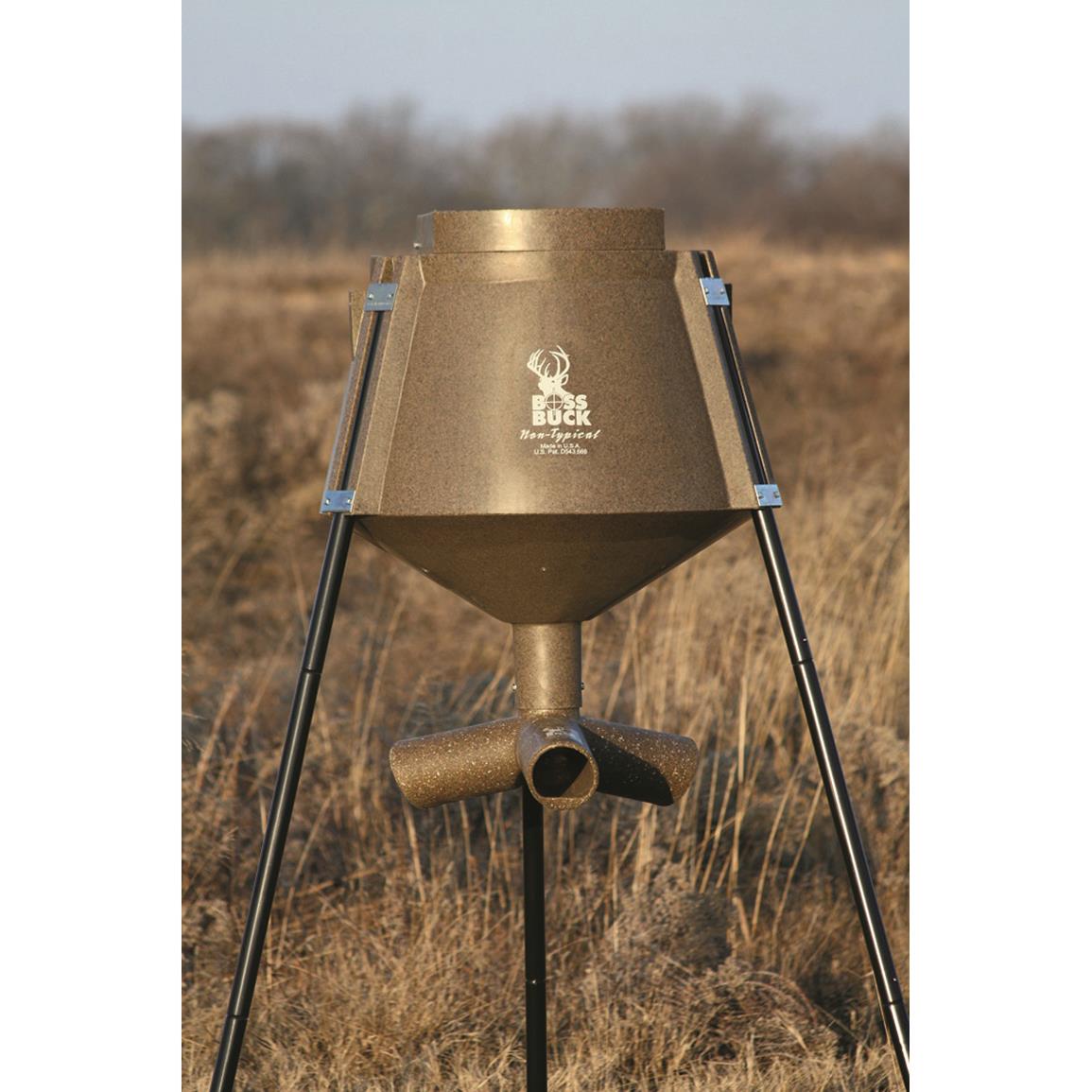
Boss Buck 350 lb Gravity Protein Feeder
Check Price on Amazon →Confirm price and availability on AmazonTexas Hunter Xtreme XPF600 Protein Feeder
Check Price on Amazon →Confirm price and availability on AmazonAs an Amazon Associate, we earn from qualifying purchases.


