
Gravity vs Timed Protein Feeders: Costs, Pros, Cons & Evidence
Control the delivery.
Measure the result.
Gravity offers passive access. A timer schedules dispensing. Neither automatically proves lower waste. Compare the whole system before choosing.
Compare the trade-offs ↓Mechanism illustration in words, not a measured performance chart.
As an Amazon Associate I earn from qualifying purchases. This is a researched comparison, not our firsthand head-to-head equipment test. No current Amazon price or guaranteed saving is claimed.
Compare the operating requirements
Swipe sideways on a narrow screen. These are mechanism-level distinctions; verify the exact product’s components and instructions.
| Decision | Gravity protein | Timed protein | Verify first |
|---|---|---|---|
| Feed access | Available as feed reaches the passive outlet. | Dispensing occurs at programmed events; material may remain afterward. | Actual outlet or tray arrangement. |
| Operating checks | Flow, feed condition, structure and access. | Those checks plus power, controls and dispensing. | Exact maintenance instructions. |
| Amount used | Measure disappearance over known intervals. | Calibrate delivery and measure disappearance. | Pounds, not only timer seconds. |
| Potential benefit | Passive delivery without scheduled motor events. | Intentional dispensing windows. | Your actual operating objective. |
| Main limitation | Availability is not ration control. | Timing does not identify which animals consume feed. | Field observations and access conditions. |
| Cost claim | No automatic lowest-cost claim. | No automatic waste-saving claim. | Total installation and recurring costs. |
Inspect the exact Amazon offer
Boss Buck 350 Protein
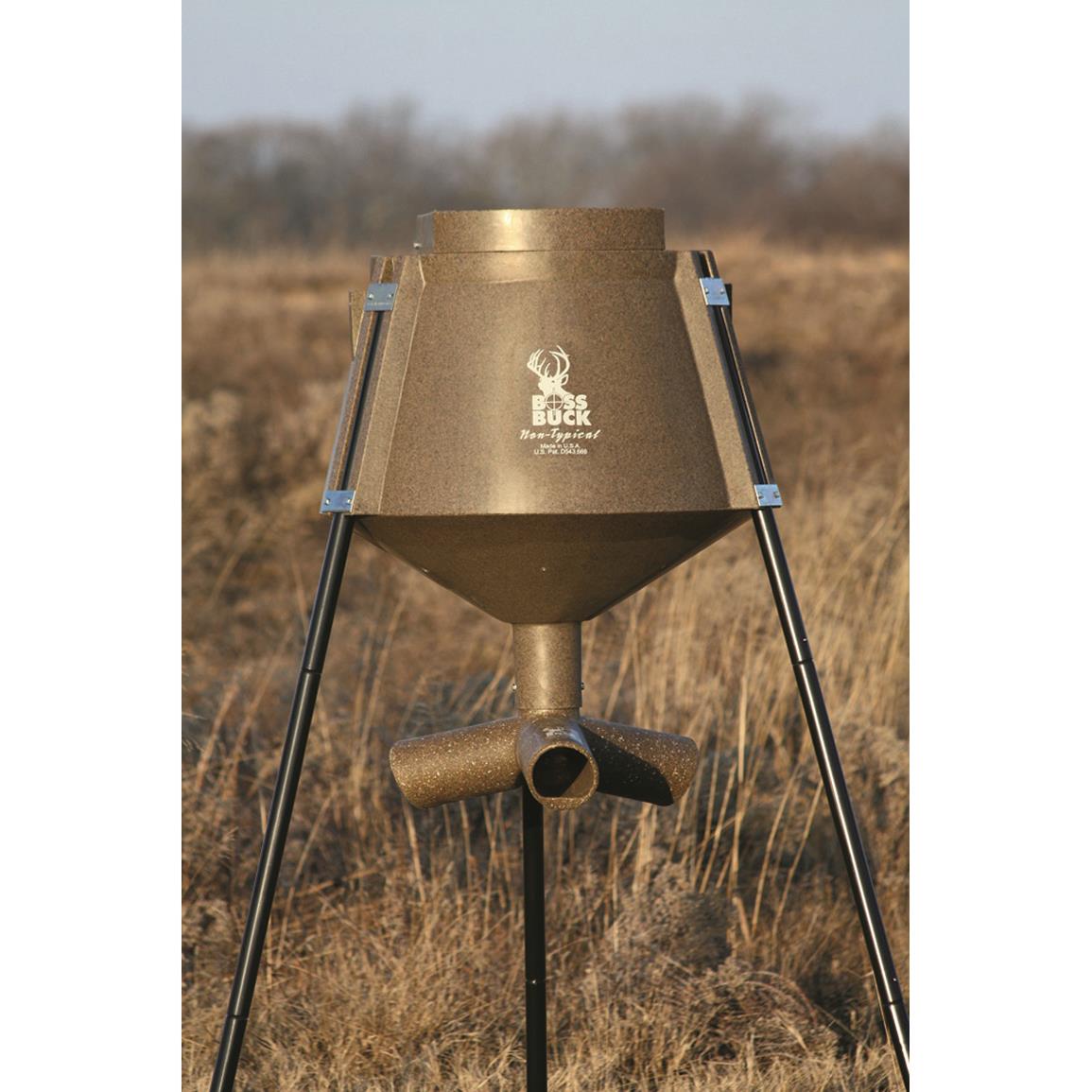
Moderate gravity example. Verify selected legs and protein head.
View Boss Buck 350 ↗Texas Hunter XPF600
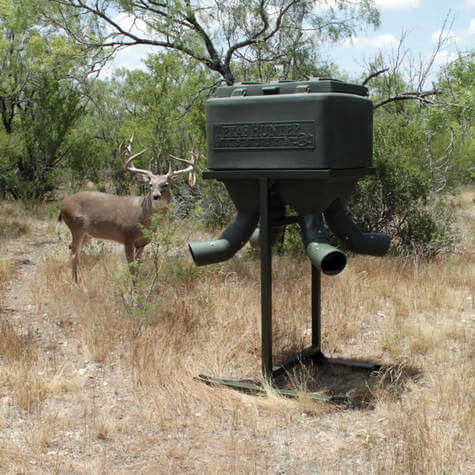
Larger gravity example. Assess filling access and delivery.
View Texas Hunter XPF600 ↗Timed protein alternatives
The All Seasons 600 exact Amazon offer is unconfirmed. This button opens search results, not the featured model.
Browse timed alternatives ↗Gravity or timed protein feeding: make the choice around the operating problem
Choose a gravity protein feeder when you want feed available through a passive delivery head and can manage the site, refill rate and access conditions. Consider a timed protein feeder when controlling dispensing events is a specific requirement and you can maintain its power and dispensing equipment. Neither mechanism, by itself, proves lower feed waste, healthier deer, larger antlers or lower operating cost. Those outcomes require evidence beyond the product category.
The question is not whether gravity is old-fashioned or a timer is advanced. It is what you need the equipment to do at your property. A timer can schedule an event without ensuring that the intended animals receive the feed. A gravity hopper can have ample feed inside while a poorly flowing outlet leaves an access point empty. Comparing mechanisms is useful only when storage, delivery and field observations are considered together.
This guide separates three decisions that often get mixed up: how much feed to store, when feed should be dispensed, and who can reach it. Capacity addresses the first. A dispensing mechanism influences the second. Port design, location, barriers where appropriate, and animal behavior affect the third. Buying one feature does not settle the other two questions.
Our recommendation is to write down the operating constraint before selecting a model. If you cannot visit frequently, confirm usable capacity and service access. If continuous access is the problem, examine a purpose-built timed protein system. If unwanted animals are consuming feed, identify the actual access route before assuming that a timer will solve it.
How gravity protein feeders work
In a gravity feeder, feed moves from the hopper toward an accessible feeding point without a scheduled powered dispensing event. The exact arrangement varies: a product may use tubes, a feed head or another passive outlet. The useful feature is the absence of a motor-driven schedule in that delivery path. It does not mean that every gravity feeder is identical, permanently free-flowing or maintenance-free.
The hopper and outlet should be assessed as a system. Feed must be suitable for the design, the delivery components must be installed correctly, and the opening needs the adjustment described in the manual. A setting that works with one pellet can behave differently with another. Check the exact product instructions rather than borrowing an adjustment from a photograph of a different feeder.
For the owner, the main operating task is to maintain an appropriate supply and inspect delivery. The absence of a timer removes timer programming from the routine, but it does not remove the need to check the lid, supports, outlet condition and actual disappearance of feed. The practical benefit is simpler delivery equipment, not freedom from all field work.
Gravity makes sense when your objective and local rules permit ongoing access and when the site can be monitored. It deserves more scrutiny when the feeder will be unattended for long intervals, the feed has not been tested in that mechanism, or unwanted animals can reach the outlets freely. Those conditions can matter more than the brand name on the hopper.
How a timed protein feeder differs from a corn spinner
A timed protein feeder is designed to dispense suitable protein feed according to programmed events. Do not assume that every corn spinner can handle the same pellets or provide the same presentation. The intended feed, motor assembly, delivery path and receiving area all matter. Confirm protein compatibility for the exact system before treating a timer upgrade as a complete conversion.
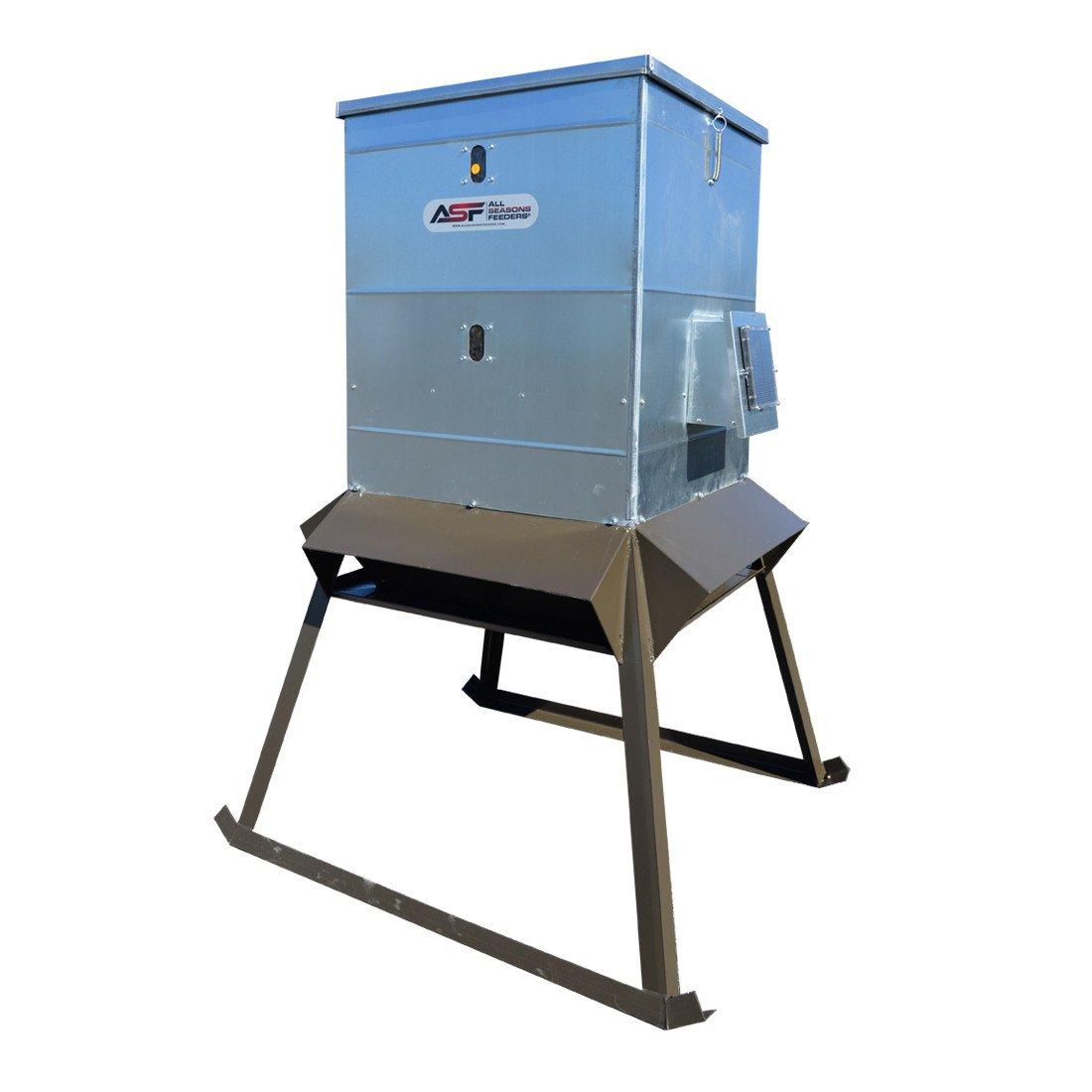
The All Seasons 600 Electric Protein Stand & Fill is one named example of a timed tray arrangement. Its manufacturer identifies a feed tray, an adjustable control system and included power components. That describes a particular product design, not a universal specification for all timed feeders. A different model may distribute feed differently or require additional components.
A timer controls the timing and duration of an event; it does not independently measure the amount animals consume. To understand pounds delivered, measure output under the approved procedure with the actual feed and settings. To understand pounds consumed by the intended animals, additional observation is needed. These quantities should remain separate in your records.
Before buying, ask whether the timed system addresses your specific problem. If the real difficulty is loading a high opening, a different fill arrangement may matter more than the timer. If the problem is inconsistent access to the property, capacity and maintainability still deserve attention. Paying for timing controls is useful only when you have a reason to use them.
Quick decision: three common property situations
For a frequently visited property where a passive protein station meets the management objective, a gravity feeder is a reasonable category to investigate first. You can observe flow, measure top-ups and adjust the operating routine without also learning a powered schedule. This is a starting point for comparison, not a recommendation to feed wildlife where local restrictions prohibit it.
For a site where continuous feed availability is specifically undesirable, a purpose-built timed protein system deserves consideration. Write down what you want to change: dispensing windows, the amount delivered per event or the form in which feed is presented. If you cannot describe the desired change, the extra controls may add work without solving a demonstrated problem.
For a distant site with substantial unwanted-animal use, start with evidence rather than a purchase. Inspect which animals arrive, how they gain access and whether feed remains outside the protected storage area. A timed tray can still hold accessible feed between events. A gravity outlet can still be interfered with. Neither category should be advertised as an automatic exclusion system.
When the situation combines all three concerns, rank them. A feeder that optimizes one minor preference while failing the main access or service requirement is not a good fit. Use the comparison matrix as a shortlist tool, then inspect the exact model and installation requirements before opening a buying link.
Pros and cons of gravity protein feeders
The main advantage is a relatively simple delivery concept. A passive gravity arrangement does not require a timed motor event to present feed. For someone who wants continuous access and can inspect the station regularly, that can make the operating routine easier to understand. It also avoids assigning a programmed time to every feed delivery.
Another practical advantage is that the system can be evaluated through direct observation and weighed top-ups. You can check whether feed reaches each outlet and track how much disappears over an interval. This does not make gravity uniquely measurable; it simply describes a useful way to operate it without relying on a timer's run-time estimate.
The limitation is that availability does not equal controlled consumption. If animals can reach the feed, the amount disappearing may exceed expectations. Adjusting an outlet is not the same as assigning each animal a ration. A buyer seeking a tightly limited daily dispensing amount should examine whether the chosen gravity design can meet that objective at all.
Other drawbacks can include inconvenient filling, difficulty servicing a loaded hopper, or outlet problems with unsuitable feed. These are model and site questions rather than proof against the entire category. Evaluate the specific system and avoid replacing a practical inspection with broad labels such as weatherproof, maintenance-free or unlimited access.
Pros and cons of timed protein feeders
The strongest reason to choose a timed system is intentional control over dispensing events. If the equipment supports your feed and the required settings, you can define when the mechanism runs and calibrate how much it releases under those conditions. That can be valuable when continuous delivery does not match your operating objective.
The trade-off is additional equipment and additional checks. Power, wiring, controls and the dispensing mechanism become part of the maintenance routine. A product may include some components and require others separately. Confirm the contents of the exact offer and plan who will inspect the system when it does not operate as expected.
Timed delivery does not prove that all dispensed feed is consumed promptly or by the intended animals. Feed can remain in the receiving area after an event. Changing the schedule may change the observation pattern without reducing total loss. Measure the outcome you care about rather than treating a shorter timer setting as evidence of savings.
A timed feeder is also not automatically a remote-control feeder. A local programmable timer, a Bluetooth connection and a cellular system have different requirements. Do not pay for a feature based on a generic description of smart feeding. Verify the exact model's controls, connection method and any service requirements before deciding that it will reduce trips.
Model review: Boss Buck 350 protein gravity configuration
The Boss Buck 350 gives this comparison a concrete gravity example. The manufacturer distinguishes approximately 350 pounds of corn from approximately 300 pounds of large protein pellets and offers different configurations. Those distinctions matter at checkout: the protein gravity arrangement is not interchangeable with every automatic option using the same hopper family. The full range is compared in our Boss Buck feeders hub.
Our assessment is that this size class is worth comparing when a measured refill plan supports a moderate pellet supply and you want passive delivery. The advantage is not an abstract claim that three hundred pounds is perfect. It is that the feed-specific specification gives you a more useful starting point than a model name alone.
The drawback to resolve is fit with your own feed and installation. A verified owner on the Tractor Supply All-In listing reported about 250 pounds of sweet-feed pellets. That single account is a reminder to measure the selected feed; it is not a universal correction to the manufacturer's specification or a controlled test of all versions.
Before ordering, confirm the delivery head, legs, service access and complete delivered cost. The linked Amazon listing identifies the 350-pound protein gravity model, but availability and selected options can change. Read the actual offer rather than assuming that every photo or marketplace variation represents the configuration discussed here.
Model review: Texas Hunter XPF600 gravity feeder
The XPF600 is a larger gravity example with four manufacturer-specified feeding stations and adjustable flow baffles. It is useful in this comparison because it shows that choosing gravity does not necessarily mean choosing a small portable container. Larger capacity brings different filling, transport and service considerations.
A first-person Hunting Gear Deals review by Camron Stover describes using the feeder on a lease and discusses difficult filling access, bulk and shipping cost. Those are useful ownership considerations, but they are not a controlled comparison with a timed feeder. The review also contains inconsistent port-count wording; the manufacturer's four-port specification is the reference used here.
Our buying interpretation is to assess the route from delivery to installation and from the feed bag to the fill opening before deciding whether the larger system is convenient. A feeder can reduce the frequency of loading while making each loading session more demanding. That balance is specific to your access and equipment.
Do not turn a favorable owner experience into a guarantee against moisture, interference or damage. The useful questions are what the reviewer observed, which exact product was involved and whether your circumstances resemble the reported setting. We have not personally assembled or weighed this feeder, and this section is sourced buying analysis rather than a firsthand test.
Model review: All Seasons 600 Electric Protein Stand & Fill
The All Seasons product provides a clear timed comparison: its manufacturer describes a tray-based protein system with up to six daily events and included twelve-volt power components. The same page warns that feed capacity is based on corn and may be lower with protein. A six-hundred-pound label therefore does not settle usable pellet capacity.
The potential advantage is the combination of scheduled dispensing and the product's loading format. Buyers who need those two features together should examine the official demonstration and installation information. The presence of a timer is not, on its own, evidence that the product will use less feed than every gravity arrangement.
The main limitations are the need to maintain powered equipment, verify actual delivery and account for feed remaining in the tray. We have not established an independent exact-model comparison that measures long-term waste against the gravity feeders in this article. There is no justified percentage-saving claim to attach to the purchase button.
An exact Amazon US offer for this model has not been confirmed in this review. The alternatives link is therefore labeled as a search, not disguised as a direct offer. If Amazon availability is essential, compare the actual model, feed compatibility and included components in the results. Do not substitute a different All Seasons accessory merely because the brand name matches.
What real-life evidence can establish
Manufacturer documentation is the best starting point for identifying the model, specified features and intended configuration. It can tell you what the product is designed to include, but promotional statements are not independent measurements of performance on your property. An official demonstration is valuable for understanding the mechanism while still being a manufacturer-produced source.
An owner report can reveal a problem a specification table does not emphasize: difficult filling, a particular pellet load or an awkward installation detail. It can also omit crucial context. Treat a single report as an observation that suggests questions, not as a representative failure rate. Check model and version before carrying the lesson into another product family.
A comparative claim needs more evidence than two separate positive reviews. To say one system saves feed, you need reasonably comparable feed, observation intervals, starting loads, access conditions and a defined measure of loss. Otherwise differences may reflect the property, the animals, the weather or a change in management rather than the mechanism.
This article does not invent a head-to-head field trial. Its model notes combine named specifications with limited attributed experiences and original decision analysis. Where exact-model evidence is missing, the gap stays visible. That is more useful for purchasing than assigning numerical scores that imply testing which never happened.
Does timed feeding really save money?
It can change how feed is dispensed, but savings must be measured. Start by defining the comparison. Are you comparing total feed purchased, feed delivered, feed remaining outside the hopper, dedicated service trips, or the cost of replacing damaged components? These are different outcomes and can move in different directions.
Suppose a timed system delivers less feed than a previous gravity arrangement. That may reduce purchased pounds, but it does not by itself prove that the intended feeding objective was maintained. Conversely, a system using more pounds is not automatically inefficient if it serves more appropriate access points. State what outcome the operation is intended to achieve.
Use actual costs when evaluating a purchase. Include the equipment difference, required power components, installation, delivery and additional service. Compare those with measured changes in recurring costs over a stated period. A low purchase price can be outweighed by difficult servicing, while a higher price needs a specific benefit rather than a general claim of advanced technology.
The decision should remain reversible where practical. A small monitored trial or a properly specified conversion may provide useful evidence before a larger commitment. Confirm that any conversion is supported by the manufacturer. Do not improvise a change to the delivery system merely to create a cheap comparison.
A transparent feed-loss example
Consider an invented ninety-day period with 1,800 pounds of feed purchased. At an assumed thirty cents per pound, the feed cost is 540 dollars. If a measured problem accounts for ten percent of that weight, the affected amount is 180 pounds and its feed value is 54 dollars. These figures explain the arithmetic; they are not a typical loss rate or a current price.
If a proposed upgrade costs four hundred dollars more, a fifty-four-dollar feed saving over one period does not recover the difference immediately. There may be other benefits, such as access or labor, but they should be counted explicitly. Repeating the same example over future periods assumes conditions remain comparable, which may not be true.
Now change the assumed price or the measured affected weight and the result changes. This is why a calculator should accept your inputs instead of displaying a single attractive savings percentage. The most useful output is often a range that shows which uncertain input drives the decision.
Do not assume all missing feed is waste. Some may have reached the intended animals, some may have been eaten by other animals, and some may have been spilled, removed or spoiled. Use observations to separate those categories as far as practical. When the split remains unknown, call it disappearance rather than pretending the entire amount has been classified.
Capacity and timing must be calculated separately
The hopper's usable pellet load determines the available supply. The operating mechanism influences how that supply reaches the access area. Neither number can replace the other. A very large timed hopper can still run out sooner than expected if the output setting is high, and a gravity system can retain feed while its outlet is not delivering properly.
For a simple refill estimate, divide usable pounds by measured daily disappearance. If you choose a reserve, subtract it before dividing. A 300-pound measured fill with a ten-percent reserve leaves 270 pounds. At fifteen pounds per day, the planned interval is eighteen days. This is arithmetic, not a recommended intake or an inspection schedule.
For a timed feeder, measured daily output can be estimated from the weight released by comparable test cycles and the number of scheduled events, where the manual permits that method. Keep the settings and feed consistent during measurement. Recheck when feed, equipment or settings change rather than assuming the original calibration remains exact.
For a gravity feeder, weighed top-ups over a known interval provide a practical measure of disappearance. Record other additions or removals so the calculation remains traceable. The dedicated capacity article provides a refill calculator, but the principle applies to both categories: use measured inputs and make uncertainty visible.
Setting up a fair comparison on your property
Start with a written question. For example: will a timed delivery arrangement reduce feed remaining exposed after a dispensing period while maintaining the access objective? That question is more testable than asking which feeder is best. Define what you will observe, how frequently you will observe it and what would count as an improvement.
Keep a baseline record before changing equipment. Record feed added, feed remaining, dates, settings where applicable and unusual events. A before-and-after comparison is already vulnerable to changing conditions; without a baseline it becomes little more than an impression. Do not reconstruct the earlier record from memory after the new feeder arrives.
Change as few relevant variables at once as practical. Moving the station, changing feed and changing the mechanism together makes the result difficult to interpret. If several changes are unavoidable, record them and avoid assigning the entire outcome to the timer or gravity head.
At the end of the observation period, compare the same measurements rather than selecting whichever result looks favorable. A reduction in feed purchased is useful only when you also understand remaining inventory and the operating objective. Keep the negative observations as well as the positive ones, because they identify the next adjustment or a reason not to expand the setup.
A field log that works for both systems
Use one row per visit and identify the station clearly. Record the date, feed type, pounds present before loading, pounds added and any feed removed for cleaning or transfer. For timed equipment, add the current schedule and output setting. For gravity equipment, record relevant approved outlet adjustments. This creates an operating history rather than a collection of disconnected photographs.
Calculate disappearance between visits using the earlier remaining weight plus additions minus the later remaining weight, with documented removals handled separately. Divide by the number of days. If the result is implausible or negative, check missing entries before using it to size the next load.
Observations should describe what you actually saw. “Raccoon visible at outlet after dark” is different from “raccoons ate all missing feed.” “Tray still held pellets at morning inspection” is different from “timer overfeeds.” Clear descriptions allow later interpretation without overstating what the evidence proves.
Export or copy the log somewhere durable. A browser-only notebook can be useful, but clearing site data or changing devices may remove local records. A printable sheet or spreadsheet is a sensible companion when the information will be used to compare seasons, justify purchases or coordinate several people servicing the property.
Unwanted animals: identify the access route
The useful first question is how the animal reaches the feed. An animal may use the intended port, interfere with a component, consume feed on the ground or reach material remaining in a tray. Those situations call for different assessments. The presence of a timer does not establish that feed becomes inaccessible immediately after the motor stops.
Inspect physical evidence and camera observations without assuming that every mark identifies the same animal. Record the time and location of observed activity, the condition of the feeder and whether feed is present outside the intended area. Avoid declaring a product pest-proof based on one favorable photograph.
Consider manufacturer-approved guards, installation requirements and site management where applicable. Do not copy improvised electrical, chemical or structural modifications from an online comment. A reviewer can describe an experience without providing a safe or appropriate modification for your circumstances.
If unwanted use is the main cost driver, compare its measured effect before and after any change. Moving from gravity to timed delivery may help a particular operating plan, do little, or create a different pattern of accessible feed. The result belongs in the field record, not in a universal claim about either mechanism.
Moisture, feed condition and inspection frequency
The amount stored and the condition of the feed are separate issues. A calculator may show several weeks of supply while a damaged lid or delivery problem requires attention immediately. Inspect according to the product and feed guidance and the conditions at the site. Do not use a large hopper as permission to ignore the station.
Check the components that protect stored feed and the areas where feed is presented. A gravity port and a timed tray expose feed differently, but the exact design and installation matter. A drainage feature or protective cover is a design element, not proof that feed will remain suitable under every weather condition.
Record whether a problem affects the stored supply, the outlet or material already dispensed. This distinction helps identify what needs attention. Replacing the entire feeder category may be unnecessary if the actual issue is an installation problem or an unsuitable operating procedure.
Follow feed-supplier guidance for storage and handling rather than relying on a general online promise about how long pellets last outdoors. If feed condition is questionable, a capacity calculation cannot resolve that question. Maintain the distinction between an arithmetic refill date and a judgment about whether the material remains appropriate to use.
Filling access and physical handling
Before ordering, work through a complete fill visit. Where does the vehicle stop? How is feed moved from storage to the hopper? How is the opening reached using an appropriate method? Which components need to be checked before leaving? A product that looks simple in a photograph can be awkward when those steps are considered together.
Do not adopt an unsafe climbing arrangement because a reviewer used it. Manufacturer instructions, suitable equipment and the actual terrain should guide the process. A first-person account is useful for revealing a difficult fill height, not for approving every technique shown or described.
Compare the weight handled per visit as well as the interval between visits. A larger feeder may reduce the number of fills while increasing the amount carried during each one. A smaller feeder can be easier to load but may require more travel. Write down which part of that trade-off is the real constraint.
Access can also change with weather or property operations. A location reachable during installation may become difficult later. Plan for realistic service conditions, including how you would inspect or empty the system if a problem occurred. This planning applies equally to gravity and timed equipment.
Installation, relocation and the cost of changing your mind
Permanent and relocatable arrangements have different advantages. A fixed installation may suit a known long-term station, while a movable system can help when the site is still being evaluated. Relocation should follow the manufacturer's procedure and usually requires planning around the loaded weight and attached components.
Separate reusable purchases from site-specific work. Some support materials, delivery arrangements or access improvements may not transfer easily to a new location. Knowing that before installation makes a staged trial easier to evaluate. It also prevents the feeder's advertised price from being mistaken for the entire cost of the decision.
For a conversion between delivery types, confirm compatibility using the exact model and version. Similar-looking hoppers do not prove that all heads, timers or motors are interchangeable. Ask what remains covered by the manufacturer's guidance and what additional components are required.
If the installation is a first attempt, define a review point. Decide which observations would justify keeping it, moving it or changing the mechanism. A planned review reduces the temptation to defend the initial purchase regardless of what the field record shows.
Buying through Amazon without ordering the wrong configuration
Use the product name and configuration as the starting point, not merely the first photograph. Verify whether the offer includes the complete feeder, the correct delivery head and the supports required for installation. A replacement part can be relevant to the same search without being a substitute for the full system.
Check selected variations immediately before purchase. A listing may offer different capacities or delivery systems under a related product family. The article's analysis does not automatically apply to every option visible on that page. Confirm that the capacity and feed type in your notes match the actual selection.
Read delivery terms and included components before comparing totals. Freight, assembly requirements and missing accessories can change the practical cost. We do not display a manually copied Amazon price or claim that a product is currently in stock; the current offer is the place to verify those details.
Our direct model links carry the site's supplied Amazon tracking tag. Where an exact model is not confirmed, the button says that it opens alternatives. Source citations to manufacturers and retailers are retained for evidence and are not presented as commission-earning purchase buttons.
How to use the videos in this guide
The Texas Hunter video is an official demonstration of the gravity feed-flow concept. Use it to inspect the arrangement and identify questions for the exact model's documentation. It does not provide an independent comparison of feed losses or prove that the same pellets will flow identically in your installation.
The All Seasons video is associated with the manufacturer's electric protein product page. Its purpose here is to show the timed tray format. It should not be described as an unsponsored owner test or used to infer a season-long failure rate. Playback availability can depend on the video platform and the viewer's browser.
Watch with a short checklist: identify the model, distinguish storage from the delivery area, observe which components need power, and note what is not demonstrated. If the video does not show a measured quantity or elapsed time, do not invent a pounds-per-day result from it.
Original-source links remain next to the players. If an embed is unavailable, the source and its limitations are still clear. The article should remain useful without video because the central decision, evidence and calculations are also explained in text and tables.
Frequently asked questions: operating choices
Can a timed feeder guarantee that deer arrive in daylight? No guarantee is established by this guide. A programmed event and an animal's behavior are different things. Evaluate camera observations and local conditions without treating the schedule as control over wildlife.
Is gravity always better for protein pellets? Not as a universal rule. The exact equipment must be intended for the selected feed, and the operating objective matters. Compare compatible gravity and purpose-built timed systems rather than assuming that any device labeled feeder is suitable.
Does a solar panel eliminate battery checks? It does not eliminate the need to follow the system's power and maintenance guidance. Verify the components and their operation rather than assuming that the presence of a panel proves reliable power under all conditions.
Can I use the same refill calculation for both categories? Yes, if the inputs represent the relevant measured supply and disappearance. The arithmetic does not remove the need to inspect the different delivery mechanisms or distinguish feed delivered from feed consumed.
Frequently asked questions: costs and evidence
Which system is cheaper over a season? Calculate the complete cost for your actual setup. Feed use, dedicated trips, installation and service can outweigh a small difference in purchase price. Without those inputs, a universal cheapest-category claim is not justified.
Should one negative review disqualify a product? A specific, credible report deserves attention, especially when it concerns your intended use. It does not automatically establish how often the issue occurs. Look for model identification, context and other independent evidence before reaching a broad conclusion.
Can a manufacturer video replace the manual? No. A demonstration can clarify the arrangement, but installation, operating limits and maintenance should follow the exact product instructions. Videos can omit steps or show a related configuration.
What if the exact feeder is not on Amazon? Keep the evidence-based comparison, clearly identify any alternatives, and do not link an unrelated product as though it were the same model. A useful affiliate article should help the reader avoid a mistaken purchase.
A purchase decision you can explain
Write one sentence describing why the chosen mechanism fits the site. A good example is that a documented dispensing requirement justifies a timed protein system and the owner can maintain its power and delivery components. Another is that continuous access meets the objective and a gravity configuration offers a manageable inspection routine. Both require confirmation of local rules and exact-model suitability.
Add the evidence supporting that sentence: measured use, confirmed capacity, realistic access, included components and the limitations you are accepting. If the decision depends mainly on a claimed saving that nobody measured, the next step is more observation rather than a stronger purchase button.
Use the first operating period to test your assumptions. Keep the record, inspect the equipment and compare actual results with the plan. A useful review is willing to revise the recommendation when the observations change. That is more valuable than declaring a permanent winner between two broad categories.
The practical winner is the complete system you can operate correctly and evaluate honestly. Gravity and timed feeding offer different controls, but neither removes the need for suitable feed, legal placement, reliable installation and a repeatable service routine.
See the delivery mechanisms
Players load only when selected. Use the source descriptions to distinguish a demonstration from an independent test.
Texas Hunter gravity feed flow
Official product-family demonstration linked by Texas Hunter. Shows the gravity concept, not an independent pellet-capacity or durability test.
Open the original video ↗All Seasons electric protein feeder
Manufacturer-linked electric protein presentation. Not an independent field comparison. YouTube playback was unavailable to verify during this update; the source link is retained.
Open the original video ↗Evidence matrix
| Source type | Useful evidence | Limit |
|---|---|---|
| Manufacturer documentation | Named model, capacity basis, delivery configuration. | Specifications and promotional claims are not independent field results. |
| Boss Buck All-In owner reviews (Tractor Supply) | Model-specific user observations about feed fit and operation. | Individual reports; feed and product versions can differ. Some entries carry incentive labels. |
| Camron Stover: XPF600 review | First-person ownership discussion, including filling and transport. | Affiliate-funded publication; not a controlled comparison. Use manufacturer specifications to resolve conflicting port counts. |
| Calculators in this guide | Transparent arithmetic using stated inputs. | Not a prediction of wildlife behavior, feed condition or equipment reliability. |
What would a measured reduction be worth?
Enter a planning-period feed weight, your actual price, and an assumed reduction to explore. This does not establish that a timed feeder will achieve that reduction.
180.0 lb at the entered price. A $400.00 difference equals 7.4 comparable periods of this assumed saving, before other costs.
No automatic savings claim. Include power, maintenance, delivery and labor separately.
Sources and review method
- Boss Buck 350 manufacturer specifications
- Texas Hunter XPF600 manufacturer specifications
- All Seasons 600 Electric Protein specifications and official video
- Tractor Supply Boss Buck All-In owner accounts
- Hunting Gear Deals XPF600 first-person review
Checked October 16, 2026. Features are attributed to their manufacturers; owner experiences are individual reports. Our scenarios and calculations are original illustrative analysis. No firsthand testing, numerical product rating, live stock or account-level commission verification is claimed.
Continue with the protein capacity calculator and full protein feeder buying guide.
Products mentioned in this guide
Boss Buck 350 lb Gravity Protein Feeder
Check Price on Amazon →Confirm price and availability on Amazon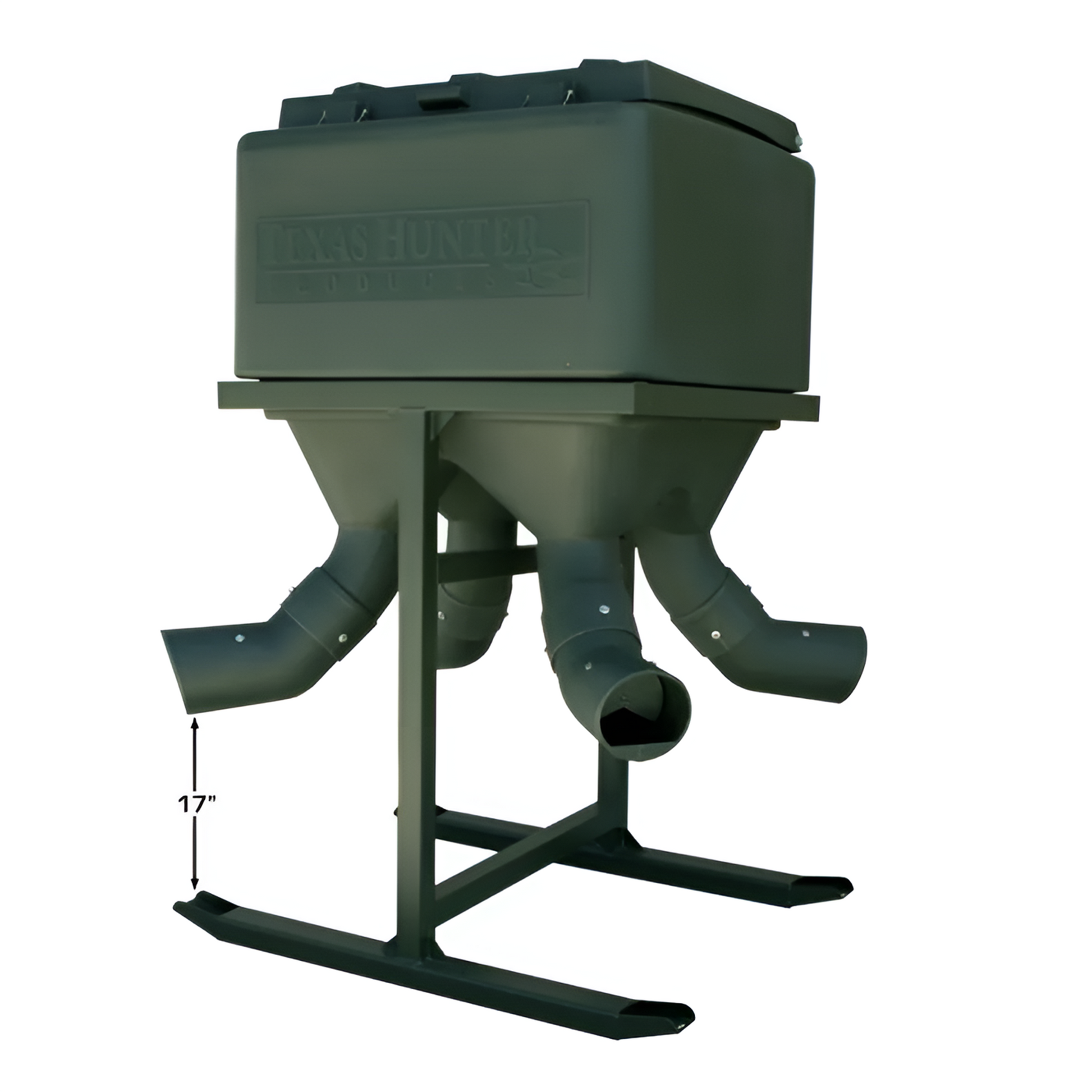
Texas Hunter Xtreme XPF600 Protein Feeder
Check Price on Amazon →Confirm price and availability on AmazonAs an Amazon Associate, we earn from qualifying purchases.


