
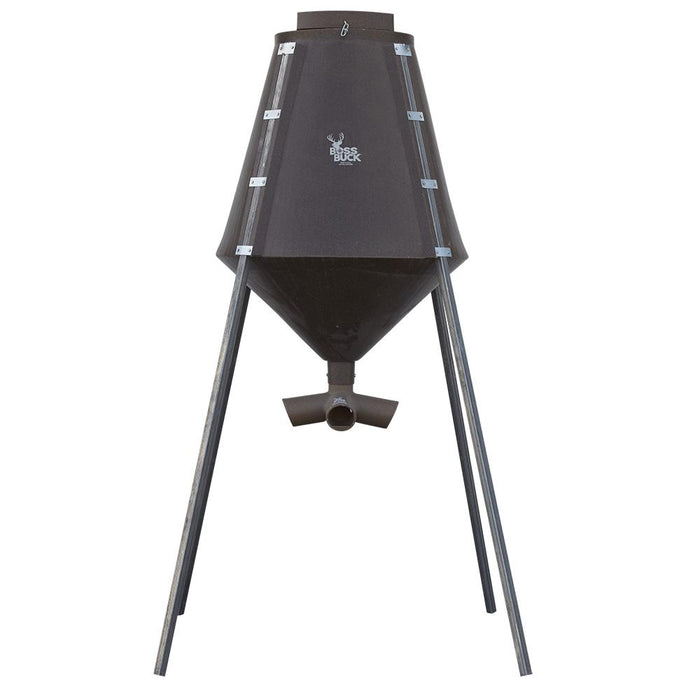
Protein Deer Feeder Capacity: Pellet Weight, Refill Math & Field Guide
Buy for the pellets.
Plan for the refill.
A hopper’s corn rating is only the starting point. Find the protein capacity, measure daily disappearance, and choose a refill interval you can actually maintain.
Calculate your refill interval ↓As an Amazon Associate I earn from qualifying purchases. Manufacturer figures are reference specifications, not our field-test results. Examples below are planning calculations, not recommended feeding rates.
How much protein feed will a deer feeder hold?
Use the manufacturer’s pellet-specific figure, not just the number in the model name. If none is provided, weigh how much of your own feed fits to the approved fill level. Pellet shape, size and packing density change the weight that occupies a hopper.
Three manufacturer examples below put the difference in practical terms. They do not establish a universal conversion for every feeder or every pellet. A “600 lb” feeder without a stated pellet capacity still needs verification; multiplying it by a standard percentage would be an assumption.
What fits?
Find the pellet weight the hopper can hold without exceeding the manufacturer’s fill or load limit.
What disappears?
Measure pounds leaving the hopper each day. That includes unwanted-animal use and loss, not just deer intake.
When can you return?
Size the useful supply around your next realistic service visit, with a reserve you choose.
Corn capacity versus protein capacity
These are approximate manufacturer figures for the named models and feed descriptions. Check the current configuration before purchasing. On a phone, swipe the table sideways.
| Feeder | Corn | Protein | 50 lb bag equivalent |
|---|---|---|---|
| Texas Hunter PF300Barrel protein model | 300 lb | 250 lb | 5 bags |
| Boss Buck 350Protein configuration | 350 lb | 300 lb large pellets | 6 bags |
| Boss Buck 1200Protein configuration | 1,200 lb | 1,000 lb large pellets | 20 bags |
Sources: Texas Hunter PF300 specifications; Boss Buck 350 specifications; Boss Buck 1200 specifications. Bag equivalents are arithmetic using 50 lb per bag, not a claim that every feed brand uses that bag size.
The Boss Buck 350 protein model is the middle row above. Check the selected feeder configuration, included legs, shipping and current availability on Amazon.
Amazon listing matched to the 350 lb protein gravity model. No current price, stock or seller claim is made here.Measure the feed you actually use
Record a known starting fill
Use the stated net bag weights, or weigh partial bags with a suitable scale. Record the feed brand, pellet type and total pounds loaded. Follow the feeder’s fill line and structural limits; do not compact feed or overfill it to match an advertised number.
A first fill need not be a full hopper. A measured partial load can establish whether the pellets move through the outlets and whether the site uses feed quickly enough to justify more storage.
Measure what leaves over time
After a recorded number of days, weigh the feed needed to return to the same marked fill level. If the level and feed are comparable, that top-up weight estimates disappearance during the interval.
For example, replacing 105 lb after seven days gives 15 lb/day. This is an invented example. It does not prove that deer ate all 105 lb: inspect for spilled pellets, other animals, moisture and blockages before interpreting the result.
Repeat the check under your actual conditions. Changes in animal visits, alternative food, weather or feed formulation can change the result. A trail camera helps identify visitors, but sightings alone do not measure pounds consumed. Keep dates and weights rather than relying on a visual guess of the hopper level.
Protein feeder refill calculator
Enter your actual pellet fill weight and measured daily disappearance. Reserve is the percentage of that starting load you want left when you return. It is a planning buffer, not a feeding recommendation.
270 lb usable before reaching a 30 lb reserve. The arithmetic empty-hopper estimate is 20.0 days.
Visit sooner if conditions change. This calculation cannot detect spoilage, blocked outlets or an empty feed port.
| Protein loaded | 10 lb/day | 20 lb/day | 30 lb/day |
|---|---|---|---|
| 250 lb | 22.5 days | 11.3 days | 7.5 days |
| 300 lb | 27 days | 13.5 days | 9 days |
| 1,000 lb | 90 days | 45 days | 30 days |
A calculated 90-day supply is not a recommendation to leave feed uninspected for 90 days. Inspection frequency and safe storage life are separate decisions.
Work backward from your next refill
Instead of starting with the biggest feeder you can afford, calculate how much usable feed you need between visits. Divide by the share of the load you plan to use before reaching your reserve.
15 lb/day for 14 days
210 lb must be available before reaching reserve. With a 10% reserve, the starting load needs to be about 233.3 lb.
A verified 250 lb pellet capacity clears this arithmetic threshold. That does not by itself establish suitable ports, durability, feed freshness or site access.
20 lb/day for 28 days
560 lb is needed before reserve. With a 10% reserve, plan for about 622.2 lb at the start.
A 600 lb corn rating does not establish that capacity. Find a confirmed pellet figure or measure the load before relying on the interval.
Round the required load upward when selecting a capacity, but do not confuse extra hopper space with a reason to fill it completely. Purchase access, lifting height, loading equipment and the time needed to inspect each station all affect whether a large feeder is practical.
A full hopper can still fail to deliver feed
Flow
Confirm that the selected feeder handles your pellet type. Inspect outlet flow after loading. Feed remaining above a blockage does not help an animal at an empty port.
Condition
Check the lid, seals, drainage and feed condition. Follow the feed supplier’s storage guidance. A refill estimate does not establish a shelf life or prove that damp feed remains suitable.
Access
Consider feeding-port height and the number of access points. More pounds stored do not necessarily give more animals simultaneous access to the feeder.
Gravity systems allow access while feed reaches the ports. Timed systems control dispensing events, but run seconds alone do not tell you the pounds delivered. Measure output for the exact equipment and feed before using it in a budget. For the delivery-system comparison, read gravity versus timed protein feeders.
Five checks worth making before checkout
- Exact configuration: verify that the listing includes the protein delivery system you want, not a spinner conversion or replacement part.
- Pellet capacity: find a stated figure for the feed type, or plan to measure it. Do not substitute the corn rating.
- Refill access: check lid height, loading method, vehicle access and whether freight delivery is suitable for the property.
- Parts and maintenance: identify the parts that control flow and how to inspect and clean them according to the manual.
- Total cost: compare the feeder, delivery, setup and repeat feed purchases. Check live price and availability on Amazon instead of relying on an old comparison-table price.
This page helps you choose capacity. For the broader trade-offs between specific models, use the protein deer feeder buying guide.
A capacity rating is a purchasing clue, not a service schedule
There are three different quantities behind the word capacity. The first is the manufacturer's advertised maximum. The second is the amount of your selected feed that fits within the approved fill limit. The third is the amount you can use before your next planned visit while preserving a reserve. A useful buying decision keeps those quantities separate. Calling all three “300 pounds” hides the uncertainty rather than removing it.
Imagine two landowners buying the same hopper. One uses a dense pellet and loads close to the maker's published example. The other uses a different formulation and reaches the fill level earlier. Neither observation, by itself, establishes a defective feeder or an inaccurate scale. They first need to compare the exact feed, loading procedure and configuration. The practical answer is to record the actual weight, not force the second load to match the first.
Usable capacity also depends on your operating decision. If you choose to return while thirty pounds remain, those pounds are deliberately unavailable for extending the visit interval. They are not necessarily wasted. That reserve gives you room for an unexpectedly busy period or a delayed service trip, but it cannot protect against every failure. An outlet blockage can stop delivery even with most of the load still inside.
Before comparing two prices, write the three quantities on a single card: advertised capacity, confirmed pellet load, and usable load before reserve. Leave a blank where the answer is unknown. An honest blank is more useful than an attractive number copied from another model, because it identifies the question you need answered before buying.
Evidence review: what a real purchaser's capacity report tells us
On the Tractor Supply listing for the Boss Buck 350 All-In gravity model, a verified product owner reports fitting about 250 pounds of sweet-feed pellets. That is an individual observation for a particular feed, not a replacement specification for every Boss Buck 350. The report illustrates why measuring your own load matters. The manufacturer's large-pellet figure and that owner's result describe different evidence.
Read the linked owner account alongside the product configuration, rather than extracting one sentence as a brand-wide verdict. Retailer pages can include different leg options, revisions or related products. A review that discusses a particular pellet or installation may be highly useful to a buyer with the same conditions and less useful to someone using a different feed. The evidence question is not merely whether the review is positive.
For capacity planning, ask whether the reviewer names the feed, gives a weight, describes how it was measured and identifies the actual feeder. Those details are more useful than a star score. A photograph of a full hopper may show the fill level, but it does not establish the weight inside. A claim that a feeder lasts “all month” is incomplete without starting load and daily disappearance.
Our buying interpretation is straightforward: use manufacturer figures to screen products, then use your own measured fill to operate the chosen feeder. A single lower-capacity report is a reason to leave planning room and ask questions. It is not enough to calculate a failure rate, accuse a manufacturer of misleading every buyer, or assume the same reduction applies to another hopper.
Review the complete delivery system, not just the container
A hopper with enough volume can still be the wrong purchase if its delivery system does not suit the feed. Check whether the selected listing is a complete protein feeder, a corn spinner, a gravity conversion, a replacement head or a hopper without the necessary support. Marketplace titles can place those products close together, even though they solve different problems. Read the included-components list before looking at the checkout total.
Ask how the feed moves from storage to the accessible outlet. A gravity feeder needs suitable flow through its opening and delivery head. A timed feeder needs an appropriate dispensing mechanism and a tested output setting. Do not transfer a run-time recommendation from a different feeder simply because both use a timer. Seconds describe operating time; they do not independently describe pounds.
Consider how you will inspect the mechanism after filling. Can the relevant area be reached without standing under an unsecured component? Can you observe delivery while following the manual's safety instructions? Can the feeder be emptied or serviced using the approved procedure? These questions belong in the capacity decision because a larger load makes an awkward service procedure more consequential.
The useful comparison is therefore not “which box holds more?” It is “which complete system can I fill, inspect, operate and service at this location?” A smaller unit with a manageable inspection routine may offer a better fit than a larger one that is difficult to reach. That is a practical judgment about your circumstances, not a universal ranking of brands.
A repeatable top-up record
Choose a feeder identifier before the first measurement. A short label such as East Gate or Station Two prevents records from different locations being mixed. Record the visit date, feed type, pounds present before loading, pounds added, and anything unusual about the outlet or ground. If the remaining weight is an estimate rather than a measurement, mark it as an estimate so later calculations do not imply false precision.
For two consecutive visits, disappearance equals the earlier remaining weight plus the feed added at that visit, minus the weight remaining at the later visit. Divide by the elapsed days. If there were additional loads between visits, include them. If you removed spoiled material or transferred feed to another station, record that separately; otherwise the arithmetic may incorrectly classify removal as animal use.
For an invented example, the first visit records twenty pounds remaining and eighty pounds added. Ten days later, forty pounds remain. The starting supply was one hundred pounds, sixty pounds disappeared, and the interval average was six pounds per day. Adding another bag at the second visit does not change what happened during the preceding ten days.
If the calculation produces a negative result, stop and check the records. Possible causes include an unrecorded top-up, inconsistent units, an incorrect date or an inaccurate remaining-weight estimate. Do not silently replace a negative number with zero and continue using the schedule. A planning tool is only helpful if unusual results remain visible.
After several intervals, retain the individual rates as well as an average. A single average can conceal a sudden increase. Your next visit should reflect the conditions you expect, not simply the largest amount of historical data available. Describe any chosen planning rate as your assumption and revisit it when the field record changes.
Planning for variable use without pretending to predict wildlife
Suppose a measured load is 300 pounds and you reserve ten percent. That leaves 270 pounds for the planned interval. At ten pounds per day, the arithmetic gives twenty-seven days. At fifteen pounds per day, it gives eighteen days. At twenty pounds per day, it gives thirteen and a half days. The feeder did not change; the daily-use assumption changed the answer.
This is why a useful estimate includes a range. You might label ten pounds as a quieter observed interval and twenty pounds as a busier observed interval, if those labels are supported by your own log. Do not present the range as a probability forecast. It is a sensitivity check showing what happens when the input changes.
Use the shorter interval when the consequence of arriving too late is unacceptable, but remember that a conservative refill estimate still does not set an inspection schedule. If severe weather, animal interference or an equipment problem is possible, an additional inspection may be needed even while the hopper is mostly full. Feed quantity and equipment condition are different questions.
Avoid estimating daily use solely from acreage or the number of deer seen in one camera image. Those observations may help describe the property, but they do not provide a calibrated weight measurement. Repeated visits, competing food sources and animals outside the camera's field of view complicate the picture. The weighed top-up method gives the calculation a clearer starting point.
Bag counts, partial bags and loading limits
Bag arithmetic is simple only when the bag weight is explicit. Six bags of fifty pounds provide three hundred pounds. Six bags of forty pounds provide two hundred forty pounds. A shopping list that says “six bags” without a weight is therefore not a capacity plan. Record the net weight on the package, and use pounds consistently throughout the calculator and field log.
Partial bags deserve the same attention as full ones. If you estimate a half bag by eye, label that number as estimated. A suitable scale gives a more repeatable result, provided you account for the empty container when weighing. Do not assume an open bag weighs its original labeled amount after some feed has already been used elsewhere.
Buying a rounded number of bags does not require loading every bag immediately. If the planned starting load is about 234 pounds and bags contain fifty pounds, buying five bags provides 250 pounds. You can retain the unused portion under the feed supplier's storage instructions. You should not overfill the feeder simply to avoid storing a partial bag.
Keep a loading record that separates feed purchased from feed loaded. Purchased weight is useful for the budget; loaded weight is the input to a refill calculation. Mixing those columns makes the feeder appear to have held more than it actually did. The distinction also helps reconcile feed shared between multiple stations.
When a larger hopper is worth considering
A larger hopper deserves attention when measured use regularly exceeds the supply you can service between realistic visits. The key word is measured. If a smaller feeder repeatedly approaches its reserve before you can return, added usable capacity may solve a genuine operating problem. Compare that benefit with the extra purchase, transport and loading requirements rather than treating size alone as an upgrade.
In an illustrative twenty-eight-day schedule, a station using twenty pounds per day needs 560 pounds before reserve. With a ten-percent reserve, the starting-load requirement becomes about 622.2 pounds. A model carrying a six-hundred-pound corn label does not automatically meet that requirement with pellets. The correct next step is to confirm the usable pellet capacity of the proposed system.
Extra capacity can reduce dedicated filling trips, but count only trips that would genuinely disappear. If you already visit the property weekly for maintenance, increasing the feed supply from two weeks to four weeks may save loading time without eliminating travel. That can still be useful, but it should not be represented as four weeks of unattended operation or a large transport saving.
There is also a concentration trade-off. One large supply places more purchased feed behind one lid, support system and delivery mechanism. Multiple smaller supplies distribute that dependence but add more inspection points. Neither arrangement is automatically superior. Compare the likely service pattern, access routes and consequences of a problem at a single station.
When a smaller feeder is the better starting point
A smaller, manageable load can be useful when you have not yet established whether a site needs supplemental feeding, where permitted, or how quickly feed will disappear. The early objective is to learn about access, flow and service requirements. Committing to the largest practical load before those observations are available can turn an uncertain trial into a large inventory decision.
Smaller does not necessarily mean easier in every respect. A low-capacity feeder at a distant location may require more visits, and an inconvenient fill opening can be awkward regardless of hopper size. Compare complete systems and actual access rather than assuming that fewer advertised pounds guarantees a simpler installation.
Consider whether the feeder can be relocated using the manufacturer's approved method after it is emptied. A temporary trial may change location, while a permanent installation may justify different supports and delivery arrangements. Write down which parts of the installation can be reused if the trial moves. That makes a staged purchase easier to evaluate.
For a property you already visit frequently, the financial benefit of a very large hopper may be modest. The more useful investment might be reliable support, appropriate delivery hardware or better records. This is an allocation question: spend on the constraint that actually prevents a workable feeding and inspection routine.
Compare total operating cost using your own prices
Separate the one-time cost of the feeder from recurring costs. The first group can include the feeder, required support, delivery and installation. The recurring group can include feed, dedicated travel, replacement parts and time. Use actual quotes where possible. A low advertised price is not the final cost if freight or essential components are excluded.
For an invented feed-budget example, fifteen pounds per day over ninety days is 1,350 pounds. At an assumed thirty cents per pound, the feed total is 405 dollars. That rate is a calculation input, not a current retail quote. If your feed costs forty cents per pound, the same weight costs 540 dollars. Changing hopper size does not automatically change either total.
Capacity can affect logistics, but it does not prove reduced consumption. If a larger hopper saves two dedicated trips costing forty dollars each, the illustrative travel saving is eighty dollars. Compare that with the additional purchase cost and any changes in handling requirements. Do not count the same trip once as a feed-delivery saving and again as an inspection saving if inspection still requires the visit.
Record spoiled, spilled or removed feed separately when evaluating cost. A difference between purchased pounds and desirable use may come from several causes. Calling the entire difference “waste caused by gravity feeding” or “savings caused by a timer” would be an unsupported conclusion unless the comparison controls the relevant conditions.
A useful video should answer a capacity question
The manufacturer demonstration embedded below is useful for seeing the Texas Hunter gravity delivery format and adjustable feed-flow concept. It is not a weighed capacity test of your chosen pellets, an independent durability assessment or a prediction of refill intervals. Watch it with specific questions rather than treating a polished demonstration as proof of all advertised outcomes.
Look for where feed is introduced, how the lid is reached and what parts of the delivery path are accessible. Identify which components shown belong to the named model family and which details you still need to confirm for the exact model. If the video shows a related version, do not copy its dimensions or capacity into your purchase notes.
A useful owner video can complement a manual by showing real access constraints, but its evidential value depends on what is actually demonstrated. Countable bags and stated weights are more informative than an unexplained claim of a full load. A clip of animals using a port does not establish how long the feeder ran, how often it was refilled or how much feed was lost.
When an embedded player does not load, use its original-source link. Do not assume the feeder is discontinued or the article is wrong simply because a video platform blocks embedding. The source, model and purpose should remain visible even without playback so the article still communicates the limits of the evidence.
First-fill review: a practical acceptance check
Before taking the feeder to a remote property, compare the delivered components with the order and manual. Confirm model identifiers, the delivery head, the support parts and any required power components. Document shipping damage or missing items before installation. This protects your time and prevents a capacity trial from being confused with an incomplete assembly.
At the site, follow the manufacturer's installation and support instructions. Check access for filling and servicing before loading a large quantity. Do not improvise a climbing method based on a reviewer's photograph. A product can meet its stated capacity while being unsuitable for the loading equipment or physical access available to you.
Begin the measurement with a known amount and record the fill level. Observe feed movement using the approved operating procedure. If flow appears irregular, address that before assuming a larger load will fix it. More weight in the hopper is not a substitute for confirming correct assembly, compatible feed and proper adjustment.
After the first interval, reconcile the record and inspect the remaining feed. Note whether the station stayed accessible, whether the supports remained as installed and whether you can still service the relevant components. The acceptance decision should cover operation and maintenance, not merely whether all purchased bags fitted inside on day one.
Questions to send a manufacturer or seller
Ask which feed was used to establish the capacity figure. If the listing gives only a model name and a weight, request the distinction between corn capacity and protein capacity. Ask whether the figure applies to the selected hopper and delivery configuration. Keep the response with your order details rather than relying on a memory of a telephone conversation.
Ask what is included. A complete feeder, a replacement hopper and a conversion kit can appear similar in a small listing photograph. Confirm legs or mounting hardware, the correct delivery head, any battery or solar components, and the assembly instructions. A clear list is more useful than a general promise that the product is ready to use.
Ask how the feeder is delivered and what access the carrier requires. Freight arrangements, unloading and the route from the drop point to the installation site belong in the purchase decision. Avoid assuming a large feeder will arrive through the same parcel process as a small accessory.
Finally, ask about service access and replacement components for the exact version. A capacity upgrade is less attractive if the part most likely to need attention is difficult to obtain or replace. This does not mean any particular model has a known defect; it is a sensible question to resolve before placing a large load of feed into a long-term installation.
Capacity planning mistakes to remove from your spreadsheet
The first common mistake is using the model name as a measured pellet weight. The second is dividing that number by an invented daily intake. The resulting refill interval looks precise because the spreadsheet produces decimals, but both inputs may be unsupported. Label uncertain values and replace them with observed ones as the operating record develops.
Another mistake is mixing gross storage with usable storage. If you want a reserve, include it explicitly rather than adding an unexplained extra week to the schedule. The calculator's percentage is a transparent choice: the user can see the withheld pounds and change the assumption. It is not a guarantee that a particular reserve is sufficient in all circumstances.
Do not count feed removed for cleaning as feed consumed, and do not count feed purchased for another station as feed loaded here. These bookkeeping errors can make an otherwise reliable feeder appear inconsistent. Keep site identifiers and dates visible so each calculation can be traced back to its inputs.
Finally, do not use a calculated refill date as a promise that no inspection is needed beforehand. Storage, delivery, feed condition and animal access can change independently. A useful capacity plan supports a maintenance routine; it does not replace one.
See the delivery mechanisms
Players load only when selected. Use the source descriptions to distinguish a demonstration from an independent test.
Texas Hunter gravity feed flow
Official product-family demonstration linked by Texas Hunter. Shows the gravity concept, not an independent pellet-capacity or durability test.
Open the original video ↗Evidence matrix
| Source type | Useful evidence | Limit |
|---|---|---|
| Manufacturer documentation | Named model, capacity basis, delivery configuration. | Specifications and promotional claims are not independent field results. |
| Boss Buck All-In owner reviews (Tractor Supply) | Model-specific user observations about feed fit and operation. | Individual reports; feed and product versions can differ. Some entries carry incentive labels. |
| Camron Stover: XPF600 review | First-person ownership discussion, including filling and transport. | Affiliate-funded publication; not a controlled comparison. Use manufacturer specifications to resolve conflicting port counts. |
| Calculators in this guide | Transparent arithmetic using stated inputs. | Not a prediction of wildlife behavior, feed condition or equipment reliability. |
Protein feeder capacity FAQs
Does a 600 lb deer feeder hold 600 lb of protein pellets?
Not necessarily. Find out what feed the 600 lb rating describes. A corn rating is not a measured pellet capacity. Use model-specific documentation or weigh a safe fill of the pellets you intend to use.
Can I reduce every corn capacity by the same percentage?
No universal conversion is established here. The manufacturer’s figures in the comparison apply to particular models and feed descriptions. Use them for those examples, not as a conversion for all hoppers.
How many bags should I buy?
Divide the starting load you need by the bag’s stated net weight. A 300 lb load is six 50 lb bags, or 7.5 bags of 40 lb feed. Round purchasing quantities up if necessary, but store the unused feed as directed rather than forcing it into the hopper.
How long will 300 lb of protein feed last?
At a measured 15 lb/day, the arithmetic empty-hopper estimate is 20 days. Returning with a 10% reserve makes the planned interval 18 days. Use your own measurements; these figures are only an example.
Can I calculate capacity from the number of deer on camera?
Camera activity alone does not establish the pounds disappearing each day. The same animal can appear repeatedly, and other animals or losses may account for some feed. Measured top-up weight is more useful for refill planning.
Should I fill a large feeder all the way?
Only within its rated fill and weight limits, and only when that load suits your inspection plan and feed-storage guidance. You can start with a smaller known load while measuring actual use.
Does a longer refill interval mean less maintenance?
It may mean fewer loading trips, but it does not eliminate inspections. Check flow, feed condition, supports and unwanted-animal activity even while feed remains.
Where the numbers come from
- Boss Buck 1200 manufacturer specifications — approximate corn and large-pellet capacities.
- Boss Buck 350 manufacturer specifications — approximate corn and large-pellet capacities; protein configuration.
- Texas Hunter PF300 manufacturer specifications — stated corn and protein capacities.
Source check: October 16, 2026. Calculations are original arithmetic using the explicitly stated inputs. We have not field-tested these capacities. No customer rating, firsthand experience, live price or feeding-rate recommendation is invented. An Amazon product match does not verify account ownership, seller performance or commission attribution.
Your next step: record a known fill, measure use, and calculate the next visit. Choose a feeder only after those numbers and the installation requirements make sense together.
Products mentioned in this guide
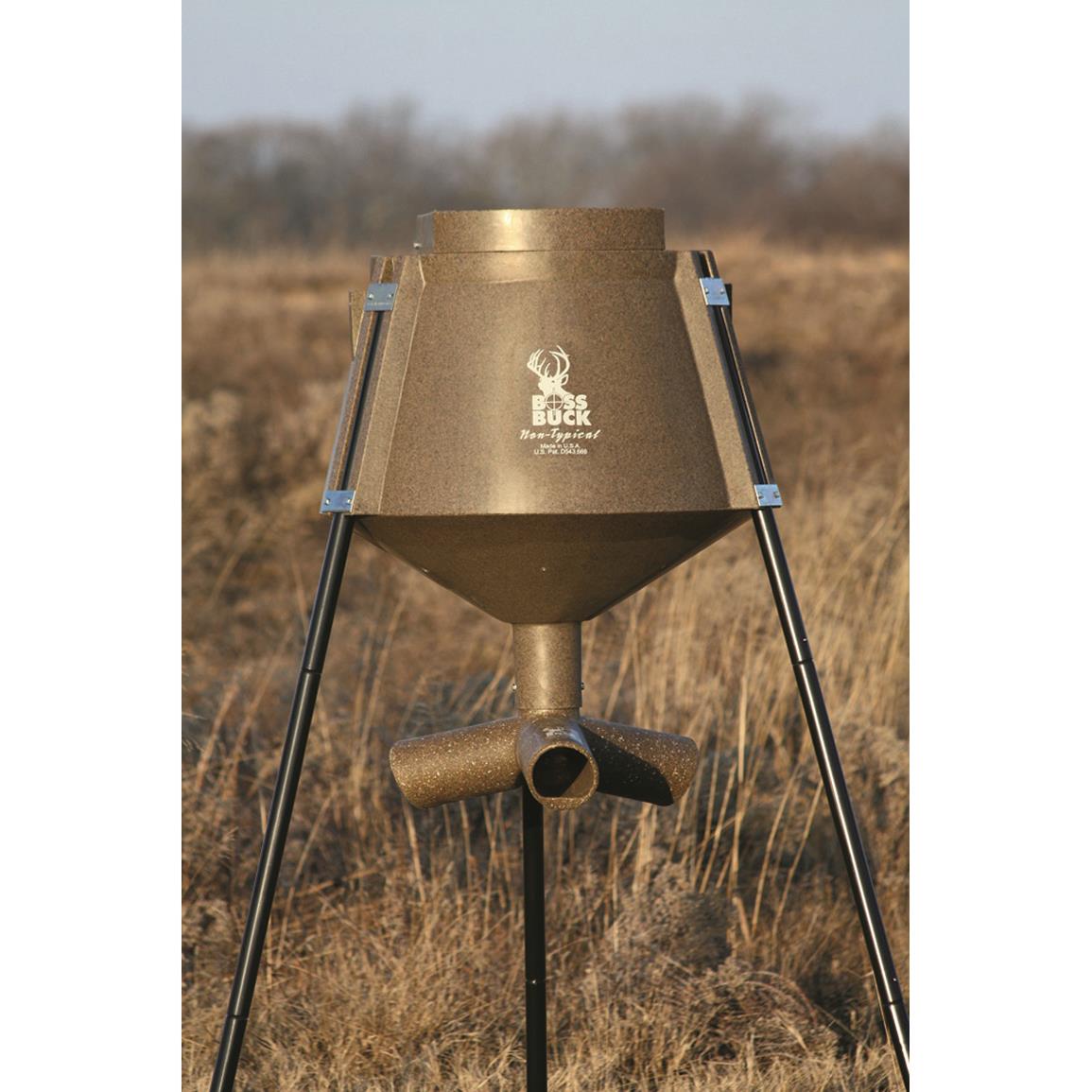
Boss Buck 350 lb Gravity Protein Feeder
Check Price on Amazon →Confirm price and availability on AmazonAs an Amazon Associate, we earn from qualifying purchases.


