
Boss Buck Feeders (2026): Every Model Reviewed & Compared
Disclosure: This post contains affiliate links. As an Amazon Associate, we earn from qualifying purchases at no extra cost to you.
Narrowed it to a gravity model? Read our Boss Buck 200 vs 350 gravity protein comparison.
The short answer
The best Boss Buck feeder for most hunters is the Boss Buck 350 lb — Boss Buck itself calls it the best seller and most popular model in the line, and the reasons hold up: a 350 lb roto-molded HDPE hopper that can’t rot, rust or leak, a patented gravity head that keeps protein pellets dry, zero batteries, and the option to convert it to a 12V automatic feeder later with a bolt-on kit. If you want automatic feeding from day one, buy the Stand & Fill 300 sled feeder instead — steel, solar-powered, filled from the ground. Everything in Boss Buck’s current range is compared below, checked model by model against bossbuck.com on October 22, 2026 — including two models the internet keeps attributing to Boss Buck that don’t exist (there is no current 250 lb or 500 lb Boss Buck feeder).
Three fast choices
Pick by your property. Read the trade-off before opening the retailer.
Disclosure: Some shopping links may earn us a commission at no additional cost to you. As an Amazon Associate I earn from qualifying purchases.
Boss Buck 350 lb
Boss Buck’s best seller: a 350 lb roto-molded HDPE hopper with the patented 3-way gravity head that keeps protein pellets dry — no batteries, and it converts to 12V automatic later with a bolt-on kit.
Caution: gravity feeding means no portion or night control — and salt-based feeds void the automatic parts warranty.
Boss Buck Stand & Fill 300
The highest-scoring Boss Buck on this site: a powder-coated steel sled feeder you fill standing on the ground, with a 12V motor, a timer with 2 Quick Set programs plus 16 customizable slots, varmint guard grating and a solar panel included.
Caution: the battery is not included on the 300 — budget for a 12V rechargeable.
Boss Buck 200 lb
The same HDPE hopper and patented 3-way gravity head as the bigger models in the lightest feeder in the line — made for stations you reach by ATV or on foot.
Caution: 200 lb of protein at a busy station lasts a few weeks, not a season — refill trips are the trade-off.
Boss Buck feeders at a glance
| Model | Best for | Capacity | Type | Price signal |
|---|---|---|---|---|
| Boss Buck 350 lb | Most protein programs | 350 lb | Gravity, convertible | Check Price → |
| Boss Buck 200 lb | Remote land, ATV access | 200 lb | Gravity, convertible | Check Price → |
| Boss Buck 600 lb | Fewer refills, 4-way feeding | 600 lb | Gravity, convertible | Check Price → |
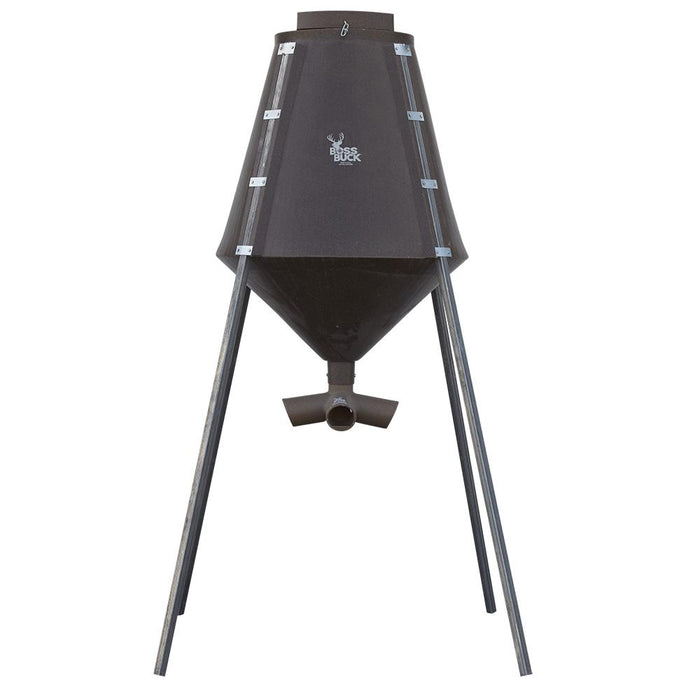 Boss Buck 1,200 lb |
Outfitters, big herds | 1,200 lb | Gravity bulk, convertible | Check Price → |
| Stand & Fill 300 / 600 sled | Automatic corn feeding | 300 / 600 lb | Automatic, steel sled | Check Price → |
| Boss Buck Post Feeder | Single-post sites | 200 / 350 lb | Gravity, post-mount | Check Price → |
| Boss Buck Cottonseed Feeder | Whole cottonseed | 350 lb | Gravity, steel | Check Price → |
One hopper family, four sizes: the 200, 350, 600 and 1,200 lb Boss Buck hoppers are each sold as a gravity protein feeder, a 12V automatic, or a combined protein-and-spinner unit. Prices quoted in this guide are bossbuck.com prices checked October 22, 2026; the Amazon buttons show live prices.
Which Boss Buck fits your property?
Step 1 — Gravity or automatic? Protein free-choice with no power → the hopper family (steps 2–3). Timed corn feeding → the Stand & Fill sled, or buy a hopper plus the Auto Feed Kit.
Step 2 — How far between refills? Weekly access → 200 lb or 350 lb. Monthly or worse → 600 lb. Seasonal bulk → 1,200 lb. Boss Buck’s own guidance is roughly one feeder per 50 acres.
Step 3 — How will you mount it? Tripod legs are standard; a single 4×4 post → the Post Feeder; your own 55-gallon drum → Boss Buck sells the lower unit and leg band, not a complete drum feeder.
Step 4 — Feeding cottonseed? Skip the hoppers: the steel Cottonseed Feeder is built for a feed that won’t flow through gravity ports.
How we picked
We audited Boss Buck’s entire store — all 83 listings on bossbuck.com — on October 22, 2026, and cross-checked every model against its own product page: capacities, head design, power, options and prices below are Boss Buck’s own published figures, quoted with their date. Three findings shaped this hub:
- The lineup is one convertible family, not separate lines. The same HDPE hopper comes as gravity, automatic, or both — so we review hoppers, not marketing names. “Non-Typical” is the series name for that family, not a separate model.
- bossbuck.com is a combined Boss Buck | American Hunter store. The SunSlinger kit, the 350 lb tripods and the hanging feeders sold there are American Hunter products. We flag them in their own section instead of crediting them to Boss Buck, which most brand roundups get wrong.
- We did not field-test these feeders. Scores blend our existing all-brand rankings (where a model appears in our main feeder guide) with design and value judgments for hub-only models. Where Boss Buck publishes no figure — throw distance is the big one — we say so rather than borrowing a number from a blog.
Boss Buck feeders, reviewed
1. Boss Buck 350 lb — the best seller · 8.1/10
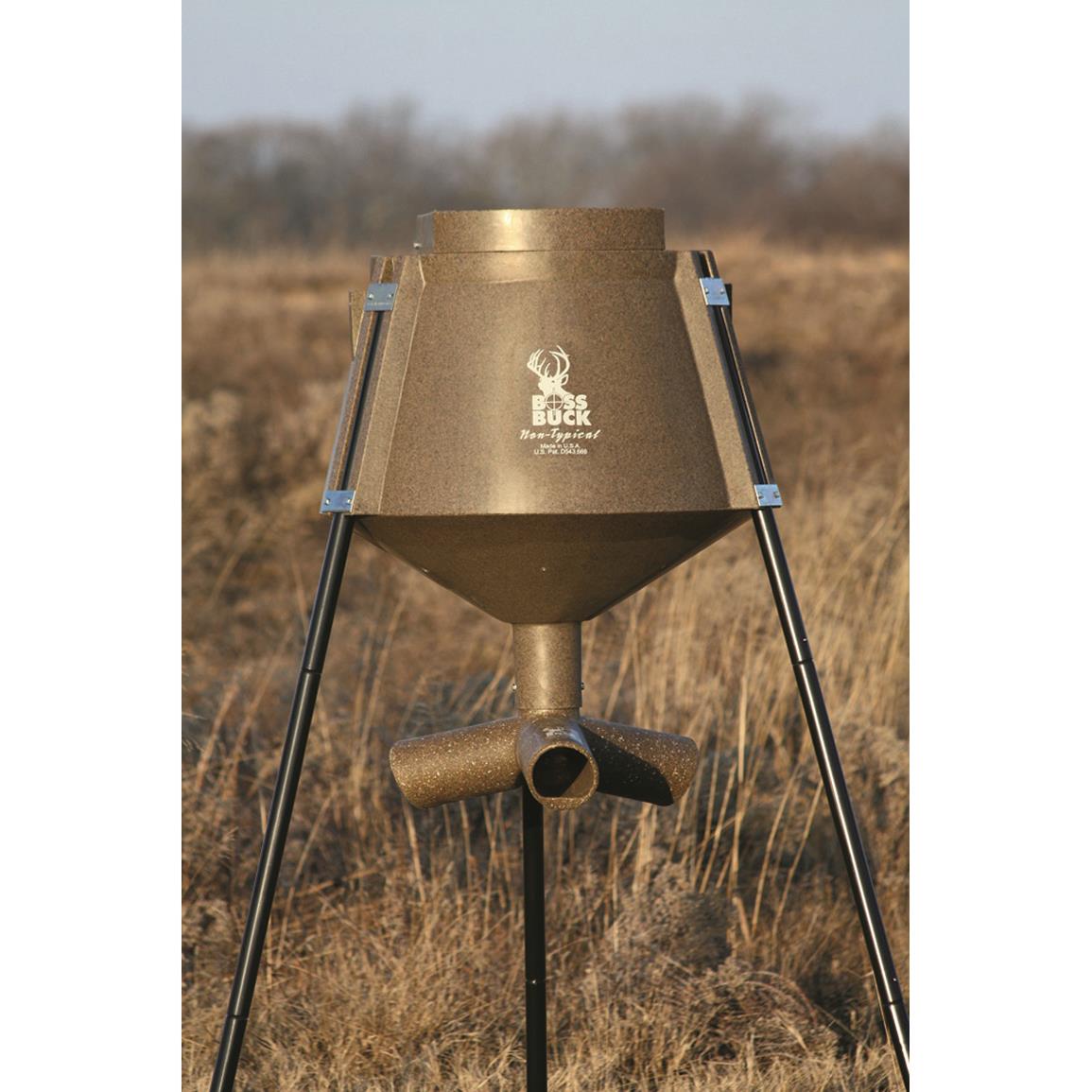
Boss Buck calls the 350 “the BEST SELLER in our line” and “the most popular feeder in our line thanks to its compact size and relative ease of transportation and installation” — and it’s the size we’d start with too. The thick-wall HDPE roto-molded hopper shrugs off weather that rusts steel and cracks fiberglass, and the patented 3-way gravity head is the real product: ports angled at 10° with a 1-inch overhang and a drain hole at each tip, so rain runs off instead of wicking into the pellets, plus an adjustable inner sleeve that meters flow from nearly shut to wide open. The double-walled hatch lid is oversized on purpose — Boss Buck says it lets the hopper breathe, cutting the condensation that spoils protein in sealed steel hoppers.
You choose the delivery system at purchase: Protein (gravity), 12V Spinner, or Protein & 12V Spinner combined, on single or multi-piece legs. Buy the gravity version and you can still convert later (§Auto Feed Kit). In our all-brand testing framework the 350 gravity scored 8.1/10 — held back by the gravity format’s usual limits: no portion control, and protein pellets are available to every raccoon that learns the ports. One hard rule from Boss Buck itself: salt-based feeds corrode the control system and void the parts warranty on automatic configurations — keep salt minerals out of it.
✅ Pros
- Boss Buck’s best seller — the proven size in the line
- Patented gravity head sheds rain; adjustable flow sleeve
- HDPE hopper can’t rot, rust or leak; breathable lid cuts condensation
- Converts to 12V automatic later with a bolt-on kit
❌ Cons
- Gravity format = no portion or night control
- Salt-based feeds void the automatic parts warranty
- Shown out of stock at times at bossbuck.com — check dealers too
| Spec | Detail |
|---|---|
| Capacity | 350 lb |
| Hopper | Thick-wall HDPE, UV-protected, roto-molded; double-walled hatch lid |
| Feed head | Patented 3-way gravity head; 4″ ports at 10°, 1″ overhang, drain holes |
| Delivery options | Protein · 12V Spinner · Protein & 12V Spinner |
| Price checked | $549.99–$629.99 at bossbuck.com, October 22, 2026 |
Skip it if: you need timed feeding from day one — the Stand & Fill sled is the automatic buy.
2. Boss Buck 200 lb — best for remote land · 8.6/10
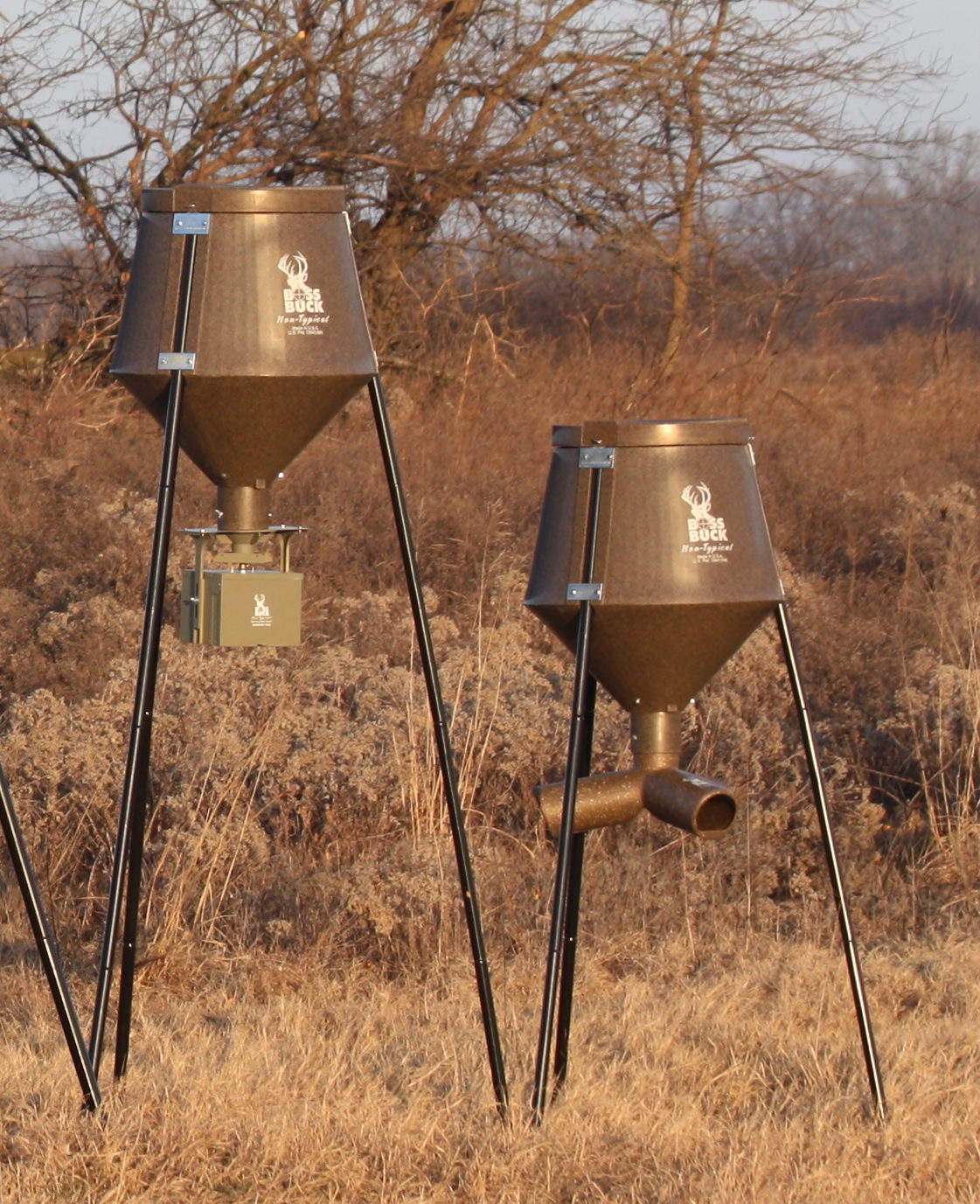
The 200 lb is the same feeder in a smaller hopper: same HDPE roto-molded construction, same patented 3-way gravity head with 10° ports, overhangs and drain holes, same conversion path to automatic. Boss Buck positions it for “remote location feeding where access is limited to ATV’s and foot access only”, which is exactly its niche — light enough to place where a 600 lb steel feeder will never go, big enough to matter between visits. It scored 8.6/10 in our main guide, the highest of the gravity hoppers, because at this size the format’s trade-offs (refill frequency vs. simplicity) balance best.
The compromises are arithmetic: 200 lb of protein at a busy station is a few weeks, not a season, and Boss Buck’s own density guidance (one feeder per 50 acres) means small properties may need two stations anyway. Price at bossbuck.com was $319.99–$479.99 depending on legs and delivery configuration, checked October 22, 2026 — the page also showed out of stock that day, so dealer stock is worth checking.
✅ Pros
- Same head and hopper tech as the bigger models
- Lightest, easiest Boss Buck to place on remote ground
- Converts to automatic like the rest of the family
- Lowest entry price in the hopper line
❌ Cons
- 200 lb empties fast at high deer density
- Stock at bossbuck.com is intermittent
- Gravity limits apply: no scheduling, no exclusion
| Spec | Detail |
|---|---|
| Capacity | 200 lb |
| Hopper | Thick-wall HDPE, UV-protected, roto-molded |
| Feed head | Patented 3-way gravity head; 4″ ports at 10°, drain holes |
| Power | None as gravity; 12V spinner conversion available |
| Price checked | $319.99–$479.99 at bossbuck.com, October 22, 2026 |
Skip it if: your station is a truck ride from the house — buy capacity (600 lb) instead of convenience.
3. Boss Buck 600 lb — best mid-size bulk feeder · 8.5/10
The 600 steps the head up to a 4-way design — four 4-inch ports, 8 inches long, same 10° angle, overhang and drain-hole weather detailing — so more deer feed at once with less crowding, on 84-inch legs that put the head at proper feeding height. Boss Buck calls it “A TOP SELLER in our line”, and it’s the size where a protein program stops being an experiment: dealer copies of Boss Buck’s specs put it at roughly 600 lb of corn or 500 lb of protein pellets per fill, which at typical free-choice draw is a month or more between refills on most properties.
Same convertible logic as the rest of the family: gravity protein, 12V spinner, or both, at $769.99–$989.99 at bossbuck.com (checked October 22, 2026). What the 600 doesn’t fix is gravity’s nature — it’s a big, always-open feed source, so in hog country it needs a pen, and its size makes it a two-person, plan-the-route placement job rather than an afternoon task.
✅ Pros
- 4-way head feeds more deer simultaneously
- ~500 lb of protein per fill — monthly refills
- 84″ legs set proper feed height out of the box
- Full conversion options, gravity to automatic
❌ Cons
- Big always-open feed source — pen it in hog country
- Two-person placement; plan vehicle access
- Approaching $1,000 in spinner configurations
| Spec | Detail |
|---|---|
| Capacity | 600 lb (approx. 500 lb protein pellets) |
| Hopper | Thick-wall HDPE, UV-protected, roto-molded |
| Feed head | Patented 4-way gravity head; 4″ × 8″ ports at 10°, drain holes |
| Legs | 84″ gravity feeder legs |
| Price checked | $769.99–$989.99 at bossbuck.com, October 22, 2026 |
Skip it if: you visit weekly anyway — the 350 does the same job for roughly $400 less.
4. Boss Buck 1,200 lb — best for outfitters & big herds · 8.4/10
The 1,200 is Boss Buck’s bulk statement — and it carries a feature nothing else in the line (or, Boss Buck claims, the market) offers: adjustable height. Move the stop brackets on the leg channels and the same feeder runs at a 40-inch protein feed height or rises to eye-level control-box height for corn feeding through the optional Automatic Conversion System. Dealer copies of the specs put a fill at about 1,200 lb of corn or 1,000 lb of protein pellets. The 4-way gravity head, HDPE hopper and breathable double-walled lid carry over from the 600.
This is outfitter and large-lease equipment: $1,139.99–$1,319.99 at bossbuck.com (checked October 22, 2026), freight-class to place, and shown out of stock at Boss Buck direct on the research date — dealer listings carry it more reliably. For a single-family property it’s almost always more feeder than the deer density justifies; Boss Buck’s one-per-50-acres guidance is the sanity check.
✅ Pros
- Adjustable height: 40″ protein mode to eye-level corn mode
- ~1,000 lb of protein per fill — season-scale refills
- 4-way head serves a whole herd at once
- Converts to automatic via the conversion system
❌ Cons
- $1,140+ before freight and placement effort
- Intermittent stock at Boss Buck direct
- Oversized for most single properties
| Spec | Detail |
|---|---|
| Capacity | 1,200 lb (approx. 1,000 lb protein pellets) |
| Hopper | Thick-wall HDPE, UV-protected, roto-molded |
| Feed head | Patented 4-way gravity head; 4″ × 8″ ports at 10°, drain holes |
| Standout feature | Adjustable leg height — protein height to control-box height |
| Price checked | $1,139.99–$1,319.99 at bossbuck.com, October 22, 2026 |
Skip it if: you’re feeding one property’s herd — two 600s give you placement flexibility for similar money.
5. Boss Buck Stand & Fill sled feeders — best automatic Boss Buck · 9.0/10
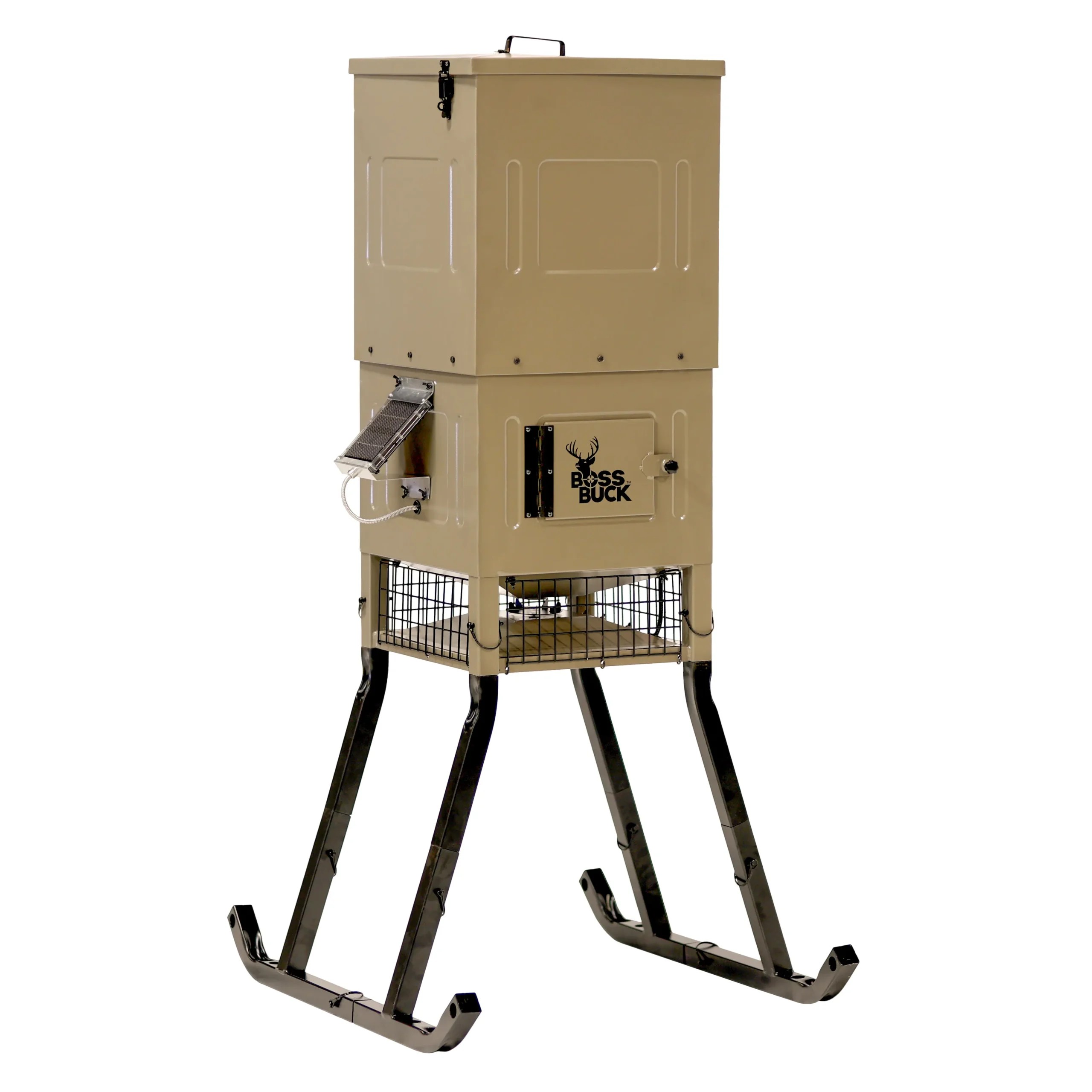
The Stand & Fill line is Boss Buck’s answer to the ladder problem: a powder-coated steel hopper on a sled base that you fill standing on the ground, with a lockable steel lid (two latches), anchor holes and tow slots for moving it, a feed-level window, and an enclosed compartment for the timer and battery. The automatic system is complete: 12V heavy-duty motor, spin plate with a diverter plate for dispersion, varmint guard grating, solar panel included, and a timer with 2 Quick Set programs plus 16 customizable slots. It scored 9.0/10 in our main guide — the highest-scoring Boss Buck anywhere on this site — and at least one major competing roundup names it its overall best feeder; we agree it’s the Boss Buck to buy if you feed corn on a schedule.
Two sizes: 300 lb at $529.99 and 600 lb at $719.99 at bossbuck.com (checked October 22, 2026; the 300 was out of stock at Boss Buck direct that day, the 600 in stock). The battery is not included on the 300 — budget for a 12V rechargeable. Steel’s trade-offs are weight and the condensation physics we flag in our main-guide review; the sled format at least makes the feeder easy to drag to a new station when a spot goes cold.
✅ Pros
- Fill from the ground — no ladder, no winch
- Complete automatic system: 12V motor, solar, 16-slot timer
- Lockable steel lid, varmint grating, feed-level window
- Sled base drags to a new station; anchor holes for fixing
❌ Cons
- Battery not included (300 lb)
- Steel hopper: heavier, and watch condensation management
- 300 lb stock at Boss Buck direct is intermittent
| Spec | Detail |
|---|---|
| Capacity | 300 lb · 600 lb |
| Hopper | Powder-coated steel on a sled base; lockable lid |
| System | 12V motor, spin + diverter plate, varmint grating, solar included |
| Timer | 2 Quick Set programs + 16 customizable slots |
| Price checked | $529.99 (300 lb) / $719.99 (600 lb) at bossbuck.com, October 22, 2026 |
Skip it if: you feed protein free-choice — that’s the gravity hoppers’ job, not a spinner’s.
6. Boss Buck Post Feeder — best post-mount · 8.0/10
The Post Feeder takes the gravity concept off legs entirely: a rotomolded hopper that mounts on top of a standard 4×4 post (stabilization sleeve and hardware included), feeding through four removable, replaceable feed tubes, with a ventilated removable lid closed by a thumbscrew. Boss Buck sells it in 200 lb and 350 lb capacities at $339.99–$439.99 (checked October 22, 2026). The post format suits sites where tripod legs are the problem — tight cover, rocky ground, or a pen corner — and a post is harder for hogs to shove than three legs.
It’s the simplest feeder in this hub: no power, no timer, no conversion path we could verify, and the smallest owner-review footprint of the line. Buy it for the mounting, not for features. If the post ever rots or the site moves, the feeder lifts off and remounts — a flexibility tripods don’t offer.
✅ Pros
- Mounts on one 4×4 post — minimal footprint
- Four removable, replaceable feed tubes
- Ventilated lid keeps feed fresher
- 200 and 350 lb sizes
❌ Cons
- No automatic conversion path verified
- Post installation is on you
- Thin owner-review record vs the tripod line
| Spec | Detail |
|---|---|
| Capacity | 200 lb · 350 lb |
| Mount | Single 4×4 post; stabilization sleeve + hardware included |
| Feed head | Gravity; 4 removable/replaceable feed tubes |
| Power | None |
| Price checked | $339.99–$439.99 at bossbuck.com, October 22, 2026 |
Skip it if: you might want automatic feeding later — the tripod hoppers convert; this one is gravity for life.
7. Boss Buck Cottonseed Feeder — best for cottonseed · 8.2/10
Boss Buck’s cottonseed entry is a different animal from ASF’s roofed trough (compared in our trough guide): an all-steel, low-profile gravity feeder whose angled plate and V-channel design push whole cottonseed out to the feeding edges by gravity alone. It’s small and light for a 350 lb feeder — 57.5″ high × 24″ × 24″, 72 lb empty — fills without a ladder, and at $249.99 at bossbuck.com (checked October 22, 2026) it’s the cheapest way into cottonseed feeding from a major brand.
Cottonseed context matters: it’s prized for protein and fat content, and it can’t be spun or port-fed, which is why both Boss Buck and ASF build dedicated feeders for it. This one is open gravity feeding, so the trough rules from our guide apply — site it drained, expect everything to sample it, and pen it in hog country.
✅ Pros
- Purpose-built V-channel gravity feed for whole cottonseed
- Low profile: fills without a ladder
- All-steel, powder-coated; only 72 lb empty
- $249.99 — cheapest branded cottonseed feeder we verified
❌ Cons
- Open gravity design — no weather roof or exclusion
- Cottonseed only; no second job
- Small footprint fills fast at popular stations
| Spec | Detail |
|---|---|
| Capacity | 350 lb of cottonseed |
| Construction | All-steel, premium powder-coated finish |
| Dimensions | 57.5″ H × 24″ W × 24″ D; 72 lb |
| Feed system | Gravity V-channel with angled distribution plate |
| Price checked | $249.99 at bossbuck.com, October 22, 2026 |
Skip it if: you don’t feed cottonseed — and read our trough roundup if you’re deciding whether to start.
The Auto Feed Kit: turning gravity into automatic
The conversion story is Boss Buck’s best idea. The Auto Feed Kit Large 12V w/ Timer ($154.99 at bossbuck.com, checked October 22, 2026) bolts onto the Non-Typical 350, 600 and 1,200 hoppers and turns a gravity protein feeder into an automatic corn feeder: high-torque motor, 5-inch swing-door slinger, heavy-duty steel mounting plate and control box, thumb-bolt quick attach, and knock-outs for a box-mount or barrel-mount solar panel. Boss Buck’s seasonal framing is the point — gravity protein in spring and summer, automatic corn in fall and winter, one feeder. The kit runs on a 12V rechargeable battery; Boss Buck sells its own 12V 7Ah rechargeable ($29.99) and a 12V Universal Solar Panel ($49.99, drum-mount, pre-assembled with bracket and wire guard) if you want the matching parts. Warranty frame, from Boss Buck’s FAQ: 1 year on the motor, 2 years on the timer — and salt-based feed through the control system voids the parts warranty.
Drums, parts & accessories
There is no complete Boss Buck drum feeder. Instead Boss Buck sells the build-your-own path around your own 55-gallon drum: the Protein Lower Unit ($159.99) turns a barrel into a gravity protein feeder with a 3-way head; the Barrel Band Leg Kit ($89.99) wraps the drum’s base — no drilling, which Boss Buck notes avoids the moisture problems drilled drums develop — and holds up to 600 lb; add a spun-steel funnel ($54.99), a slip-on lid ($79.99) and a varmint cage ($33.99) and you have a drum feeder built from warranted parts. Our DIY drum feeder guide walks the full build.
Parts are roughly half the Boss Buck store, which is a genuine ownership advantage: replacement 12V motors ($42.99), the 6V/12V digital timer ($29.99), gravity heads (3-way and 4-way, $89.99–$129.99), leg kits, foot pads, funnels and lids are all stocked. For varmint defense, the two Boss Buck originals are Shark Teeth strips ($21.99 for three 36-inch galvanized strips — Boss Buck: “If they can’t touch it, climb it, bump it or lick it; they can’t tear it up”; two strips per leg, broken into 6-inch pieces for the control box) and the Varmint Cage Large Deluxe Round ($69.99), which bolts to the threaded inserts on all current hoppers so raccoons can’t reach the spinner plate. Shark Teeth scored 8.4/10 in our varmint guard roundup; the full parts picture is in our parts & accessories guide. One more honest note: Boss Buck sells no complete road feeder either — its 80 lb ATV Seeder/Spreader ($279.99) broadcasts feed, seed and fertilizer from a 2-inch receiver, the closest product; purpose-built road feeders are compared in our road feeder guide.
Sold on bossbuck.com — but not Boss Buck
bossbuck.com is a combined Boss Buck | American Hunter store (both are GSM Outdoors brands), and several products shoppers assume are Boss Buck are American Hunter models. The distinction matters for parts, manuals and warranties, so here is the honest map, verified October 22, 2026:
- SunSlinger Kit ($84.99) — American Hunter. A 6V spin kit with built-in solar charger and a fully enclosed varmint cage. Its timer offers 2 Q-Set programs (6:30 AM/PM at 3 or 5 seconds) plus 1–16 custom times with 0–60 second runs. Despite what the name suggests to some shoppers, the current listing is a spin-plate broadcast kit — it does not claim a directional throw.
- Heavy Duty Digital Spin Kit ($159.99) — American Hunter. Metal control housing, high-torque motor, “No Blow” slinger; runs on 6V or 12V; 1–8 feed times a day.
- The two 350 lb tripod feeders ($309.99 with the 20558 timer; $279.99 TX Edition with SunSlinger kit) — American Hunter, steel hoppers, sold through the Boss Buck store.
- Hanging feeders (50 lb X-Pro at $74.99, 50 lb at $69.99, 40 lb at $44.99) — American Hunter. The 50 lb X-Pro is the same feeder we review as the American Hunter 50 in our main guide (8.0/10).
None of this makes them bad products — American Hunter’s XDE-Pro and hanging feeders appear across our guides — but if you buy one expecting Boss Buck’s gravity-head system or parts support, you’ll be looking in the wrong catalog. Our automatic feeder guide covers the American Hunter automatic models in their own right.
What a Boss Buck feeder really costs
| Cost item | Price at bossbuck.com | Notes |
|---|---|---|
| 200 lb hopper feeder | $319.99–$479.99 | Checked October 22, 2026; range = leg and delivery-system configurations |
| 350 lb hopper feeder | $549.99–$629.99 | Checked October 22, 2026 |
| 600 lb hopper feeder | $769.99–$989.99 | Checked October 22, 2026 |
| 1,200 lb hopper feeder | $1,139.99–$1,319.99 | Checked October 22, 2026; freight placement extra |
| Stand & Fill sled 300 / 600 | $529.99 / $719.99 | Checked October 22, 2026; 300 lb battery not included |
| Post Feeder 200 / 350 | $339.99–$439.99 | Checked October 22, 2026; plus your 4×4 post |
| Cottonseed Feeder 350 | $249.99 | Checked October 22, 2026 |
| Auto Feed Kit Large 12V | $154.99 | The conversion that makes a gravity hopper automatic |
| Ownership parts | Battery $29.99 · solar panel $49.99 · Shark Teeth $21.99 | Boss Buck’s own 12V battery and universal solar panel, checked October 22, 2026 |
The takeaway: Boss Buck’s value case is longevity and parts, not sticker price. A 350 lb gravity feeder at ~$550 costs more than big-box tripod feeders, but the hopper carries no electronics to fail, converts to automatic for $155 instead of a second feeder, and every wear part is stocked by the manufacturer. Boss Buck’s FAQ adds that bulk discounts are considered at 10+ units — worth a call for lease and outfitter setups.
Boss Buck owner questions, answered from the source
How far does a Boss Buck feeder throw feed?
Boss Buck doesn’t publish one. We checked the Auto Feed Kit page, both sled pages, the conversion materials and the FAQ on October 22, 2026: Boss Buck specifies feed durations and (on sister-brand kits) motor speeds, but no spread distance or radius anywhere. Any site quoting you a Boss Buck throw distance in feet is estimating, not quoting. Practically: throw depends on the spinner configuration, feed type and run time you set — pellets throw shorter than corn — so set your stand distance from your own test throws, not a spec sheet.
What battery does a Boss Buck automatic feeder need?
Boss Buck automatic systems (hopper conversions and Stand & Fill sleds) run on a 12V rechargeable battery — Boss Buck’s own store sells a 12V 7Ah rechargeable ($29.99) and a 12V lithium option. The American Hunter kits sold on the same store are different: the SunSlinger and X-Pro kits run 6V, and the Heavy Duty spin kit accepts 6V or 12V. Solar: sled feeders include a panel; conversions take Boss Buck’s box-mount panel or the 12V Universal Solar Panel ($49.99) — and the Auto Feed Kit can be rotated after filling to face the best sun, which is the whole install trick.
How do I program a Boss Buck timer — and reset it?
Sled feeders use 2 Quick Set programs plus 16 customizable slots. If a Boss Buck digital timer locks up or loses the plot, Boss Buck’s FAQ documents a hardware reset: a reset button under the Program button — hold it for 5 seconds with a pin or toothpick to reboot to the original programming. For the American Hunter SunSlinger timer sold on the same store, Q-Set 1 is 6:30 AM and 6:30 PM at 3 seconds, Q-Set 2 the same times at 5 seconds, with up to 16 custom times beyond that. If your feeder still won’t run after a reset and a known-good battery, work through our feeder diagnosis hub before buying parts.
Does Boss Buck sell replacement parts?
Yes — parts are roughly half the store: motors, timers, gravity heads, lower units, leg kits, foot pads, funnels, lids, batteries, solar panels and varmint hardware, all listed in our drums & parts section above. Warranty frame from Boss Buck’s FAQ: the feeder box itself carries no warranty; motors are covered for 1 year and timers for 2 years; salt-based feed through an automatic control system voids the parts warranty.
Boss Buck resources
- Best Deer Feeders — where Boss Buck’s models rank against all brands
- Deer Feeder Reviews — the hub for every feeder type
- Best Gravity Deer Feeders
- Best Protein Deer Feeders
- Best Automatic Deer Feeders
- Best Deer Feed Troughs — including the cottonseed comparison
- Best Deer Feeder Varmint Guards — Shark Teeth reviewed
- Best Deer Feeder Parts & Accessories
- DIY 55-Gallon Drum Deer Feeder
- Best Road Feeder for Deer
- Deer Feeder Not Working?
- Shop — Boss Buck products in our catalogue
- Boss Buck’s own FAQ — warranty, density and reset answers
Boss Buck feeder FAQs
What is the best Boss Buck feeder?
For most hunters, the Boss Buck 350 lb gravity feeder — the line’s best seller, with the patented rain-shedding gravity head, an HDPE hopper that can’t rot or rust, and a bolt-on path to automatic feeding. If you want automatic from day one, the Stand & Fill 300 sled feeder is the best automatic Boss Buck (9.0/10 in our main guide).
How much do Boss Buck feeders cost?
At bossbuck.com on October 22, 2026: the hopper family runs $319.99–$479.99 (200 lb), $549.99–$629.99 (350 lb), $769.99–$989.99 (600 lb) and $1,139.99–$1,319.99 (1,200 lb) depending on legs and delivery system. Stand & Fill sleds are $529.99 (300 lb) and $719.99 (600 lb). Dealer and Amazon prices vary.
Is there a Boss Buck 500 lb or 250 lb feeder?
Not in the current line. We audited all 83 listings on bossbuck.com on October 22, 2026: the hopper sizes are 200, 350, 600 and 1,200 lb — there is no 250 lb or 500 lb model. Older “500 series” references online point at discontinued or mislabeled listings; buy the 350 or 600 instead.
What does “Non-Typical” mean on a Boss Buck feeder?
Non-Typical is Boss Buck’s series name for its convertible hopper feeders — the 200 to 1,200 lb HDPE hoppers that feed gravity protein in spring and summer and convert to an automatic system for fall and winter. It is not a separate model.
Can a Boss Buck gravity feeder be converted to automatic?
Yes. The Auto Feed Kit Large 12V ($154.99 at bossbuck.com, October 2026) bolts onto the 350, 600 and 1,200 hoppers and adds a high-torque motor, 5-inch swing-door slinger and timer, running on a 12V rechargeable battery. The sled feeders are automatic from the factory and don’t need it.
How far does a Boss Buck feeder throw corn?
Boss Buck doesn’t publish a throw distance — we checked its product pages and FAQ in October 2026. It specifies run durations, not spread radius. Expect throw to vary with spinner setup, feed type and run time; test your own feeder and set stand distance from the result.
What battery do Boss Buck feeders use?
Boss Buck automatic systems use a 12V rechargeable battery (Boss Buck sells a 12V 7Ah unit for $29.99). Gravity models use no battery at all. Note the American Hunter kits sold on bossbuck.com differ: SunSlinger and X-Pro kits are 6V; the Heavy Duty spin kit takes 6V or 12V.
Are Boss Buck feeders worth the money?
If you’ll keep a feeder for years, the case is strong: HDPE hoppers don’t rot, rust or leak, the gravity head is genuinely weather-shedding, every wear part is stocked, and a gravity feeder converts to automatic for $155 instead of being replaced. If you replace feeders every couple of seasons anyway, cheaper tripod feeders make more sense.
How many Boss Buck feeders do I need?
Boss Buck’s own FAQ recommends roughly one feeder per 50 acres. Treat that as a ceiling for protein programs, not a target — deer density, feed goals and how far apart your bedding and food plots sit matter more than acreage alone.
Does Boss Buck make a drum feeder or a road feeder?
No complete version of either. For drums, Boss Buck sells the parts — Protein Lower Unit, Barrel Band Leg Kit, funnels and lids — to build a 55-gallon drum feeder around your own barrel. Its closest vehicle product is the 80 lb ATV Seeder/Spreader on a 2-inch receiver, which broadcasts feed and seed rather than feeding deer at a station.
Is the SunSlinger a Boss Buck feeder?
No — the SunSlinger kit sold on bossbuck.com is an American Hunter product (both brands belong to GSM Outdoors and share the store). It’s a 6V spin kit with built-in solar and a varmint cage, with 2 Q-Set programs and up to 16 custom feed times. It is not a directional feeder in its current listing.
What is Boss Buck’s warranty?
Per Boss Buck’s FAQ: no warranty on the feeder box itself, a 1-year warranty on motors and a 2-year factory warranty on timers. Using salt-based feed through an automatic control system voids the parts warranty — keep salt minerals in a separate station.
Final verdict
Start with the Boss Buck 350 lb if you feed protein — it’s the best seller for sound reasons — or the Stand & Fill 300 if you feed corn on a timer and hate ladders. Scale to the 600 or 1,200 when refill trips, not deer, become the constraint; drop to the 200 when the station is a long ATV ride in. Feed cottonseed from the Cottonseed Feeder, mount the Post Feeder where legs won’t work, and remember the brand’s real moat: whatever you buy, Boss Buck still sells the motor, timer, head and lid for it years later. Comparing brands rather than models? Start with our main feeder guide.
Prices are bossbuck.com snapshots checked October 22, 2026 and will move; the Amazon buttons show live prices. Feeding and baiting rules vary by state and county — check yours before ordering. Last updated: October 22, 2026.
Products mentioned in this guide
Boss Buck 350 lb Gravity Protein Feeder
Check Price on Amazon →Confirm price and availability on AmazonBoss Buck Stand & Fill 300 Feeder
Check Price on Amazon →Confirm price and availability on AmazonBoss Buck 200 lb All In Gravity Feeder
Check Price on Amazon →Confirm price and availability on AmazonAs an Amazon Associate, we earn from qualifying purchases.


