
Best Road Feeder for Deer (2026): 6 Hitch & Tailgate Feeders Compared
Disclosure: This post contains affiliate links. As an Amazon Associate, we earn from qualifying purchases at no extra cost to you.
On this page
- The 6 best road feeders at a glance
- Which road feeder in 30 seconds
- How we picked these feeders
- The 6 best hitch & tailgate deer feeders of 2026 — full reviews
- Watch them work: videos
- What a road feeder really costs
- How to choose the right road feeder
- Feeder resources & guides
- Best road feeder for deer: FAQ
- Final verdict
The short answer
The best road feeder for deer for most hunters in 2026 is the Texas Hunter Products RF100 Road Feeder. It holds two full bags of corn, slides into any 2-inch receiver hitch, and fires from a wireless remote — so you can lay a trail of corn along senderos and ranch roads without ever leaving the driver’s seat.
Below, we compare six hitch-mounted and tailgate-style feeders side by side — capacity, mount type, power, and what real owners say — so you can match one to your truck, UTV, and property. Every price link goes to the live Amazon listing, where you can check today’s price.
Best road feeders for deer at a glance — 2026
| Feeder | Best for | Capacity | Mount | Owner signal | Price |
|---|---|---|---|---|---|
| Texas Hunter Products RF100 Road Feeder | Most hunters | 100 lb | 2″ receiver hitch | Wireless remote; Texas road-feeding tradition | Check Price → |
| All Seasons Feeders 100 lb Galvanized Road Feeder | Best value | 100 lb | 2″ receiver hitch | Aggressive spinner throw; $339 direct (checked Oct 2026) | Check Price → |
| Texas Hunter Products RF50 Road Feeder | Compact rigs | 50 lb | 2″ receiver hitch | Same remote system; one-bag fills | Check Price → |
| All Seasons Feeders 200 lb Hercules Road Feeder | Heavy-duty use | 200 lb | 2″ receiver hitch | Heavy-gauge build; $549 direct (checked Oct 2026) | Check Price → |
| Lamco UTV50 50 lb UTV Road Feeder | UTVs & side-by-sides | 50 lb | 2″ receiver, UTV extension tube | $320 retail (review); tailgate stays usable | Check Price → |
| SpinTech Outdoors Heavy-Duty Hitch Spreader (50/100 lb) | Zero-waste design | 50 / 100 lb | 2″ receiver hitch | $399.99 (checked Oct 2026); patented sealing spinner | Check Price → |
Prices change frequently — the links above go to the live Amazon listings so you always see today’s price. Manufacturer-direct prices shown were checked October 2026.
Which road feeder in 30 seconds
What are you mounting it on?
Full-size truck, Jeep, or SUV → any 2″ receiver model works: Texas Hunter RF100 or All Seasons 100 lb.
UTV / side-by-side → get the purpose-built Lamco UTV50 with its raised extension tube — a truck feeder on a UTV blocks the tailgate.
How do you want to trigger it?
Wireless remote from the driver’s seat → Texas Hunter RF100 / RF50.
Long wired cord from the cab → SpinTech (25-ft cord) or Lamco (20-ft cord).
Simplest possible → any model wired to the trailer-light plug.
How much ground are you covering?
A few senderos near camp → 50 lb is plenty (RF50, Lamco UTV50).
Miles of ranch roads per run → 100 lb (RF100, All Seasons 100).
Feeding a big property or running a lease → 200 lb Hercules — but respect your hitch’s tongue-weight rating.
Rough roads?
Bumpy ranch roads shake corn out of ordinary spinners → pick the SpinTech with its sealing spinner, or the Lamco with its cutoff-style bowl spinner. Add an anti-rattle hitch pin to any of them.
How we picked these feeders
Road feeders are a small, Texas-rooted niche — and that shows in the search results. The page currently ranking #1 for “road feeders” is the manufacturer’s own catalog page (allseasonsfeeders.com). It lists their models and prices, but it does three things a buyer actually needs: no side-by-side comparison with rival brands, no independent owner voices, and no honest discussion of trade-offs like mount wobble, weight on rough roads, or power quirks. This guide fixes all three.
What we aggregated: manufacturer specifications (capacities, mounts, power options), an in-depth independent review of the Lamco UTV feeder (Texas Outdoors Network), owner reports from hunting forums (Habitat Talk), product listings with real specs from implement dealers, and Texas Hunter Products’ own documentation and use-cases. Every product below is a real, currently sold feeder you can buy.
What we did not do: invent test drives, fabricate owner quotes, or claim hands-on time with units we haven’t touched. Independent owner reviews for road feeders are genuinely scarce — this is a buy-it-from-the-manufacturer niche — and where the evidence is thin, we say so instead of filling the gap with adjectives.
The 6 best hitch & tailgate deer feeders of 2026 — full reviews
1. Texas Hunter Products RF100 Road Feeder — Best Overall
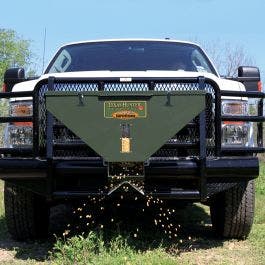
The RF100 is the reference design for the whole category: a 100-pound galvanized steel hopper that slides into any 2-inch receiver hitch and broadcasts corn at the press of a wireless remote. Texas Hunter has built feeders in San Antonio since 1954, and the road feeder line carries the same DNA as their stationary units — heavy-duty high-torque motor, specially designed spinner plate, sight gauge so you can see the feed level at a glance, and built-in lid stops that keep the lid from banging your tailgate. Two bags of corn per fill means you can run a full morning of senderos without stopping to reload.
The standout feature is the power flexibility. You can run it off your vehicle’s trailer-light plug — no battery to remember, no cords to route — or drop in an optional 12V battery for fully wireless remote operation. The honest quirks, straight from the manufacturer’s own documentation: on trailer-plug power you must switch on the vehicle’s parking or headlights to energize the feeder, and if you go the battery route you should disconnect a terminal when storing the unit or it will slowly discharge. Neither is a dealbreaker, but both are the kind of thing you want to know before opening day.
Pros
Cons
From the field
| Spec | Detail |
|---|---|
| Capacity | 100 lb (two 50-lb bags) |
| Mount | 2″ receiver hitch (truck, Jeep, ATV, UTV, RTV) |
| Activation | Wireless remote control |
| Power | Trailer light plug or optional 12V battery |
| Construction | Galvanized steel |
| Best for | Most hunters — the default road-feeder pick |
2. All Seasons Feeders 100 lb Galvanized Road Feeder — Best Value
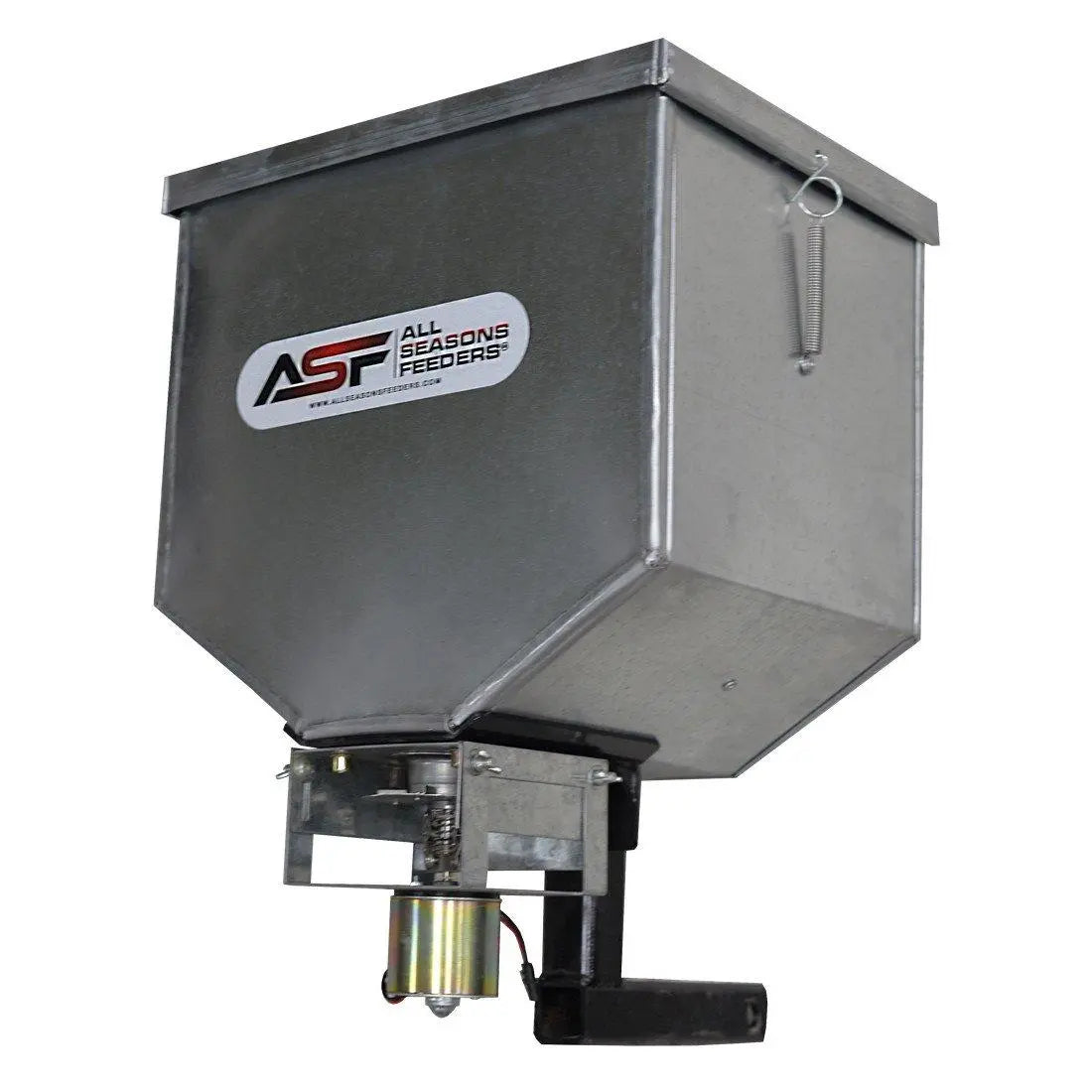
All Seasons Feeders owns the #1 search result for “road feeders,” and the 100 lb galvanized model is why: $339 direct (checked October 2026) for a 100-pound hitch-mounted feeder from a company that has built nothing but feeders since the late 1980s. The design brief is simple — feed more ground, cover more country — and the unit is built for exactly that: controlled distribution from your truck or UTV wherever the road takes you. If the Texas Hunter is the refined remote-control option, the All Seasons is the workhorse alternative at a workingman’s price.
The meaningful difference is in the spinner. An independent reviewer who has run both brands’ road feeders notes that the All Seasons spinner — with its small bars — “really slings the corn out fast and hard,” throwing noticeably more corn than the bowl-style spinner on his Lamco (Texas Outdoors Network). That’s a genuine advantage when you want maximum coverage per pass. The trade-off from the same reviewer: the All Seasons’ chains and moving spinner plate “can get grimy and stop working in dusty and harsh conditions” — a maintenance note worth taking seriously if your ranch roads are caliche dust in August. A quick clean-out between runs solves it, but it isn’t maintenance-free.
Pros
Cons
From the field
| Spec | Detail |
|---|---|
| Capacity | 100 lb |
| Mount | 2″ receiver hitch |
| Construction | Galvanized steel |
| Price (direct) | $339 (checked October 2026) |
| Best for | Maximum coverage per dollar |
3. Texas Hunter Products RF50 Road Feeder — Best Compact

The RF50 is the RF100’s smaller sibling: same 2-inch receiver mount, same wireless remote, same galvanized steel construction — but a 50-pound hopper sized for exactly one bag of corn. If your feeding runs are short loops around camp, a dove field, or a couple of senderos, the 50 is the smarter buy: lighter on the hitch, quicker to fill, easier to pull off and store when the season ends.
The one-bag design is also a discipline feature. Road feeding has no portion control — you’re broadcasting while you drive — so a smaller hopper naturally limits how much corn disappears per run. Texas Hunter’s own account of family road-feeding runs notes the two-sizes lineup exists precisely so you can “stop and add a bag of corn and keep on going” — with the RF50, each stop is one bag, no measuring, no half-used sacks rolling around the truck bed. The same power notes apply as the RF100: trailer-plug mode needs the headlights on, and disconnect the 12V battery in storage.
Pros
Cons
From the field
| Spec | Detail |
|---|---|
| Capacity | 50 lb (one bag) |
| Mount | 2″ receiver hitch |
| Activation | Wireless remote control |
| Power | Trailer light plug or optional 12V battery |
| Construction | Galvanized steel |
| Best for | Short loops, small properties, quick mounts |
4. All Seasons Feeders 200 lb Hercules Road Feeder — Best Heavy-Duty
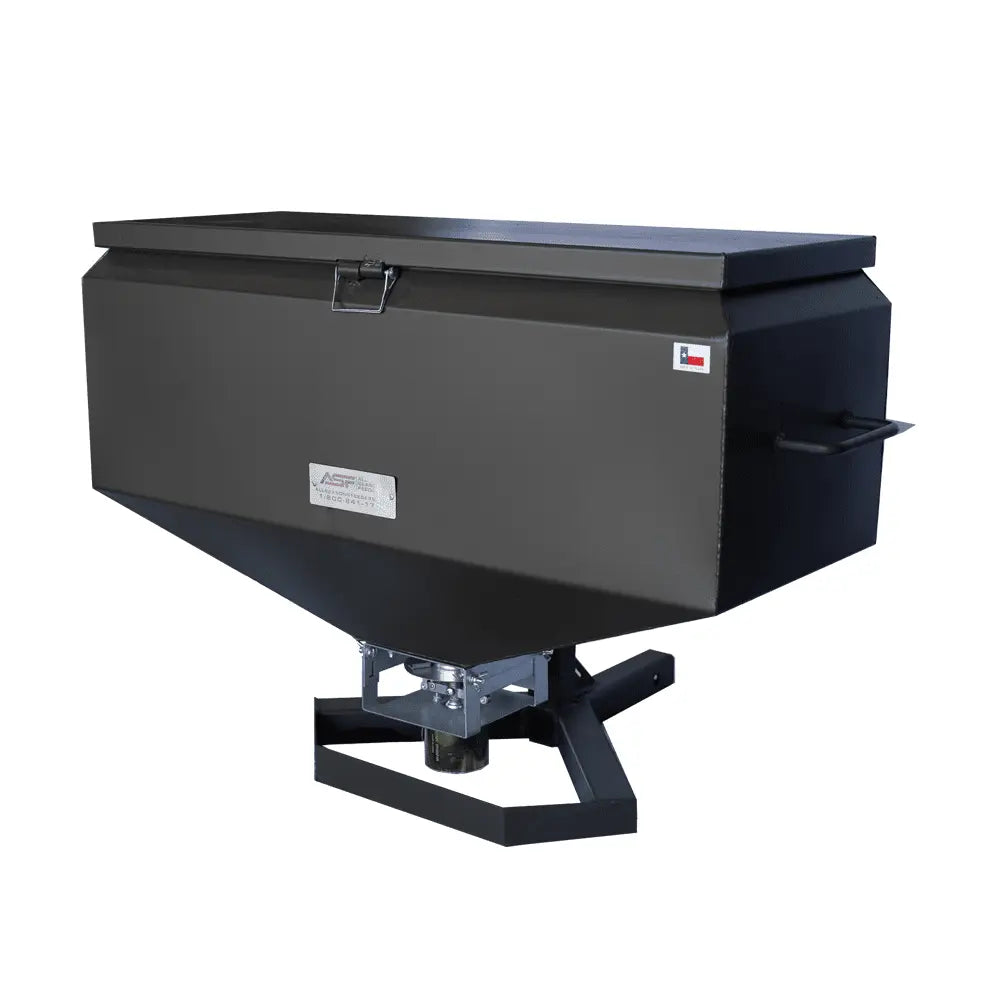
When the job is feeding a big ranch, a hunting lease, or a commercial operation, 100 pounds doesn’t cut it — and that’s the Hercules 200’s entire reason to exist. Two hundred pounds of corn (four bags) in a heavy-gauge steel body, at $549 direct (checked October 2026). It’s the largest hitch-mounted road feeder in All Seasons’ lineup, aimed at the buyer who measures feeding runs in miles, not minutes.
The serious consideration here isn’t the feeder — it’s your hitch. Two hundred pounds of corn plus the steel hopper puts real weight on the receiver, and on rough ranch roads that weight is bouncing. Check your vehicle’s tongue-weight rating before you buy, and if your roads are rough, budget the $49.99 anti-rattle hitch pin All Seasons sells — hitch slop under a 200-lb load is miserable. This is also the unit where the brand’s accessory ecosystem matters most: the Z bracket extension ($95) buys ground clearance if your receiver sits low.
Pros
Cons
From the field
| Spec | Detail |
|---|---|
| Capacity | 200 lb |
| Mount | 2″ receiver hitch |
| Construction | Heavy-gauge steel |
| Price (direct) | $549 (checked October 2026) |
| Best for | Large ranches, leases, commercial use |
5. Lamco UTV50 50 lb UTV Road Feeder — Best for UTVs
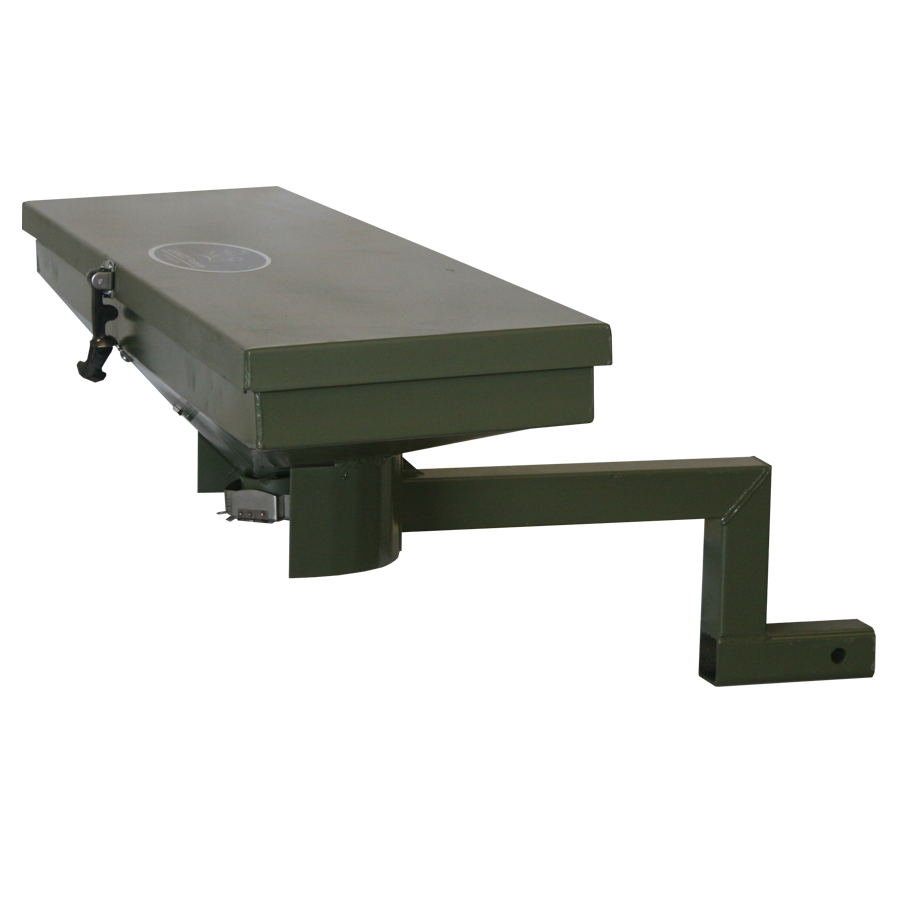
Here’s the problem the Lamco UTV50 solves: a standard truck road feeder mounted on a UTV blocks the tailgate and sits too high to reach comfortably. Lamco’s answer is a raised extension tube that drops the spinner behind the bed and below the tailgate — so the tailgate opens fully and the bed stays usable. It’s the only feeder here purpose-designed for a Polaris Ranger, Kawasaki Mule, or similar side-by-side, and it shows in the details: low-profile hopper for rear visibility, a heavy-duty rubber latch on the lid that stretches tight with no rattling parts to lose, and a 20-foot power cord with a heavy-duty toggle switch for in-cab activation.
The spinner is the other differentiator. Where All Seasons uses a chained spinner plate, Lamco uses a simple bowl design with fewer moving parts — and the independent reviewer who ran both preferred the Lamco’s simplicity for dusty conditions, even while conceding the All Seasons throws harder. At $320 retail (per the review; bought at a Texas implement dealer), it’s priced between the budget galvanized units and the premium Texas Hunter line. Lamco also sells a 100-lb UTV version (58 lbs empty, reinforced bracket) if you need more range.
Pros
Cons
From the field
| Spec | Detail |
|---|---|
| Capacity | 50 lb (100-lb version also sold) |
| Mount | 2″ receiver hitch + UTV extension tube |
| Activation | 20-ft cord, heavy-duty toggle switch |
| Power | 12V (plugs into vehicle accessory outlet) |
| Construction | All-welded steel |
| Best for | UTVs and side-by-sides |
6. SpinTech Outdoors Heavy-Duty Hitch Spreader (50/100 lb) — Best Leak-Proof Design
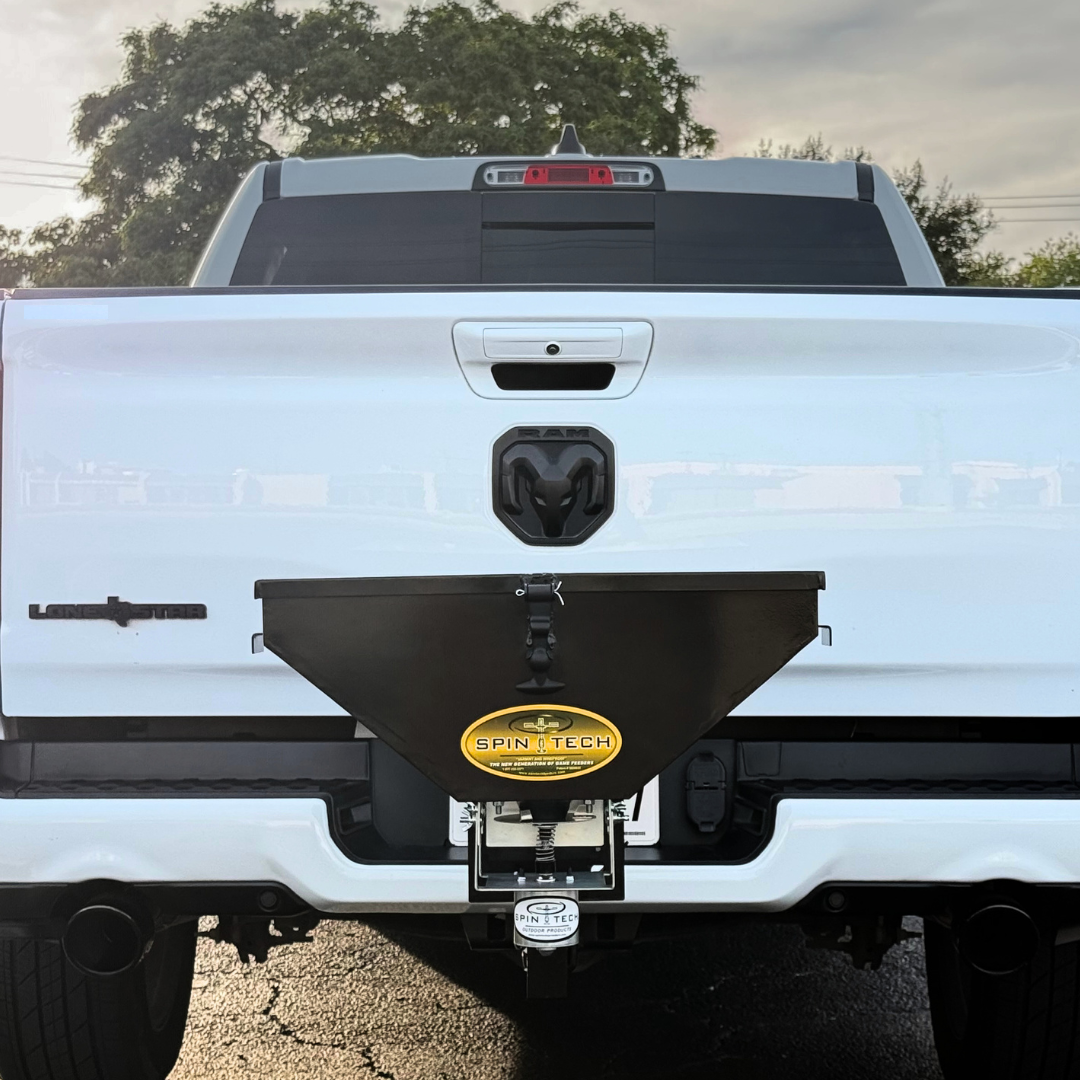
Every road feeder has the same dirty secret: on rough roads, corn leaks out of the spinner while you drive, leaving a “trail of gold” between your actual feeding spots. SpinTech’s answer is a patented spinner mechanism that drops down to dispense, then raises and seals shut when the motor stops — no leakage on bumpy roads, no wasted feed, no accidental bait piles where you didn’t want them. It’s the most mechanically interesting design in this roundup, and the company is explicit that the unit “doubles as a road feeder for corn and feed distribution.”
The specs are solid: 16-gauge powder-coated steel, mounts to any standard 2-inch receiver on truck, UTV, or ATV, and a 25-foot activation cord that reaches the driver’s seat. At $399.99 (checked October 2026 on spintechoutdoors.com), it sits at the premium end — you’re paying for the patented mechanism. SpinTech also sells a 100-lb directional “Sendero” version with a deflector that lays feed in a controlled ~5-foot lane instead of broadcasting wide — worth knowing if your goal is precise sendero feeding rather than maximum spread.
Pros
Cons
From the field
| Spec | Detail |
|---|---|
| Capacity | 50 lb (100-lb version also sold) |
| Mount | 2″ receiver hitch (truck, UTV, ATV) |
| Activation | 25-ft cord for driver’s-seat operation |
| Construction | 16-gauge powder-coated steel |
| Price (direct) | $399.99 (checked October 2026) |
| Best for | Rough roads; zero-waste feeding |
Watch them work: videos
One honest note first: dedicated third-party video reviews of road feeders are scarce on YouTube — most manufacturers host their demos on their own sites instead. What we can show you: the manufacturer’s own road-feeder demo, plus a straight-talking look at the strategy question behind road feeding.
Texas Hunter Products road feeder demo
The manufacturer’s own walkthrough of the tailgate/road feeder concept: mounting to a 2″ receiver, spreading feed on the move, and the wireless remote in action.
Does deer feed attract deer — or just deer hunters?
Arms Family Homestead asks the question every road-feeder buyer should think about: are you patterning deer, or just feeding the local does? Worth watching before you plan your feeding routes.
What a road feeder really costs
The feeder is a one-time buy. Here’s the honest math around it:
| Cost item | What we found | Notes |
|---|---|---|
| Road feeder unit | $299–$549 direct (checked Oct 2026) | All Seasons 50 lb at $299 to Hercules 200 lb at $549; Lamco 50 lb UTV $320 retail; SpinTech $399.99 |
| Anti-rattle hitch pin | $49.99 (All Seasons) | Worth it — hitch slop under a loaded feeder is miserable |
| Receiver extension (Z bracket) | $95 (All Seasons) | Buys ground clearance if your receiver sits low |
| Corn per fill | One–two 50-lb bags | Road feeding has no portion control — you broadcast as you drive, so a 50-lb unit empties fast on long runs |
| 12V battery (optional) | Only if you skip trailer-plug power | Texas Hunter units run off the trailer plug; battery is the wireless option |
The takeaway: budget the feeder plus one accessory (the anti-rattle pin), then budget corn by the run, not the month. A road feeder is a distribution tool, not a set-and-forget feeder — a 50-lb hopper can disappear in a single long ranch loop, which is exactly why the 100 and 200-lb units exist. Pair it with a stationary feeder at your stand sites and use the road feeder to connect the dots.
How to choose the best road feeder for deer
Hitch mount vs. UTV-bed mount
Almost every road feeder uses a 2-inch receiver hitch — it’s the universal standard across trucks, Jeeps, ATVs, and UTVs. The question is what the mount does to the rest of the vehicle. On a truck, a hitch feeder hangs behind the tailgate and costs you nothing in bed space. On a UTV, a truck-style feeder blocks the tailgate and sits too high to fill comfortably — which is why the Lamco UTV50 exists, with its extension tube dropping the unit below the tailgate line. Match the feeder to the vehicle you’ll actually use, not the one you wish you had.
Power: trailer plug, battery, or wired switch
You have three options, each with a trade-off. Trailer-light plug: simplest — no battery to charge — but on the Texas Hunter units you must switch on the parking or headlights to energize the feeder. 12V battery: fully wireless with the remote, but remember to disconnect a terminal in storage or it drains. Wired switch/cord (Lamco’s 20-ft cord, SpinTech’s 25-ft cord): dead reliable, no batteries, no headlight quirk — just a cord to route into the cab. For a feeder you’ll use twice a season, the trailer plug wins on simplicity; for weekly runs, the wired cord is the set-and-forget answer. Our feeder battery guide covers the 12V side in detail.
What capacity do you actually need?
Think in runs, not months. A 50-lb feeder covers short loops around camp or a dove field; a 100-lb unit handles a full morning of senderos; the 200-lb Hercules is for miles of ranch road per run. But weight is the hidden cost: the Lamco reviewer’s rule — “I would not want more weight bouncing around back there on the rough roads we drive on” — was said about a 50-lb unit. Check your hitch’s tongue-weight rating before going big, and remember that your distribution rate is really controlled by your right foot: slow down where you want extra coverage, as the Lamco reviewer puts it.
Legality: check before you mount
Road feeding is baiting, legally speaking — you’re distributing feed to attract deer. In Texas it’s legal (that’s why this entire product category was born there), but many states ban baiting outright, restrict it in CWD zones, or limit it to certain seasons. A Texas Parks & Wildlife biologist has noted that in South Texas brush country, “feed routes where they feed out of a truck or corn the roads” are a standard management tool — but that’s Texas. Check our Texas 2026 rules guide and confirm your own state’s regulations before you buy. Also note: some states prohibit hunting over bait even where feeding is legal — know the difference.
Feeder resources & guides
Road feeders work best as part of a system. Go deeper here:
- Best deer feeders (2026) — the main roundup: 7 stationary feeders compared
- Best gravity deer feeders (2026) — 10 models for set-and-forget sites
- Where to place a deer feeder — funnels, edges, and water
- How far should a feeder be from your stand?
- Best deer feeder batteries (6V & 12V)
- Deer feeder solar panels — for your stationary units
- Are deer feeders legal in Texas? (2026 rules)
- Keeping raccoons and hogs off feeders
- Texas Parks & Wildlife Department — the authority on Texas feeding rules and wildlife management
Best road feeder for deer: FAQ
Final verdict
The best road feeder for deer in 2026 depends on one question: what’s pulling it? For most truck owners, the Texas Hunter RF100 is the answer — a 100-pound reference design with a wireless remote and the flexibility to run off your trailer plug or a 12V battery. It’s the feeder the rest of the category is measured against.
Stretch your dollar furthest with the All Seasons 100 lb ($339 direct), cover the biggest country with the Hercules 200, feed from a side-by-side with the Lamco UTV50, and stop wasting corn on washboard roads with the SpinTech. Whichever you choose, check your state’s baiting rules first — and budget more corn than you think.
Ready to mount up? Start with the default pick below, and read our best deer feeders of 2026 for the full picture — stationary, gravity, and road options side by side.
Last updated: October 2026. Prices and availability change; we verify links and pricing before every review cycle.


