
Moultrie vs Wildgame: which deer feeder deserves your money?
Skip the brand hype. We compared the Moultrie Pro III 250 lb with Wildgame Quick-Set Pro 270 lb, and included the standard Quick-Set 270 and 225 so you don’t confuse a budget feeder with a Pro model.

Wildlife photo: Scott Carroll / Unsplash; not a feeder performance test.
Affiliate disclosure: BestDeerFeeders.com earns from qualifying purchases through some links, at no extra cost to you. We have not personally run a controlled, side-by-side durability test of these models. Manufacturer facts, public owner accounts and our buying analysis are distinguished below. Prices, stock and rules can change.
Our most defensible pick: Moultrie Pro III for flexible control; Wildgame Pro for its built-in guard
At the official prices we checked in October 2026, the Moultrie Pro III page listed $169.99, while Wildgame’s Quick-Set Pro listed $249.99 MSRP. That does not mean the Moultrie is cheaper at every store. It does mean the old blanket claim “Wildgame is the budget brand” is not valid for this exact comparison. Moultrie wins on scheduling and nearby phone control; Wildgame’s guard and square tube legs are compelling when nuisance animals are a recurring problem.
Neither brand has credible, publicly available independent failure-rate data proving it lasts longer. For actual buying decisions, compare the retailer’s total delivered cost, included battery, specific SKU, refill access and how the feeder fits your property.
Meet the two feeders worth comparing first
Product photography is more useful when it shows the exact model. These pictures identify the current Pro III and Quick-Set Pro rather than showing a similar-looking older feeder.
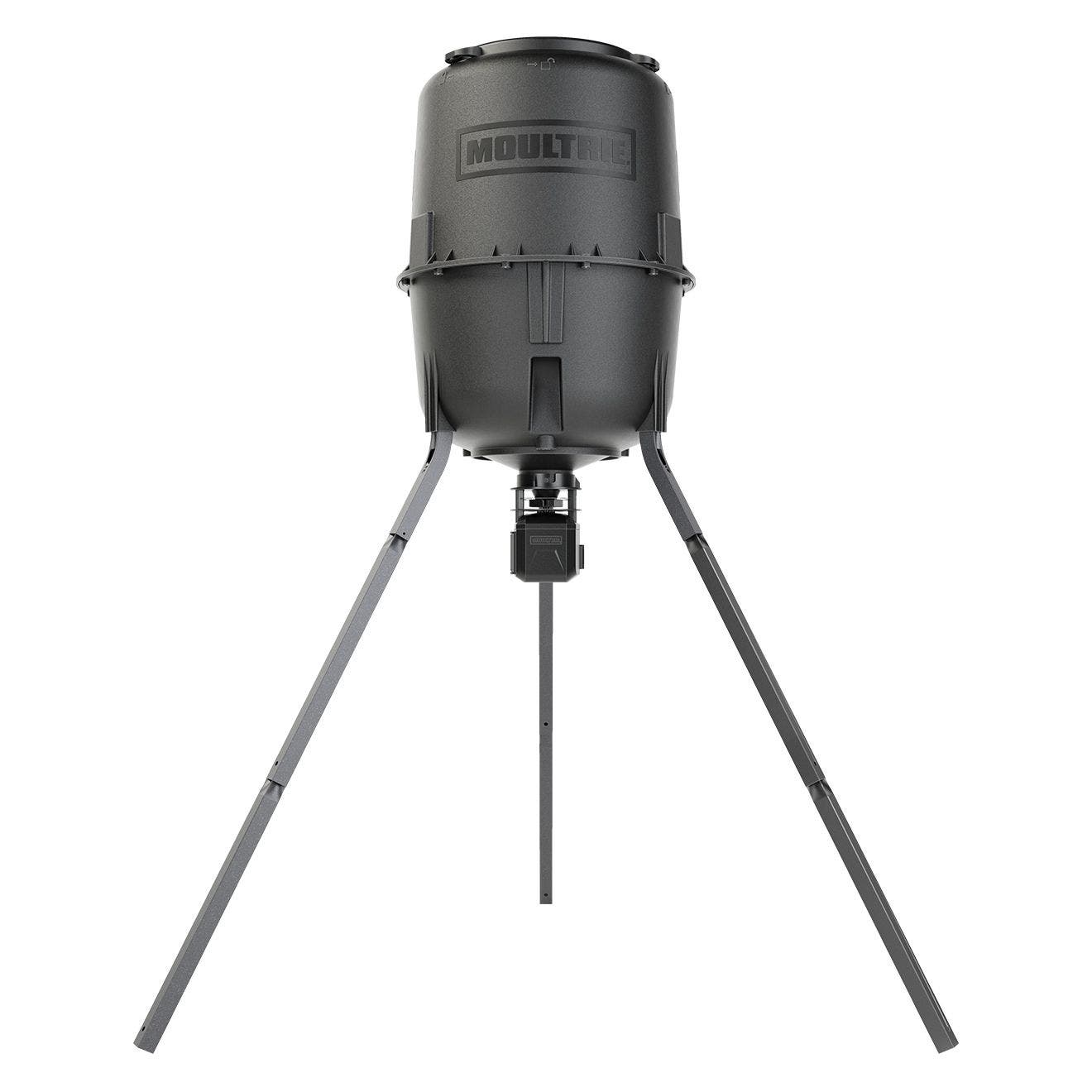
Moultrie 250 lb Pro III
Manufacturer SKU MFG-15104 • Official reference price $169.99, subject to change
What stands out: Bluetooth programming through Moultrie’s app when nearby, a 360° throw, ten feeding events per day, 1–60-second runs and three spinner-speed settings. The 6-foot fill height is a practical detail if you refill with heavy bags of corn.
Don’t miss: a 6V tab-top rechargeable battery is sold separately. Camera-assisted long-range control needs compatible EDGE 3 series hardware; this standard Pro III is not a standalone cellular feeder.
Product image: Moultrie manufacturer. Shown model MFG-15104.
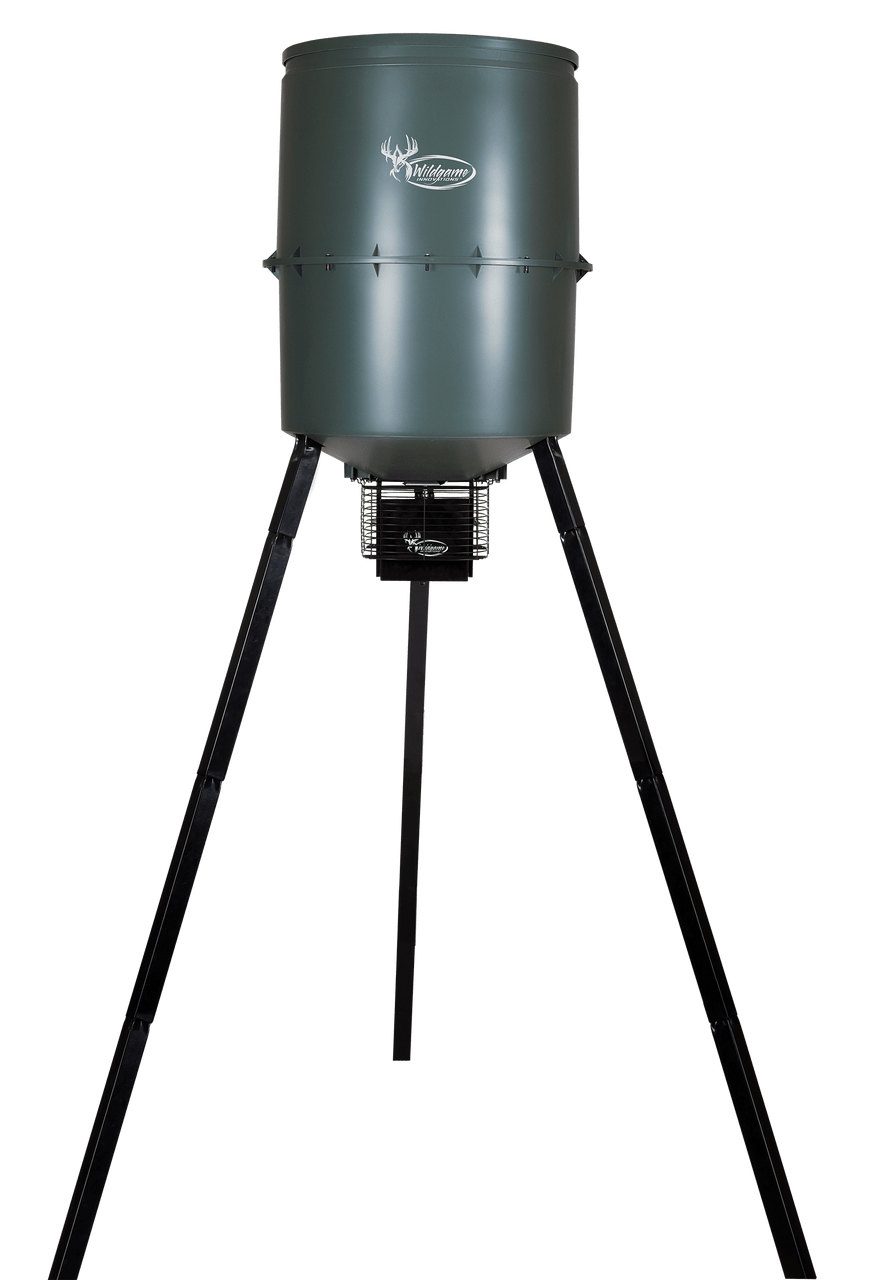
Wildgame Quick-Set Pro
Manufacturer SKU WGI-WGIFD0030 • Official $249.99 MSRP, subject to change
What stands out: a rigid guard around the power-control unit, powder-coated square-tube legs, and a six-event timer with 1–30-second settings. It appeals to hunters who would rather set a straightforward schedule than integrate a feeder with an app.
Don’t miss: a rigid guard protects the power unit; it does not make the plastic hopper animal-proof. Confirm battery requirements and accessories with the exact seller listing before ordering.
Product image: Wildgame Innovations manufacturer. Shown model WGI-WGIFD0030.
Four real feeder choices—with the pictures and buying links in one place
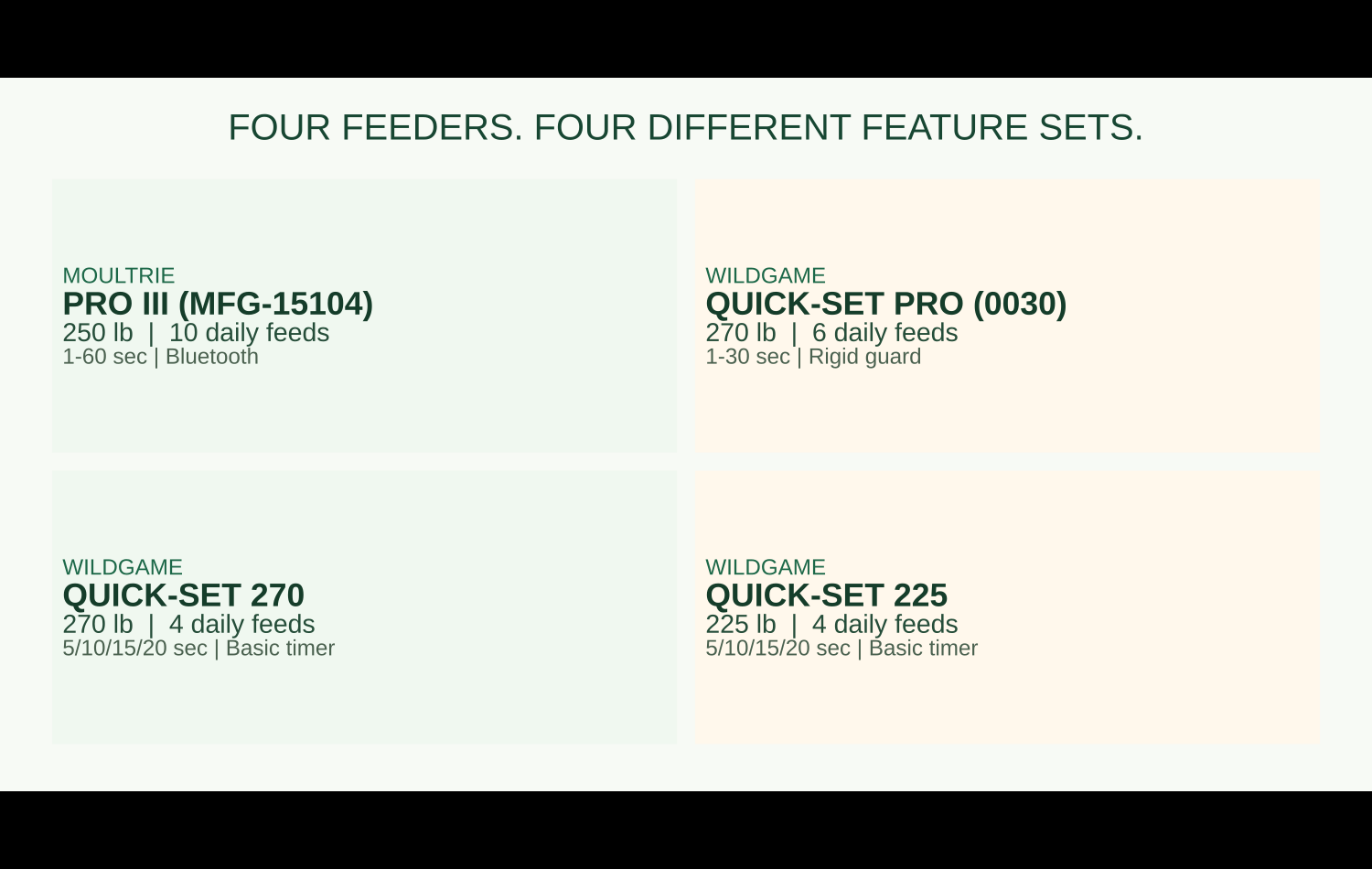
Choose a complete feeder rather than an accidentally substituted timer or motor kit. The first two photographs show the matching Pro models; the standard models use labeled capacity illustrations rather than potentially misleading product photos.
Moultrie Pro III
Model MFG-15104
250 lb • 10 daily feeds • Bluetooth
Manufacturer product photograph
View model on Amazon ↗Wildgame Quick-Set Pro
Model WGI-WGIFD0030
270 lb • 6 daily feeds • Rigid guard
Manufacturer product photograph
View model on Amazon ↗Wildgame Quick-Set 270
Model WGIFD0026
270 lb • 4 daily feeds • Preset timer
Capacity illustration, not product photo
View model on Amazon ↗Wildgame Quick-Set 225
Model WGIFD0025
225 lb • 4 daily feeds • Preset timer
Capacity illustration, not product photo
View model on Amazon ↗Amazon destination pages can change. Moultrie and standard Wildgame models use independently matched ASINs; Quick-Set Pro uses a model-specific Amazon search until its exact product page is confirmed. This site may earn affiliate commission from qualifying purchases.
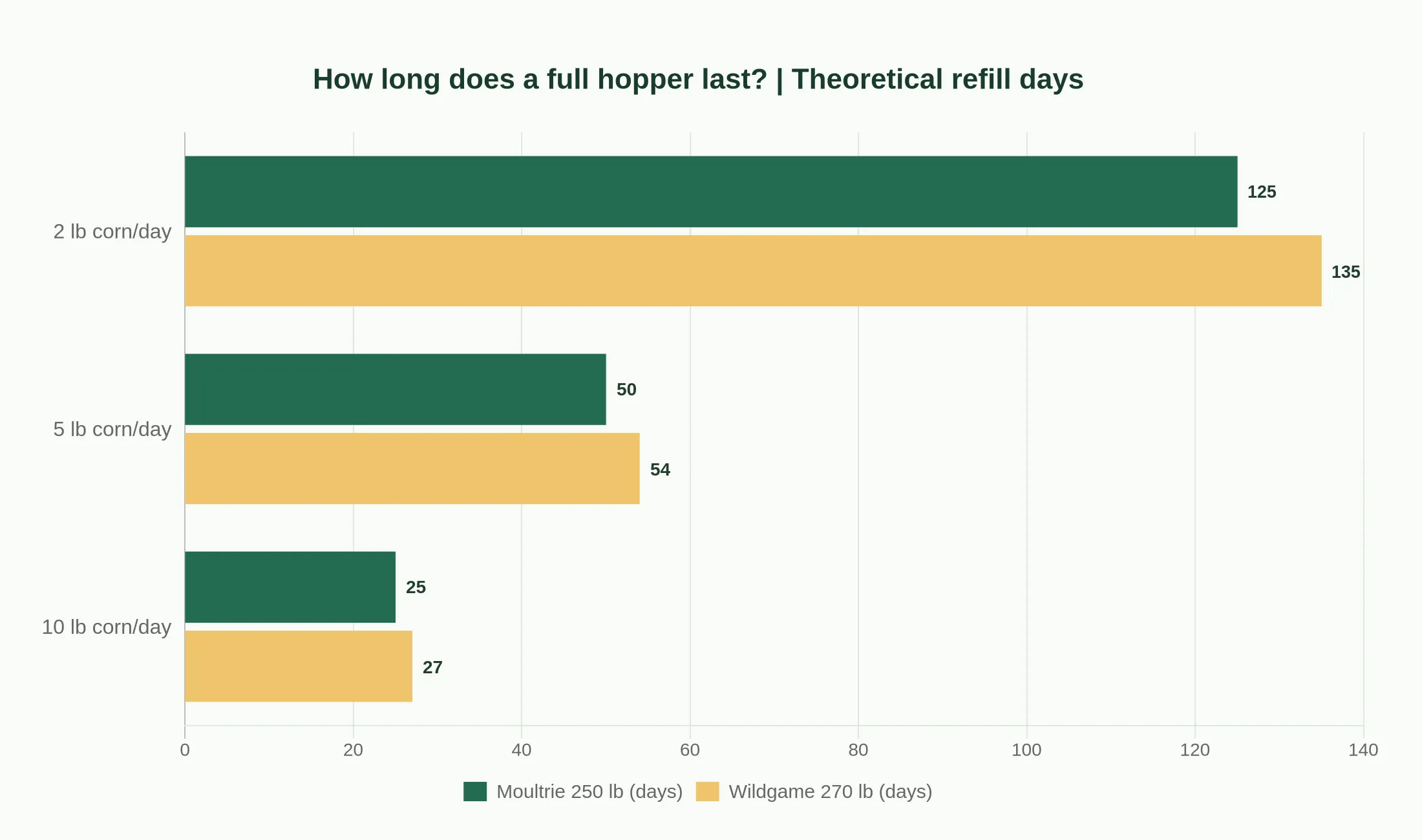
Visual reference: capacities, timers and refills
Which feeder solves your problem?
Nearby phone programming
Choose Moultrie Pro III if you want Bluetooth controls and more feeding slots.
See Moultrie pros and cons ↗Guard around the electronics
Compare Wildgame Quick-Set Pro’s rigid power-unit guard, while protecting the full installation.
See Wildgame pros and cons ↗Simple routine and no app
Compare Quick-Set 225 and 270 when four daily feeds are enough.
Compare all model settings ↗Bluetooth is not remote cellular access
Local Bluetooth setup
Optional camera bridge
The separately sold Moultrie Connected feeder is a different system. Confirm compatible hardware, signal and service before paying for remote features.
Six checks that prevent an expensive wrong order
Accessories and solutions worth checking next
These pages are published on this website and address the questions buyers commonly have after choosing a feeder.
Product specifications are model-specific and subject to manufacturer revision. No side-by-side field durability test or guaranteed Amazon stock is claimed.
The model-to-model comparison that prevents expensive mistakes
Wildgame has multiple Quick-Set models, and Moultrie has several Pro and Connected generations. This is the right table to check before a discount or sponsored marketplace result convinces you to buy the wrong model.
| Specification | Moultrie Pro III 250 lb | Wildgame Quick-Set Pro | Wildgame Quick-Set 270 | Wildgame Quick-Set 225 |
|---|---|---|---|---|
| Identifying SKU | MFG-15104 | WGI-WGIFD0030 | WGI-WGIFD0026 | WGI-WGIFD0025 |
| Hopper capacity | 250 lb | 270 lb class — confirm listing | 270 lb | 225 lb |
| Feeds per day | Up to 10 | Up to 6 | Up to 4 | Up to 4 |
| Run duration | 1–60 seconds | 1–30 seconds | 5, 10, 15 or 20 sec | 5, 10, 15 or 20 sec |
| Program nearby by phone? | Yes, Bluetooth | No equivalent advertised | No equivalent advertised | No equivalent advertised |
| Spinner control | High / medium / low RPM | Digital timed feed | Preset timed feed | Preset timed feed |
| Rigid varmint guard included? | Check kit/guard arrangement | Yes, on power unit | Not claimed standard | Not claimed standard |
| Leg design | Powder-coated steel | Powder-coated square tube | Review exact package | Review exact package |
| Power | 6V tab-top rechargeable, extra | Confirm 6V type and inclusions | Check listed version | Check listed version |
| Manufacturer listed price | $169.99 | $249.99 MSRP | $189.99 MSRP | $179.99 MSRP |
| Best reason to consider | Scheduling, phone features | Built-in guard, leg design | Simple 270 lb routine | Simple 225 lb routine |
Source pages: Moultrie Pro III · Wildgame Pro · Quick-Set 270 · Quick-Set 225. Prices seen October 2026 and not live checkout quotes. Feed settings are manufacturer specifications; we did not independently measure delivery rates.
More possible feeds per day
Moultrie Pro III supports up to four more programmed daily events than the Wildgame Pro; whether you need them is a separate question.
More nominal hopper capacity
The 270-lb class holds 20 additional pounds versus a 250-lb hopper, a difference of only eight percent.
Difference in official list prices
Moultrie’s $169.99 listing versus Wildgame’s $249.99 MSRP when researched. Sales, availability and shipping alter the real deal.
Pros and cons: the features that pay off and the ones that can annoy you
Instead of calling one brand “premium” and the other “cheap,” these pros and cons refer to the two current models photographed above. The cons include real purchase limitations, not invented defect percentages.
✓ Advantages
- Ten daily feed events, useful when testing different schedules.
- Local Bluetooth programming saves opening the control door for every adjustment.
- Three adjustable motor-speed settings.
- Full 360° broadcast with 6-foot fill height.
- Published manufacturer price below the compared Wildgame Pro MSRP.
- Compatible camera bridge can provide added remote features.
✕ Tradeoffs
- 6V tab-top rechargeable battery is separate.
- Bluetooth is not a direct cellular connection from home.
- Remote camera control requires supported EDGE 3 hardware and active camera service.
- Many timer options add complexity if you only need two feeds per day.
- Hopper still needs protection from chewing, weather and unstable terrain.
✓ Advantages
- Rigid guard comes standard around the power-control unit.
- Square-tube powder-coated legs are a meaningful design distinction.
- Six feeds per day with 1–30-second timing, ample for many users.
- Higher nominal capacity than 250-lb Moultrie comparison.
- Direct timer approach requires no phone to set a basic schedule.
- Strong shortlist candidate if accessing the spinner has been a recurring nuisance-animal problem.
✕ Tradeoffs
- Fewer daily feeding events than Pro III.
- No manufacturer-advertised equivalent Bluetooth feature on this model.
- Rigid guard does not prevent animals chewing plastic hopper walls or lids.
- Official MSRP higher at time researched.
- Exact listing must be checked for included battery and accessories.
Decision flow: choose the right feeder in under a minute
“I want to change schedules without opening the timer.”
Local Bluetooth and granular scheduling matter more than a guard or an extra 20 pounds of corn.
“Raccoons keep reaching my spinner.”
A factory-installed PCU guard is important, but you still need to protect the lid, barrel and support legs.
“I just want a dependable fixed schedule.”
Compare the standard Quick-Set 225/270 and local store offers; avoid paying for functions you will never use.
Don’t mistake regular Bluetooth for remote internet control. Compare Moultrie Connected or Pro III plus compatible EDGE 3 camera; account for the camera/service costs.
Re-evaluate the complete installation, enclosure and material choice. A strong control guard alone will not solve structural damage.
Who wins on the problems hunters actually face?
Each verdict is limited to documented features and practical purchasing implications. We don’t assign made-up “9.6/10” ratings or invented reliability scores.
Programming and timer flexibility
Moultrie allows up to ten events, each one to sixty seconds, with selectable RPM and nearby app setup. Quick-Set Pro permits six events at one to thirty seconds. That does not make the Wildgame inadequate; many leases deliberately use one or two carefully timed throws. The extra Moultrie range is most useful for a manager who changes schedules by day, experiments with short events or manages several neighboring feeders. When time and output matter, an actual measured feed test is still essential.
Animal interference
The Wildgame Pro’s rigid guard is a concrete included feature, and a more convincing reason to pay attention than an exaggerated “raccoon-proof” claim. It is designed to shield the power-control unit from direct access. Squirrels can still chew a plastic hopper or lid, and persistent hogs can challenge an unsecured tripod. In online discussions, owners describe very different outcomes even with similar plastic feeder systems, which suggests location and mounting arrangement matter. No controlled evidence here establishes which complete feeder is more animal-resistant.
Phone, Bluetooth and cellular
Pro III provides nearby Bluetooth control through Moultrie’s app without a feeder subscription. If paired with a supported EDGE 3 Series cellular camera, the feeder can communicate through that camera, which itself needs appropriate service and signal. The manufacturer supports up to a 300-foot pairing distance under its guidance; actual obstruction and signal conditions can affect usage. The standalone Moultrie 250-lb Connected model is a separate product and currently advertises an active app subscription. These are three different control arrangements, not interchangeable marketing terms.
Manufacturer technical reference: Pro Hunter III Bluetooth linking guide.
Hopper size and refill effort
At face value, 270 pounds versus 250 is eight percent more capacity. At five pounds of measured corn dispensed per day, that is 54 versus 50 theoretical days, assuming complete usable capacity and no spills. Four days can matter on remote property, but may not cover even one extra battery trip if the feeder must be inspected regularly. Consider safe fill height, the terrain around the legs, lid design and whether you can move filled bags to the opening. A safer, easier refill may matter more than nominal capacity.
Feed throw and control
The Moultrie Pro III publishes an adjustable high/medium/low RPM feature, allowing some control over its broadcast pattern. Don’t convert those settings into fixed measured feet without manufacturer documentation and local testing. Throw distance depends on corn size, dryness, spinner clearance, feed level and wind. Wildgame also offers digital duration control, but this comparison does not assume identical output in pounds per second. For a tight food plot or trail corridor, Moultrie’s separately sold directional Pro III is worth considering rather than trying to force a broadcast model to behave like one.
Weather and long-term durability
Both brands sell feeders for outdoor use, but an IP rating, standard method or verified comparative reliability data is not established for these specific entire assemblies. Water entry, damaged battery terminals, poor feed quality, unsecured lids and loose tripod connections can disable nearly any timer feeder. Don’t confuse manufacturer words like rugged or durable with independently measured service life. Ask which individual components are covered by warranty, and inspect replacement motors, timers and hoppers before choosing. We don’t invent multi-season testing results to award an artificial winner.
First-year purchase value
The surprising result of the manufacturer price check is that a 250-lb Moultrie Pro III was listed for $169.99 while the Quick-Set Pro showed a $249.99 MSRP. It would be irresponsible to call Wildgame universally more economical on that evidence. When comparing Amazon or a local tractor-supply store, include freight, tax, battery, charger, solar kit, anchors and any protective enclosure. The Pro III can represent good feature value, while the Wildgame Pro could still be preferable to someone who values its guard or finds a superior local deal.
Parts, setup and ownership complexity
Moultrie’s documentation and support material for the Pro Hunter III kit provide detailed setup, battery and Bluetooth troubleshooting paths. Wildgame sells accessories and replacement parts, but matching a Wildgame power-control unit to a particular generation can take care. A simple timer can be welcome if several people share a lease, while documented app functions can reduce button-press mistakes for a single operator. Neither advantage supersedes the basics: save the SKU, keep the manual, measure the actual feed rate, and check the legs and wiring during every refill.
What would change our recommendation?
If current delivered prices are similar and your major problem is nuisance animals reaching the electronics, Quick-Set Pro moves up the list. If a local sale makes Moultrie cheaper and flexible control matters, Pro III becomes more compelling. If your property requires low-access, metal, ground-fill or gravity equipment, neither of these plastic tripod feeders necessarily solves the real problem. A sound buying guide should be able to recommend buying neither.
The best feeder for a Texas lease may be wrong for a Georgia creek bottom
Instead of making vague promises about “attracting trophy bucks,” start with the weather, wildlife, distance to the land and how often someone can service the equipment.
Texas lease with feral hog traffic
Do not build the whole plan around the motor guard. Evaluate the legs, anchors, surrounding enclosure and what happens when animals strike the hopper at night. Consider whether you can service the feeder without entering a heavily traveled spot. If the ground is loose or seasonally wet, stabilize the installation according to the maker’s instructions and recheck after the first heavy storm. On a long-drive lease, monitor feed use and battery health rather than assuming a large hopper makes the site maintenance-free.
Georgia, Alabama or South Carolina woods with raccoons
A varmint guard may help at the control unit, but squirrels often target plastic elsewhere and raccoons can exploit a spinner they can reach. Check branches close to the feeder, lids that can be lifted, corn building up on supports, and signs of chewing. A trail camera pointed at the entire feeder, not only the corn pile, can help identify the actual interference. Compare Quick-Set Pro’s guard with total installation measures before blaming the brand.
Upper Midwest winters and short daylight
Cold batteries, frozen feed, hard-to-reach paths and ice on tripod legs can create a larger operational problem than the feed schedule. Test the feeder before the coldest weeks and use the specified battery and charger. A solar panel can extend maintenance intervals but is not guaranteed to replace visits in shaded, snowy conditions. Track feed output and visibility after storms; do not use an assumed “runs all season” claim as your maintenance calendar.
Small food plot or wooded corridor
A 360-degree broadcast can scatter corn outside a narrow clearing or under vegetation. Rather than simply running the spinner longer, measure the pattern and decide whether a directional alternative is more suitable. Moultrie’s Pro III Directional, SKU MFG-15105, is a different product and is designed for focused delivery. If you need a small amount of feed in a controlled area, a larger hopper does not compensate for a poor throw pattern.
Remote multi-property manager
Document the timer on each feeder, the current battery, last refill, feed type and miles per visit. Bluetooth is great when you’re close, but not useful for changing a schedule from home unless there is a supported camera bridge. Compare extra equipment and service costs to the fuel needed for repeated trips. If management is shared, keep setup instructions in a simple file so no one resets a schedule accidentally.
Calculate actual feed consumption and refill trips
The number that matters isn’t printed on the hopper. It’s the pounds your installation dispenses per day. Run a controlled throw according to the owner’s manual, weigh the actual feed distributed and record your timer setting, feed condition and motor speed.
Weigh one test throw
Record the dry corn used over several short programmed events. Compare the hopper or container weight before and after, and average the runs to reduce measurement error.
Multiply by daily events
If one measured event throws 2.5 pounds and you program two events daily, daily consumption is approximately 5 pounds, before waste and feeding by non-target animals.
Divide nominal capacity
At 5 pounds per day, a 250-lb hopper has a theoretical 50-day interval; a 270-lb one has 54. Leave a realistic safety margin instead of planning trips to the last grain.
| Measured corn use per day | 250-lb hopper | 270-lb hopper | Extra theoretical days from 20 lb |
|---|---|---|---|
| 2 lb | 125 days | 135 days | 10 |
| 4 lb | 62.5 days | 67.5 days | 5 |
| 5 lb | 50 days | 54 days | 4 |
| 8 lb | 31.25 days | 33.75 days | 2.5 |
| 10 lb | 25 days | 27 days | 2 |
Your own refill estimator
Enter actual measured daily feed use. This calculator shows arithmetic capacity estimates, not a guaranteed refill interval.
The calculator is optional JavaScript enhancement: if a browser blocks scripts, the starting sample of 5 lb/day with a 10% safety reserve stays visible. It assumes linear feed use and no spoilage, spills or density changes.
How to run a practical test safely
Before touching any spinner or feed chute, disconnect the feeder’s power. Follow the maker’s test procedure and stand clear of moving parts and flying corn while the motor operates. Record test duration and results. If output changes dramatically after a rainstorm or when switching between corn and pellets, investigate clumping or a blocked funnel rather than simply increasing motor runtime. Keep a date-stamped log so you can spot worsening performance before an entire bag is wasted.
First-year ownership: a more useful price comparison
Hopper price is the easiest number to advertise and often the least complete. Add the power equipment, delivery, anchoring, consumable feed, site visits and repairs that your property actually requires.
| Cost or decision | Moultrie Pro III | Wildgame Pro | How to estimate |
|---|---|---|---|
| Official reference price | $169.99 | $249.99 MSRP | Replace with current delivered checkout price. |
| Battery | 6V tab-top rechargeable, extra | Verify specification & inclusion | Match terminals, voltage and battery type. |
| Solar charging | Compatible option, extra | Check accessory compatibility | Only count if suitable sun exposure and wiring. |
| Animal protection | Site- and kit-specific | Rigid PCU guard included | Don’t assume an included guard protects the whole barrel. |
| Refill travel | Driven by real daily feed use | Driven by real daily feed use | Trip miles × actual vehicle costs × expected trips. |
| Repairs and downtime | Unknown | Unknown | Keep a repair reserve; don’t invent defect odds. |
Illustrative annual corn budget
At 5 lb/day for 180 days, you would use about 900 lb of feed, regardless of whether the hopper holds 250 or 270 pounds. At an assumed $0.25 per pound, that equals $225 in corn. That price is a hypothetical example, not a current local corn quote.
The larger Wildgame hopper changes how often you refill, not how much feed your programmed schedule consumes. If the two feeders dispense at different actual rates, measure and recalibrate before making the comparison.
Illustrative trip budget
If a feeder needs five refill and inspection trips over a season, and the round trip is 60 miles, you drive 300 miles. At a hypothetical $0.50 per mile including fuel and wear, that’s $150 of travel costs, not counting your time.
That is why battery reliability and service access can be worth more than a small difference in advertised capacity. Shared leases should track who checked the site so repeated trips don’t eat up any saving from a cheaper model.
Eight ownership details that change which feeder is right
Battery and connector traps
The Moultrie Pro III specified in this article needs a 6V tab-top rechargeable battery, purchased separately. The name “Moultrie” alone is not sufficient to buy a battery: some separate models require sealed lead-acid batteries, others take AA cells or differ in their charging connection. Likewise, Wildgame’s product line includes several voltage and timer variations. Never wire a 12V solar charger into a 6V system just because the connector appears convenient. A mismatched voltage can damage electronics or create an unsafe condition. If you plan to leave a feeder for weeks, bring the exact battery manual to your first setup, confirm polarity, and document battery installation date. Look for corrosion, brittle connectors and signs of water intrusion at every refill.
How Moultrie app control actually works
Nearby Bluetooth and cellular remote access are not identical. A Pro III can connect directly to a phone in local Bluetooth range. Moultrie’s manufacturer guide says eligible Pro Hunter III equipment can link by Bluetooth Low Energy to a powered, active EDGE 3 series trail camera as a bridge, with the camera and feeder within about 300 feet of each other in supported conditions. From there, the connected camera provides cellular communication. The company notes that remote operation uses the Moultrie app and that camera connectivity and service must be maintained. Contrast that with the separately marketed Moultrie 250-lb Connected model, which has a Feed Hub system and currently requires an active subscription. A shopper who buys the wrong SKU can easily mistake an included feature for an extra ecosystem purchase.
Solar before or after purchasing?
A compatible solar panel may reduce charging visits if a site’s sunlight and usage profile allow it, but it does not increase hopper capacity, fix a jam or protect a lid from chewing. Check the specific feeder’s supported solar voltage and intended battery chemistry. Inspect the cable routing and avoid placing wiring where animals or fast-moving feed can damage it. Full tree canopy, long stretches of overcast weather and short winter days can reduce practical charging performance. Instead of assuming a panel has made the setup maintenance-free, establish a battery-voltage baseline and revisit it after the first few scheduled feed events. Only then can you decide whether the panel saves enough trips to justify its price.
Corn versus protein pellets
The standard Wildgame Quick-Set 225 and 270 product pages list both corn and protein-pellet feeding, but this does not automatically establish pellet compatibility for every brand variant, funnel or motor kit. Pellet size, moisture, fines and hopper geometry all influence feed flow. A timer that works with clean dry corn may give a different measured output with another material. Consult the manual, avoid wet or moldy feed, and test a small amount before committing to a full hopper. Wildlife feeding is not a complete nutritional management program; landowners concerned about deer health should consult qualified local wildlife and habitat guidance rather than assuming supplemental corn will improve antler quality or herd condition.
Broadcast versus directional delivery
A broad 360-degree spinner distributes corn around the feeder and can cover a clearing where animals approach from multiple directions. A directional kit focuses delivery into a narrower area, a potentially better fit for trail corridors, fence lines or locations with obstacles. Do not assume that shortening a 360-degree feeder’s timer produces the same pattern as a directional system. Check whether corn is being thrown into water, dense brush, a road or a neighboring property. Moultrie’s Pro III Directional carries its own SKU, MFG-15105, and should not be silently substituted for the broadcast Pro III we compare. Wildgame’s Quick-Set Pro is also a broadcast-style feeder; the right choice depends on the usable landing area.
Assembly and the risk of flimsy support
Easy assembly is valuable only if the final structure is secure. The standard Wildgame Quick-Set marketing states an approximately fifteen-minute setup, but assembly speed is a manufacturer claim rather than our timed test. The way tripod legs attach to the barrel is more important than shaving a few minutes from the job. On a buyer’s first day, lay out all hardware, check that every supplied part matches the manual, and tighten connections evenly according to its instructions. Set the empty feeder on stable level ground before adding feed. After the first weather event, inspect the ground and every joint. Do not move a full feeder across uneven terrain unless the manufacturer explicitly permits that procedure.
Maintenance without creating more problems
The most economical repair is often preventing a second failure. At each refill, inspect the hopper lid for deformation and moisture, the spinner for obstruction, the legs for shifting, and the battery leads for corrosion. Check timer clock accuracy after power changes, especially where the control box has been opened in rain. If the feeder is not dispensing, disconnect power and inspect for blocked feed before replacing the motor. Do not wash electrical controls with a hose or allow moldy feed to contaminate a new batch. Record repairs against the model number so future replacement parts can be ordered quickly, and keep your receipt for any warranty query.
The first thirty days after setup
Treat the first month as an acceptance test rather than declaring victory after the first successful spin. During week one, test the timer and measure output with dry feed. During week two, inspect the feeder after its first rain, wind or nocturnal animal visits. In week three, compare camera activity with feed times, but avoid repeatedly changing location, schedule, feed type and camera placement at once. In week four, reconcile corn used with your refill estimate, evaluate battery health and inspect the supports. If the feeding area is attracting non-target animals, adjust the whole system rather than blaming the name on the hopper. This process also helps you spot assembly or warranty issues while documentation is still easy to find.
Make the purchase easier: the 12-point retailer checklist
Before clicking the final payment button, confirm these details instead of relying on the most attractive hero photo or a high star average aggregated across different feeder generations.
Exact SKU
MFG-15104 vs WGI-WGIFD0030, never just the brand name.
Complete feeder or kit?
A feeder kit might be only the motor and timer, not the hopper/legs.
Correct hopper capacity
A 225, 250, 270 and 30-gallon item may look similar in results.
Battery included?
Read the actual seller’s what’s-in-the-box section.
Battery connector
Voltage, terminal type, rechargeable chemistry, polarity.
Delivery charges
Large plastic hoppers can involve oversize shipping.
Material and lid
Look for a secure close and practical service access.
Leg hardware
Confirm the assembly hardware is included and documented.
Guard coverage
Check whether the guard protects the PCU or the whole system.
Warranty conditions
Read exclusions before relying on a headline duration.
Return route
Who handles a damaged or incomplete shipment?
Parts availability
Can you source the right timer, spinner and motor later?
What actual owners complain about—and why we don’t turn anecdotes into fake ratings
Hunting forums and retail reviews are useful because they reveal failure modes product pages rarely mention. They’re not laboratory tests. We preserve model age and source context so an older unit’s experience isn’t sold as a current Pro III finding.
Quick-Set 225 leg connections
A July 2026 syndicated retail review of the Quick-Set 225 praised the budget value but suggested improving the way its legs lock. This is a shopper’s report about the 225, not proof the square-leg Quick-Set Pro has the same problem.
Source: Scheels Quick-Set 225 owner reviews. Seller syndication and the absence of controlled inspection limit generalization.
“Raccoon-proof” is a dangerous shortcut
In a 2023 hunting discussion, several owners with different feeders described raccoons continuing to reach corn despite guards or improvised setups. That illustrates why a metal cage or rigid control guard is only one layer of an installation. It does not prove one current brand is more durable.
Source: r/Hunting corn feeder discussion. Older models, uncontrolled conditions and self-reported experiences.
Squirrels and plastic hoppers
An October 2026 owner thread describes chewing around a plastic feeder lid. Other commenters describe very different experiences with their own plastic Moultrie units. The useful lesson is to monitor lid and barrel damage—not to assign a made-up brand failure rate.
Source: r/Hunting discussion, October 2026.
Two useful feeder videos—with clear model context
Videos work best when readers can see timer menus, wiring, hopper assembly and a full spin test. The first is a 2025 Pro Hunter III review; the second is the 2025 manufacturer’s demonstration. Neither should be interpreted as a head-to-head longevity study, and the Wildgame Pro must be verified with its own instruction manual.
Owner-oriented look: Pro Hunter III
Rack Daddies, June 2025. A review lead for how the kit is controlled through the app. Treat opinions as creator testimony, not independently repeated test data.
Open original videoManufacturer walk-through: timer and Bluetooth
Moultrie, June 2025. Useful for viewing advertised features and housing design; brand-produced footage is marketing evidence, not a disinterested test.
Open original videoNeed to see a Wildgame demonstration?
Watch the Wildgame Innovations feeder setup and demonstration (2017) for historical construction context, but do not assume that older feeder has the 2026 Quick-Set Pro’s square legs, rigid guard or timer. For the exact current Quick-Set Pro, use the manufacturer product page and model-specific manual. A dated independent Quick-Set Pro assembly test with measured output is still an editorial gap worth filming.
Helpful add-ons that can save a second shopping trip
These images identify accessory categories. An accessory sold under the same brand is not automatically compatible with every feeder carrying that logo.
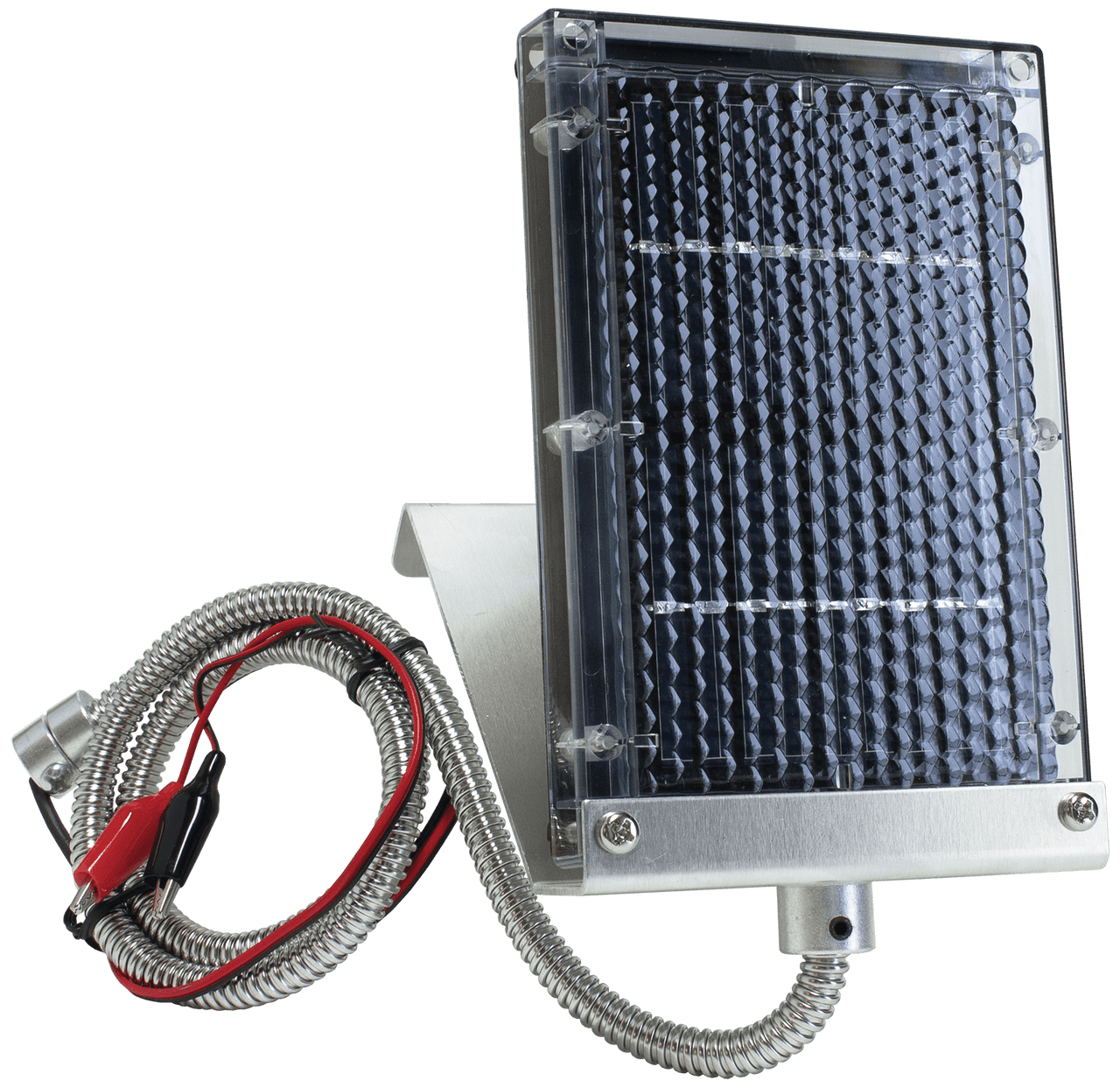
6V solar panel
Potentially useful for distant land where battery charging trips add cost. Confirm voltage, cable fit, charging profile and sunlight exposure first.
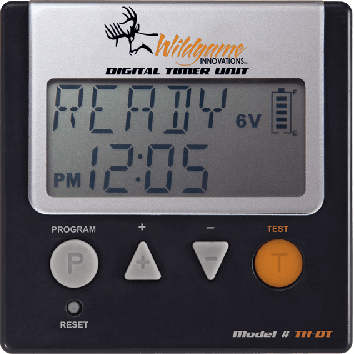
Digital timer
When replacing a timer, compare controller part number, mounting, motor wiring and firmware generation. An older timer picture cannot identify a current unit.
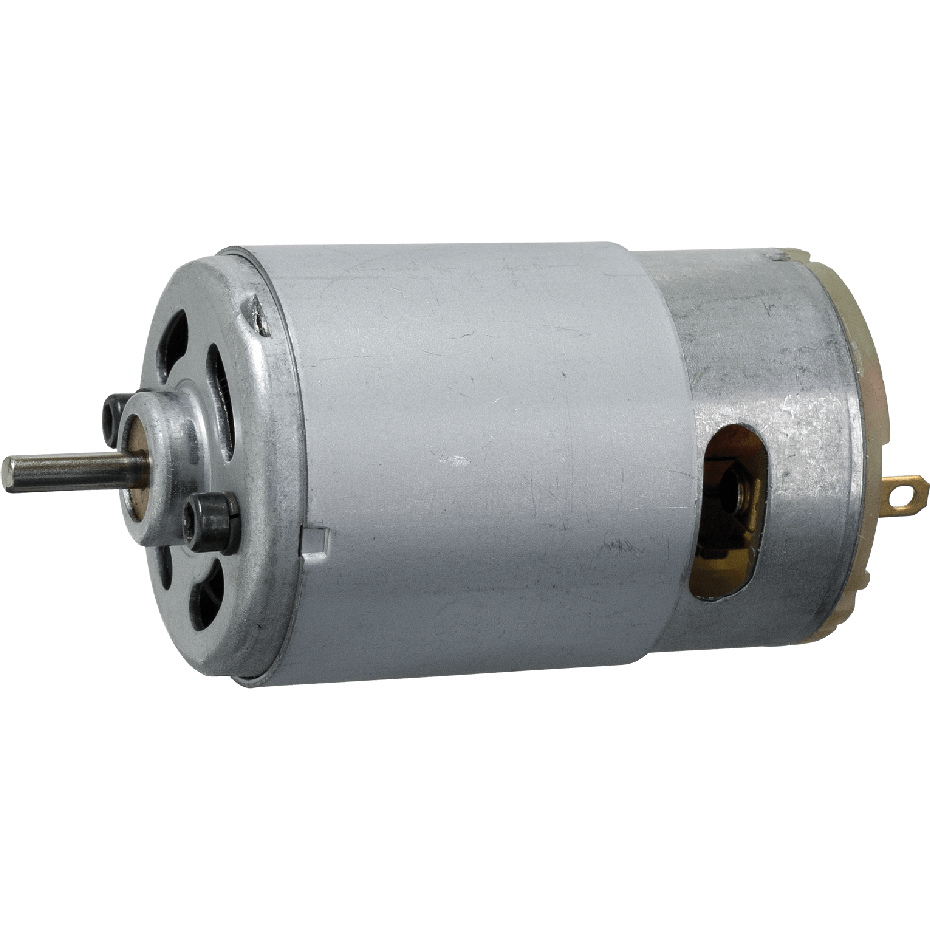
Replacement motor
Confirm voltage, shaft diameter, gearbox orientation and mounting hardware; never buy by voltage alone or swap unverified parts across brands.
Accessory photos from this site’s existing media library; intended to illustrate accessory types. Exact compatibility must be confirmed with each product manual.
The installation and maintenance sequence we’d actually use
Before buying
Identify SKU, total delivery price, battery type and feed restrictions; check if the package includes a guard and all mounting hardware.
On assembly day
Sort parts, set the empty tripod on stable ground, tighten approved fasteners and install the maker-specified battery with correct polarity.
Test before filling
Program one conservative event, follow the manufacturer’s test procedure and observe dispersion from a safe distance, away from moving parts.
Measure corn output
Weigh consumption for two or three short events and use the calculator above for estimated refill intervals with a reserve.
After the first rain
Check the lid and hopper for water entry; inspect the spinner, legs, timer housing and battery connections.
Every refill visit
Inspect for damaged feed, pests, leaks, corrosion, loose joints and an accurate controller clock; document any change.
End of season
Empty and clean as instructed, remove power equipment if specified, and preserve the receipt, settings photos and component part numbers.
Moultrie vs Wildgame: answers before you checkout
Is Moultrie or Wildgame the better deer feeder brand?
No manufacturer logo is universally better for every property. Among the exact models compared, Moultrie Pro III offers more schedule control and nearby Bluetooth programming, while Wildgame Quick-Set Pro includes a rigid varmint guard and square legs. Reliability must be assessed through installation needs and documented ownership reports, not made-up percentages.
Which is better for raccoons and squirrels?
The Wildgame Pro’s guard is the clearest included control-unit protection feature in this comparison. It does not protect every part of the plastic hopper. Check how animals reach the device, whether branches aid climbing, and whether damage is occurring to the lid or barrel rather than the spinner.
Is Moultrie Pro III cellular?
The standard Moultrie Pro III is Bluetooth-capable. Remote control from elsewhere requires compatible EDGE 3 camera-based Moultrie Connect functionality. The separately sold Moultrie 250-lb Connected is a different SKU with its own cellular service requirements.
Does Moultrie Bluetooth require a subscription?
Moultrie advertises nearby Bluetooth programming without a subscription for the Pro Hunter III system. Camera-linked remote features depend on compatible hardware and an active camera service plan. The standalone Connected feeder is advertised with a separate active Moultrie app subscription.
How many times can these feeders throw corn per day?
Moultrie Pro III allows up to ten programmed events per day, Wildgame Quick-Set Pro up to six, and standard Quick-Set 225/270 models up to four according to their manufacturer listings. More possible events do not automatically improve hunting results.
Do batteries come with either feeder?
Moultrie explicitly sells the Pro III’s 6V tab-top rechargeable battery separately. For Wildgame, confirm battery inclusions and the correct type on the exact retailer SKU and box contents, because package and version details can differ.
Can I use corn and protein pellets?
Wildgame’s official descriptions for standard Quick-Set 225 and 270 mention corn or protein pellets. Do not generalize that statement to every model. Check the specific manual and test clean, dry feed, because pellet size and moisture influence flow.
How far will the corn throw?
Throw pattern depends on motor, spinner design, settings, wind and feed condition. Moultrie Pro III advertises adjustable RPM and 360-degree coverage; precise real-world radius should not be invented. Test with the chosen corn at your property.
Will a 270-pound feeder last noticeably longer than a 250-pound feeder?
If everything else is equal, it holds eight percent more feed. At a measured five pounds used per day, the theoretical intervals are 54 and 50 days. Your actual schedule, usable capacity, non-target feeding and waste determine the real difference.
Can I buy the Wildgame motor for a Moultrie feeder?
Not safely based only on superficial similarity. Cross-brand adaptation requires manufacturer confirmation of voltage, shaft dimensions, wiring polarity, motor speed and mounting. Use an exact compatible replacement where possible.
Is a tripod deer feeder legal in every US state?
No. Feeding and hunting over bait can be restricted by state, season, land type and CWD management boundaries. Verify the current rule with the state wildlife agency for the precise parcel before placing feed.
What is the best beginner choice?
If you want two fixed daily feed events, compare standard Quick-Set 225/270 against discounted Pro models. If phone setup would genuinely reduce mistakes, the Pro III may be easier for you despite having more features. Shop actual delivered cost and don’t pay for a capability you won’t use.
Does an expensive feeder guarantee more deer or bigger antlers?
No. Habitat quality, hunting pressure, seasonal food supply, deer movement, local regulations and overall herd health are outside a timer’s control. A feeder can make supplemental feed available on a schedule, but it cannot guarantee visits, harvest opportunities or nutritional outcomes.
What should I check if my timer runs but no corn comes out?
First disconnect power and inspect the outlet and spinner for blockage or damaged feed. Confirm the hopper is dry, the motor turns as instructed, and the battery has sufficient charge. Consult the exact model’s troubleshooting manual instead of forcing the spinner by hand while it is powered.
Are these recommendations based on independent field tests?
No. This guide combines official model documents, publicly accessible dated owner reports, practical operating calculations and transparent editorial analysis. We have not personally measured side-by-side throw distance, quantified reliability or performed a multi-season durability trial.
Buy the solution to your problem, not just the brand name
If your top priority is schedule flexibility…
Start with Moultrie Pro III MFG-15104. Its combination of up to ten daily feeds, adjustable spinner speed and local Bluetooth control is stronger for buyers who change settings. At the maker’s listed price checked for this article, the pricing also compares well against Wildgame Pro MSRP.
Check Moultrie offers ↗If your top priority is access to the spinner…
Start with Wildgame Quick-Set Pro WGI-WGIFD0030. The rigid power-unit guard is a real product distinction, although hopper and installation protection still matter. Make sure its final retail price and included power accessories justify the difference for your land.
Check Wildgame offers ↗Amazon product selection and prices may change. Compare the exact SKU at checkout. We may receive an affiliate commission, which does not increase your price.
Where our product facts and owner observations came from
This review was updated for a US audience in October 2026. Product claims below are attributed to manufacturer pages; customer comments are clearly described as anecdotes. We did not conduct a controlled 2026 head-to-head test and do not pretend that Amazon product search pages represent verified single-SKU purchase links.
- Moultrie 250-lb Deer Feeder Pro III — SKU MFG-15104 — capacity, schedules, Bluetooth, power, fill height and warranty.
- Wildgame Quick-Set Pro — WGI-WGIFD0030 — six event timer, rigid guard, square-tube legs, current MSRP.
- Wildgame Quick-Set 270 — 270 lb, four events, preset lengths and advertised feed types.
- Wildgame Quick-Set 225 — 225 lb and preset-timer specifications.
- Moultrie Pro Hunter III official setup — battery installation, programming and safe test.
- Moultrie Connect BLE linking guide — EDGE 3 series camera requirements and operating behavior.
- Moultrie 250-lb Connected model — distinguish standalone cellular hardware and subscription.
- Scheels Wildgame Quick-Set 225 owner reviews — individual dated reviewer observations on older/lower-tier model.
- 2023 r/Hunting discussion about raccoons — owner-reported animal pressure; not a brand reliability sample.
- October 2026 r/Hunting discussion about plastic feeders — varied first-person reports about squirrels and plastic lids.
- NC Wildlife 2026 CWD guidance — example of region-specific feeding restrictions; not a universal law.
- 2025 Pro Hunter III video — Rack Daddies and Moultrie official Pro Hunter III introduction — demonstrations and editorial context, not proof of durability.
Keep researching the right feeder type
Our broader best deer feeders buyer’s guide includes gravity, automatic and hanging systems for properties where neither model on this page makes sense. Your own measured feed use, refill access and local hunting law should decide the final equipment choice.
Products mentioned in this guide
Amazon product B0FKD3B1T1
Check on Amazon ↗ASIN B0FKD3B1T1 · Confirm price and availability on AmazonAmazon product B00JSPJTKA
Check on Amazon ↗ASIN B00JSPJTKA · Confirm price and availability on AmazonAmazon product B00IIULX9G
Check on Amazon ↗ASIN B00IIULX9G · Confirm price and availability on AmazonAs an Amazon Associate, we earn from qualifying purchases.


