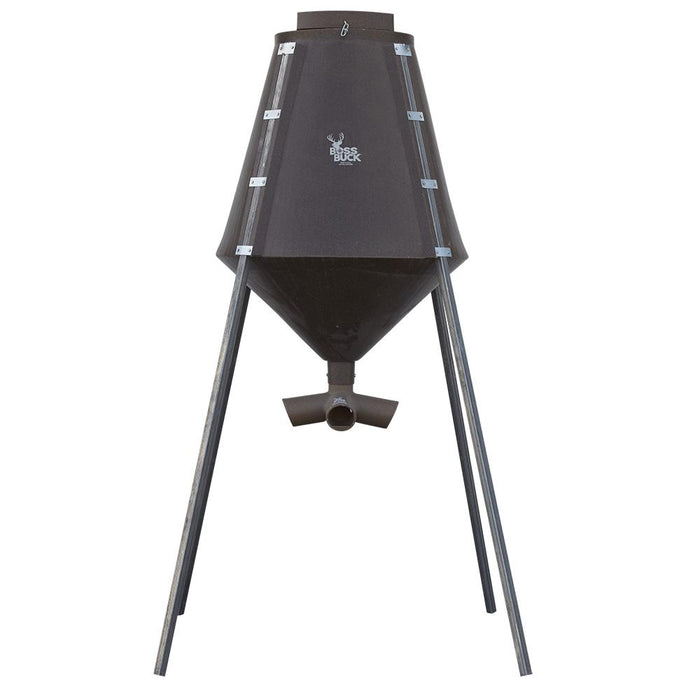
Best ATV Seed Spreader for Food Plots (2026)
Disclosure: This post contains affiliate links. As an Amazon Associate, we earn from qualifying purchases at no extra cost to you. Prices below are dated snapshots checked October 25, 2026, not live prices — recheck the listing before you buy, since prices and availability change.
Your 30-second spreader route
2026 food-plot buyer’s guide • 5 ATV spreaders
Size your plots first, match the spreader type, then open the review for owner signals and the honest weaknesses.
Buying on Amazon? Prime members get fast, free delivery on eligible items, and new members may qualify for a free trial. See Prime options →
PLOT SIZE ▸ MATERIAL ▸ BEST FIT
80 lb ATV/UTV 12V receiver-mount spreader.
Boss Buck BB-1.80 — wireless remote, 80 lb hopper; read the 3.6-star rating first.
Agri-Fab 130 lb tow-behind — 10–12 ft spread, about 3,400 ratings.
Chapin 8622B TurfPro — auto-stop impeller, 11 gate settings; not for lime.
Contents
- The short answer
- At-a-glance comparison
- Mount-on or tow-behind? Decide in four steps
- How we picked these five
- 1. 80 lb ATV/UTV 12V Broadcast Spreader — Best value 12V mount
- 2. Boss Buck ATV Seeder Spreader — Best wireless control
- 3. Agri-Fab 130 lb Tow-Behind — Best tow-behind
- 4. Chapin 8622B TurfPro Tow-Behind — Best auto-stop tow-behind
- 5. Moultrie ATV Spreader — The food-plot name everyone knows
- Watch: spreaders in action
- What an ATV spreader really costs
- Seed-rate table: clover, brassicas and rye
- How to choose the right ATV seed spreader
- Resources hub
- Frequently asked questions
- Final verdict
The short answer
For food plots under 5 acres, a 12V ATV-mounted broadcast spreader with an 80 lb hopper is the simplest choice. For larger plots or lime, a pull-behind spreader carries more and spreads more evenly.
If you want one recommendation, start with the 80 lb ATV/UTV 12V broadcast spreader: it mounts to a receiver hitch, runs off your machine’s 12V power, and holds enough seed or fertilizer for a small plot without a trailer trailing behind you on tight timber trails. If your plots are bigger, rougher, or mostly fertilizer and pelletized lime, skip ahead to the Agri-Fab tow-behind. The comparison table below lays out all five side by side, and the decision flow after it will point you to the right type in under a minute.
Our 3 picks at a glance
- Best overall value: 80 lb ATV/UTV 12V Broadcast Spreader — simple receiver mount. Check Price on Amazon →
- Best tow-behind: Agri-Fab 130 lb Tow-Behind Spreader — 130 lb hopper, 10–12 ft spread. Check Price on Amazon →
- Best wireless control: Boss Buck ATV Seeder Spreader — wireless remote and adjustable nozzle, but read the honest 3.6-star rating before buying. Check Price on Amazon →
Fast picks: all five spreaders
Best overall value
80 lb ATV/UTV 12V Broadcast Spreader
Simple receiver mount — the simplest choice for plots under 5 acres.
Caution: Fine seed may need an agitator workaround.
Best wireless control
Boss Buck ATV Seeder Spreader (BB-1.80)

Wireless start/stop from the seat; 80 lb hopper, 2 in. receiver.
Caution: 3.6-star rating; wash the hopper after salt and fertilizer.
Best tow-behind
Agri-Fab 130 lb Tow-Behind (45-0463)
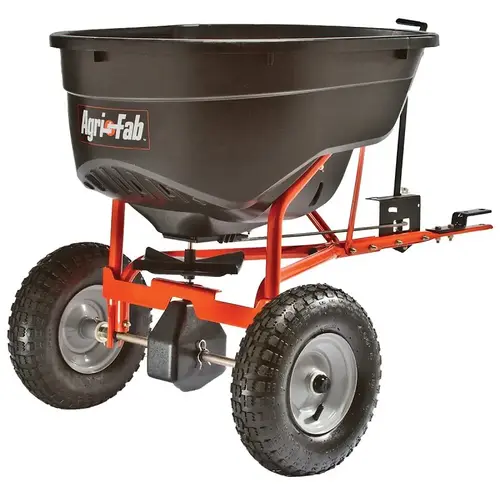
130 lb hopper; 10–12 ft spread; larger plots and fertilizer.
Caution: Needs storage for a 48 in. long trailer.
Best auto-stop tow-behind
Chapin 8622B TurfPro Tow-Behind

Auto-stop dual impeller; 11 gate settings; stops waste at turns and gates.
Caution: Not for lime.
The food-plot name everyone knows
Moultrie ATV Spreader

50 lb standard hopper; 100 lb electronic-gate version.
Caution: No verified Amazon listing; agitator weakness — buy the electronic-gate version.
See the Moultrie electronic-gate version at a retailer → Read review →
At-a-glance comparison
| Photo | Product | Best for | Capacity / key spec | Type | Owner signal | Price |
|---|---|---|---|---|---|---|
| 80 lb ATV/UTV 12V Broadcast Spreader | Plots under 5 acres | 80 lb hopper, 12V motor | Receiver mount | See current reviews on Amazon | Check Price → | |
|
|
Boss Buck ATV Seeder Spreader (BB-1.80) | Wireless start/stop from the seat | 80 lb hopper, wireless remote, 2 in. receiver | Receiver mount | See current reviews on Amazon | Check Price → |
|
Agri-Fab 130 lb Tow-Behind (45-0463) | Larger plots and fertilizer | 130 lb hopper, 10–12 ft spread | Tow-behind | See current reviews on Amazon | Check Price → |
|
|
Chapin 8622B TurfPro Tow-Behind | Stopping waste at turns and gates | 150 lb hopper, auto-stop dual impeller, 11 gate settings | Tow-behind | See current reviews on Amazon | Check Price → |
|
|
Moultrie ATV Spreader | The familiar food-plot option | 50 lb standard hopper; 100 lb electronic-gate version | Rack mount | Decades of forum discussion; no verified Amazon listing in this guide | See the Moultrie electronic-gate version at a retailer → |
Prices and ratings change often; use the buttons to see today’s price and current reviews on Amazon. One honest note before the reviews: two of these five carry ratings under 4 stars. That is not a mistake in the table. It is the reason the reviews below spend as much time on weaknesses as on strengths.
Mount-on or tow-behind? Decide in four steps
- Step 1 — How big is the ground? Under 5 acres of plots, or several small kill plots tucked into timber? Go mount-on: the 80 lb 12V spreader keeps you nimble on narrow trails. Over 5 acres, or one big open field? Go tow-behind: the Agri-Fab’s 130 lb hopper means fewer refills.
- Step 2 — What are you spreading most? Mostly clover, brassicas and small seed? A mount-on unit with a fine gate setting does the job, and the Boss Buck’s adjustable nozzle helps meter small material. Mostly fertilizer or pelletized lime by the bag? Go tow-behind, where the bigger hopper and ground-driven spread pattern earn their keep.
- Step 3 — How tight are your trails? Tight turns, timber edges and gates you open and close? A mount-on unit turns with the machine, and the Chapin’s auto-stop gate is the tow-behind answer to wasted seed at every stop. Wide-open fields? Either type works, so choose on capacity.
- Step 4 — Do you want to stop spreading without getting off? If yes, pick a remote or electronic gate: the Boss Buck’s wireless remote, or the Moultrie’s electronic-gate version with its handheld controller. If you are happy reaching back to a lever, the Agri-Fab’s rod control from the seat is simple and has nothing electronic to fail.
How we picked these five
We did not run a lab comparison, and we will not pretend otherwise. No spreader in this guide was put through a measured side-by-side trial by us, and no owner quote here was invented to fill a gap. What we did instead: we aggregated manufacturer and retailer specifications, retailer review counts and ratings, and real forum posts from hunters who actually plant food plots, then we checked each claim against a second source wherever one existed. Where sources disagreed — and they did, on spread widths and on hopper weights — we say so in the review rather than picking the flattering number.
Three weaknesses we found in competing roundups shaped this guide. First, most roundups quote a single spread width as if it were a fixed fact, when in practice width changes with material, gate setting and ground speed — so we label widths as manufacturer-stated and tell you to calibrate. Second, most roundups hide weak ratings behind vague praise; we print the 3.6-star ratings for the Boss Buck and the Chapin right in the table. Third, most roundups treat lime as just another material any spreader can handle, when in fact one tow-behind here (the Chapin) is explicitly not recommended for lime or sand mixes, and bulk ag lime is a job for bigger equipment — so the lime question gets its own honest FAQ answer.
What we did not do: invent owner experiences, invent specifications, or present dated snapshot prices as live prices. If a link is dead or the listing has changed by then, it should be fixed or dropped before this article goes live, not published on hope.
1. 80 lb ATV/UTV 12V Broadcast Spreader — Best value 12V mount
This is the simplest machine in the guide, and for most food plotters that is a virtue, not a compromise. A receiver-mounted broadcast spreader with an 80 lb hopper and a 12V motor does exactly one job: it throws seed, fertilizer or small grain behind your ATV or UTV while you drive a steady pass. There is no trailer to jackknife on a timber trail, no ground-drive gearbox to maintain, and no second set of wheels to drag through a wet bottom. For a landowner planting clover, brassicas or rye on 1–15 acres — especially where the plots are several small patches rather than one big field — that simplicity is worth more than extra capacity you rarely use.
The honest limitation is the same as the strength: 80 lb is not much when you move from seed to fertilizer. A 5-acre clover planting at 10 lb per acre needs only 50 lb of seed, so one fill covers it. The same 5 acres of fertilizer at a typical bag rate will empty the hopper several times over, and every refill is a stop, a bag to haul, and a chance for a spill. The other limitation is one every mount-on spreader shares: the pattern is only as even as your ground speed and your gate setting. Drive fast on one pass and crawl on the next, and you will see the stripes when the plot greens up. The fix is calibration, covered later in this guide, and it costs nothing but ten minutes on a driveway with a tarp or a measured strip.
✅ Pros
- 80 lb hopper suits small and mid-size plots without a trailer
- 12V power from the machine — no ground-drive parts to wear out
- Receiver mount fits ATVs and UTVs and comes off fast for storage
- Strongest owner signal in this guide
❌ Cons
- 80 lb capacity means frequent refills on fertilizer-heavy jobs
- Spread width varies by material and speed — retailer listings disagree, so calibrate rather than trusting one number
- No wireless remote on the base configuration described here — you control it from the unit’s switch
🧑🌾 From the field: The closest widely sold equivalent of this class, the Field Tuff AS-80ATV12, is described by its retailers as a receiver-mount 12V unit with an 80 lb poly hopper, a sealed motor, a wiring harness with an on/off switch, and an included rain cover — the same shape of machine as this pick. Retailer listings disagree on its broadcast width (some say up to 12 ft, others 6 ft), which is exactly why this guide refuses to print one width as gospel: your gate setting, your material and your speed decide the real pattern. The takeaway from owners of this class is consistent — it is the easy, grab-and-go option for small plots, and it is not the tool for bulk lime.
| Spec | Detail |
|---|---|
| Capacity | 80 lb |
| Power | 12V motor |
| Mount | ATV/UTV receiver hitch |
| Owner signal | See current reviews on Amazon |
| Price | Check the current price on Amazon |
Skip it if: your plots total more than about 10 acres of fertilizer work, or you need to spread bulk ag lime — look at the Agri-Fab tow-behind instead, and read the lime FAQ before you buy anything for lime.
2. Boss Buck ATV Seeder Spreader — Best wireless control
The Boss Buck BB-1.80 is the spreader for the solo operator who is tired of stopping, climbing off, and reaching back to work a gate. It mounts to a 2 in. receiver hitch, runs off 12V power through a 4-prong trailer plug, and — the headline feature — comes with a wireless push-button remote. The hopper holds 80 lb of feed, seed, salt or fertilizer, and two controls set the rate: an adjustable nozzle with a thumb screw that lets the neck float up or down to restrict flow to the slinger plate, and a slide valve on the front of the hopper that controls the opening to the spout. Small seed gets a fine setting; corn and fertilizer get a wider one. The hinged top closes with a UV-stabilized rubber latch, and the steel build is heavier and more rigid than the plastic hoppers elsewhere in this guide.
Now the honest part, because this is where many roundups go quiet: the Boss Buck’s owner signal is the joint-weakest in this guide. That does not make it a bad spreader — a wireless remote and a directional spread path are genuinely useful on solo plots — but it does mean you should buy it for the remote and the metering controls, not on the assumption that owners are universally happy. Retailer guidance also carries a practical warning: after spreading salt, flush the hopper with water and dry it, then run the motor to clear water near it, or corrosion will shorten the unit’s life. And note the power quirk documented by retailers: you cannot use the trailer-light plug for power and the remote at the same time — pick one power route and set it up that way from the start.
✅ Pros
- Wireless push-button remote — start and stop from the seat
- Two-stage rate control: adjustable nozzle plus front slide valve
- Directional spread path, useful along edges and trails
- Steel construction with a latched, hinged top
❌ Cons
- Mixed owner ratings — the joint-weakest owner signal here; read recent reviews before buying
- Steel hopper needs washing and drying after salt or fertilizer, or corrosion follows
- Cannot run the trailer-light plug and the remote at the same time
- At 46.1 lb empty (retailer-stated), it is heavier to mount and remove than a plastic-hopper unit
🧑🌾 From the field: Boss Buck’s own food-plot audience is the reason this spreader is in the guide at all — the brand is a known name in deer country, and its feeder business means many buyers already trust the badge. Forum owners in the Deer Hunter Forum thread linked below talk more about Moultrie, Earthway and Herd than about Boss Buck, so we will not invent Boss Buck owner stories to balance the section. What the retailer record does show is a spreader bought for control: the nozzle and slide valve exist precisely because one gate setting cannot serve both tiny clover seed and corn. If small-seed metering is your main worry, that two-stage control is the feature to weigh against the 3.6-star rating.
| Spec | Detail |
|---|---|
| Model | BB-1.80 |
| Capacity | 80 lb |
| Power | 12V battery or 4-prong trailer plug |
| Mount | 2 in. receiver hitch; ATV/UTV |
| Control | Wireless push-button remote; adjustable nozzle + slide valve |
| Dimensions | 32.9 × 22.6 × 12.5 in. (retailer-stated) |
| Owner signal | See current reviews on Amazon |
| Price | Check the current price on Amazon |
Skip it if: you want the highest-rated unit in the guide, or you will not wash the hopper after salt and fertilizer — in either case, the 12V value pick or the Agri-Fab will suit you better.
3. Agri-Fab 130 lb Tow-Behind — Best tow-behind
If the mount-on spreaders in this guide are pocket knives, the Agri-Fab 45-0463 is the workbench. It is a ground-driven tow-behind broadcast spreader with a 130 lb poly hopper, 13 × 4 in. pneumatic tires, an enclosed gearbox, and a steel rod flow control you work from the seat. Agri-Fab rates it at about half an acre — 25,000 sq ft — per fill and a 10–12 ft spread width, depending on material and speed. The universal hitch fits most lawn tractors and ATVs, and the whole unit is backed by a 3-year limited warranty, the longest warranty stated in this guide.
Why it wins the tow-behind slot is not just capacity. A tow-behind spreads only while it rolls, so the pattern is tied to ground speed in a predictable way, and the big tires handle tilled ground better than a small mounted spinner hanging off a rack. The enclosed gearbox matters more than it sounds: fertilizer dust is corrosive, and an open gear set is where cheap tow-behinds die. The trade-offs are real, though. You are towing something, so tight timber trails, sharp turns and steep side slopes all get harder — forum owners in the linked threads report tipping tow-behinds on rough ground, and one owner notes you cannot spread in anything over a foot tall with a pull-behind. Assembly takes time (retailers suggest around 45 minutes), and the hopper cover, grate and deflector are optional extras, not included.
✅ Pros
- 130 lb hopper — about half an acre per fill, fewer stops on big plots
- Enclosed gearbox protects gears from fertilizer dust and dirt
- 10–12 ft manufacturer-stated spread width
- 3-year limited warranty; large pneumatic tires for rough ground
- Strongest review volume here: solid owner ratings
❌ Cons
- Towing is awkward on tight trails and side slopes; tip-over risk on rough ground
- Hopper cover, grate and deflector sold separately
- Assembly required; no motor, so spread rate follows ground speed exactly
- At its current price, it is not the cheapest way to seed a single small plot
🧑🌾 From the field: The Agri-Fab’s own manual guidance is the most useful owner advice in this section, and it applies to every tow-behind: keep a consistent, appropriate speed (the manual material suggests roughly 1–2 mph for even work), break up clumps before they reach the impeller, and check tire pressure, because a soft tire changes the drive speed and therefore the rate. Forum owners echo the same theme from the other direction — the tow-behind owners who struggle are usually the ones fighting rough ground or tall cover, not the ones on open, worked fields. Buy this one for open ground, not for a hillside hidey-hole.
| Spec | Detail |
|---|---|
| Model | Agri-Fab 45-0463 |
| Capacity | 130 lb; about 25,000 sq ft (½ acre) per fill |
| Spread width | 10–12 ft (manufacturer-stated) |
| Tires | 13 × 4 in. pneumatic |
| Drive | Ground-driven; enclosed gearbox; steel rod flow control |
| Warranty | 3-year limited |
| Owner signal | See current reviews on Amazon |
| Price | Check the current price on Amazon |
Skip it if: your plots are small, steep or timber-tight, or you have no place to store a 48 in. long trailer — the mount-on 12V pick will serve you better there.
4. Chapin 8622B TurfPro Tow-Behind — Best auto-stop tow-behind
The Chapin 8622B solves the single most annoying tow-behind habit: the pile of wasted seed or fertilizer that lands every time you stop. Its auto-stop dual impeller opens the gate when the unit starts moving and closes it when it stops, so you no longer have to reach back and work a lever at every turn, gate or pause. Around that idea, Chapin built a serious farm-grade trailer: a 2.2 cu ft rust-resistant poly hopper on a powder-coated steel frame, 14 in. pneumatic tires for rough ground, oil-impregnated bearings on the axle and gearbox, 11 incremental gate adjustments, a spiked auger and baffle for even flow, and two hitch pins included. Chapin states a 150 lb hopper capacity and backs it with a limited lifetime warranty.
Two honest warnings come with it. First, owner ratings are mixed — joint-weakest in this guide alongside the Boss Buck — so the auto-stop mechanism is worth checking in recent reviews before you commit, since it is the part you cannot easily jury-rig if it misbehaves. Second, and more important for food plotters: Chapin explicitly does not recommend this spreader for sand, sand mixes, lime or pelletized lime mixes. If lime is a big part of your program, this is the wrong tow-behind, full stop — the Agri-Fab is the better general-purpose choice, and bulk ag lime belongs on bigger equipment anyway (see the lime FAQ).
✅ Pros
- Auto-stop dual impeller ends the wasted pile at every stop and turn
- 150 lb hopper and 14 in. tires for rough farm and field ground
- 11 gate adjustments for dialing in seed versus fertilizer
- Limited lifetime warranty; made in the USA with global materials
❌ Cons
- Mixed owner ratings — check recent reviews of the auto-stop mechanism first
- Not recommended for sand, lime or pelletized lime mixes
- Tow-behind handling limits: awkward on tight trails and steep ground, like any trailer
- One of the pricier options in this guide
🧑🌾 From the field: There is no forum chorus for the Chapin in the Deer Hunter Forum threads used here, so we will not dress one up. What owners of tow-behinds generally report — and what the Chapin is designed to fix — is the stop-and-pile problem: every pause becomes a burned or over-seeded spot, and every turn becomes a guess. If your plots have many stops (gates, timber edges, short passes), the auto-stop gate is the feature that pays for the price difference over the Agri-Fab. If your passes are long and open, save the money and take the Agri-Fab.
| Spec | Detail |
|---|---|
| Model | Chapin 8622B TurfPro |
| Capacity | 150 lb; 2.2 cu ft poly hopper |
| Gate | Auto-stop dual impeller; 11 incremental gate adjustments |
| Tires | 14 in. pneumatic |
| Frame | Powder-coated steel; oil-impregnated bearings |
| Warranty | Limited lifetime |
| Not for | Sand, sand mixes, lime, pelletized lime mixes (manufacturer guidance) |
| Owner signal | See current reviews on Amazon |
| Price | Check the current price on Amazon |
Skip it if: you spread lime or sand, or your plots are long open passes where auto-stop buys you nothing — the Agri-Fab is cheaper and more general-purpose.
5. Moultrie ATV Spreader — The food-plot name everyone knows
Moultrie is the name that comes up first in food-plot conversation, and this guide would be incomplete without it — but it comes with a disclosure of its own. We could not verify a current Amazon listing (Amazon listing) for the Moultrie ATV spreader to the standard this guide requires, and Amazon blocks agent access to its listing pages, so this review carries no Amazon buy link. Guessing an Amazon listing would risk sending you to the wrong product, and we will not do that. Instead, the retailer link below goes to a sporting-goods listing for the electronic-gate version, and the specifications below are drawn from retailer and manufacturer descriptions of the two current shapes of this spreader.
There are two versions to know. The standard ATV Food Plot Spreader (model MFHP53880) has a 50 lb tapered plastic hopper that will not rust, a heavy-duty 12V motor, an adjustable shut-off gate, a quick-release system for fast bucket removal, and a universal mounting bracket for most ATVs. The electronic-gate version steps up to a 100 lb tapered hopper, a handheld wired controller with 6 dispense settings, a deflection shield, and a 23 ft wire harness; a UTV/truck conversion bracket is sold separately. The tapered hopper is the design detail that matters most: unlike a flat-bottomed bin, it funnels material toward the outlet instead of leaving a ring of seed stranded at the edges.
The honest weakness is the one forum owners keep naming: the standard version has no agitator. One owner in the Deer Hunter Forum thread linked below puts it plainly — there is no agitator, and there is no cone slope directing seed to the hole because the bin bottom is flat. Another owner, reviewing the same spreader elsewhere, reports material that only comes out when the machine hits bumps, and recommends a brand with an agitator. That is not a reason to avoid Moultrie outright — the electronic-gate version and the tapered hopper address part of it — but it is a reason to understand the agitator section of this guide before you buy, and to favor the electronic-gate version if fine seed and consistent flow matter most to you.
✅ Pros
- The best-known food-plot spreader brand; parts and advice are easy to find
- Tapered, rust-proof plastic hopper designed to empty completely
- Electronic-gate version: 100 lb hopper with a 6-setting handheld controller
- Quick-release removal and universal ATV mounting bracket
❌ Cons
- No verified Amazon listing for this guide — no Amazon buy link (see retailer link below)
- Standard version has no agitator, and owners report flat-bin flow problems
- 50 lb standard hopper is the smallest in this guide — frequent refills on bigger plots
- One forum thread reports owners getting only 3–4 years out of a Moultrie before replacing it
🧑🌾 From the field: The Deer Hunter Forum thread “ATV seed spreader” (published August 9, 2016; forum posts, not professional reviews) is the single best owner record for this class of spreader, and it is worth reading in full. In it, one owner of the cheaper Moultrie (the roughly $129 model at the time) says he is very pleased with it and has used it for everything after buying it for small seed. Another owner reports running fertilizer, lime and seed from soybeans down to turnips through a Moultrie with no issues at all. A third owner, of the same cheaper Moultrie, likes it overall but flags the missing agitator and the flat bin bottom with no cone to funnel seed. A separate thread on the same forum adds the durability caution: one owner replacing a Moultrie says he only seems to get 3 or 4 years out of one. Taken together, that is a fair picture — a popular, easy, affordable spreader with a known flow weakness and a finite lifespan, not a lifetime tool.
The same thread carries two more owner notes that shaped this guide. An Earthway owner calls his spreader adequate and plans to add a pin to the shaft as an agitator — the DIY fix explained in the agitator section below. And a Herd ATV spreader owner reports it performed well on clover, soybeans and corn. The Herd GT-77, for context, is a pricier spreader with a vibrating agitator and a stated 28 ft spread width for clover, and it appears in a second forum thread where an owner who spread soybeans, corn, clover, turnips and radish with it says it worked wonderfully. It is not one of the five reviewed here, because no verified Amazon listing and dated price were supplied for it — but if the agitator problem is your main worry, it is the upgrade path to research next.
| Spec | Detail |
|---|---|
| Standard model | MFHP53880 — 50 lb tapered plastic hopper, 12V motor, adjustable shut-off gate |
| Electronic-gate version | 100 lb tapered hopper, handheld controller with 6 settings, 23 ft harness, deflection shield |
| Mount | Universal bracket for most ATVs; quick-release bucket removal |
| Amazon link | Sold through the retailer listed below |
Skip it if: you want a verified Amazon listing and the strongest owner rating in this guide, or you refuse to deal with a spreader that may need an agitator workaround for fine seed.
See the Moultrie electronic-gate version at a retailer →
Watch: spreaders in action
Two videos below passed the verification rule for this guide: each was found by title search and its ID returned a 200 response from YouTube’s oEmbed endpoint. The other two videos originally shortlisted — a Moultrie review and a fertilizing guide — could not be matched to a verifiable YouTube ID by title search, so they were dropped rather than embedded on a guess. Every embed below still needs a full watch-through before publish, since these were found by title search only and have not been watched end to end.
Boss Buck Non-Typical UTV/ATV Seeder: how to assemble and use
Assembly and use walkthrough for the Boss Buck receiver-mount seeder — useful before you judge whether the wireless setup suits a solo operator.
Hooyman 24 Volt Spreader: product callout
The manufacturer’s own product video for the 24V chest spreader — a useful contrast to ATV-mounted units, since it shows the walk-and-spread option for small plots and tight spots where a machine cannot go. Note this is a manufacturer video, not an independent review.
What an ATV spreader really costs
The spreader is the cheapest part of the system. The real cost is the spreader plus the seed and fertilizer it carries, plus the refills your time pays for. The table below uses the seed rates from the next section and the hopper sizes in this guide, so you can see why capacity matters more than the sticker price suggests. Seed and fertilizer prices are deliberately left out: they vary by region, bag size and season, and any national dollar figure here would be stale on arrival. Price your seed at your local co-op or farm store and multiply by the pounds in the table.
| Cost item | What owners report | Notes |
|---|---|---|
| Mount-on 12V spreader (80 lb) | Price on application — check the listing | Best value pick; smallest total outlay in this guide |
| Boss Buck BB-1.80 | Price on application — check the listing | Remote and steel build; wash after salt or fertilizer |
| Agri-Fab 130 lb tow-behind | See current price | Add hopper cover, grate or deflector if you want them — sold separately |
| Chapin 8622B tow-behind | See current price | Highest-priced option here; auto-stop is the premium feature |
| Moultrie ATV spreader | Retailer pricing varies by version | Standard 50 lb vs 100 lb electronic-gate version; no Amazon link in this guide |
| Seed for 5 acres of clover at 10 lb/acre | 50 lb of seed — one fill of any 80 lb hopper | See seed-rate table; bag rate always wins over this guide |
| Seed for 5 acres of cereal rye at 80 lb/acre | 400 lb of seed — 5 fills of an 80 lb hopper, 4 fills of a 130 lb tow-behind | This is where a tow-behind earns its price |
| Fertilizer for 5 acres | Multiple fills on any spreader here | Bag rate and soil-test recommendation decide the total; budget for refills, not just the spreader |
The takeaway: if you plant mostly clover and brassicas, hopper size barely matters and the cheaper mount-on spreader is the better buy. If you plant rye or fertilize several acres, every refill is ten minutes of stopping, hauling and spilling — and the tow-behind’s extra capacity pays for itself in the first season. Either way, wash the spreader after fertilizer or salt. Corrosion is the quiet cost that kills spreaders, and it is the one cost in this table that is entirely avoidable.
Seed-rate table: clover, brassicas and rye
These are starting ranges gathered from seed suppliers, forage references and forum owners — not prescriptions. Your seed bag’s label rate, adjusted for broadcast planting (broadcast rates run higher than drilled rates, because not every seed lands in good soil contact), is the number to follow. If your bag and this table disagree, follow the bag. All rates are pounds of seed per acre, broadcast.
| Seed | Broadcast rate (lb/acre) | Notes |
|---|---|---|
| White / ladino clover | 8–10 | Small seed; needs a fine gate setting or a carrier mix (see agitator section) |
| Red clover | 12–15 | Slightly larger seed than ladino; still small enough to over-apply if the gate is wide |
| Brassicas in a mix (turnips, rape, radish) | 3–5 | Keep the rate low in mixes — brassicas crowd out clover and grain if sown heavy |
| Brassicas alone | About 5–8 | Follow the blend’s label; radish-heavy blends differ from turnip-heavy blends |
| Cereal / winter rye | 50–100 (60–80 most commonly reported) | Big seed, big volume — this is the crop that exposes a small hopper |
Two worked examples show why the table matters. Five acres of clover at 10 lb per acre is 50 lb of seed: one fill of an 80 lb hopper, one relaxed afternoon. Five acres of rye at 80 lb per acre is 400 lb: five fills of an 80 lb mount-on spreader, or four fills of the Agri-Fab’s 130 lb hopper (three full fills plus a part fill). Neither answer is wrong — but if you buy the mount-on spreader expecting to plant rye all day without stopping, you bought the wrong tool for that job. Mixes complicate it further: a clover-plus-rye planting should be figured crop by crop, not as one blended rate, because the small seed and the big seed leave the gate at different rates.
How to choose the right ATV seed spreader
Mount-on or tow-behind?
Mount-on wins on maneuverability, storage and simplicity. It turns with the machine, fits tight trails, hangs on a garage wall in the off-season, and has no trailer wheels to maintain. Tow-behind wins on capacity, on fertilizer-heavy programs, and on open ground where long straight passes make the trailer irrelevant. The deciding question is not which is “better” — it is what your ground looks like. Timber trails, gates and side slopes point to mount-on. Open, worked fields point to tow-behind. If you have both kinds of ground, the honest answer is that most serious plotters end up with a mount-on unit for the tight plots and borrow or buy a tow-behind for the big field — and this guide’s five picks are priced so that starting with the mount-on unit is not a costly mistake.
The agitator fix: why fine seed bridges, and what owners do about it
Bridging is what happens when fine seed arches over the outlet instead of flowing through it, so the spinner throws nothing while the hopper still looks full. It is the classic complaint about spreaders without an agitator, and it is why the Moultrie section of this guide spends so much time on one missing part. An agitator is simply something that stirs the material above the outlet — a vibrating plate, a spinning pin, a spiked auger — so the arch collapses and seed keeps feeding. The Chapin’s spiked auger and the Herd’s vibrating agitator are factory versions of the same idea.
Owners have three practical answers, in order of effort. First, mix small seed with a carrier: blend clover or brassica seed with a larger, free-flowing material (pelletized fertilizer or a grain) so the mix bridges less and the gate meters more evenly — and calibrate for the mix, not for the seed alone. Second, use the smallest gate opening that still flows, and make two light passes in different directions rather than one heavy pass; a half-rate crisscross pattern hides both bridging gaps and speed wobbles. Third, the DIY fix straight from the Deer Hunter Forum thread: an Earthway owner plans to spot-weld a pin to the shaft so it stirs seed as the spinner turns, and another owner in a related thread plans to add a small hose clamp to the spinner shaft to help feed larger seed. Treat any DIY modification as your own responsibility — check that nothing can fall into the spinner, keep hands clear of moving parts, and do not modify a unit you may need to return. If you would rather not modify anything, buy a spreader with a factory agitator or auger in the first place: that is the Chapin’s spiked auger or, as an upgrade path, the Herd GT-77’s vibrating agitator.
Calibration: the ten minutes that save the plot
No gate number on any spreader is a seeding rate. Gate numbers are openings; rates come from material, speed and width together. Calibrate like this: pick a measured strip (say 100 ft long), set the gate low, drive it at your normal planting speed with the gate open, and weigh what came out — or mark the hopper level before and after. Work out pounds per pass, multiply by your pass width, and compare with the target rate from the seed-rate table. Adjust the gate and repeat until the numbers match. Do it again whenever you change material, because clover, rye and fertilizer at the same gate setting are three different rates. This is also how you discover your real spread width: measure where material actually lands, edge to edge, rather than trusting a brochure number. Retailer listings for the same 80 lb class disagree by a factor of two on width, and your driveway will settle the argument for your machine.
Mistakes that ruin a planting
Wet seed bridging. Damp seed clumps, bridges and stops flowing — and then dumps in a pile when the arch collapses. Store seed dry, do not plant in rain if you can avoid it, use the hopper cover, and if seed does get damp, dry it before it goes in the hopper rather than hoping the spinner will sort it out. Fertilizer left damp in a hopper overnight will also cake and corrode; empty and wash the hopper after every fertilizer or salt job.
Uneven passes. The two causes are speed changes and overlap errors. Drive a steady speed, overlap each pass by roughly a third of your measured spread width, and split the total rate into two passes at right angles where the plot allows — the crisscross pattern is the oldest fix for striping and the most reliable one in this guide. Mark your first pass with flags or a wheel track so you are not guessing where the last pass ended.
Spreading lime like seed. Pelletized lime flows through a broadcast spreader; bulk ag lime mostly does not, and it is heavy enough to overwhelm a small hopper and a light frame. Check your spreader’s guidance before you buy for lime — the Chapin is explicitly not recommended for it — and get bulk lime delivered and spread by a supplier or a larger spreader where the tonnage justifies it. A soil test tells you how much lime you actually need; guessing wastes money and can overshoot pH.
Ignoring the gate at the edges. The first and last passes, the turns and the headlands are where over-application happens, because the gate stays open while the machine slows or turns. Close the gate before the turn, not during it. If your spreader has a remote, electronic gate or auto-stop impeller, this is the moment those features pay for themselves.
Resources hub
- Best Deer Feeders 2026: 16 Top-Rated Models Compared — the site’s main roundup, for matching a feeder to the plot this spreader plants
- Deer Feeder Reviews — type comparisons and cost tables for gravity, tripod and hanging feeders
- Best Tripod Deer Feeders — the feeder style most often paired with an established food plot
- Best Gravity Deer Feeders — low-maintenance feeding once the plot is in
- Where to Place a Deer Feeder for Best Results — placement thinking that applies to plot location too
- Deer Hunter Forum: “ATV seed spreader” (2016) — owner posts on Moultrie, Earthway and Herd spreaders quoted in this guide
- Deer Hunter Forum: “I need a new broadcast seed spreader, what to buy” — owner posts on Moultrie, Earthway, Herd GT-77 and tow-behind tip-overs
- Chapin 8622B manufacturer page — auto-stop description and lime/sand exclusion
- Agri-Fab 45-0463 at Northern Tool — capacity, spread width and warranty details
- Moultrie electronic-gate ATV spreader at a retailer — 100 lb hopper and 6-setting controller details
For anything about what you may plant, feed or hunt, and when: check your own state’s wildlife agency for current rules. This guide makes no claim about any state’s laws, seasons or baiting and feeding regulations, because those change and they differ by state — your state agency’s published rules are the only source to trust on that question.
Frequently asked questions
Can an ATV spreader spread lime?
Pelletized lime, usually yes — it flows like fertilizer through most broadcast spreaders. Bulk ag lime is a different job: it is heavy, often damp, and it bridges and clumps in small hoppers. The Chapin 8622B in this guide is explicitly not recommended for lime or pelletized lime mixes, so check the manufacturer’s guidance for your model before you buy for lime. For tonnage-scale lime, a supplier spreader or a larger farm spreader is the realistic tool, and a soil test should decide how much lime you need in the first place.
Do I need an agitator for clover seed?
Not always, but it helps a lot. Clover seed is tiny and bridges over the outlet of spreaders without an agitator, which is the exact complaint forum owners make about the standard Moultrie. If your spreader has no agitator, mix the seed with a carrier, use the smallest gate that flows, and make two light crisscross passes. If you want the problem solved at the factory, look for a spiked auger (Chapin) or a vibrating agitator (Herd GT-77).
How wide does an ATV spreader throw?
It depends on the model, the material, the gate setting and your ground speed — there is no single number. Manufacturer and retailer figures in this guide range from about 6 ft to 12 ft for the same 80 lb class, and the Agri-Fab is stated at 10–12 ft. Measure your own spread on a driveway or a measured strip during calibration, and overlap passes by about a third of the measured width.
Mount-on or tow-behind?
Mount-on for plots under about 5 acres, tight timber trails and easy storage; tow-behind for larger plots, fertilizer-heavy programs and open ground. The decision flow near the top of this guide walks through it in four steps: plot size, main material, trail tightness, and whether you want to stop spreading without getting off.
What size spreader do I need for 5 acres?
For seed, an 80 lb mount-on spreader handles 5 acres of clover (about 50 lb at 10 lb per acre) in one fill, but 5 acres of rye (about 400 lb at 80 lb per acre) needs five fills of an 80 lb hopper versus four of a 130 lb tow-behind. For fertilizer across 5 acres, the tow-behind’s capacity is the practical choice. Size the spreader to your heaviest job, not your lightest.
Can one spreader handle seed and fertilizer?
Yes, with cleaning between jobs. Every spreader in this guide is described by its maker or retailer for seed and fertilizer, and most also handle feed or salt. The catch is corrosion: fertilizer and salt residue will damage steel parts and gearboxes if left in the hopper. Empty, wash and dry the spreader after every fertilizer or salt job, and run the motor briefly to clear water near it, as Boss Buck’s retailer guidance recommends.
Why is my spreader leaving stripes?
Almost always speed changes or overlap errors. Drive a steady speed, overlap each pass by about a third of your measured spread width, and split the rate into two passes at right angles where the plot allows. If stripes persist, recalibrate: weigh what the spreader actually puts out over a measured strip at your normal speed.
What is the best ATV spreader for small seed like clover?
The one with the finest metering control: a small gate opening, an adjustable nozzle (Boss Buck), or a factory agitator. Forum owners also report using a separate small hand or chest spreader for clover while the ATV unit handles grain and fertilizer — a legitimate two-tool answer if your clover plots are small and your ATV spreader will not meter fine enough.
Do I need a 12V connection, or will a tow-behind work without power?
Mount-on broadcast spreaders need 12V power from the machine’s battery or trailer plug; tow-behinds are ground-driven and need no power at all. That makes a tow-behind the simpler choice if your ATV has no accessible 12V outlet or you do not want to wire a harness — but it also means the spread rate follows your ground speed exactly, so steady driving matters more.
How do I stop wasting seed at turns and gates?
Close the gate before the turn, not during it. If your ground has many stops, buy the feature that does this for you: a wireless remote (Boss Buck), an electronic gate with a handheld controller (Moultrie electronic-gate version), or an auto-stop impeller that closes when the unit stops moving (Chapin 8622B).
Is the Boss Buck’s 3.6-star rating a dealbreaker?
Not automatically, but it is a reason to read recent reviews before buying. A 3.6-star average from 262 ratings means a meaningful share of owners were unhappy, and this guide prints that figure rather than hiding it. Buy the Boss Buck for its wireless remote and two-stage metering if those features matter to you; buy the 12V value pick or the Agri-Fab if the highest owner rating matters more.
Can I legally use an ATV spreader on any land I hunt?
Spreading seed is not the same as baiting or feeding, and the rules differ by state, by land type and by season. This guide makes no claim about any state’s laws. Check your own state wildlife agency’s current published rules — and the landowner’s or lease’s rules — before you plant, feed or hunt over any plot.
Final verdict
For most food plotters reading this guide — clover, brassicas or rye on 1–15 acres, often in several small patches — the 80 lb ATV/UTV 12V broadcast spreader is the right first buy: simplest to mount, easiest to store, and the strongest owner rating in the guide at 4.5 stars. If you want to start and stop from the seat, the Boss Buck’s wireless remote is genuinely useful, but buy it with eyes open about its 3.6-star rating and its wash-after-salt discipline. If your ground is big and open, the Agri-Fab 130 lb tow-behind is the workhorse, with the longest warranty and the deepest review base. If your ground has stops at every turn, the Chapin’s auto-stop gate earns its higher price — just not for lime. And the Moultrie remains the familiar food-plot name, best bought as the electronic-gate version if you go that way, with the agitator weakness understood before you pay.
Whichever you choose, calibrate before you plant, overlap your passes, wash the hopper after fertilizer, and check your state wildlife agency’s rules before you hunt over the plot. The spreader does not grow the plot — even seed, good soil contact and rain do that. The spreader just decides whether the seed lands where you meant it to.
Check the best-value 12V pick on Amazon →
Last updated: October 25, 2026. Prices and ratings are dated snapshots checked October 25, 2026 — recheck listings on publish day.
Products mentioned in this guide
See this product on Amazon
Check Price on Amazon →Confirm price and availability on AmazonSee this product on Amazon
Check Price on Amazon →Confirm price and availability on AmazonSee this product on Amazon
Check Price on Amazon →Confirm price and availability on AmazonSee this product on Amazon
Check Price on Amazon →Confirm price and availability on AmazonAs an Amazon Associate, we earn from qualifying purchases.