
Covert Trail Cameras: Models & Service Compared (2026)
Note: This article contains no affiliate links. The camera and accessory links below go directly to the manufacturer’s own pages and to Covert’s service pages, so you can check the current model, price, and plan terms at the source before you buy. We earn nothing if you click them.
Your 30-second Covert route
2026 Covert buyer’s guide • 3 current Interceptor models • specs checked Oct 25, 2026
Check your carrier at the tree first, then pick by feeder traffic and budget. Every link goes to the maker — this guide has no affiliate links.
SIGNAL ▸ TRAFFIC ▸ BEST FIT
Don’t buy for that tree yet — move the camera position or pick a different site.
Interceptor Solar — 32MP, 2K video transmission, solar panel plus 8 AA backup.
Interceptor Pro — 2-inch screen, 90-ft flash, 1080p video transmission.
Base Interceptor — 16MP, 75-ft flash, same app and plan system.
On this page:
- The short answer
- Covert cameras at a glance
- Which Covert camera fits your feeder site?
- First, identify which Covert generation you own
- How we picked
- Covert Interceptor cameras in detail
- Coverage and network requirements
- Photo and video features
- Power accessories: batteries, lithium tray, and solar
- Plan terms: what a Covert Wireless plan actually costs
- Support and warranty: the current route
- Covert cameras on feeder sites
- Why old owner reports mislead new-model comparisons
- Why not a different brand?
- Video: what to watch before you buy
- What a Covert camera really costs
- How to choose
- Resources
- Frequently asked questions
- Final verdict
The short answer
If you are buying a Covert cellular trail camera in 2026, buy from the current Interceptor family, not from a leftover listing for an older Covert name. The Covert Interceptor Solar is the best pick for most feeder sites because it pairs the Interceptor Pro’s feature set with a 32-megapixel sensor, 2K video transmission, and an integrated solar panel, which is exactly what a high-traffic feeder location demands. The Interceptor Pro is the right pick if you want the same real-time control and GPS on a lower upfront budget and are willing to manage AA batteries yourself. The base Interceptor is the budget entry point, with a 16-megapixel sensor and 720p image transmission, and it makes sense only on a low-traffic trail or a second camera position where you do not need the Pro’s screen or longer flash range. Before you order anything, check the carrier your site actually has, because a Covert camera runs on Covert Wireless service over AT&T or Verizon networks, and no camera choice fixes a dead signal at the tree.
The comparison table below lays out the three current models side by side. The rest of this guide explains how to tell the current family apart from Covert’s older generations, what the plan terms really mean, how to power a camera on a busy feeder, and where to get support when something goes wrong.
Fast choices: which Covert camera for your feeder site?

Covert Interceptor Solar
32MP photos, 2K video transmission, 0.4-second trigger, 90-foot flash, GPS, real-time control — integrated solar panel plus 8 AA backup.
Caution: Bulkier than most cellular cameras; panel cord needs tidying; compact panel can fall behind on very high-traffic feeders in poor sun; listed as preorder when this guide was written (ships October 26, 2026) — check stock.

Covert Interceptor Pro
20MP photos, 1080p video transmission, 0.4-second trigger, 90-foot flash, 2-inch screen, GPS — the same real-time control as the Solar without the panel.
Caution: No built-in solar — more battery visits on high-traffic feeders; no verified current manufacturer price when this guide was written.
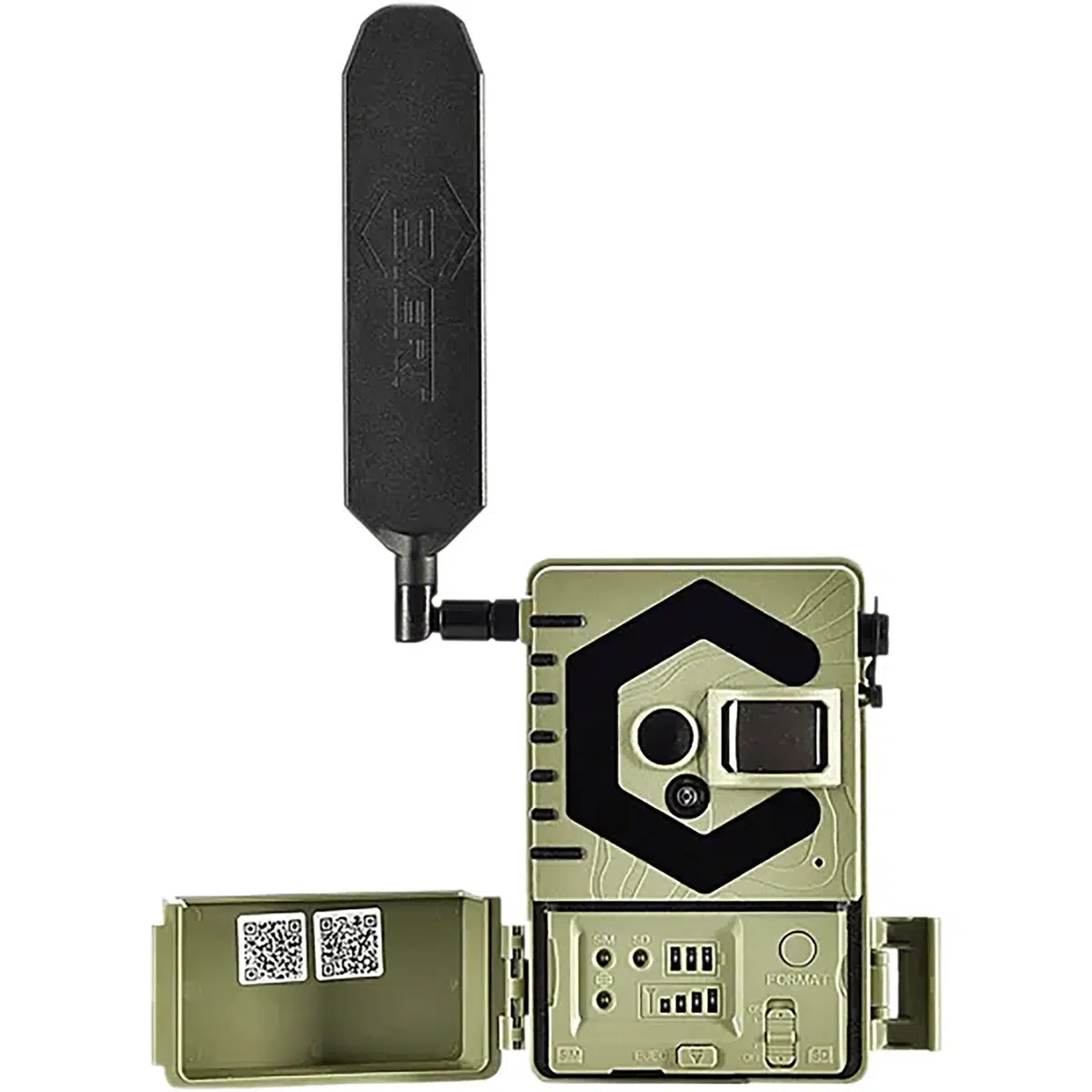
Covert Interceptor
16MP photos, 1080p recording, 720p transmission, 0.4-second trigger, 75-foot flash, GPS — the same app and plan system as its siblings.
Caution: Shortest flash range (75 ft); phone images arrive at 720p; 8-AA-only power means more visits on busy feeders.
Covert cameras at a glance
| Photo | Camera | Best for | Key specs | Power | Where to check it |
|---|---|---|---|---|---|
|
|
Covert Interceptor Solar | Busy feeder sites and long-term, low-visit scouting | 32MP photos; transmits 2K video; 0.4-second trigger; 90-foot flash range; 2-inch screen; GPS; real-time control | Integrated solar panel plus 8 AA batteries; external 12V/solar expansion supported | Check at FeraDyne → |
|
|
Covert Interceptor Pro | Most hunters who want real-time control without solar | 20MP photos; transmits 1080p video; 0.4-second trigger; 90-foot flash range; 2-inch screen; GPS; real-time control | 8 AA batteries or Interceptor Lithium Battery Tray | Check the Interceptor family at FeraDyne → |
|
Covert Interceptor | Budget entry point; low-traffic trails and second positions | 16MP photos; 1080p video recording; transmits 720p images; 0.4-second trigger; 75-foot flash range; GPS | 8 AA batteries or Interceptor Lithium Battery Tray | Check at FeraDyne → |
Prices below are dated October 2026 snapshots taken from FeraDyne’s own product pages when this guide was written on October 25, 2026: the Interceptor was listed at $129.99 and the Interceptor Solar at $179.99. The Interceptor Solar page also showed a preorder note stating it ships October 26, 2026, so check availability before you plan a hang date around it. No price is quoted here for the Interceptor Pro because FeraDyne’s own live page did not show a verified current price when this guide was written, and retailer prices for it varied too widely to present as a snapshot. If a price matters to your decision, check the manufacturer’s page on the day you buy, not a roundup article, and never trust a marketplace listing that shows a different model name than the box you will receive.
Which Covert camera fits your feeder site?
- Step 1 — Check signal first. Confirm which carrier reaches your feeder tree. If neither AT&T nor Verizon has usable signal there, no Covert model is the right buy for that tree yet. Move the camera position or pick a different site. See Coverage and network requirements.
- Step 2 — Count the traffic. If the feeder gets daily deer, hog, and raccoon traffic, choose the Interceptor Solar. High photo volume is what drains batteries, and solar plus AA backup is built for that job.
- Step 3 — Weigh visits against budget. If you visit often and do not mind swapping batteries, the Interceptor Pro gives you the 2-inch screen, 90-foot flash range, and 1080p video transmission for less money than the Solar.
- Step 4 — Fill a second position cheaply. If you already own a Solar or Pro on the feeder and want a second angle on a trail, the base Interceptor covers it at the lowest price, with the same app and plan system.
First, identify which Covert generation you own
This is the step most Covert buyers skip, and it is the one that causes the most confusion. Covert has sold cameras under many names over the years: Code Black, Blackhawk, WC, WC20, WC30, AW, E, and LB families, plus the current Interceptor family. FeraDyne’s own firmware page still lists firmware for the WC20 A/V, WC30-A, WC30-V, and Code Black Select, alongside the Interceptor Solar and Pro, which tells you two things: older cameras are still supported for firmware, and older cameras are still floating around in used sales, old reviews, and leftover retail listings. A review of a Blackhawk or a WC30 is not a review of an Interceptor, even if the seller’s listing uses similar words.
To identify the camera in your hand, start with the label inside the door. The Interceptor manuals tell you to find the QR code sticker inside the camera door, and the IMEI number on that same sticker, plus the ICCID number on the SIM card, when you add the camera to your account manually. Older families identify differently: WC models carry an A or V suffix that names the carrier (A for AT&T, V for Verizon), such as WC20-A, WC20-V, WC30-A, and WC30-V, and the Blackhawk and Code Black families carry their own model years, with FeraDyne’s firmware page grouping Code Black LTE and Blackhawk LTE as 2018–2022 models. If your camera’s manual talks about text-message delivery as the main way pictures arrive, or about a 2018–2022 model year, you are reading about an older generation, not the current Interceptor system, which is built around the Covert Wireless app and web portal.
Three practical checks settle it. First, look at the SD card limit in your manual: Interceptor models support up to a 64GB SD card, while the older WC and Blackhawk families top out at 32GB. Second, look at the battery tray: Interceptor models run on 8 AA batteries or the Interceptor Lithium Battery Tray, while older families commonly take 12 AA batteries. Third, look at the setup path: Interceptor setup is QR-code activation through the Covert Wireless app, with the web portal at covert-wireless.com and billing at secure.covert-wireless.com. If your camera needs a different activation path, do not follow Interceptor instructions for it, and do not judge Interceptor battery life or image quality by what that older camera did.
Why does this matter for a new purchase? Because a used or leftover WC20, WC30, Blackhawk, or Code Black camera may still work, but it is not the same product as an Interceptor. Its flash range, video transmission, screen, SD limit, and battery system are different, and its remaining support life is different. If you already own one of the older cameras and it still serves you, keep running it and use FeraDyne’s firmware page for its updates. If you are buying new, buy the Interceptor family, and compare Interceptor reviews only with other Interceptor reviews. The section Why old owner reports mislead new-model comparisons explains the traps in detail.
How we picked
We did not test cameras in the field for this guide, and we do not claim otherwise. What we did was aggregate the manufacturer’s own current product pages, the Interceptor manuals, Covert’s published service terms, FeraDyne’s support and firmware pages, and independent field reporting on the Interceptor Solar, then checked every specification against at least one of those sources before writing it down. Where sources disagreed, we said so instead of picking the friendlier number. Where a price or a plan figure could not be read on a live Covert or FeraDyne page when this guide was written, we left it out rather than repeating an old article’s number as if it were current.
Three weaknesses in competing coverage shaped this guide. First, most roundups mix Covert generations together, so a reader cannot tell whether a complaint about battery life or a praise for image quality belongs to the camera they would actually buy. We fixed that by separating the current Interceptor family from the legacy families and by naming the identification checks. Second, most roundups quote plan prices from years-old articles as if they were today’s prices. We fixed that by describing the plan structure from Covert’s live terms page and by quoting only the pay-per-use charges that page actually publishes. Third, most roundups treat a cellular camera as a standalone gadget. We fixed that by covering the whole system a feeder hunter actually lives with: signal at the tree, SD card rules, power on a high-traffic site, plan balance, cloud storage, and the support route when something stops transmitting.
What we did not do: we did not invent test results, we did not invent owner quotes, and we did not assign scores. The owner experiences quoted in this guide are paraphrased or quoted from FeraDyne’s own product-page reviews and from Field & Stream’s published field test of the Interceptor Solar, and they are attributed as such. If a claim has no source, it is not in this article.
Covert Interceptor cameras in detail
1. Covert Interceptor Solar — Best for busy feeder sites
The Interceptor Solar is Covert’s top current model, and FeraDyne describes it as combining all the advanced features of the Interceptor Pro with the power of the sun. Its headline specifications are a 32-megapixel sensor, 2K video transmission, a 2-inch screen, real-time control, GPS, an upgraded antenna, QR-code setup, a 0.4-second trigger, a 90-foot flash range, and a 2-year warranty, powered by 8 AA batteries plus its integrated solar panel. That combination matters most on a feeder, where the camera fires far more often than it would on a quiet trail. A feeder camera that only runs on AAs will eat batteries; a feeder camera with solar harvesting during the day and battery backup at night can stay out for weeks with fewer visits, which also means less human scent at the site.
The honest weaknesses are size and the solar cord. Field & Stream’s published field test calls the camera larger and bulkier than most cellular competitors, a real consideration in tight or concealed locations, and notes that the solar panel connects to the camera via an external cord, which adds a potential failure point and complicates discreet mounting. The same test found the cord never came unplugged during testing, but the reviewer still wanted a cord-free design and used small zip ties or tape to keep the cord tidy. FeraDyne’s own solar-panel page adds a second caution worth hearing: the panel is compact, so it performs best with direct sunlight and moderate photo volume, and it may not be the ideal standalone option for high-traffic feeder locations where power demand can outpace charging conditions. That is not a contradiction; it is the real trade-off. Solar stretches battery life dramatically, but on a feeder with hogs visiting all night, you still want AA backup in the tray and, for a remote lease, an external 12V battery or additional panel as expansion.
✅ Pros
- 32MP photos and 2K video transmission — the sharpest image package in the current Covert family
- Integrated solar panel plus 8 AA backup, with external 12V/solar expansion supported
- Real-time control, GPS, upgraded antenna, and 2-inch on-site screen
- 0.4-second trigger and 90-foot no-glow flash range
❌ Cons
- Bulkier than most cellular cameras — harder to hide in tight spots
- External cord between panel and camera needs tidying and care
- Compact panel can fall behind on very high-traffic feeders in poor sun — backup power still matters
- Listed as preorder on FeraDyne’s page when this guide was written (ships October 26, 2026) — check stock before planning around it
🧑🌾 From the field: Field & Stream’s tester ran the Interceptor Solar for 60 days in southeast Colorado through 50-mile-per-hour winds, extreme heat, hail, and rain, and reported that it kept running the entire period, with the paddle-style antenna staying upright and the solar panel keeping the camera going even on a thick-timber river crossing and a three-way trail crossing. Battery dipped below 30 percent at night at times but recovered to 80 percent during the day even without direct sun, and on a pond and alfalfa plot it never dropped below 60 percent and reached full charge daily. Over the test it took 413 photos, 19 of them blank, which the tester attributed to false triggers in high wind and extreme heat rather than missed animals. The no-glow flash was, in the tester’s words, totally undetectable — he walked back and forth in front of the camera for five minutes and never saw it, and no deer reacted to it except one doe curious about its smell. On FeraDyne’s own product page, owners praise picture quality and report battery staying at 100 percent with the solar panel, while one owner warns that the solar panel only faces the direction the camera faces, so aiming the camera at the sun is good for charging but bad for photos — a placement trade-off to plan around. Another owner reports running the camera down with heavy daily hog traffic, then pausing photo and video capture for a week to let the solar battery recover to 100 percent, which is a realistic recovery tactic for a remote lease camera.
| Spec | Detail |
|---|---|
| Photo resolution | 32 megapixels |
| Video transmission | 2K video, in real time |
| Trigger speed | 0.4 seconds |
| Flash range | 90 feet, no-glow infrared |
| Screen | 2-inch LCD for setup and playback |
| Power | Integrated solar panel plus 8 AA batteries; external 12V battery and/or additional solar panel supported |
| Memory | SD card up to 64GB |
| Connectivity | Covert Wireless over AT&T and Verizon networks; QR-code setup; GPS; real-time control |
| Warranty | 2 years (registration within 10 days of purchase required — see Support and warranty) |
| October 2026 snapshot | $179.99 on FeraDyne’s product page, checked October 25, 2026; page showed preorder, ships October 26, 2026 |
Check the Interceptor Solar at FeraDyne →
2. Covert Interceptor Pro — Best for hunters who want real-time control without solar
The Interceptor Pro is the middle of the current family and, for many hunters, the sweet spot. FeraDyne’s product data lists it at 20 megapixels, with 1080p video transmission, a 2-inch screen, real-time control, GPS, an upgraded antenna, 8 AA batteries, QR-code setup, a 0.4-second trigger, a 90-foot flash range, and a 2-year warranty. Its manual adds the settings detail that matters day to day: image size selectable at 4, 12, or 20 megapixels, capture numbers of 1–9 images per trigger, video quality at 720, 1080, or 2560, and video lengths of 5–60 seconds. In other words, the Pro gives you the same flash range, trigger speed, screen, GPS, and real-time control as the Solar, and trades the solar panel and the 32MP/2K upgrade for a lower price and a smaller body.
The honest weakness is power management on a busy site. The Pro runs on 8 AA batteries or the Interceptor Lithium Battery Tray, with no solar harvesting built in. On a trail or a lightly visited feeder that is fine, especially with lithium AAs or the lithium tray. On a feeder with daily hog and raccoon traffic, expect to visit more often than a Solar owner, or add an external power option. The second weakness is price visibility: when this guide was written, FeraDyne’s live Interceptor Pro data showed an older $189.99 figure on a staging copy while retailers listed $139.99–$169.99, so we quote no Pro price as a snapshot here. That disagreement is itself useful information — it tells you to check the manufacturer’s current page and at least one retailer on the day you buy, rather than trusting any single roundup’s number.
✅ Pros
- 20MP photos, 1080p video transmission, 90-foot flash range, 0.4-second trigger
- 2-inch screen for on-site setup and playback — the base Interceptor has no comparable screen in its published feature list
- Real-time control and GPS, same app and plan system as the Solar
- Flexible capture settings: 1–9 images per trigger, 5–60 second videos
❌ Cons
- No built-in solar — battery visits are more frequent on high-traffic feeders
- No verified current manufacturer price when this guide was written — check before buying
- Older reviews sometimes quote a 0.3-second trigger for the Pro; FeraDyne’s current product data says 0.4 seconds — trust the current listing for the camera you would buy
🧑🌾 From the field: The Pro shares its platform with the Solar, so the Field & Stream Solar findings on flash invisibility, app setup, and real-time video requests carry over in spirit, but they are not Pro test results and we do not present them as such. Direct Pro owner reporting is thinner in the sources we verified: the clearest signal comes from the Interceptor family manuals and FeraDyne’s feature data, which agree on the Pro’s core package, and from retailer listings that consistently describe the same 20MP, 1080p, 2-inch-screen, GPS, and real-time package. That thinness is worth stating plainly. If you need deep owner reporting before buying the Pro, read Solar owner reports for the shared app and real-time behavior, and treat Pro-specific battery-life claims in old articles with suspicion unless they name the Pro, the battery type, and the traffic level.
| Spec | Detail |
|---|---|
| Photo resolution | 20 megapixels (selectable 4, 12, or 20 in the manual) |
| Video transmission | 1080p video |
| Trigger speed | 0.4 seconds (per FeraDyne’s current product data) |
| Flash range | 90 feet |
| Screen | 2-inch screen |
| Power | 8 AA batteries or Interceptor Lithium Battery Tray |
| Memory | SD card up to 64GB |
| Connectivity | Covert Wireless; GPS; real-time control; QR-code setup |
| Warranty | 2 years (registration within 10 days of purchase required) |
| Price | Not quoted — no verified current manufacturer price found when this guide was written; retailer prices varied ($139.99–$189.99 in sources checked) |
Check Covert’s current resources and plan pages at FeraDyne →
3. Covert Interceptor — Best budget entry point
The base Interceptor is the entry point to the current family. FeraDyne’s live product page lists it at 16 megapixels with 1080p video recording, 720p image transmission to your device, a 0.4-second trigger, a 75-foot flash range, GPS, QR-code setup, an upgraded antenna, 8 AA batteries, and a 2-year warranty. Its manual confirms the same power and storage package as its siblings — 8 AA batteries or the Interceptor Lithium Battery Tray, and an SD card up to 64GB — and the same QR-code activation path through the Covert Wireless app. What you give up against the Pro is the 2-inch screen, 15 feet of flash range, and the higher transmission resolution. What you keep is the part that matters most for scouting: the same app, the same plan system, the same real-time updates, and the same GPS.
The honest weaknesses are the ones the spec sheet already shows. A 75-foot flash range is shorter than the Pro and Solar’s 90 feet, so on a wide feeder clearing or a long field edge, night images at distance will be weaker. Transmitting at 720p means the image that reaches your phone is not the full-resolution file; the full file lives on the SD card, which is standard for cellular cameras but worth knowing before you judge night quality from a phone thumbnail. And FeraDyne’s own product page carries a blunt owner warning: one reviewer reports pictures were fine but battery life was far too short, with the Interceptor dying in 4 weeks where their older WC20 and WC30 cameras lasted all year. That single report is not a verdict on the whole model — battery life depends on traffic, signal strength, settings, and battery type — but it is a reminder that the base Interceptor on 8 AAs, without solar, is not a set-and-forget camera on a busy site.
✅ Pros
- Lowest price in the current family ($129.99 snapshot, October 2026, FeraDyne)
- Same Covert Wireless app, GPS, real-time updates, and QR setup as the Pro and Solar
- 16MP photos and 1080p recording with 64GB SD support
- Good second-camera or low-traffic trail choice
❌ Cons
- Shortest flash range in the family (75 feet vs. 90 feet)
- Transmits 720p images — full-resolution files stay on the SD card
- No 2-inch screen in its published feature list
- 8-AA-only power (plus lithium tray) means more visits on high-traffic feeders
🧑🌾 From the field: FeraDyne’s Interceptor product page shows only two owner reviews, both 1-star, and the detailed one is the battery-life complaint above, contrasted explicitly with the reviewer’s older WC20 and WC30 cameras. That contrast is exactly the generational trap this guide warns about: the older cameras took 12 AA batteries, while the Interceptor takes 8, so a direct battery-life comparison without accounting for battery count, traffic, and settings misleads. Treat the complaint as a prompt to plan power properly — lithium AAs or the lithium tray, sensible trigger intervals, and realistic expectations on a busy feeder — not as proof that every Interceptor dies in a month. If your site is high-traffic, the Solar, not the base Interceptor, is the honest recommendation.
| Spec | Detail |
|---|---|
| Photo resolution | 16 megapixels |
| Video | 1080p recording; transmits 720p images to your device |
| Trigger speed | 0.4 seconds |
| Flash range | 75 feet |
| Power | 8 AA batteries or Interceptor Lithium Battery Tray |
| Memory | SD card up to 64GB |
| Connectivity | Covert Wireless; GPS; QR-code setup; upgraded antenna; real-time updates |
| Warranty | 2 years (registration within 10 days of purchase required) |
| October 2026 snapshot | $129.99 on FeraDyne’s product page, checked October 25, 2026 |
Check the Interceptor at FeraDyne →
Coverage and network requirements
Covert cellular cameras do not run on your personal phone plan. They run on Covert Wireless service, which Covert’s own terms describe as service options through AT&T and Verizon, delivered over the carriers’ licensed networks, with data transferred to the mobile app and web portal over the fastest connection protocol available up to and including 4G LTE. That sentence carries three practical consequences. First, your camera needs a Covert service plan with a positive balance to operate at all — the terms state plainly that the product only operates when service is active and you have a positive service balance. Second, actual data speeds depend on the camera’s capabilities and the coverage at the camera’s location, plus changing network conditions, so a camera that works well at home may transmit slowly, or not at all, in a bottom with weak signal. Third, coverage maps are general information only and are not a guarantee of coverage; Covert’s terms say so explicitly, and the maps depict predicted, approximate, optimal outdoor coverage.
Before you buy, test the site the way the camera will experience it. Stand at the exact tree, at camera height, and check whether your phone holds a usable AT&T or Verizon signal there. A phone on a different carrier proves nothing, and a signal reading from the road proves nothing about a hollow 200 yards in. The Interceptor family’s upgraded antenna helps — FeraDyne lists it as a feature on all three current models — but an antenna improves a weak signal; it does not create one. If signal is marginal, hang the camera higher, face the antenna toward open sky where the mount allows, and avoid deep draws and metal feeder parts that can shield the antenna. If signal is absent on both carriers, do not buy a cellular camera for that tree. Use a non-cellular camera there, or move the cellular camera to a location with signal and accept the different view.
Activation itself takes time. Covert’s terms warn that activating and reinstating service can take up to 24 hours, so do not activate the morning of opening day and expect instant pictures. Activate at home or at camp the day before, confirm the first test picture arrives in the app, and only then hang the camera for the season. Keep a record of each camera’s IMEI number and SIM ICCID number — the terms advise this for reactivation after a payment failure — because support will ask for them, and the numbers live on the sticker inside the door and on the SIM card, not on the outside of the box you threw away.
Photo and video features
Across the Interceptor family, the shared photo and video logic is more important than any single megapixel number. All three current models are motion- and heat-activated or time-lapse triggered, sending photos and videos through the Covert Wireless app and web portal. The Interceptor manual’s settings show the levers you will actually use: camera mode (photo, video, or dual), image size, capture number (1–9 images per trigger on the Pro; 1–9 on the base Interceptor’s manual as well), video size, video length (5–60 seconds), trigger interval, night-image flash mode (short range, fast, or long range), PIR sensitivity (auto, low, normal, high), work period, and transmission frequency (instant, daily, or weekly in the Interceptor manual’s transmit-frequency setting). Learning those settings matters more than the box specs, because a feeder camera set to maximum images, maximum video length, and instant transmission on every trigger will burn through plan balance and batteries far faster than the same camera set sensibly.
Video deserves a special note because it is where Covert’s system differs most from a plain SD-card camera. On the Interceptor Solar, FeraDyne advertises 2K video transmission in real time, and Field & Stream’s tester confirmed the practical version of that claim: when an image arrived that he wanted to examine, he could tap the play icon, request the video, and view it right away, without waiting for the camera to trigger again, provided the real-time capturing feature was activated in the app’s settings. On the Pro, video transmits at 1080p. On the base Interceptor, video records at 1080p but images transmit at 720p. In all cases, the full-resolution files also sit on the SD card, so if a phone image looks soft, pull the card before blaming the sensor. And video requests are not free under the plan terms — Covert’s terms list a $0.07 charge per video request under the real-time pay-per-use bundle, which is why the cost section below separates triggered photos from on-demand requests.
Night images are no-glow infrared across the current family. Field & Stream’s tester could not detect the Solar’s flash at all during a five-minute walk in front of the camera, and no deer reacted to it. That is the standard you should expect from a modern no-glow camera, and it is one of the reasons Covert cameras suit feeder sites: a low-glow or white-flash camera that lights up the feeder every night will change deer behavior at the very spot you are trying to pattern. Flash range still differs by model — 90 feet on the Pro and Solar, 75 feet on the base Interceptor — so match the camera to the distance. On a feeder clearing where deer feed 20–40 feet from the tree, all three are ample. On a field edge where you want faces at 80 feet, the Pro or Solar earns its price.
Two app features are easy to miss and worth knowing before you buy. First, GPS: all three current models include GPS, which shows the camera’s location on the app’s camera map when the GPS switch is on, and which matters for theft recovery and for managing multiple cameras across a lease. Second, recognition software: FeraDyne’s resources page describes Covert Wireless recognition categories of buck, hog, bear, human, vehicle, turkey, and other, offered at $12.99 yearly or $1.99 monthly as shown on that page when this guide was written. Field & Stream’s tester tried it for 30 days and reported it worked as advertised, while also noting he is not personally fond of species recognition. Treat it as an optional filter for high-volume feeder cameras, not as a reason to choose Covert over another system, and confirm the current rate in the app before subscribing, since add-on rates change.
Power accessories: batteries, lithium tray, and solar
Power is where feeder cameras succeed or fail, and Covert’s system gives you four layers. Layer one is 8 AA batteries, which all three current Interceptor models take. Alkaline AAs are cheap and available everywhere; lithium AAs cost more but handle cold weather and heavy use better, and they are the sensible default for a camera you will not visit for weeks. Layer two is the Interceptor Lithium Battery Tray, which the manuals for all three models name as the alternative to loose AAs. It slides out of the bottom of the unit on an eject button, which makes swaps faster and cleaner than fishing individual cells out of a tray in the dark, and FeraDyne owner reports specifically call the lithium pack a must for the Solar. Layer three is the Solar’s integrated panel, which harvests during the day and leans on the AA backup at night. Layer four is external expansion: FeraDyne’s solar-panel page states the Interceptor Solar supports three power sources working together — the integrated panel, 8 AA batteries, and external power expansion via a 12V battery and/or an additional solar panel — and the standalone Covert Solar Panel it sells includes a 6-foot power cord so you can position the panel for sun while keeping the camera’s aim where it belongs.
The SD card is part of the power story too, because a bad card causes phantom problems that look like battery or signal failures. Interceptor manuals specify an SD card up to 64GB, installed before powering up, pushed until it clicks, with formatting available in the camera menu. Older Covert guidance, preserved in the WC30 firmware instructions, recommends only certain Class 10 cards (Sony, ONN, or Covert) and warns against high-speed variants that can malfunction in Covert cameras. That older warning is written for older cameras, but the underlying advice survives: use a plain, reputable card in the size your manual specifies, format it in the camera before first use, and do not assume the fastest card on the shelf is the best card for a trail camera. Carry a spare formatted card on every visit; swapping a card is faster than troubleshooting one in the field.
Three power habits save more money than any accessory. First, set a sensible trigger interval and, on a very busy feeder, use the remote-control delay setting FeraDyne’s FAQ describes: putting cameras on at least a 4-hour delay under the remote-control setting lets the wireless module sleep longer, and Covert reports running its own cameras on a 24-hour delay for over two months in the field. You still receive triggered pictures; you simply can only make settings changes or real-time requests at the delay interval you chose. Second, turn off video transmission on a camera that is drowning in hog pictures, and pull video from the SD card on visits instead — video requests cost plan balance and battery. Third, on a solar camera, aim the panel honestly: FeraDyne’s solar page notes the panel’s 6-foot cord lets you rotate the panel around the tree so the camera does not have to face the sun, and an owner review warns that the integrated panel faces wherever the camera faces. Use the cord, or the separate panel, to get sun without pointing the lens into sunrise or sunset.
Plan terms: what a Covert Wireless plan actually costs
Covert’s plan system is the part of this guide most likely to surprise a first-time buyer, so read this section before you budget. Covert sells service plans through its own billing site, secure.covert-wireless.com, in monthly, quarterly, and yearly forms, and FeraDyne’s resources page states that plans can be shared across multiple cameras and adjusted seasonally. Older articles quote starting prices such as $4.99 per month for 100 photos, and a shared-plan structure rather than one plan per camera. We deliberately do not present a current plan price table here, because FeraDyne’s current plan tables are published as images on its resources page, and their figures could not be read and verified as text on a live page when this guide was written. Quoting an old article’s price table as today’s prices would repeat exactly the error this guide warns against. Check the plan table inside your Covert Wireless account or on FeraDyne’s resources page on the day you activate, and screenshot it for your records.
What Covert’s live terms page does publish, in text, is the pay-per-use bundle for real-time control, and those figures are worth knowing exactly. If you want real-time control — settings changes and real-time, on-demand pictures — you are grouped into a pay-per-use bundle: real-time photo requests and settings changes cost $0.02 per use, email and text message requests cost $0.03 per use, high-resolution image requests cost $0.03 per use, and video requests cost $0.07 per use. If you turn real-time control off, you are charged nothing extra for it, and you still receive pictures when the camera is triggered by heat or motion — you simply cannot make on-demand changes, change personal settings, or retrieve a video through the app or web portal until you turn it back on. That is a fair trade for most feeder hunters: leave real-time on during the weeks you are actively patterning, and turn it off, or accept the per-use charges consciously, during the off-season.
Four more terms deserve attention because they bite owners every year. First, a camera only operates with active service and a positive balance, and unused balances do not carry over: the terms state that texts, data, and service days have no cash value, do not accumulate, and are non-refundable, including balances on a lost or stolen camera. Second, auto-refill is automatic once you save a valid payment method — you are charged on your service end date at the same data level as the previous period — and changing it requires emailing support, so set a calendar reminder before the off-season rather than discovering a renewal later. Third, plans include 30 days of free cloud storage, and a photo you “like” is not deleted, so like the images you want to keep before the 30 days expire. Fourth, Covert does not support international SMS messaging, and attempting to send international messages where not permitted can deactivate service and clear the prior balance — a US hunter with a US number will not hit this, but do not try to run a camera’s alerts to a non-US number.
Suspending service for the off-season is straightforward, and FeraDyne’s FAQ describes it: log in to secure.covert-wireless.com, go to My Services and Equipment, and either click ACTIVE to SUSPEND a camera’s line or click the red X to DEACTIVATE it from the account entirely. A suspended camera can be re-added to the existing account when the season returns. A deactivated camera is removed and must be re-added as well. Do not simply let a plan lapse and assume the camera will pick up where it left off — reactivation can take up to 24 hours, and a payment failure requires updating the card and emailing support with the camera’s IMEI or MEID number.
Support and warranty: the current route
Covert is a FeraDyne Outdoors brand, and the current support route runs through FeraDyne, not through the retailer you bought from. Covert’s warranty page states this directly: if you experience an issue, do not contact the store you purchased from; contact Covert’s customer service. That page lists the toll-free number 270-743-1515 and the email support@dlccovert.com. FeraDyne’s product-warranties page and Covert’s service terms also list 877-462-1799 as a Covert contact number, and FeraDyne’s resources page lists covertsupport@feradyne.com alongside 270-743-1515. The honest way to present this is that Covert publishes more than one contact address across its own pages, and the stable starting point is FeraDyne’s contact page at feradyne.com/contact, with the phone number 270-743-1515 and the email support@dlccovert.com as the warranty page’s stated route. If one address bounces or goes unanswered, try the other published address and keep your proof of purchase and registration details ready, because support will ask for them either way.
The warranty itself is a 2-year manufacturer’s warranty on all 2016 or newer products, covering defects in materials and workmanship only — not damage from misuse or abuse. Three conditions catch owners out. First, proof of purchase is required for all warranty service. Second, prior registration must have been completed within 10 days of purchase receipt; the warranty exclusions list failure to register within 10 days as a reason warranty service will not apply, so register the camera the day it arrives, not the day it breaks. Third, all returns need an RMA number provided by Covert before shipping, and return shipping is prepaid by the customer while Covert prepays return shipping in the US when the product is found defective; if the camera is found not defective, return shipping is billed to the customer. Remove accessories — SD cards, batteries, solar panels, SIM cards, straps — before sending a camera in, because accessories received with a return are not returned.
For firmware and self-help, the route is FeraDyne’s Covert firmware page, which lists firmware for the WC20 A/V, WC30-A, WC30-V, Code Black Select, and the Interceptor Solar and Pro families, and advises having the camera on hand so you receive the correct firmware for your exact model and carrier. Do not install firmware for a different model or carrier on your camera, and do not use a tablet or phone for the manual WC-series firmware updates that require a Windows computer, per the WC30 instructions. For account problems — a suspended account, a plan overage, or a camera that stopped transmitting — FeraDyne’s FAQ gives the first steps: a suspended account most often means updating the credit card, and reaching the photo limit means replenishing through the app or web portal’s replenish button, then contacting support at the numbers above if the problem persists.
Covert cameras on feeder sites
A feeder site is the hardest job a trail camera does, and it is where Covert’s system either earns its keep or exposes its weaknesses. A feeder concentrates deer, hogs, raccoons, and other visitors in one small area, day and night, which means high trigger counts, high photo volume, high battery demand, and high plan-balance burn. The Solar is the natural feeder camera for exactly that reason: solar harvesting plus AA backup plus external 12V expansion is the only power stack in the current family that matches feeder traffic without constant visits. The Pro and base Interceptor can work on a feeder, but only with a power plan — lithium AAs or the lithium tray, a sensible trigger interval, video transmission used sparingly, and a visit schedule you will actually keep.
Placement on a feeder follows the same rules as any trail camera, with two feeder-specific twists. First, height and angle: Covert’s manual guidance recommends mounting about 3 feet off the ground and facing as straight forward as possible, adjusting for uneven terrain, and using a mounting system to get higher and point down when no straight tree is available. On a feeder, a slightly higher mount looking down at the feed area reduces the number of close, half-frame hog pictures and keeps the camera out of easy reach. Second, sun: the manual guidance also recommends facing north or south to avoid overexposure in the morning and evening when game movement peaks, and placing the camera 20–30 feet from a field edge facing the woods, or facing a thicket about 20–30 feet away inside timber. On a feeder in an open area, that translates to: do not point the lens into sunrise or sunset, give the flash a backdrop to reflect from where possible, and clear brush from directly in front of the camera, because wind-blown brush is the most common source of blank pictures — Field & Stream’s Solar test recorded 19 blank images out of 413, attributed to wind and heat false triggers, which is a normal rate for a feeder-area camera and not a defect.
Feeder-site suitability also means thinking about what the camera is for. If the goal is patterning deer for hunting, a cellular camera’s value is real-time information: you learn which stand to hunt without visiting the site and leaving scent. If the goal is simply counting visitors or watching hogs, a cellular plan may be more than you need, and the same Covert camera still records full-resolution files to its SD card for review on visits. Either way, pair the camera with the feeder content it supports: a gravity feeder or tripod feeder that holds feed consistently will produce steadier camera data than a feeder that runs empty for days, and a feeder with raccoon and hog pressure will produce far more night triggers than a clean site. Read those companion guides before finalizing placement, not after.
Why old owner reports mislead new-model comparisons
Old Covert owner reports mislead new-model comparisons in four specific ways, and each one has bitten real buyers. First, the model names repeat. A “Blackhawk” from 2018 and a “Blackhawk” from 2022 are not the same camera in FeraDyne’s firmware grouping, and neither is an Interceptor. A review that says “Blackhawk” without a year, SKU, or carrier suffix cannot be mapped to any camera you can buy today. Second, the power systems changed. Older families commonly ran on 12 AA batteries; the Interceptor family runs on 8. A battery-life comparison that does not state battery count, battery chemistry, traffic level, and transmission settings is comparing different systems, not different cameras. The FeraDyne Interceptor review that contrasts a 4-week Interceptor against year-long WC20 and WC30 cameras is a textbook example: the older cameras had 50 percent more cells, and the comparison states no traffic or settings data.
Third, the delivery system changed. Older Covert cameras sent pictures by text message; the current system delivers through the Covert Wireless app and web portal, with real-time control, on-demand video, and GPS as standard features. A complaint about text delivery, or praise for it, belongs to the old system and says nothing about the app experience on an Interceptor. Fourth, the plan prices changed. Articles from the Blackhawk era quote plan ranges that no longer match the current plan tables, and some quote different ranges for the same era — one retailer listing quotes $6.99–$36.99 for the Blackhawk 20 LTE while another quotes $4.99–$19.99 for the Blackhawk 21 LTE. Both may have been right on the day they were written, and neither should be quoted as today’s price. The rule for reading any Covert report is simple: if it does not name the exact model, carrier suffix, and year, and if its price or plan figure is not dated, treat it as background color, not as evidence about the camera you are about to buy.
Why not a different brand?
This guide covers Covert only, by design, and it does not pick a competing brand’s camera as an alternative. The honest reason to consider another brand is not image quality in the abstract; it is system fit. If you already run several cameras from another brand’s app and plan system, adding one Covert camera means a second app, a second plan, and a second support route, and that friction is real. If your site has no AT&T or Verizon signal but does have another carrier’s coverage, a system built on a different carrier network may be the only cellular option for that tree. And if you need a feature Covert’s current family does not offer — for example, a specific live-streaming implementation or a built-in battery design — another brand may suit you better. None of those reasons makes a Covert camera bad; they make it the wrong system for that particular hunter. If none of them apply to you, and you want Covert’s real-time control, GPS, and shared-plan structure on a feeder, there is no reason in this guide to leave the Covert system. Do not let a roundup that ranks a different brand’s camera above a Covert camera on a single spec — megapixels, for instance — override the system question, because you live with the app, the plan, and the support route for years, not with the spec sheet.
Video: what to watch before you buy
No YouTube video is embedded in this article. That is deliberate: the house rule for this site is to embed only videos whose IDs verify through YouTube’s oEmbed endpoint, and no Covert Interceptor video ID verified when this guide was written, so every candidate embed was dropped rather than guessed. What you should watch instead is straightforward. First, watch a current Interceptor Solar field review that shows the camera’s size in hand, the solar cord routing, and the app’s real-time video request in action — Field & Stream’s published Interceptor Solar field test is the written version of that review and is linked in the sources. Second, watch a Covert Wireless app walkthrough that shows QR-code activation, plan selection, and the real-time control toggle, because the app is half the product. Third, watch a feeder-placement video that shows camera height and angle on an actual feeder, not on a trail, because feeder framing differs from trail framing. When you search for these, filter for videos that name the Interceptor, Interceptor Pro, or Interceptor Solar specifically, and ignore videos that review a Blackhawk, WC, or Code Black camera as if it were a current model.
What a Covert camera really costs
| Cost item | What owners and Covert’s own pages report | Notes |
|---|---|---|
| Camera (Interceptor) | $129.99 snapshot, FeraDyne, October 25, 2026 | Lowest upfront cost; highest visit cost on a busy feeder |
| Camera (Interceptor Solar) | $179.99 snapshot, FeraDyne, October 25, 2026; preorder, ships October 26, 2026 | Highest upfront cost; lowest visit and battery cost over a season |
| Camera (Interceptor Pro) | No verified current manufacturer price when this guide was written | Check FeraDyne and retailers on the day you buy |
| Covert Wireless plan | Monthly, quarterly, and yearly plans; shareable across cameras; seasonal adjustment supported | No current price table quoted — plan tables are images on FeraDyne’s resources page; verify in your account before activating |
| Real-time pay-per-use | $0.02 per real-time photo request or settings change; $0.03 per email/text request; $0.03 per high-resolution image request; $0.07 per video request (Covert terms) | Only charged when real-time control is on; turn it off to avoid these charges |
| Recognition software (optional) | $12.99 yearly or $1.99 monthly, per FeraDyne’s resources page | Categories: buck, hog, bear, human, vehicle, turkey, other |
| Batteries | 8 AA per camera; lithium tray available | Lithium AAs or the lithium tray pay off on remote or high-traffic cameras |
| SD card | Up to 64GB (Interceptor family) | Use a plain reputable card; format in the camera; carry a spare |
| Solar expansion (optional) | Standalone Covert Solar Panel with 6-foot cord; 12V battery expansion supported on the Solar | Best value on a remote lease camera you visit rarely |
| Cloud storage | 30 days free; “liked” photos are not deleted | Like keepers before the 30 days expire |
The takeaway is that the camera price is the smallest part of the first-year cost on a busy feeder. A Solar at $179.99 with a plan and lithium backup can cost less over a season than a $129.99 base Interceptor that needs three battery visits, three sets of lithium AAs, and the fuel and time to reach a remote lease. On a quiet trail near home, the math reverses, and the base Interceptor wins. Budget the system — camera, plan, power, and visits — not the camera alone, and remember that unused plan balances do not carry over, so do not buy a bigger plan than your feeder’s actual photo volume needs.
How to choose
How much signal do you really need?
You need enough signal for the camera to transmit reliably, not just to show bars on a phone. Test at the tree, at camera height, on AT&T or Verizon, and run a test picture through the app before leaving the camera for the season. If the test picture is slow or fails, move the camera, raise it, or choose a different tree. A camera that cannot transmit is an expensive SD-card camera, and no plan upgrade fixes a dead spot.
How many photos will your feeder actually generate?
A feeder with daily deer and hog traffic can generate hundreds of triggers a week; Field & Stream’s Solar test recorded 413 photos in 60 days on trail and field-edge positions, and a busy feeder can exceed that. High volume means high battery demand and high plan-balance burn, which pushes the choice toward the Solar and toward a plan tier with headroom. Low volume — a trail camera on a quiet crossing — means the base Interceptor or Pro will serve you well on AAs. Count your traffic honestly before choosing a plan tier, and use the replenish button rather than overbuying a tier you will not use, since unused balances expire.
Do you need real-time control, or just pictures?
Real-time control is Covert’s standout feature: change settings, request an on-demand picture, or pull a video from the app without visiting the camera. If you pattern deer for hunting and want to decide which stand to hunt from home, it is worth the per-use charges. If you only want a daily batch of pictures, turn real-time off and save the per-use fees — triggered pictures still arrive. The mistake is leaving real-time on all season, requesting videos freely, and then being surprised by the per-use total. Use it deliberately, during the weeks it changes a decision.
What about theft, GPS, and security?
All three current models include GPS, which helps locate a camera on a large lease and aids recovery after theft. Use a cable lock through the camera’s security port, mount above easy reach where the view allows, and record the IMEI number before hanging the camera. If a camera is lost or stolen, notify Covert — the terms state the account will be deactivated and unused balances lost — and do not expect a plan refund on a stolen camera. GPS is a recovery aid, not a guarantee, and a camera on a public-land feeder should be hung with the assumption that it may be seen.
Resources
Start with Covert’s own pages, then use the feeder guides below to place the camera well:
- Covert Interceptor Solar — FeraDyne product page
- Covert Interceptor — FeraDyne product page
- Covert resources and plan pages — FeraDyne
- Covert warranty — FeraDyne
- Covert firmware — FeraDyne
- Covert Wireless terms of service
- Field & Stream: Covert Interceptor Solar field test
- Best Deer Feeders 2026: the site’s main buying guide
- Best Gravity Deer Feeders
- Best Tripod Deer Feeders
- Best Deer Feeder Timer
- Best Protein Deer Feeders
- Keep Raccoons, Hogs and Pigs Off Your Deer Feeder
- Deer Feeder Solar Panel guide
- Best Deer Feeder With Camera App Control
For hunting regulations, do not rely on this article or any roundup: rules on transmitting trail cameras vary by state, land type, species, and season, and they change — Idaho’s 2026 law, for example, restricts transmitting cameras on public land from August 30 through December 31. Check your own state wildlife agency’s current regulations before hanging a cellular camera for hunting.
Frequently asked questions
Which Covert camera should I buy in 2026?
Buy from the current Interceptor family. The Interceptor Solar is the best pick for busy feeder sites, the Interceptor Pro is the best balance of features and price without solar, and the base Interceptor is the budget entry point for low-traffic positions. Do not buy an older Blackhawk, WC, or Code Black listing as if it were a current model.
How do I tell which Covert generation I own?
Check the label inside the door for the model name, QR code, and IMEI number, and check your manual’s SD limit and battery count. Interceptor models take 8 AA batteries (or the lithium tray) and support up to 64GB SD cards, while older WC and Blackhawk families commonly take 12 AA batteries and top out at 32GB. WC models also carry an A (AT&T) or V (Verizon) carrier suffix.
Do Covert cameras work on AT&T and Verizon?
Yes. Covert Wireless service offers plans through AT&T and Verizon, and the Interceptor family is designed to send photos and videos over those approved cellular networks. Test signal at the exact tree before buying, because coverage maps are approximate and are not a guarantee.
Do I need a Covert plan, or can I use my phone plan?
You need a Covert Wireless plan. Covert’s terms state a camera only operates with active service and a positive service balance, and activation and billing run through secure.covert-wireless.com, not through a carrier store.
How much does a Covert plan cost?
Covert offers monthly, quarterly, and yearly plans that can be shared across cameras and adjusted seasonally, but this guide does not quote a current price table because FeraDyne’s current tables are published as images and could not be verified as text when this guide was written. Check the plan table inside your Covert Wireless account before activating. Separately, real-time pay-per-use charges published in Covert’s terms are $0.02 per real-time photo request or settings change, $0.03 per email/text or high-resolution image request, and $0.07 per video request.
What is real-time control, and can I turn it off?
Real-time control lets you change settings, request on-demand pictures, and retrieve videos from the app or web portal. You can turn it off; you will not be charged the per-use fees, and you will still receive pictures when the camera is triggered by heat or motion, but you cannot make on-demand changes or pull videos until you turn it back on.
How long does activation take?
Covert’s terms warn that activating and reinstating service can take up to 24 hours. Activate the day before you need the camera, and confirm a test picture arrives in the app before hanging it for the season.
What SD card does an Interceptor need?
An SD card up to 64GB, installed before powering up and formatted in the camera. Older Covert families top out at 32GB, so do not apply an old manual’s card limit to an Interceptor, or vice versa.
How do I power a Covert camera on a busy feeder?
Use the Interceptor Solar with its integrated panel plus AA backup, and add external 12V or additional solar expansion for a remote lease. On a Pro or base Interceptor, use lithium AAs or the Interceptor Lithium Battery Tray, set a sensible trigger interval, and use video transmission sparingly. FeraDyne’s FAQ notes that a 4-hour or 24-hour remote-control delay lets the wireless module sleep longer and extends battery life.
What is Covert’s warranty, and how do I claim it?
Covert offers a 2-year manufacturer’s warranty on 2016 or newer products, covering defects in materials and workmanship only. You must keep proof of purchase, register within 10 days of purchase, and obtain an RMA number before returning a camera. Contact Covert through FeraDyne’s contact page, phone 270-743-1515, or email support@dlccovert.com — do not contact the retailer for warranty service, per Covert’s own warranty page.
Can I suspend service in the off-season?
Yes. Log in to secure.covert-wireless.com, go to My Services and Equipment, and click ACTIVE to SUSPEND a camera’s line, or click the red X to DEACTIVATE it. A suspended or deactivated camera can be re-added to your existing account when the season returns, but reactivation can take up to 24 hours.
Are cellular trail cameras legal everywhere?
No. Rules on transmitting cameras vary by state, land ownership, species, and season, and they change regularly. Check your own state wildlife agency’s current regulations before using a cellular camera for hunting, and do not rely on a roundup article for legal advice.
Final verdict
The Covert Interceptor Solar is the pick for most feeder hunters in 2026: 32MP photos, 2K video transmission, real-time control, GPS, and solar power built for the high-traffic job a feeder actually is. The Interceptor Pro is the right runner-up if you visit often, want the 2-inch screen and 90-foot flash range, and would rather save money upfront than harvest sunlight. The base Interceptor is the right budget runner-up for a low-traffic trail or a second angle, and the wrong camera for a busy feeder you rarely visit. Whichever you choose, buy the current Interceptor family by name and SKU, verify signal at the tree, register within 10 days, and check the current plan table in your Covert Wireless account before activating. And before you hang any cellular camera for hunting, check your state wildlife agency’s current rules — transmitting-camera regulations vary by state, land type, and season, and the camera is only legal where the rules say it is.
Last updated: October 25, 2026.


