Moultrie 250 vs Boss Buck 200: Gravity Feeders Compared (2026)
Disclosure: As an Amazon Associate, Best Deer Feeders earns from qualifying purchases made through links on this page, at no extra cost to you. Prices and availability change, so always check the current listing before ordering.
Two fast choices
Pick by your site. Read the trade-off before opening the retailer.
MAXIMUM CAPACITY
Moultrie 250 Gravity
250 lb of corn or protein pellets, battery-free, with a triple-funnel gravity head and Quick-Lock hopper.
No scheduling or measured dispensing; gravity ports stay open to weather and non-target animals.
Check Price on AmazonBEST OVERALL
Boss Buck 200 Gravity
200 lb of corn, about 170 lb of pellets, with an adjustable three-way inner sleeve and drain-hole ports.
Salt-based mineral supplements may damage this feeder, and its hopper is smaller than the Moultrie 250.
Available on Amazon. Confirm the listing is the gravity-head version, not the 12V spinner combo, before ordering.
These are use-case starting points, not claims of firsthand testing. Prices change — check the current listing before you buy.
The Short Answer
Choose the Boss Buck 200 if you want the more refined gravity feeder overall: finer flow control, rain-shedding ports with drain holes, a deep hatch lid, and a gravity head that converts to a timed spinner later. Choose the Moultrie 250 Gravity if maximum capacity on a simpler, battery-free setup matters most: it holds 250 pounds of feed against the Boss Buck 200’s 200 pounds of corn, or about 170 pounds of pellets, and it uses a triple-funnel gravity system with no electronics to program, power, or maintain. Neither feeder is a spinner feeder out of the box, and neither needs a battery in gravity form. The real difference is not whether they feed deer, because both are designed to do that on demand, day and night, without a timer. The difference is how much control you get over the flow, how the ports handle rain and waste, how tall and stable each tripod stands, and how each design fits a protein program in spring and summer versus a corn program in fall. This comparison works through each of those differences in detail, using manufacturer and retailer specifications, so you can match the feeder to your property, your herd, and how often you can realistically get back to refill it.
If you only have a minute, here is the decision in one paragraph. A hunter who visits a lease infrequently, runs protein pellets through the antler-growing season, and wants to slow the flow down to cut waste will get more from the Boss Buck 200, even though it holds less feed, because its three-way inner sleeve and angled, drain-holed ports are built specifically for that job. A hunter or landowner who wants the largest gravity hopper for the least complexity, who feeds corn for most of the season, and who does not mind a simpler flow adjustment will get more from the Moultrie 250, because 50 extra pounds of corn capacity means fewer trips with a truck full of feed bags, and its Quick-Lock hopper keeps a later upgrade path open within the Moultrie system. If you run several sites, that capacity gap compounds: five Moultrie 250 feeders hold 250 pounds more in total than five Boss Buck 200 feeders at corn capacity, which is a full extra feeder load across a small lease system. If you run one site and visit weekly, the capacity gap matters far less than the flow control and port design, and the Boss Buck 200 pulls ahead. Both feeders belong on the shortlist for gravity feeding, and neither is a poor choice. The rest of this guide explains why, section by section, so the choice is yours for a stated reason rather than a guess.
At a Glance: Moultrie 250 Gravity vs Boss Buck 200
| Feature | Moultrie 250 Gravity | Boss Buck 200 Gravity |
|---|---|---|
| Capacity, corn | 250 lb | 200 lb |
| Capacity, protein pellets | 250 lb as listed for corn or protein pellets | About 170 lb |
| Hopper volume | 30 gallons | 30 gallons |
| Port design | Triple funnel, three adjustable feed-flow funnels | Three ports, 10 inches long, 10-degree angle, drain holes, 1-inch overhang |
| Flow control | Adjustable funnels, moved up or down to constrict or increase flow | Adjustable three-way inner sleeve, turned to allow more or less feed to flow |
| Legs | Steel tripod, six leg sections, 6-foot fill height | 75-inch galvanized tripod legs |
| Hopper material | UV-resistant plastic, black | Tough roto-molded plastic barrel with galvanized metal hardware |
| Lid | Twist-on lid | 3-inch-deep hatch lid |
| Power | None in gravity form, no batteries or electronics | None in gravity form, no batteries or electronics |
| Feed coverage | 360 degrees, as listed by Moultrie | Three ports around the head |
| Convertibility | Quick-Lock capability, compatible with other Moultrie feeder kits | Converts from gravity to an automatic spinner setup, spinner kit sold separately or in combo versions depending on the listing |
| Feed restriction | Corn, protein pellets, and mixed grains as listed | Non-salt-based feed only, salt-based mineral supplements may damage the feeder |
| Manufacturer model | MFG-15107 | Listed by retailers as the Boss Buck 200-pound gravity tripod feeder |
| Warranty as listed | 1 year, as listed by Moultrie | 90 days, as listed by retailers |
| Throw or spread distance | Not applicable, gravity feeder with no spinner | Not published, Boss Buck publishes no throw or spread distance for this gravity feeder, and none is stated here |
| Price | Check the current listing, prices change and no undated price is stated here | Check the current dealer listing, prices change and no undated price is stated here |
Read the table carefully, because two rows are easy to misread. First, both hoppers are described as 30 gallons, yet their pound ratings differ, because corn and pellets do not weigh the same per gallon and because manufacturers rate their own hoppers differently. Do not assume that equal gallons mean equal days between refills. Use the pound rating for the feed you actually plan to run. Second, the Boss Buck 200’s pellet figure is approximate, about 170 pounds, while its corn figure is 200 pounds. If you run pellets all spring, plan refills on the pellet number, not the corn number, or you will overestimate your interval by roughly 15 percent. The Moultrie 250, by contrast, is listed at 250 pounds for corn or protein pellets, so its planning number does not change when you switch feed types. That is a genuine planning advantage for a mixed program, and it is one of the few places where the Moultrie clearly wins on paper before any discussion of build quality or port design begins.
Meet the Moultrie 250 Gravity
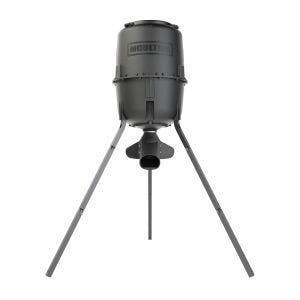
The Moultrie 250 Gravity, manufacturer model MFG-15107, is a battery-free tripod gravity feeder built around a 30-gallon hopper that holds up to 250 pounds of feed. Moultrie lists it for both protein feeding in spring and corn feeding in fall, which matches how most gravity feeders are actually used: free-choice protein while antlers are growing and does are raising fawns, then corn as an attractant and energy source through the hunting season. The feeder needs no electronics and no batteries. Fill the hopper through the twist-on lid, set the three funnels, and deer eat on demand as feed flows down by gravity. There is no timer to program, no motor to fail in cold weather, no battery to check, and no solar panel to keep clear of leaves. For a remote site that you visit once a month, or a property where you simply do not want another electronic device in the woods, that simplicity is the whole point.
The hopper is black, UV-resistant plastic, and Moultrie lists a 6-foot fill height, steel legs in six sections, 360-degree feed coverage, an operating temperature range of 14 degrees Fahrenheit to 140 degrees Fahrenheit, and a one-year warranty. The overall assembled footprint is listed by retailers at about 65 inches by 65 inches by 74 inches, with an item weight of about 37 pounds. That weight matters for transport: it is light enough for two people to carry and set up without a tractor, yet heavy enough, once filled with 250 pounds of feed, to stand firmly on its tripod. Do not judge stability by the empty weight. Judge it by the filled weight, the leg spread, and the ground you set it on, and always set a gravity feeder on ground that is as level as you can find. A feeder that leans will feed unevenly, because gravity does not negotiate with a slope, and the downhill port will always run faster than the uphill port.
The triple-funnel system is the heart of the Moultrie design. Three funnels, sometimes described as chutes or tunnels, sit beneath the hopper, and each one has an adjustable flow rate. The adjustment is mechanical and simple: move the chute up to constrict flow for corn, or down to provide more flow for protein pellets, which are larger and need a wider opening to move freely. That single adjustment is how one feeder serves two very different feeds across the year. It is not a precision metering device, and it should not be described as one. Gravity feeders meter by restriction, not by measurement. You set the opening, deer eat, more feed slides down to replace what was eaten, and the flow stops when the port is full. The skill is in setting the opening small enough that deer must work for the feed, which slows consumption and cuts waste, but large enough that pellets do not bridge and jam above the opening. Bridging, where pellets lock together into an arch over the outlet and stop flowing even though the hopper is still full, is the most common gravity-feeder frustration, and it is more likely with large pellets and a too-tight setting. Start with a more open setting for pellets, watch consumption for a week, and tighten gradually until waste on the ground is minimal but flow stays steady.
The Quick-Lock system is the Moultrie’s second major feature, and it is easy to undervalue until you have owned a feeder for several seasons. Moultrie lists Quick-Lock capability as a specification for this feeder, and the gravity kit twists onto a Quick-Lock hopper with a lock ring. In practical terms, that means the hopper is not married to the gravity head forever. If your needs change, for example if you later want a timed spinner kit for fall corn while keeping gravity protein in spring, the Quick-Lock mount allows you to swap kits within the Moultrie system rather than buying a whole new feeder. Check compatibility of any specific kit with the MFG-15107 hopper before ordering, because Quick-Lock covers a family of products, not every Moultrie kit ever made, and the gravity feeder itself ships with the gravity kit, not a spinner. The value here is optionality, not a promise that every future kit will fit. For a buyer who is unsure whether gravity feeding is a permanent choice or a first step, that optionality is worth real money, because it protects the hopper investment.
Maintenance on the Moultrie 250 is deliberately minimal, which is both its strength and its limit. There are no batteries to replace, no motor brushes to wear, no timer display to fog, and no spinner plate to bend. The maintenance list is short: keep the lid seated and the twist lock engaged, clear debris from the funnels, check that the leg brackets and leg sections are fully seated after the first few weeks of settling, and inspect the hopper for cracks or sun damage at the start of each season. UV-resistant plastic is not UV-proof plastic. Years of direct sun will eventually fade and embrittle any polymer hopper, and a feeder left in an open field in Texas will age faster than the same feeder under a partial canopy in Wisconsin. Store feed dry, never fill a wet hopper, and never leave a bag of pellets open in the bed of a truck in the rain before loading. Wet feed clumps, clumped feed bridges, and bridged feed means deer visit an empty port while the hopper above it is still full, which is the worst outcome for a feeder that is supposed to need no attention.
Check Price on Amazon for the Moultrie 250 Gravity

Meet the Boss Buck 200 Gravity
The Boss Buck 200 Gravity is a tripod gravity feeder built around a roto-molded plastic barrel and galvanized metal hardware, with three feeder ports and a deep hatch lid. Retailers list it at 200 pounds of corn or about 170 pounds of protein pellets, on 75-inch legs, with a 30-gallon barrel. Boss Buck’s own hopper line runs 200, 350, 600, and 1,200 pounds, so the 200 is the entry point of that family, not a mid-size model, and there is no 250-pound or 500-pound Boss Buck feeder in that line. That matters when you are comparing sizes across brands, because a shopper who assumes a Boss Buck 250 exists will waste time searching for a model that was never made. If you outgrow the 200, the next step in the same family is the 350, which is a substantial jump in both capacity and footprint, not a small step up.
The Boss Buck head is where this feeder earns its reputation. Each of the three ports is 10 inches long, set at a 10-degree angle for slow feeding, fitted with a drain hole to expel rainwater, and finished with a 1-inch overhang at the end of the port to keep feed from spilling out. Take each element in turn, because each one solves a specific gravity-feeder problem. The 10-inch length gives deer a defined feeding station and keeps the feed inside the port rather than scattered on the ground, where it would be wasted and would attract non-target animals. The 10-degree angle slows the feed down, so deer eat at a controlled pace instead of having feed pour out as fast as they can nose it. The drain hole is the rain defense: water that blows into the port has a way out, rather than pooling and turning pellets to mush at the mouth of the feeder. The 1-inch overhang is the spill defense: it acts as a small lip that holds feed back when a deer bumps the port or pulls its head away with a mouthful. None of these features is dramatic on its own. Together, they form a port system that is more considered than a plain open funnel, and that consideration shows up in less waste and drier feed at the point of eating, which is exactly where waste and spoilage happen.
Flow control on the Boss Buck 200 comes from an adjustable three-way inner sleeve. Turn the sleeve to allow more or less feed to flow, matching the opening to the feed shape and size. Corn kernels are small and round and flow easily, so they need a tighter setting. Protein pellets are larger and more variable in size, and they need a wider setting, or they will bridge and stall. The sleeve gives you that adjustment inside the head, rather than by sliding external funnels up and down. The practical difference between the two systems is a matter of feel and precision. A sleeve that rotates through a range of openings can be adjusted in small increments, and it stays where you set it, protected inside the head. An external funnel that slides up or down is simpler to see and adjust, but it is also more exposed to bumps from deer and to the gradual loosening that comes with vibration and weather. Neither system is objectively superior in every situation, but for a pellet program where the difference between flowing freely and bridging can come down to a small change in opening size, the sleeve’s finer adjustment is an advantage worth weighing seriously.
The lid and hardware complete the Boss Buck picture. The hatch lid is 3 inches deep, which retailers describe as deterring tampering by critters, and the double-walled lid design described for this family is intended to let the hopper breathe and reduce condensation buildup inside the barrel. Condensation is an underrated enemy of stored feed: a sealed barrel that heats up in the sun and cools at night will sweat on the inside, and that moisture will migrate into the top layer of feed. A lid that vents that moisture, combined with a barrel that resists condensation, keeps the top of the load drier for longer, which matters most when a feeder sits for weeks between visits. The hardware is galvanized metal throughout, and the barrel is tough roto-molded plastic, a combination that resists rust and impact better than plain steel or thin injection-molded plastic. Retailers list the feeder at about 26.3 pounds empty and list dimensions of 29 inches by 25 inches by 25 inches for the feeder unit, with a 90-day manufacturer warranty as listed by retailers. That warranty figure is shorter than Moultrie’s one-year listing, and it is worth noting plainly, even though warranty length alone does not determine how long a feeder lasts in the field. What determines field life is material, hardware, lid sealing, and how the feeder is sited and maintained, and on those points the Boss Buck’s roto-molded barrel and galvanized hardware are strong credentials.
One restriction deserves emphasis, because ignoring it can damage the feeder. Boss Buck specifies non-salt-based feed only for this feeder, and states that salt-based mineral supplements may damage it. Do not pour a salt-based mineral mix into a Boss Buck gravity feeder and expect the warranty or the hardware to forgive it. Salt is corrosive, it draws moisture, and it will attack galvanized hardware and lodge in ports in ways that corn and pellets do not. If you run minerals, run them in a separate mineral station, away from the feeder, where deer can use them without contaminating the feed supply or corroding the feeder. This restriction is not a flaw in the feeder. It is a condition of its design, and a buyer who plans to run minerals through the same hopper should choose a different approach rather than fight the specification.
Where to Find the Boss Buck 200
The Boss Buck 200 has no Amazon link in this article, because no verified Amazon listing is used here. Find it through Boss Buck dealer channels, including bossbuck.com, Cabela’s, and Sportsman’s Guide, and confirm the exact version, gravity-only or gravity-and-spinner combo, before ordering, because combo versions include a spinner kit and timer that the gravity-only version does not. Check the current dealer price and availability at the time you order.
Design and Build, Side by Side
Put the two feeders next to each other and the design philosophies become clear. Moultrie builds a large, simple, polymer hopper on a steel tripod, with a twist-on lid and three adjustable funnels. Boss Buck builds a smaller, more engineered barrel on galvanized legs, with a deep double-walled hatch lid, a roto-molded barrel, and a port system that has been detailed down to the angle, the drain hole, and the overhang. Neither philosophy is wrong. They answer different questions. Moultrie asks, how do we hold the most feed with the fewest parts that can fail? Boss Buck asks, how do we control the feed at the point of eating as precisely as possible, and keep it dry while we do it? A buyer who values capacity and simplicity will lean Moultrie. A buyer who values control and weather resistance at the port will lean Boss Buck. The rest of this section breaks that summary into the parts you can actually compare before you buy.
Start with the hopper. The Moultrie hopper is UV-resistant plastic in black, rated at 250 pounds, with a twist-on lid that is designed for quick refills and a secure closure. The Boss Buck barrel is roto-molded plastic, a process that produces a thick, seamless wall with no weak joints, paired with galvanized metal hardware that resists rust. Roto-molding is generally the tougher process for a barrel that will be knocked by deer, bumped by ATVs, and left out through freeze and thaw cycles, because a seamless thick wall distributes impact better than a thinner molded wall. That does not mean the Moultrie hopper is fragile. UV-resistant polymer hoppers have served hunters for decades, and Moultrie’s one-year warranty listing reflects confidence in the material. It does mean that if your feeder will live in a spot where hogs rub against it, where branches fall, or where you haul it in and out of a truck bed several times a year, the Boss Buck barrel has a material edge that is worth acknowledging. If your feeder will sit in one sheltered spot for years and rarely move, that edge matters less, and the Moultrie’s larger capacity matters more.
Next, consider the lid, because the lid is where water and varmints get in, and where feed quality is won or lost. The Moultrie twist-on lid aligns with notches in the hopper top and twists until it rests flush against a lid stop. That is a positive, mechanical closure: you can feel when it is seated, and it resists being lifted by raccoons that have learned to pry at loose lids. The Boss Buck hatch lid is 3 inches deep, which gives it a deeper overlap with the barrel, and the double-walled design is intended to reduce condensation by letting the hopper breathe and reach ambient temperature faster than a steel or fiberglass feeder would. Both lids work. The Boss Buck lid has a deeper engagement and a condensation story, which helps in humid climates where morning dew and temperature swings are daily events. The Moultrie lid has a twist-lock feel that is easy to verify by hand in the dark, which helps when you are refilling at dawn before a hunt and cannot see the lid clearly. Neither lid makes a feeder varmint-proof on its own, and no gravity feeder should be sold as varmint-proof without a dedicated varmint guard, but both lids are a meaningful step above a loose friction-fit cap that a raccoon can lift with one paw.
Legs and stability deserve their own discussion, because a gravity feeder is only as good as its stance. The Moultrie uses steel legs in six sections, with a 6-foot fill height, which means you can fill the hopper standing on the ground without a ladder, an important safety and convenience point when you are handling 50-pound feed bags. The Boss Buck stands on 75-inch galvanized legs, which is 6 feet 3 inches, a comparable height that also allows ground-level filling for most adults, with the feeder ports sitting at a height deer can reach comfortably. Retailer listings for the Boss Buck family note an inside spread of legs of about 40 inches for related models, which gives a sense of the tripod footprint, but always confirm the spread for the specific 200 model you order, because leg spread, not leg length alone, determines how resistant a feeder is to tipping. A wide, level stance on firm ground will outperform a narrow stance on a slope every time, regardless of brand. For both feeders, the setup rules are the same: choose the most level ground available, push the legs firmly into the soil, check that all three legs bear weight evenly, and revisit the stance after the first heavy rain, because saturated soil settles unevenly and a feeder that was level in August can lean by September.
Height also affects which animals can reach the feed, and that is a feature, not an accident. Gravity ports are set high enough that deer can eat comfortably while standing, but low enough that they do not have to stretch or climb. If ports are too low, hogs and raccoons will dominate the feeder and deer will be pushed out. If ports are too high, fawns and smaller deer will struggle, and you will see feed waste as deer nose at ports they cannot comfortably use. Both feeders sit in the standard gravity range, with ports well above ground level but within comfortable deer reach, and neither requires a ladder for filling. If hogs are a serious problem on your property, height alone will not solve it, because hogs can stand on their hind legs and reach surprisingly high, and they will root under a feeder and push it if they are determined. For hog-heavy properties, consider a feeder site with a fence or pen around it, or a spinner feeder on a taller leg set, rather than expecting any gravity feeder’s height to be a complete hog defense. That is a property-management decision, not a product defect, and it applies equally to both feeders in this comparison.
Port and Flow Systems in Detail
Gravity feeding looks simple from the outside, but the port is where the engineering lives, and it is where these two feeders diverge most. The Moultrie system uses three adjustable funnels. Feed falls from the hopper into a down tube, then out through the funnels, and the flow rate is set by moving each funnel up or down. Up constricts flow, which suits corn. Down opens flow, which suits protein pellets. The adjustment is visible, tool-free, and easy to explain to anyone who helps you refill: slide it up for corn, down for pellets, and check that all three funnels are set the same, or one port will run faster than the others and deer will crowd the fast port while the slow ports sit untouched. That crowding matters, because a gravity feeder with three ports is supposed to let three deer eat at once, reducing competition and letting subordinate deer feed without being pushed off by dominant animals. Uneven flow defeats that purpose, so always set all three funnels to the same position and verify by watching feed levels in each port after the first few days.
The Boss Buck system uses a three-way inner sleeve inside the head, plus the detailed port geometry described earlier: 10-inch ports, 10-degree angle, drain holes, and a 1-inch overhang. The sleeve is turned to allow more or less feed to flow, and it is designed to accommodate almost all feed shapes and sizes, in the manufacturer’s wording. The internal cone described for this head family feeds all three ports evenly, so no single port starves while another floods. That even feeding is a real advantage when you run pellets, because pellets vary in size from batch to batch, and a system that distributes evenly is less likely to leave one port jammed while the others run dry. The sleeve adjustment is internal, which protects it from deer bumps and weather, but also means you need to learn the feel of the adjustment rather than seeing it from outside. Make a small change, wait a day, and observe, rather than cranking the sleeve from one extreme to the other and wondering why consumption swung wildly. Gravity flow responds to small changes, and patience in adjustment will save more feed than any single setting.
Rain handling is the second port difference, and it may be the most important one for hunters in wet climates. The Boss Buck ports have drain holes specifically to expel rainwater, plus an overhang to shield the port mouth. The Moultrie funnels, as listed, do not carry a drain-hole specification, which does not mean they flood in every rain, but it does mean they rely on the funnel angle and the lid to keep water out, rather than on a dedicated drainage path. In a light rain, both systems will keep feed dry enough. In a driving rain with wind pushing water sideways into the ports, a drain hole is a genuine advantage, because it gives water somewhere to go instead of letting it pool and soak the pellets at the mouth. Soaked pellets swell, crumble, and clog the port, and the next deer to visit will find a paste rather than feed. If you hunt in the Southeast, the Gulf Coast, or any region where afternoon thunderstorms are a daily pattern in summer, weight the Boss Buck drain holes heavily. If you hunt in a drier climate where rain is infrequent and light, the difference narrows, and the Moultrie’s larger capacity may matter more than its simpler rain handling.
Waste is the third port difference, and it is where flow control pays for itself. Every pound of feed on the ground is a pound you paid for that no deer ate, and it is also an attractant for raccoons, hogs, and rodents that you did not intend to feed. A slow, controlled port reduces waste in two ways: it limits how much feed a deer can scatter with its nose in a single visit, and it keeps the feed inside the port where the next deer can eat it, rather than on the ground where it will be trampled and rained on. The Boss Buck’s 10-degree angle and 1-inch overhang are specifically aimed at this problem, slowing feed and holding it back. The Moultrie’s funnel adjustment achieves a similar effect by constricting the opening, but it does not have the same overhang geometry to catch feed that a deer dislodges. In practice, both feeders can be tuned to low waste, but the Boss Buck gives you more tools to do it, and more margin for error when the setting is not perfect. If you measure success by pounds of feed actually eaten per dollar spent, rather than by pounds poured into the hopper, the port system deserves as much weight in your decision as the hopper size.
Capacity and Refill Planning
Capacity is the Moultrie’s headline advantage, and it is worth quantifying, because a 50-pound difference sounds small until you translate it into days between visits. The table below uses simple arithmetic, not consumption claims, to show how that difference plays out at different illustrative daily consumption levels. Your actual consumption will vary with herd size, season, competing food sources, and how many other feeders are on the property, so treat these numbers as planning examples, not predictions.
| Illustrative Daily Consumption | Moultrie 250, Days per Fill | Boss Buck 200 Corn, Days per Fill | Boss Buck About 170 Pellets, Days per Fill |
|---|---|---|---|
| 5 lb per day | 50 days | 40 days | 34 days |
| 10 lb per day | 25 days | 20 days | 17 days |
| 15 lb per day | About 17 days | About 13 days | About 11 days |
| 20 lb per day | About 13 days | 10 days | About 9 days |
At 10 pounds per day, a common planning figure for a small group of deer on a single feeder, the Moultrie runs about five days longer on corn than the Boss Buck, and about eight days longer than the Boss Buck on pellets. At 5 pounds per day, the gap stretches to 10 days on corn and 16 days on pellets. Those extra days are not just convenience. Every refill trip costs fuel, time, and scent in the woods. Scent matters most in the weeks before and during hunting season, when repeated visits can pattern deer to avoid the feeder during daylight. A feeder that needs refilling every 17 days in pellet season, versus one that runs 25 days, means roughly one fewer intrusion per month, and over a four-month protein season, that is four fewer trips. For a hunter who drives two hours to a lease, that difference alone can justify the larger hopper, even if the smaller feeder has better ports.
Refill planning is not only about days, though. It is also about bags. Feed is sold in 40-pound and 50-pound bags in most farm stores, so translate capacity into bags before you buy. A 250-pound hopper holds five 50-pound bags exactly, with no partial bag left in the truck. A 200-pound hopper holds four 50-pound bags exactly. A 170-pound pellet load is three full 50-pound bags plus 20 pounds from a fourth bag, which means you will always have a partial bag to store, and partial bags are where moisture and pests get in. That is a small logistical point, but it is the kind of point that matters on a real property, where a torn partial bag in a shed can lose 20 pounds to mice before you ever get back to the feeder. Plan your pellet purchases in full-bag multiples where possible, store partial bags in sealed containers, and never assume that a pellet load will weigh exactly the rated figure, because pellet density varies by brand and by how tightly the hopper is packed.
Seasonal planning ties capacity to feed type. In spring and summer, when you run protein pellets for antler growth and fawn development, the Boss Buck’s pellet capacity of about 170 pounds is the planning number, and the Moultrie’s 250-pound rating is the planning number, giving the Moultrie an 80-pound advantage in pellet season. In fall, when you switch to corn, the gap narrows to 50 pounds. That seasonal swing means the Moultrie’s advantage is largest exactly when you want it most, during the long protein season when visits are less frequent and deer are consuming steadily, and smallest in fall, when you are visiting more often anyway for hunting. If your program is protein-heavy, weight the Moultrie’s capacity more. If your program is corn-heavy and you visit weekly during season, weight it less. Either way, do not plan refills on the corn number when you are running pellets, and do not plan on the pellet number when you are running corn. Use the right number for the season you are in, and check the actual feed level on every visit, because no planning table replaces eyes on the hopper.
Corn Versus Protein Pellets: Which Feeder for Which Feed
Corn and protein pellets are not interchangeable, and a gravity feeder that handles one well does not automatically handle the other equally well. Corn kernels are small, hard, round, and flow freely. They are forgiving of a tight port setting, they resist bridging, and they store well if kept dry. Protein pellets are larger, more variable in size, softer, and more sensitive to moisture. They flow less freely, they bridge more easily, and they turn to mush faster when wet. A feeder designed for pellets must therefore have a wider, more adjustable opening, better rain protection at the port, and a head that distributes evenly to all ports. A feeder designed for corn can be simpler, because corn will flow through almost any reasonable opening and will not punish a slightly tight setting the way pellets will.
On that test, the Boss Buck 200 is the more pellet-focused design. Its three-way inner sleeve is explicitly described as controlling flow for almost all feed shapes and sizes, its ports are long and angled for slow feeding, and its drain holes address the pellet’s greatest weakness, moisture. The Moultrie 250 is listed for corn, protein pellets, and mixed grains, and its funnel adjustment covers the same range, moving down for more pellet flow and up for constricted corn flow. Both feeders can run both feeds. The difference is in the margin. The Boss Buck gives you finer control and better rain defense at the port, which matters most for pellets. The Moultrie gives you a larger load of either feed, which matters most when you cannot visit often. If you run pellets exclusively, the Boss Buck’s port system is the stronger argument. If you run corn exclusively, the two feeders are closer, and the Moultrie’s capacity and simplicity may tip the balance. If you run both, switching with the season, weigh the pellet season more heavily, because that is when port design and moisture handling are tested hardest.
Mixed grains deserve a brief note, because some hunters blend corn with pellets or add other grains to stretch a protein program. Mixed feeds are the hardest to meter, because the small kernels flow faster than the large pellets, and the mix can separate in the hopper, with fine material settling and coarse material bridging. If you run a mix, set the flow for the largest component in the mix, not the average, and check the ports more often in the first week, because separation will show up as one port running corn while another runs pellets. Neither feeder is specifically designed for mixed feeds, and neither manufacturer lists a mixed-feed capacity separate from corn and pellets. The safest approach is to run a single feed type per fill, switch cleanly between seasons, and avoid blending unless you have a specific nutritional reason and are willing to monitor the ports closely. Clean switching also makes refill planning simpler, because you always know which capacity figure applies to the load in the hopper.
Leg Height, Stability, and Placement
Placement is where a good feeder becomes a productive feeder, and where a poor placement can undo even the best port design. Both feeders are tripods, which means they need level ground, a clear approach for deer, and a site that deer already use or can learn to use without feeling exposed. Choose a site near cover, but not so deep in cover that deer cannot see approaching predators, and not so open that they feel exposed while feeding. A feeder on the edge of a food plot, near a trail intersection, or at the transition between bedding cover and feeding areas will outperform a feeder in the middle of an open field or deep in thick brush, regardless of brand. Deer are edge animals, and they feed most confidently where they can eat and watch at the same time.
Leg height affects both filling and feeding. The Moultrie’s 6-foot fill height and the Boss Buck’s 75-inch legs both allow most adults to fill from the ground, which is safer than climbing a ladder with a 50-pound bag on your shoulder. Fill height is measured to the top of the hopper, not to the ports, so do not confuse the two. Ports sit lower, at deer mouth height, and the distance between the fill height and the port height is the drop that gravity uses to feed the ports. A taller feeder does not feed faster, because gravity flow is controlled by the port restriction, not by the height of the column above it. Height matters for filling convenience, for keeping the hopper above hog reach, and for keeping the ports at a comfortable deer height, not for flow rate. Do not choose a feeder because it is taller and assume it will feed more aggressively. Choose it because you can fill it safely and deer can eat from it comfortably.
Stability in wind is a legitimate concern for any tripod feeder, especially when it is empty or nearly empty and a storm comes through. A full feeder is heavy and stable. An empty feeder is light and vulnerable. If you leave a feeder empty through the off-season, consider lowering it, securing it, or storing it under cover, rather than leaving an empty tripod to catch wind like a sail. If you must leave it standing empty, stake the legs or anchor them according to the manufacturer’s instructions, and check the stance after every major storm. Both feeders, when filled, are heavy enough to resist ordinary winds on level ground, but no tripod feeder is storm-proof, and a feeder on a ridge or in a wind corridor will face more force than the same feeder in a sheltered hollow. Site selection is wind management, and it costs nothing to choose the sheltered hollow over the exposed ridge when both are near deer travel routes.
Varmint Resistance and Maintenance
No gravity feeder in this comparison is varmint-proof, and any article that claims otherwise would be misleading. Raccoons are dexterous, persistent, and strong for their size. Squirrels can chew through plastic if motivated. Hogs can push, root, and tip a feeder that is not anchored or fenced. What a good gravity feeder can do is raise the cost of raiding, so that varmints move on to easier food, and protect the feed itself from moisture and contamination while deer are eating. On that standard, both feeders have credible defenses, and the Boss Buck has a slight edge in the details.
The Boss Buck defenses are the 3-inch-deep hatch lid, which gives raccoons a deeper overlap to defeat, the roto-molded barrel, which resists chewing better than thin plastic, and the galvanized hardware, which resists the corrosion that would otherwise loosen a lid or a port over time. The Moultrie defenses are the twist-on lid with a positive lock feel, the UV-resistant polymer hopper, and the reinforced Quick-Lock connection with a locking ring and hose clamp, which retailers describe as ensuring that varmints cannot remove the feeder kit. That last point matters: a gravity head that can be twisted off by a raccoon is a failed feeder, because the raccoon does not need to open the lid if it can remove the whole head. The Moultrie’s lock ring addresses that failure mode directly, and it is a feature to verify on every refill, because a lock ring that is not seated correctly is no lock at all. For both feeders, the maintenance rule is the same: check the lid, check the head attachment, check the ports for chew marks, and do it on every visit, not once a season.
Maintenance beyond varmint checks is short for both feeders, which is the point of gravity design. There are no batteries, no motors, no timers, and no solar panels to maintain in gravity form. The list is: keep feed dry, keep ports clear, keep the lid seated, check leg stability, and inspect the hopper and hardware at the start of each season. Clean out any wet or moldy feed immediately, because moldy feed will contaminate the next load and can make deer sick. Never top off a hopper that still holds wet feed at the bottom, thinking the dry feed on top will fix it. Empty it, clean it, dry it, and refill with fresh feed. That discipline matters more than any feature difference between these two feeders, because a clean, dry Moultrie will outperform a neglected, moldy Boss Buck every time, and vice versa. The feeder is a tool. The management is the program.
Seasonal maintenance differs by climate. In humid climates, check for condensation inside the lid and the top layer of feed more often, and consider the Boss Buck’s double-walled lid advantage in that context. In cold climates, check that ports have not iced over after a freeze, and that pellets have not absorbed moisture and frozen into a solid mass in the head. Moultrie lists an operating temperature range down to 14 degrees Fahrenheit for the 250, which is a useful specification for northern hunters, but it does not mean feed will flow perfectly at that temperature if the feed itself is wet. Dry feed flows in cold weather. Wet feed does not, regardless of brand. In all climates, the end-of-season routine is the same: empty the feeder if you will not use it for months, clean the head and ports, inspect the hopper for cracks, and store any remaining feed in sealed containers away from rodents. A feeder left full and unattended through the off-season will not be ready when you return, and the feed inside it will not be worth feeding.
Convertibility: What Happens When Your Needs Change
Convertibility is where a gravity feeder purchase becomes a longer-term investment, and both feeders offer a path forward, but on different terms. The Boss Buck 200 gravity head converts to an automatic spinner setup. Retailer and dealer listings describe the conversion as taking seconds, swapping the gravity head for a spinner kit, with combo versions that include a 12-volt spinner system programmable for up to 16 feed times per day. The seasonal logic is clear: run gravity protein free-choice in spring and summer, when deer need constant access and you want no electronics to fail, then swap to a timed spinner in fall, when you want to control exactly when and how much corn is thrown, pattern deer to daylight visits, and stretch a load of corn across the hunting season. That seasonal swap is one of the strongest arguments for the Boss Buck platform, because it lets one hopper and one leg set serve two very different feeding strategies across the year, without buying a second feeder.
The Moultrie 250 offers convertibility through the Quick-Lock system, which allows the gravity kit to be swapped for other Moultrie feeder kits. That is a broader promise, because the Moultrie kit family includes timed spinner kits and other configurations, but it is also a promise that requires checking compatibility for the specific kit and hopper combination. Do not assume that a spinner kit designed for a different Moultrie hopper will fit the MFG-15107 without verification. Check the kit’s compatibility listing, confirm the Quick-Lock mount matches, and confirm whether the kit includes its own power source or requires a separate battery or solar panel. The Moultrie path is flexible, but it is a family of products, not a single combo box, and the buyer needs to do the compatibility homework. The Boss Buck path, by contrast, is often sold as a combo, with the spinner kit included in the box, which makes the conversion decision simpler at purchase time, even if the gravity-only version requires buying the spinner kit separately later.
There is also a cost dimension to convertibility that is easy to overlook. A gravity feeder that converts to a spinner saves you the cost of a second hopper and leg set, but it does not save you the cost of the spinner kit, the battery, and, if you want it, a solar panel. Budget for the full spinner system, not just the kit, when you compare a convertible gravity feeder to a dedicated spinner feeder. A dedicated spinner feeder that ships with battery and solar panel in the box may be cheaper in total than a gravity feeder plus a separately purchased spinner kit, battery, and panel, even if the gravity feeder itself costs less. Conversely, if you will run gravity for two or three seasons before ever converting, the convertible gravity feeder lets you defer the spinner cost until you actually need it, which is a cash-flow advantage. Match the purchase to your timeline, not to a hypothetical future, and do not pay for a spinner kit you will not use for years when that money could buy feed.
Pros and Cons: Moultrie 250 Gravity
Pros
- 250-pound capacity holds more corn and more pellets per fill than the Boss Buck 200, extending the interval between refills.
- Battery-free gravity design with no electronics, timers, or motors to fail, program, or power.
- Triple-funnel system with adjustable flow for corn, protein pellets, and mixed grains.
- Quick-Lock capability keeps an upgrade path open to other Moultrie feeder kits.
- Twist-on lid with a positive lock feel for quick, secure refills.
- 6-foot fill height allows ground-level filling without a ladder for most adults.
- UV-resistant plastic hopper and steel legs, with a one-year warranty as listed by Moultrie.
Cons
- Simpler port design than the Boss Buck, with no drain-hole specification listed for the funnels.
- External funnel adjustment is more exposed to deer bumps and weather than an internal sleeve.
- Polymer hopper, while UV-resistant, will age faster in direct sun than a roto-molded barrel in the same exposure.
- Capacity advantage narrows in fall corn season, where the gap is 50 pounds rather than the 80-pound pellet-season gap.
- No spinner kit included, so a later conversion requires a separate compatible Moultrie kit purchase.
Pros and Cons: Boss Buck 200 Gravity
Pros
- Refined port system: 10-inch ports, 10-degree angle, drain holes, and 1-inch overhang for slow, dry, low-waste feeding.
- Adjustable three-way inner sleeve gives finer flow control for different feed shapes and sizes.
- Roto-molded plastic barrel with galvanized metal hardware for toughness and rust resistance.
- 3-inch-deep hatch lid and double-walled lid design aimed at critter deterrence and condensation reduction.
- Converts from gravity to an automatic spinner setup, supporting a spring protein and fall corn seasonal strategy.
- 75-inch galvanized legs and a stable tripod stance for ground-level filling.
- Non-salt feed specification is clear, which helps buyers avoid a damaging mistake.
Cons
- Smaller capacity: 200 pounds of corn and about 170 pounds of pellets, requiring more frequent refills than the Moultrie 250.
- Pellet planning is less tidy, because 170 pounds does not divide evenly into 50-pound bags.
- No verified Amazon link is used in this article, so buyers must order through dealer channels.
- Retailer-listed warranty of 90 days is shorter than Moultrie’s one-year listing.
- Salt-based mineral supplements are prohibited, so minerals need a separate station.
- No throw or spread distance is published, so buyers comparing spinner performance must look to a spinner model, not this gravity feeder.
Which Hunter Should Buy Which Feeder
Choose the Moultrie 250 Gravity if you visit your property infrequently, if you drive a long distance to a lease, if you run a protein program through spring and summer and want the longest interval between refills, if you prefer the simplest possible feeder with no electronics, or if you already own Moultrie Quick-Lock equipment and want to stay within that family. The Moultrie is also the better choice if you manage multiple sites and the capacity gap compounds across feeders, or if your budget prioritizes hopper size over port refinement. It is a straightforward, large, battery-free feeder that does its job with a minimum of parts, and for many hunters, that is exactly the right job description.
Choose the Boss Buck 200 Gravity if you visit weekly or can refill on a regular schedule, if you run protein pellets and want the finest flow control and the best rain defense at the port, if you hunt in a wet climate where drain holes matter, if you plan to switch from gravity protein in spring to a timed spinner in fall, or if your feeder will live in a spot where hogs, branches, and weather will test the barrel and hardware. The Boss Buck is also the better choice if you measure success by feed actually eaten rather than feed poured in, because its port system is designed to reduce waste at the point of eating. It holds less, but it wastes less of what it holds, and for a hunter who is present enough to refill it, that trade is favorable.
Choose neither as a first feeder if your real need is a timed spinner that throws corn on a schedule, because neither feeder does that out of the box. Both are gravity feeders, and both feed on demand, not on a timer. If you need scheduled throws, buy a spinner feeder, or buy one of these gravity feeders with the explicit plan and budget to add the spinner kit. Do not buy a gravity feeder expecting it to behave like a spinner, and do not buy a spinner feeder expecting it to behave like a free-choice protein station. The feeding method is the first decision, before brand, before capacity, and before price. Get the method right, and the brand choice becomes a refinement. Get it wrong, and no port design or hopper size will fix it.
For properties with both needs, a mixed system is often the best answer, and it is worth stating plainly. Run a Boss Buck 200 as a protein station near bedding cover in spring, where its port control and rain defense matter most, and run a Moultrie 250 as a high-capacity corn station near a food plot in fall, where its larger hopper reduces refill trips during hunting season. That combination uses each feeder where it is strongest, rather than forcing one feeder to do both jobs imperfectly. It costs more than a single feeder, but it is cheaper than replacing a feeder that was the wrong choice for its site, and it gives you a direct comparison on your own property, under your own conditions, which is more valuable than any article, including this one.
Verdict Box
Verdict: Boss Buck 200 for best overall gravity performance, Moultrie 250 for maximum capacity on a simpler setup.
For best overall performance, choose the Boss Buck 200. Its three-way inner sleeve, angled ports with drain holes and overhang, roto-molded barrel, galvanized hardware, deep hatch lid, and spinner convertibility form the more complete gravity feeder, especially for protein pellets and wet climates. For maximum capacity on a tight, simple setup, choose the Moultrie 250. Its 250-pound hopper, triple-funnel system, Quick-Lock upgrade path, and battery-free design give you the longest interval between refills with the fewest parts to maintain. If you can only buy one feeder and you visit infrequently, buy the Moultrie 250 for capacity. If you can refill regularly and want the feeder that wastes least and controls flow best, buy the Boss Buck 200. If you hunt a wet, pellet-heavy property and can visit weekly, the Boss Buck 200 is the clear pick. If you hunt a distant lease and visit monthly, the Moultrie 250 is the clear pick. Either choice, sited well, filled with dry feed, and maintained on a simple routine, will feed deer reliably through the season.
Check Price on Amazon for the Moultrie 250 Gravity
Boss Buck 200 buyers: order through dealer channels including bossbuck.com, Cabela’s, and Sportsman’s Guide, and confirm gravity-only versus gravity-and-spinner combo before ordering.
Frequently Asked Questions
Is the Moultrie 250 Gravity better than the Boss Buck 200?
Neither feeder is better in every situation. The Moultrie 250 is better for maximum capacity and simplicity, holding 250 pounds against the Boss Buck 200’s 200 pounds of corn or about 170 pounds of pellets. The Boss Buck 200 is better for flow control, rain handling at the port, and spinner convertibility, thanks to its three-way inner sleeve and its angled, drain-holed ports. Choose by your visit frequency, your feed type, and your climate, not by a single headline number.
How much feed does the Boss Buck 200 hold in pellets?
About 170 pounds of protein pellets, against 200 pounds of corn. Plan pellet-season refills on the 170-pound figure, not the corn figure, and expect a partial bag left over when you load from 50-pound bags, because 170 pounds is three full bags plus 20 pounds from a fourth bag.
Does Boss Buck make a 250-pound feeder?
No. The Boss Buck hopper line is 200, 350, 600, and 1,200 pounds. There is no 250-pound or 500-pound Boss Buck feeder in that line. If you outgrow the 200, the next step in the same family is the 350.
Does the Boss Buck 200 have a throw distance?
No throw or spread distance is published for this gravity feeder, and none is stated in this article. Gravity feeders do not throw feed. They let deer eat on demand from ports. A throw distance only applies to a spinner feeder, which is a different product, or to this feeder after it is converted with a spinner kit, in which case the spinner kit’s specifications apply, not the gravity head’s.
Can the Moultrie 250 Gravity run protein pellets?
Yes. Moultrie lists the 250 Gravity for corn, protein pellets, and mixed grains, with three adjustable funnels. Move the funnels down for more pellet flow and up to constrict flow for corn, set all three funnels the same, and check flow in the first week, because pellets bridge more easily than corn if the setting is too tight.
Can the Boss Buck 200 convert to a spinner feeder later?
Yes. The Boss Buck 200 gravity head converts to an automatic spinner setup, and combo versions include a 12-volt spinner system programmable for up to 16 feed times per day, according to dealer listings. Confirm whether the version you order is gravity-only or a combo, because the gravity-only version requires buying the spinner kit separately.
Can I put salt-based mineral supplements in the Boss Buck 200?
No. Boss Buck specifies non-salt-based feed only for this feeder, and states that salt-based mineral supplements may damage it. Run minerals in a separate mineral station, away from the feeder.
Do either of these feeders need batteries?
No, not in gravity form. Both feeders operate by gravity with no batteries, timers, or electronics. A battery is only needed if you add a spinner kit to the Boss Buck, or a compatible powered kit to the Moultrie Quick-Lock hopper, and in those cases the kit’s own power requirements apply.
Which feeder is better for a remote lease I visit once a month?
The Moultrie 250, on capacity alone. At an illustrative 10 pounds per day, it runs about 25 days per fill, against about 20 days for the Boss Buck on corn and about 17 days on pellets. That longer interval means fewer trips and less scent in the woods, which matters most when visits are infrequent and the drive is long.
Which feeder wastes less feed?
The Boss Buck 200 has the stronger waste-reduction design on paper, with 10-degree angled ports, drain holes, a 1-inch overhang, and a three-way inner sleeve for fine flow control. The Moultrie 250 can also be tuned to low waste by constricting its funnels, but it does not have the same port geometry to catch feed that deer dislodge. In either case, the setting matters as much as the design: a wide-open port on either feeder will waste feed, and a properly restricted port on either feeder will waste little.
Related Guides
For the wider field, see our best deer feeders roundup. For gravity feeding in depth, see our best gravity deer feeders guide. If budget is the deciding factor, see our best deer feeder for the money guide. Each of those guides uses the same rule as this comparison: specifications as listed, no invented throw distances, and no undated prices presented as current.
Sources and notes: Moultrie specifications for model MFG-15107, including 250-pound capacity, 6-foot fill height, steel legs, Quick-Lock capability, and one-year warranty, are as listed by Moultrie. Boss Buck specifications, including 200-pound corn and about 170-pound pellet capacity, 75-inch legs, 10-inch ports at a 10-degree angle with drain holes and a 1-inch overhang, three-way inner sleeve, roto-molded barrel, galvanized hardware, and 3-inch-deep hatch lid, are as listed by retailers and dealers. Prices are not stated in this article because they change frequently; check the current Amazon listings for both feeders at the time you order. This article contains no testing or ownership claims and no hands-on results.
Products mentioned in this guide
Moultrie 250 lb Gravity Deer Feeder
Check Price on Amazon →Confirm price and availability on Amazon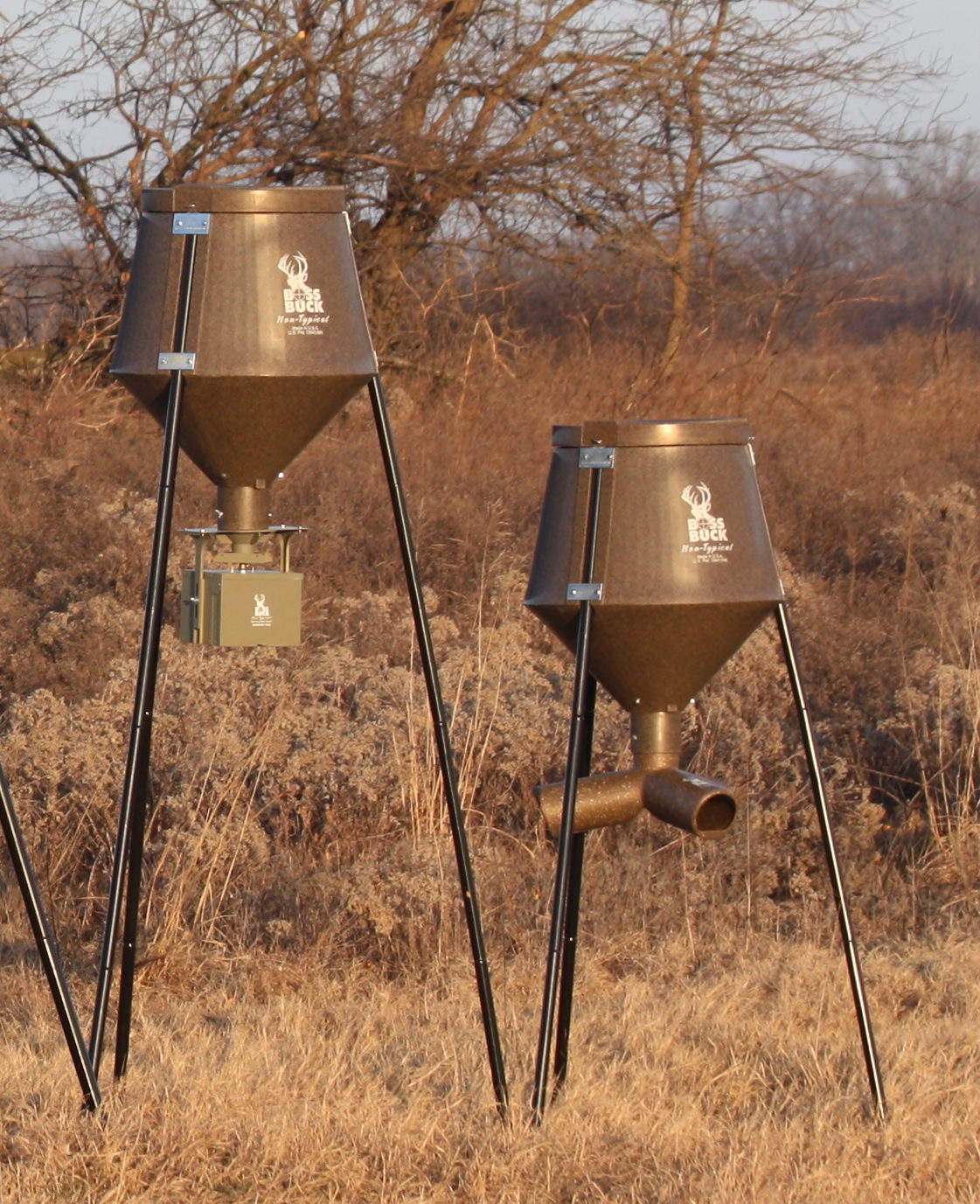
Boss Buck 200 lb All In Gravity Feeder
Check Price on Amazon →Confirm price and availability on AmazonAs an Amazon Associate, we earn from qualifying purchases.