

Best Large-Capacity Deer Feeders
As an Amazon Associate, I earn from qualifying purchases. This guide covers large-capacity deer feeders only: every feeder ranked here has a manufacturer-published capacity of 300 pounds or more. No prices are quoted in this article, because prices change often and a stale price helps no one; check the retailer or manufacturer listing at the time you buy. Nothing in this guide is based on hands-on testing by this site. Capacities, materials, and features below come from manufacturer pages and this site’s own published articles, and where a manufacturer does not publish a figure, this guide says so rather than guessing.
On this page: Quick Answer · At a Glance · How to Choose · The Feeders, Ranked · Refill Math · FAQs · Verdict
Quick Answer: Best Large-Capacity Deer Feeder 300 lb and Up
The best large-capacity deer feeder for most buyers is the All Seasons Feeders 600 lb EZ Broadcast, because it is the only feeder in this roundup that combines a full 600-pound hopper with ground-level filling and a 12-volt battery and solar panel already included in the box. You fill it standing on the ground, set its timer, and walk away for weeks instead of hauling corn up a ladder every few days. If you run protein pellets free-choice on a large property and want the biggest hopper you can buy, the Boss Buck 1200 lb Gravity Feeder is the capacity king at 1,200 pounds of corn, but it is a gravity feeder, not a timed feeder, so feed is available around the clock and you cannot schedule feeding times. If your budget or your site only needs the entry point of this band, the Texas Hunter TF300L4 gives you a timed, stand-and-fill 300-pound feeder with a proven timer and a sight glass so you can see the feed level without opening the hopper.
One warning before you shop: capacity figures are not all measured the same way. A feeder rated for 600 pounds of corn will hold less weight of large protein pellets, because pellets are bulkier and lighter per scoop. Boss Buck publishes both figures for its big feeders, and this guide prints both wherever the manufacturer does. Where a maker publishes only a corn figure, this guide prints only the corn figure. Also beware of gallon ratings. A 30-gallon feeder holds roughly 200 pounds of corn, which is well below this guide’s 300-pound floor, so no 30-gallon feeder appears here no matter how popular it is. Always buy on the pound figure for your feed type, not on the gallon figure on the box.
This is a capacity-band roundup, not a general best-feeder list. Every feeder here holds at least 300 pounds. That single rule shapes everything that follows: the feeders are bigger, heavier, and harder to move than the tripod feeders most hunters start with, and the real buying questions are not about brand loyalty but about how you fill it, how often you can visit the site, whether you need timed feeding or free-choice feeding, and what happens to a full hopper of feed when it rains for a week. If you have not yet decided between timed and gravity feeding, read Spin vs Gravity Feeders and Gravity vs Timed Protein Feeders first, then come back and pick a size. For the full picture across all sizes, see Best Deer Feeders.
Large-Capacity Deer Feeders at a Glance
| Product | Best for | Capacity / key spec | Type | Photo |
|---|---|---|---|---|
| All Seasons Feeders 600 lb EZ Broadcast | Ranch-scale timed feeding | 600 lb; 40-foot QuadCast spread; 12V battery and solar included | Timed spin, stand and fill |  |
| Boss Buck 1200 lb Gravity Feeder | Biggest free-choice protein site | 1,200 lb corn / about 1,000 lb large protein pellets; adjustable height | Gravity, 4-way head | |
| Boss Buck 600 lb Gravity Feeder (BB-1.6.P) | Large movable protein site | 600 lb corn / about 500 lb large protein pellets; 81-inch lid height | Gravity, 4-way head | |
| Texas Hunter TF300L4 | Entry-level 300 lb timed feeder | 300 lb; EZ Set timer, 1 to 9 feedings a day; 4-foot legs | Timed spin, stand and fill | 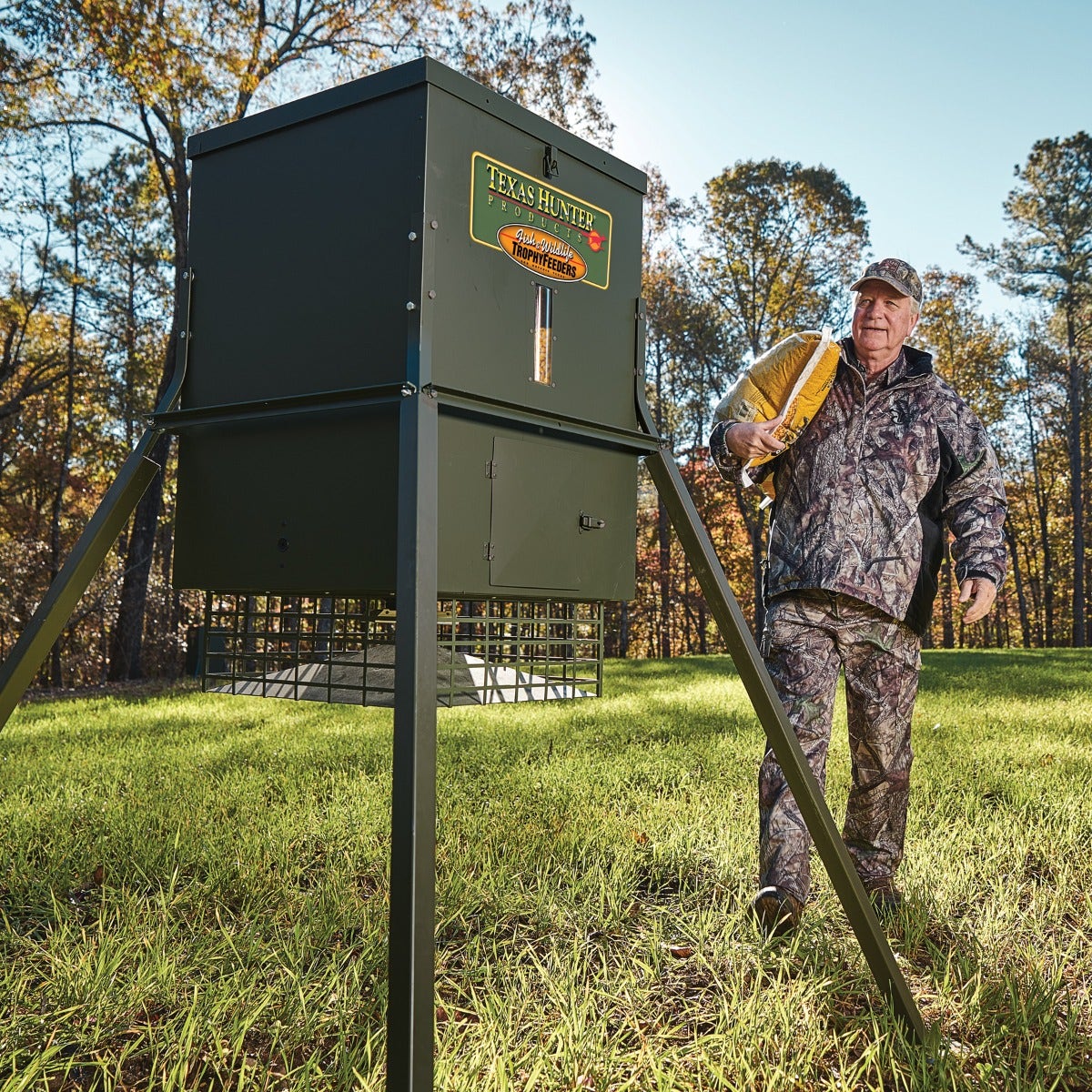 |
| Capsule OPI 400 lb Stand and Fill | Hog and cattle country | 400 lb; auger-fed; gate stays closed between feedings | Timed auger, ground level | 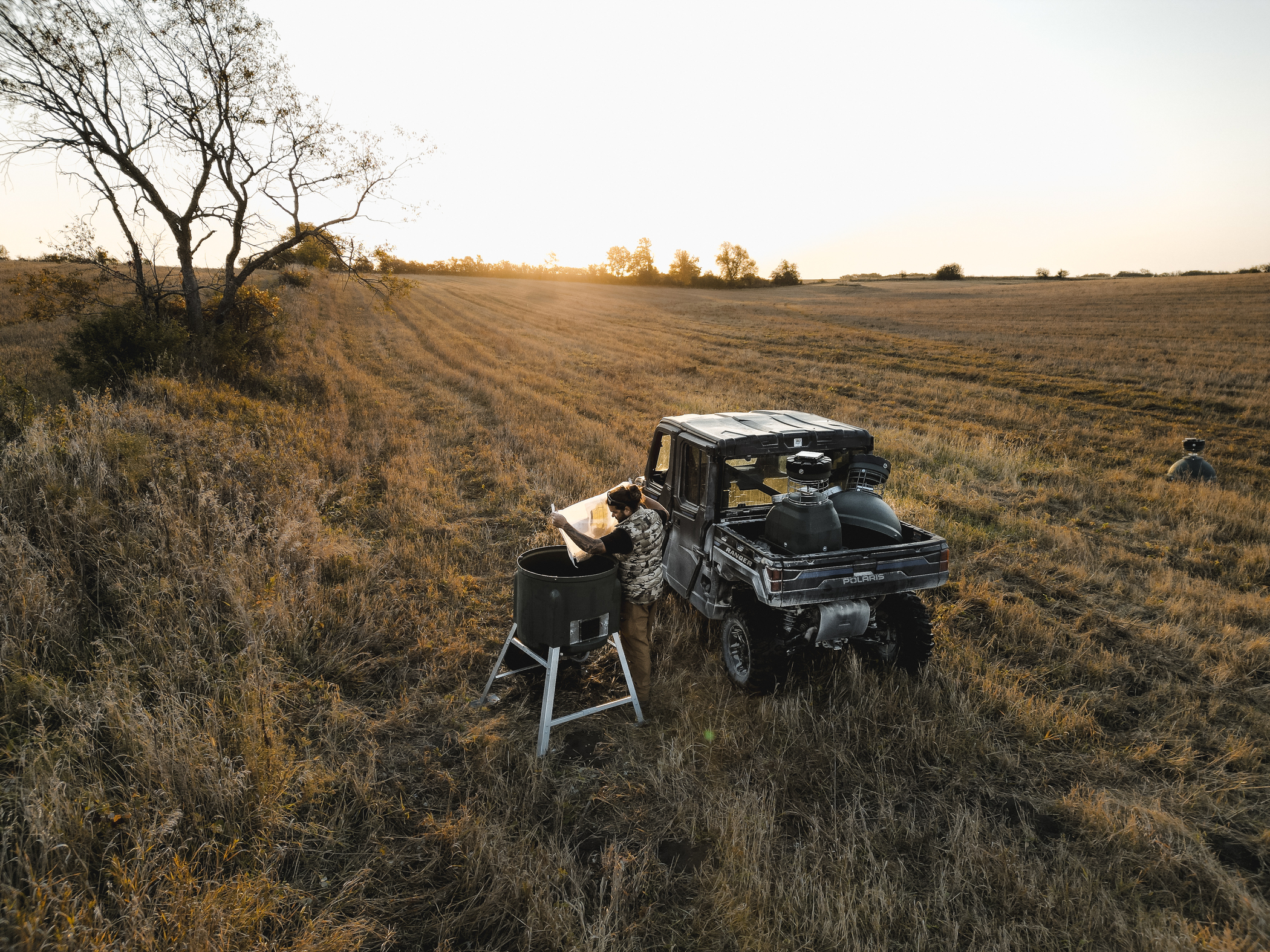 |
| Banks Outdoors Feedbank 300 (FB300) | Permanent single-post site | 300 lb; 4 adjustable ports at 42 inches | Gravity, single post | 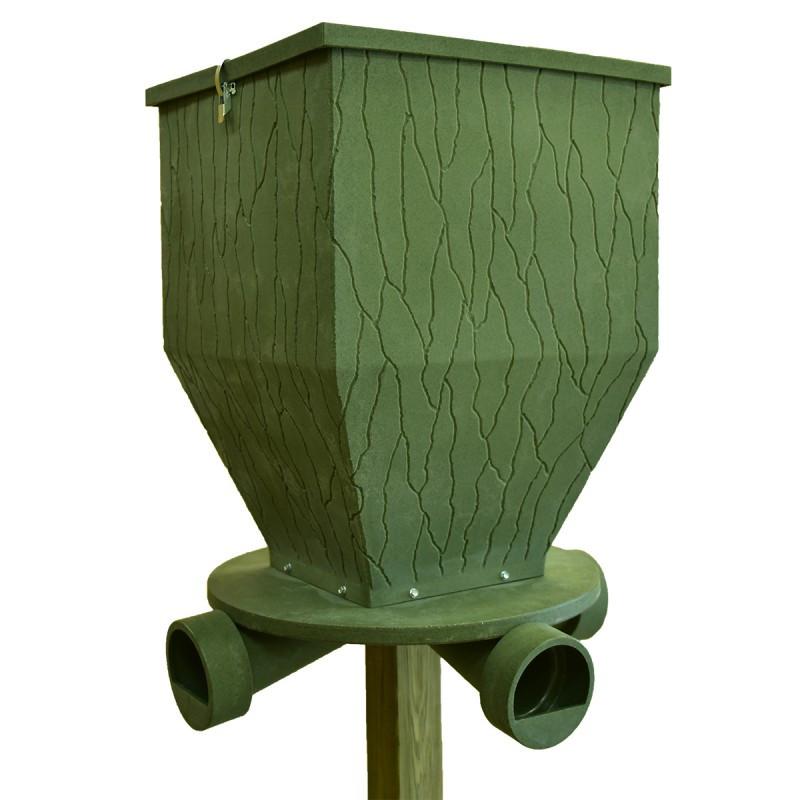 |
Two rows in that table are blank on purpose. No verified exact-model photograph could be found for the Boss Buck 600 or the Boss Buck 1200, and this guide will not substitute a photograph of a different Boss Buck model, a different brand, or a generic feeder and caption it as the product. A blank row is honest; a wrong photograph is not. If you are comparing the two Boss Buck feeders, compare them on their published specifications and on the dealer listing, not on a picture in this table. The same rule applies throughout this guide: a figure appears only where a real photograph of that exact product exists.
How to Choose a 300 lb and Up Deer Feeder
Start with the feed type, because corn pounds and pellet pounds are not the same
The most common sizing mistake in this category is buying a feeder by its headline number and then filling it with a different feed. Corn is dense. Large protein pellets are not. Boss Buck is unusually clear about this: the 600 holds approximately 600 pounds of corn but approximately 500 pounds of large protein pellets, and the 1200 holds approximately 1,200 pounds of corn but approximately 1,000 pounds of large protein pellets. That is a real difference of about a sixth of the hopper, and it changes your refill schedule by the same fraction. If you run pellets, do your refill math on the pellet figure, not the corn figure. If a manufacturer publishes only one figure and you run the other feed type, assume you will hold less than the headline number and plan an earlier first refill until you have measured a real fill yourself. Our companion guide to Protein Deer Feeder Capacity works through pellet weight and refill math in more detail, and Best Protein Deer Feeders compares protein-first models across sizes.
Feed type also decides which delivery system makes sense. Gravity heads and free-choice ports suit pellets, because deer eat at their own pace and the feeder simply keeps the ports supplied. Timed spin feeders suit corn, because a timer can scatter a measured amount at dawn and dusk and nothing is left sitting out overnight for raccoons. Auger feeders, represented here by the Capsule OPI 400, sit in between: they meter feed out on a timer, but through an auger rather than a spinner, and the gate stays closed between feedings so feed is not exposed to weather or varmints while it waits. Do not buy a gravity feeder and then complain that non-target animals eat free-choice, and do not buy a timed feeder and then complain that deer cannot eat between scheduled times. Both behaviors are the design working as intended.
Decide how you will fill it, because a full 600-pound feeder is not a ladder job
At 300 pounds and above, filling height is a safety question, not a convenience question. A 300-pound bag of corn is six 50-pound sacks, and a 1,200-pound fill is twenty-four of them. Stand-and-fill designs, led by the ASF 600 EZ and the Texas Hunter TF300L4, let you fill standing on the ground, which is the single biggest practical advantage in this whole roundup. Low-profile and ground-level designs, like the Capsule OPI 400 at four feet tall, offer the same benefit in a different shape. By contrast, the Boss Buck 600 puts its lid 81 inches off the ground, and the Boss Buck 1200 adjusts from 108 to 132 inches overall, so you need a safe way to get feed up there: a truck bed, a trailer, a grain scoop with a long handle, or a second person. Before you order a tall feeder, stand at the site and work out exactly how the feed gets from your vehicle into the hopper, because the answer determines whether you will actually keep it full. A feeder that is too tall to fill comfortably becomes a feeder that runs empty, and an empty feeder feeds nothing. For placement and access planning, see Where to Place a Deer Feeder and How High Should a Deer Feeder Be.
Weight matters on the way in, too. The Boss Buck 1200 hopper alone weighs 60 pounds before a single pound of feed goes in, and the ASF 600 EZ weighs 105 pounds empty. These are not feeders you casually relocate on a whim, and a site that needs moving every season calls for a smaller, lighter feeder or a feeder with skids. The ASF 600 EZ is a stand-and-fill road-style feeder that can be relocated more easily than a legged tower, while the Banks Feedbank 300 is the opposite philosophy: a single post set into the ground for a permanent site. Match the feeder’s permanence to the site’s permanence. A permanent feeder on a trial site is a mistake you will pay for with a post hole and a long carry.
Match the delivery system to how often you can visit
Capacity only saves you trips if the feeder can be left alone for the interval its capacity promises. A timed feeder needs a charged battery, and a dead battery means no feeding until you service it, no matter how full the hopper is. That is why included power matters: the ASF 600 EZ and the Capsule OPI 400 both include a 12-volt battery and a solar panel, so the charging question is answered in the box, while the Texas Hunter TF300L4 includes its 12-volt battery and is pre-wired for its optional SP12 solar charger, which you add separately. Check the battery and timer guidance in Best Deer Feeder Batteries and Best Deer Feeder Timers before you commit to a remote site. Gravity feeders have no battery to die, which is their great strength for remote land, but they have the opposite weakness: feed is available around the clock to every animal that finds the ports, so a gravity feeder on a hog-heavy property can empty far faster than its capacity suggests. Hogs, raccoons, and cattle are a capacity question, not just a nuisance question, and our guide to Keeping Raccoons and Hogs Off a Deer Feeder is worth reading before you choose free-choice feeding on a property where those animals are common.
Visit frequency also decides whether 300 pounds is enough or whether you should jump straight to 600 or 1,200. Work it out from the refill-math section below before you buy, not after. A feeder that holds 300 pounds and is visited once a month needs to dispense no more than about 10 pounds a day on average. If your herd eats more than that, you need a bigger hopper, a lower dispense rate, or more frequent visits, and only one of those three is free. Finally, check the law before you buy anything in this category. Feeding and baiting rules vary by state and sometimes by county, and a large-capacity feeder does not exempt you from them. Start with the legality guides for your state, and confirm the current rules with your state wildlife agency before you put feed out.
Plan for weather, because a big hopper is a big spoilage risk
A small feeder that spoils costs you a few pounds of corn. A 1,200-pound feeder that spoils costs you a season’s feed budget and a hopper full of mold. Moisture control is therefore a first-class buying criterion at this size, not a footnote. Look for a lid that actually sheds water and lets the hopper breathe rather than trapping condensation, for ports with drain holes and an overhang so rain does not run straight into the feed, and for a design that lets you see or check the feed level without opening the whole hopper in the rain. The Boss Buck gravity head is built around exactly this problem, with angled ports, an overhang, and a drain hole per port, and the Banks Feedbank 300 uses a watertight cover over a polyethylene body. The Texas Hunter TF300L4 adds a sight glass, so you can check the level at a glance. Whatever you buy, plan a first-fill inspection: fill it, wait for the first real rain, then open it and look. If feed is caking at the bottom or clumping in the ports, you have a moisture problem to fix before the hopper is full, not after. Feed that sits for months also goes stale, so a feeder that is too big for your herd is not just wasted money; it is a freshness problem. Size the hopper to your herd and your visit schedule, not to your ambition.
The Best Large-Capacity Deer Feeders, Ranked
1. All Seasons Feeders 600 lb EZ Broadcast — Best Overall Large-Capacity Feeder
The ASF 600 EZ is the best overall pick in this roundup because it solves the two problems that actually defeat big feeders: filling and power. It is a stand-and-fill feeder, so you fill a 600-pound hopper standing on the ground instead of climbing a ladder with sacks of corn, and its 12-volt battery and solar panel are included in the box, so the timer question and the charging question are answered before you ever leave the dealer. The EZ digital timer sits under the lid with the battery, and the QuadCast spinner plate throws an even 40-foot spread, which is wide enough to scatter feed across an open area rather than piling it in one spot where a single dominant animal can guard it. The body is galvanized metal with a powder-coated finish, built to be varmint- and hog-resistant, and the manufacturer describes the design as varmint-resistant with a heavy-duty steel build. For a ranch-scale site, a large herd, or a property you visit infrequently, that combination — 600 pounds, ground filling, included power, and a wide spread — is the most complete package in this band.
The honest weaknesses start with weight and permanence. At 105 pounds empty, this is a heavy, semi-permanent feeder, and moving it is a job, not an errand. It is also a timed feeder, which means it is only as reliable as its battery and timer: a dead battery means no feeding until you service it, however full the hopper is, and the solar panel helps only if it gets enough sun at the site. A feeder tucked under a thick canopy will charge more slowly than one in the open, so site selection matters for power as well as for deer movement. Finally, the EZ is a corn-first broadcast design. If your program is built on free-choice protein pellets, a gravity head will serve you better than a spinner, and you should look at the Boss Buck feeders below rather than forcing a timed corn feeder into a protein job. The ASF 600 EZ is the best feeder here for timed corn feeding at scale; it is not the best feeder for every feeding program.
Pros
- 600-pound hopper with ground-level stand-and-fill loading — no ladder needed
- 12-volt battery and solar panel included in the box
- Even 40-foot QuadCast spread covers an open feeding area
- Galvanized metal body built to resist varmints and hogs
- Timer and battery sit under the lid, protected from weather
Cons
- 105 pounds empty — heavy and semi-permanent once sited
- A dead battery stops all feeding until serviced
- Solar charging depends on sunlight at the site
- Timed broadcast design is corn-first, not a free-choice protein feeder
- No verified Amazon button in this article — buy through the manufacturer or a dealer
From the field. Model-specific reviews of the 600 EZ itself are thin, but the brand evidence reported on this site’s main roundup is unusually strong: ASF timer and feeder units rate 4.9 out of 5 across 48 Amazon reviews, one owner’s timer lasted more than seven years, and another owner who runs thirteen units calls them bulletproof. A verified buyer of the 600 EZ in July 2023 reported that it keeps deer fed and drawn to his property season after season. That is not a claim that this site tested the feeder, and it is not a promise that every unit will last seven years, but it is a meaningful signal about the brand’s electronics and build over time, and it is the strongest owner-evidence base of any feeder in this roundup. The counterweight is that thin model-specific coverage cuts both ways: there is less documented evidence about this exact model’s long-term weak points than there is for high-volume tripod feeders, so inspect the timer, spinner plate, and lid seal on arrival rather than assuming a famous brand name covers a manufacturing defect.
| Spec | Detail |
|---|---|
| Capacity | 600 lb |
| Type | Timed spin broadcast, stand and fill |
| Spread | About 40 feet, QuadCast spinner plate |
| Power | 12-volt battery included; solar panel included |
| Build | Galvanized metal, powder-coated finish |
| Size and weight | About 56 inches tall, 43 inches wide, 49 inches long; 105 lb empty |
| Fill | Ground level (stand and fill) |
Buying note: No verified exact-product Amazon link could be confirmed for the ASF 600 EZ from the sources this article is allowed to use, so this review carries no Amazon button. Check the manufacturer’s site or an authorized dealer for current availability. Do not buy a similarly named ASF feeder and assume it is this model; confirm the 600 lb EZ Broadcast name and the 600-pound capacity on the listing before ordering.
2. Boss Buck 1200 lb Gravity Feeder — Biggest Capacity You Can Buy
There is no subtlety to the Boss Buck 1200: it is the biggest hopper in this roundup by a factor of two, holding approximately 1,200 pounds of corn or approximately 1,000 pounds of large protein pellets, and it is the right choice when refill trips are genuinely expensive — a remote ranch, a property visited once a month or less, or a high-use protein site where a smaller feeder would run dry between visits. Its headline feature beyond size is adjustable height: the feeder adjusts from 108 to 132 inches overall, so you can set a 40-inch protein feed height for free-choice feeding or raise the control-box height for an automatic corn conversion, using the optional Automatic Conversion Kit that is sold separately. The hopper is thick-wall HDPE UV-protected plastic that will not rot, rust, or leak, the patented four-way gravity head dispenses feed evenly to all four ports, and the four-way inner sleeve lets you control feed flow for different feed shapes and sizes. The hopper itself weighs 60 pounds and measures 61 inches tall by 43.5 inches wide, which is light for its size but still a large object to transport and assemble.
The weaknesses are the direct consequences of its size. First, it is a gravity feeder, so feed is available around the clock to deer, hogs, raccoons, and anything else that finds the ports; on a property with heavy hog pressure, a 1,200-pound hopper can become a 1,200-pound hog feeder, and no capacity figure survives contact with a sounder of hogs. Second, filling it is a project: at adjustable heights up to 132 inches, you need a truck bed, a trailer, or a safe elevated filling method, and you need to think through that method before the feeder arrives, not after. Third, a hopper this large is a freshness risk. Feed that sits for months in heat and humidity can cake, clump, and spoil, and the cost of a spoiled full hopper dwarfs the cost of a spoiled small one. Buy the 1200 only if your herd and your visit schedule genuinely consume feed fast enough to turn the hopper over, and inspect the ports and the bottom of the hopper on every visit. If your herd cannot eat 1,200 pounds before it goes stale, the Boss Buck 600 below is the same design at half the risk.
Pros
- Largest capacity here: about 1,200 lb corn / 1,000 lb large protein pellets
- Adjustable height (108 to 132 inches) for protein or automatic conversion use
- Four-way gravity head with adjustable flow sleeve for different feed shapes
- Thick-wall HDPE hopper that will not rot, rust, or leak
- No battery, motor, or timer to fail on a remote site
Cons
- Free-choice feeding means hogs and raccoons eat around the clock too
- Filling at up to 132 inches needs a truck bed, trailer, or elevated method
- A full hopper that goes stale is a large and expensive loss
- Automatic conversion kit is sold separately, not included
- No verified exact-model photograph and no verified Amazon button in this article
| Spec | Detail |
|---|---|
| Capacity | About 1,200 lb corn; about 1,000 lb large protein pellets |
| Type | Gravity, 4-way protein head |
| Height | Adjustable from 108 to 132 inches; protein feed height 40 inches |
| Hopper | 61 inches tall x 43.5 inches wide; 60 lb hopper weight |
| Legs | 105-inch galvanized steel legs |
| Build | Thick-wall HDPE UV-protected plastic; galvanized hardware |
| Conversion | Converts to automatic feeding with optional kit (sold separately) |
Buying note: No verified exact-model photograph and no verified exact-product Amazon link could be confirmed for the Boss Buck 1200 from the sources this article is allowed to use, so this review carries no photograph and no Amazon button. Boss Buck models in this family are also sold through dealers, and some configurations are dealer-only. Confirm the exact model number, the 1,200-pound capacity, and whether the configuration you are buying is the gravity head or a spinner conversion before ordering, and never accept a photograph of a smaller Boss Buck feeder as proof of what you will receive.
3. Boss Buck 600 lb Gravity Feeder (BB-1.6.P) — Best Large Movable Protein Feeder
The Boss Buck 600 is the same proven gravity design as the 1200, sized for properties where 1,200 pounds would be too much feed, too much money, or too much risk of spoilage. It holds approximately 600 pounds of corn or approximately 500 pounds of large protein pellets, which is enough for a large property or a high-use site while still turning over fast enough to stay fresh. The four-way gravity head uses ports angled at 10 degrees with a 1-inch overhang and a drain hole per port, so rain is less likely to run into the feed, and the internal cone dispenses feed evenly to all four ports while the four-way inner sleeve lets you control flow for different feed shapes and sizes. The lid sits 81 inches off the ground and the feed height at the spout is 42 inches, a comfortable height for deer and a workable height for inspection. The hopper is thick-wall HDPE UV-protected plastic that will not rot, rust, or leak, all hardware is galvanized, and the feeder converts from a protein feeder to a spin feeder in minutes with the conversion kit, which gives you a genuine second life for the same hopper if your feeding program changes.
The weaknesses mirror the 1200’s, at a smaller scale. It is still a gravity feeder, so feed is available around the clock to every animal that finds it, and on hog-heavy ground that is a real cost, not a theoretical one. The 81-inch lid height still demands a filling plan: better than the 1200’s adjustable tower, but still not a ground-level fill, and still a ladder or truck-bed job unless your site offers a natural elevation. Boss Buck publishes no throw or spread distance for its gravity feeders, and this guide prints none, because a gravity feeder does not throw feed; anyone quoting a spread distance for this model is inventing a specification. Finally, the Boss Buck family runs 200, 350, 600, and 1,200 pounds only. There is no 250-pound or 500-pound Boss Buck feeder, and any listing that claims one should be treated as a mislabeled or different product until the model number proves otherwise. Confirm BB-1.6.P on the listing for this gravity configuration.
Pros
- 600 lb corn / about 500 lb large protein pellets — large without the 1200’s spoilage risk
- Four-way head with angled, drained ports for moisture control
- Internal cone and flow sleeve dispense evenly and adjust to feed shape
- Converts from protein to spin feeding in minutes with the conversion kit
- Roto-molded HDPE hopper that will not rot, rust, or leak
Cons
- Free-choice feeding means non-target animals eat around the clock
- 81-inch lid height still needs a filling plan — not a ground-level fill
- Conversion kit is a separate purchase, not included
- No verified exact-model photograph for BB-1.6.P — this review has no figure
- No verified Amazon button in this article; some Boss Buck models are dealer-only
| Spec | Detail |
|---|---|
| Capacity | About 600 lb corn; about 500 lb large protein pellets |
| Model | BB-1.6.P (gravity configuration) |
| Type | Gravity, 4-way protein head |
| Feed height | 42 inches (ground to spout); 81 inches (ground to lid) |
| Ports | 4 ports, 8 inches long, 4 inches inside diameter, 10-degree angle, drain hole each |
| Build | Thick-wall HDPE UV-protected plastic; galvanized hardware |
| Conversion | Converts to spin feeding in minutes with conversion kit (sold separately) |
Buying note: No verified exact-model photograph exists for BB-1.6.P in the sources available to this article, so this review deliberately carries no figure rather than substituting a photograph of the Boss Buck 200, 350, or any other model. No verified exact-product Amazon link could be confirmed either, so there is no Amazon button here. Buy through Boss Buck’s dealer network or a verified retailer, and confirm the BB-1.6.P model number and the 600-pound capacity on the listing.
4. Texas Hunter TF300L4 — Best Entry-Level 300 lb Timed Feeder
The TF300L4 is the most accessible way into this capacity band: a genuine 300-pound timed feeder with a stand-and-fill design, a timer that hunters have used for years, and a set of practical details that show the maker has thought about daily use. The EZ Set Digital Timer feeds 1 to 9 times per day with run times and test runs of 1 to 60 seconds, so you can set short, frequent scatterings or fewer, longer ones depending on your herd and your site. The 4-foot extension legs with footpads and stabilizing stakes let you fill standing on the ground, which is the feature that matters most at this size, and the built-in sight glass lets you check the feed level without opening the hopper. A 12-volt rechargeable battery is included, the unit is pre-wired for the optional and recommended SP12 solar charger, the compartment that holds the battery and timer locks, and the spinner plate is stainless steel with built-in gate stops that help keep wind from turning it. The body is galvanized steel with a powder-coated finish, and the varmint guard is designed to protect feed with no moving parts to fail.
The honest trade-off is capacity. Three hundred pounds is the floor of this roundup, not the middle of it, and on a high-use site it will need refilling twice as often as a 600-pound feeder and four times as often as a 1200. If your visit schedule is monthly and your herd eats more than about 10 pounds a day, this feeder will run dry between visits, and you should size up rather than hope the herd eats less. It is also a timed feeder, so a dead battery stops feeding until serviced, and the solar charger that would prevent that is an optional extra rather than an included part, unlike the ASF 600 EZ and the Capsule OPI 400. Finally, the TF300L4 is a corn-first broadcast feeder. It will scatter corn on a schedule very well, but if your program is free-choice protein pellets, a gravity feeder will serve the pellets better. Buy the TF300L4 when you want timed corn feeding, ground-level filling, and a proven timer at the smallest size that still counts as large capacity.
Pros
- True 300 lb capacity with ground-level stand-and-fill loading on 4-foot legs
- EZ Set timer: 1 to 9 feedings a day, 1 to 60-second run times
- Sight glass shows the feed level without opening the hopper
- 12-volt battery included; lockable battery and timer compartment
- Galvanized steel, powder-coated, with a no-moving-parts varmint guard
Cons
- 300 lb is the floor of this band — refills twice as often as a 600 lb feeder
- Solar charger (SP12) is optional, not included
- A dead battery stops all feeding until serviced
- Timed broadcast design is corn-first, not a free-choice protein feeder
- No verified Amazon button in this article — buy through the manufacturer or a dealer
| Spec | Detail |
|---|---|
| Capacity | 300 lb |
| Model | TF300L4 (4-foot legs) |
| Type | Timed spin broadcast, stand and fill |
| Timer | EZ Set Digital Timer: 1 to 9 times per day; run time 1 to 60 seconds; test run 1 to 60 seconds |
| Power | 12-volt rechargeable battery included; pre-wired for optional SP12 solar charger |
| Build | Galvanized steel with powder-coated finish; stainless steel hardware and spinner plate |
| Extras | Footpads and stabilizing stakes; sight glass; lockable compartment; varmint guard |
Buying note: No verified exact-product Amazon link could be confirmed for the TF300L4 from the sources this article is allowed to use, so this review carries no Amazon button. The manufacturer sells direct and through dealers; confirm the TF300L4 model number and the 300-pound capacity on the listing, and note that the TF300L8 is the same 300-pound hopper on 8-foot legs, not a larger feeder.
5. Capsule OPI 400 lb Stand and Fill — Best for Hog and Cattle Country
The Capsule OPI 400 is the only feeder in this roundup that solves the hog problem by design rather than by fencing. It sits on the ground, stands four feet tall on four metal legs with sink-proof feet, and its low center of gravity means hogs and cattle cannot tip it the way they can tip a legged tripod feeder. Instead of a spinner plate, it uses an auger to meter feed out, and its gate-plate stays closed between feedings, so feed is not sitting exposed to weather or varmints while it waits for the next scheduled feeding. The programmable timer runs up to 6 feedings a day, and the 12-volt battery and solar panel are included. It handles corn, protein pellets, or a mix of both, which makes it unusually flexible for a feeder at this size: you can run corn through hunting season and switch to pellets or a mix without changing feeders. The body is heavy-duty roto-molded plastic that will not rust, and the sit-and-fill design means filling is a ground-level job for a person of any age or strength.
The trade-offs are capacity and complexity. Four hundred pounds sits in the middle of this band: more than the 300-pound entry point, but a full third less than the 600-pound feeders, so on a high-use site it will need refilling noticeably more often than the ASF or Boss Buck 600. An auger is also a more complex delivery system than a gravity head or a simple spinner, with more parts that can jam if feed cakes, bridges, or gets wet inside the hopper, so feed quality and moisture control matter more here than on a gravity feeder with nothing to jam. The ground-level design that defeats tipping also puts the feeder at ground level for every other animal, and while the closed gate protects feed between feedings, it does not make the feeder invisible to hogs that learn the feeding schedule. Finally, the Capsule line runs from 100 pounds to 1,000 pounds, so confirm you are buying the 400-pound Stand and Fill model specifically; a smaller or larger Capsule feeder is a different purchase with a different refill schedule.
Pros
- Ground-level, tip-resistant design — low center of gravity defeats hogs and cattle tipping
- Auger metering with a gate that stays closed between feedings, protecting feed
- Handles corn, protein pellets, or a mix of both
- 12-volt battery and solar panel included; up to 6 feedings a day
- Four feet tall with sink-proof feet — fill standing on the ground
Cons
- 400 lb is mid-band — refills more often than a 600 lb feeder on a high-use site
- Auger system has more to jam than a gravity head if feed cakes or gets wet
- Ground-level placement does not hide the feeder from animals that learn the schedule
- No verified Amazon button in this article — buy through the manufacturer or a dealer
| Spec | Detail |
|---|---|
| Capacity | 400 lb |
| Type | Timed auger, ground level, stand and fill |
| Feedings | Up to 6 per day, programmable timer |
| Power | 12-volt battery included; solar panel included |
| Build | Heavy-duty roto-molded plastic; four metal legs with sink-proof feet |
| Height | Four feet tall |
| Feed | Corn, protein pellets, or a mix |
Buying note: No verified exact-product Amazon link could be confirmed for the Capsule OPI 400 from the sources this article is allowed to use, so this review carries no Amazon button. Confirm the 400-pound Stand and Fill model on the listing, since the Capsule line spans 100 to 1,000 pounds.
6. Banks Outdoors Feedbank 300 (FB300) — Best Permanent Single-Post Feeder
The Feedbank 300 is the permanent-site answer to this capacity band. Instead of legs, it mounts on a single center post, which gives deer 360-degree access without tripod legs getting in the way of antlers, and it holds a full 300 pounds of feed behind four adjustable ports that stand at an optimal height of 42 inches. The body is UV-stabilized polyethylene, so it will not rust and will stand up to years of sun and weather, and a large watertight cover keeps feed fresh while making filling straightforward. There is no motor, no timer, and no battery, which means there is nothing electronic to fail on a remote site and nothing to charge. For a proven site that you intend to feed for years — a food-plot edge, a long-term protein station, a property corner that has produced season after season — the Feedbank 300 is a set-it-and-forget-it feeder in the best sense, provided you accept what set-and-forget really means for a gravity feeder.
The weaknesses are permanence and free-choice feeding. A single post set into the ground is not a feeder you move on a whim, so this is the wrong choice for a trial site or a property where you are still learning deer movement; start movable and graduate to a post-mounted feeder once the site has proven itself. The post itself is not included in the usual package description — the feeder mounts on a single 4-by-4 post, and you supply and set that post — so factor the post, the concrete or tamping, and the setting work into your plan. And because it is gravity-fed, feed is available around the clock to every animal that finds the ports, with adjustable flow as your only control. On hog-heavy ground, that can empty a 300-pound hopper faster than the capacity figure suggests, and the adjustable ports need checking: a port left wide open on a high-use site is a fast drain, while a port set too tight can starve the site. Check the ports on every visit, and treat the first month as a calibration period, not a finished setup.
Pros
- Single-post mounting gives 360-degree access without antler-blocking legs
- Four adjustable ports at 42 inches for controlled free-choice feeding
- UV-stabilized polyethylene body with a watertight cover
- No motor, timer, or battery — nothing electronic to fail remotely
- Permanent, low-maintenance design for a proven long-term site
Cons
- Permanent post mounting — wrong choice for a trial or movable site
- Mounting post is not included; setting it is extra work
- Free-choice feeding means non-target animals eat around the clock
- 300 lb is the floor of this band — the smallest hopper ranked here
| Spec | Detail |
|---|---|
| Capacity | 300 lb |
| Model | FB300 |
| Type | Gravity, single-post mount |
| Ports | 4 adjustable feeding ports at 42 inches |
| Build | UV-stabilized polyethylene; watertight cover |
| Mount | Single 4-by-4 post (post not included) |
Check Price on Amazon: Banks Outdoors Feedbank 300
What did not make this roundup, and why: the Boss Buck 200, at 200 pounds, and the Moultrie 250 Gravity, at 250 pounds, both sit below this guide’s 300-pound floor. The Boss Buck 350, at 350 pounds, would clear the floor on capacity alone, but it is covered in depth in Best Gravity Deer Feeders and in the Boss Buck 200 vs 350 comparison, and this roundup prioritises the 600 and 1200 as the large end of the Boss Buck family rather than repeating the 350 here. Any 30-gallon feeder, at roughly 200 pounds of corn, is below the floor too, however good it may be in its own class. This guide’s floor is a rule, not a judgment on those feeders, and readers who need a smaller feeder should start with the gravity guide or the main roundup rather than buying a 300-pound feeder they do not need.
Refill Math: How Long Will a Full Hopper Actually Last?
Capacity is only useful when you turn it into days. The honest formula is the same one this site’s corn calculator uses, and it has no magic in it: days per fill equals capacity in pounds divided by daily use in pounds. Daily use, for a timed feeder, equals feedings per day multiplied by seconds per feeding multiplied by pounds per second. Pounds per second is not a universal constant — it depends on your feeder, your spinner or auger, and your feed — so measure it on your own feeder by catching one feeding in a bucket and weighing it, rather than trusting a stranger’s number. The tables below use daily-use figures in pounds per day, which is the number you actually need, and one worked timed-feeder example using a figure published on this site’s main roundup for the ASF 600 EZ, where about 1.5 pounds of corn is dispensed per 4 seconds of run time. That figure is specific to that feeder and that feed; do not apply it to a different feeder.
Days per fill at different daily-use rates
| Feeder (corn capacity) | 5 lb/day | 10 lb/day | 20 lb/day | 30 lb/day |
|---|---|---|---|---|
| Boss Buck 1200 (1,200 lb) | 240 days | 120 days | 60 days | 40 days |
| ASF 600 EZ (600 lb) | 120 days | 60 days | 30 days | 20 days |
| Boss Buck 600 (600 lb corn) | 120 days | 60 days | 30 days | 20 days |
| Capsule OPI 400 (400 lb) | 80 days | 40 days | 20 days | 13 days |
| Texas Hunter TF300L4 (300 lb) | 60 days | 30 days | 15 days | 10 days |
| Banks Feedbank 300 (300 lb) | 60 days | 30 days | 15 days | 10 days |
Read that table with two corrections. First, protein pellets change the answer: the Boss Buck 600 holds about 500 pounds of large pellets, not 600, so at 10 pounds a day it lasts 50 days on pellets, not 60; the Boss Buck 1200 holds about 1,000 pounds of large pellets, so at 10 pounds a day it lasts 100 days on pellets, not 120. Second, gravity feeders do not have a daily-use figure you control. On a gravity feeder, daily use is whatever the animals eat, and hogs, raccoons, and a large deer herd can push daily use far above your estimate. Treat the gravity rows in the table as planning scenarios — if animals eat 20 pounds a day, a 300-pound gravity feeder lasts 15 days — not as promises. If you cannot visit for a month and your gravity site eats 20 pounds a day, you need 600 pounds, not 300, and you need a hog plan, not just a bigger hopper.
Worked example: a timed feeder, step by step
Take the ASF 600 EZ as the example, using this site’s published figure of about 1.5 pounds per 4 seconds. Suppose you run it twice a day for 6 seconds per feeding. Each feeding dispenses about 2.25 pounds (6 seconds divided by 4 seconds, multiplied by 1.5 pounds), so daily use is about 4.5 pounds, and a full 600-pound hopper lasts about 133 days (600 divided by 4.5). Run it twice a day for 10 seconds instead, and each feeding dispenses about 3.75 pounds, daily use is about 7.5 pounds, and the hopper lasts about 80 days. Run it four times a day for 10 seconds, and daily use is about 15 pounds, so the hopper lasts about 40 days. The lesson is that timer settings move the refill date more than capacity does: doubling your run time halves your days per fill, whatever feeder you own. Set the timer for the herd you have, not the herd you imagine, and re-weigh a feeding after you change feed type, because pellets and corn do not dispense at the same rate.
For any other timed feeder, run the same steps with your own measured rate: first, catch and weigh one feeding to find your pounds per second; second, multiply feedings per day by seconds per feeding by pounds per second to get daily use; third, divide capacity by daily use to get days per fill. If the answer is shorter than your visit interval, you have three honest options: buy a bigger hopper, reduce feedings or run time, or visit more often. What you cannot do is buy a 300-pound feeder, set it to scatter 30 pounds a day, visit once a month, and expect it to be full when you return. The math does not negotiate. More detail on how long corn lasts in a feeder, including spoilage and moisture checks, is in How Long Does Deer Feeder Corn Last and How Many Times a Day Should a Deer Feeder Go Off. For the best feeding times themselves, see Best Time of Day to Run a Deer Feeder.
Ownership costs beyond the feeder itself
A large-capacity feeder’s purchase price is only the first cost, and this guide deliberately quotes no prices because they change too fast to print responsibly. The recurring costs are feed, batteries, and visits. Feed is the dominant cost by far: a feeder that dispenses 10 pounds a day consumes 300 pounds a month, and at any plausible corn or pellet price that dwarfs the feeder’s purchase price within a season or two. Batteries are the second cost: a timed feeder needs a healthy 12-volt battery, and a solar panel pays for itself by reducing battery replacements and dead-battery visits, which is why the included solar panels on the ASF and Capsule models matter more than they first appear. Visits are the hidden cost: fuel, time, and wear on your vehicle to a remote site, multiplied by every refill trip the feeder’s capacity does not save you. That is the real economic case for a 600- or 1,200-pound feeder — not that it is cheaper to buy, but that it can cut refill trips from weekly to monthly or from monthly to quarterly, and every trip you do not make is money and time saved. Against those savings, set the spoilage risk: a hopper that is too big for its herd wastes feed to staleness, and wasted feed is the most expensive feed there is, because you paid for it and no deer ate it.
Large-Capacity Deer Feeder FAQs
What counts as a large-capacity deer feeder?
This guide uses 300 pounds and up as the large-capacity band, because 300 pounds is roughly six 50-pound sacks of feed and marks the point where filling method, visit frequency, and spoilage risk all change. Below that, a feeder is a standard or mid-size feeder; at 300 pounds and above, you are buying refill intervals measured in weeks and months, not days.
Is a 30-gallon deer feeder a large-capacity feeder?
No. A 30-gallon feeder holds roughly 200 pounds of corn, which is well below this guide’s 300-pound floor. Gallon ratings are misleading because a gallon of corn and a gallon of pellets do not weigh the same, and a gallon of one feed type is not a gallon of another. Always buy on the manufacturer’s pound figure for your feed type, not on the gallon figure.
How many pounds of corn does a 600 lb feeder hold in protein pellets?
Less than 600 pounds. Boss Buck publishes both figures: its 600 holds approximately 600 pounds of corn but approximately 500 pounds of large protein pellets, and its 1200 holds approximately 1,200 pounds of corn but approximately 1,000 pounds of large protein pellets. If a manufacturer publishes only a corn figure, plan on holding less weight of pellets and do your refill math on a measured first fill.
Should I buy a timed feeder or a gravity feeder for a large property?
Buy a timed feeder if you want deer fed at specific times, want to limit non-target animals, and can keep a battery charged. Buy a gravity feeder if you want free-choice feeding, have a remote site where a dead battery would be a serious problem, and can accept that hogs and raccoons will eat around the clock. There is no universally better answer; the right answer depends on your animals, your visit schedule, and your feeding program.
How do I fill a feeder whose lid is 81 inches off the ground?
Plan the filling method before you buy. Options include filling from a truck bed or trailer parked beside the feeder, using a site with a natural elevation, or using a long-handled scoop. What does not work is climbing a ladder with 50-pound sacks on a regular basis, which is unsafe and unsustainable. If you cannot work out a safe filling method for a tall feeder, buy a stand-and-fill or ground-level feeder instead.
How long will 300 pounds of corn last in a deer feeder?
Divide 300 by your daily use in pounds. At 5 pounds a day, 300 pounds lasts 60 days; at 10 pounds a day, 30 days; at 20 pounds a day, 15 days; at 30 pounds a day, 10 days. For a timed feeder, daily use equals feedings per day multiplied by seconds per feeding multiplied by pounds per second, and you should measure pounds per second on your own feeder by weighing one feeding. For a gravity feeder, daily use is whatever the animals eat, so treat any figure as a planning scenario, not a promise.
Do Boss Buck feeders come in 250 lb or 500 lb sizes?
No. The Boss Buck hopper family is 200, 350, 600, and 1,200 pounds only. There is no 250-pound or 500-pound Boss Buck feeder. Any listing that claims one should be checked against the model number before you buy, because it is either mislabeled or a different product.
Can a Boss Buck gravity feeder be converted to a timed feeder?
Yes, with the conversion kit. Boss Buck gravity feeders convert from a protein feeder to a spin feeder in minutes using the Automatic Conversion Kit, which is sold separately and is not included with the gravity feeder. The 1200’s adjustable height is designed for exactly this change, letting you move from a protein feed height to a control-box height for automatic corn feeding.
Will a large feeder keep feed fresh for months?
Not automatically. Feed that sits for months in heat and humidity can cake, clump, and spoil, and a large hopper makes a spoilage event more expensive, not less. Look for a watertight lid that still lets the hopper breathe, ports with drain holes, and a way to check the feed level, and inspect the bottom of the hopper and the ports after the first real rain. Size the hopper to your herd and visit schedule so feed turns over before it goes stale.
Are large-capacity feeders legal everywhere?
No. Feeding and baiting rules vary by state and sometimes by county, and they change. A large-capacity feeder does not exempt you from any rule. Check your state wildlife agency’s current regulations for feeding, baiting, and any capacity or timing restrictions before you put feed out, and re-check before each season.
What is the best large-capacity feeder for hog country?
The Capsule OPI 400 is the strongest answer in this roundup, because it sits on the ground with a low center of gravity that hogs and cattle cannot tip, and its gate stays closed between timed feedings so feed is not exposed. No feeder is hog-proof, and hogs that learn a feeding schedule will still visit, but a tip-resistant, closed-gate, timed design loses far less feed to hogs than an open gravity feeder on the same property.
Do I need a solar panel for a large timed feeder?
You need a charging plan, and a solar panel is the most reliable version of one for a remote site. The ASF 600 EZ and the Capsule OPI 400 include a solar panel; the Texas Hunter TF300L4 is pre-wired for its optional SP12 solar charger. Without solar, you are relying on battery swaps and visits, and a dead battery stops all feeding until you service it, no matter how full the hopper is.
Verdict: Which Large-Capacity Feeder Should You Buy?
Buy the All Seasons Feeders 600 lb EZ Broadcast if you want the most complete large-capacity package: 600 pounds, ground-level filling, and battery plus solar included, in a timed corn feeder that suits ranch-scale sites and large herds.
Buy the Boss Buck 1200 lb Gravity Feeder if you run a large free-choice protein site, visit infrequently, and need the biggest hopper available — and you accept around-the-clock feeding and a serious filling plan.
Buy the Boss Buck 600 lb Gravity Feeder (BB-1.6.P) if you want the same gravity design at half the size and half the spoilage risk, on a large movable protein site.
Buy the Texas Hunter TF300L4 if you want timed corn feeding at the entry point of this band, with a proven timer, a sight glass, and ground-level filling.
Buy the Capsule OPI 400 if hogs or cattle are your main problem, because its ground-level, tip-resistant, closed-gate auger design loses less feed to them than any open feeder here.
Buy the Banks Outdoors Feedbank 300 if your site is proven and permanent, and you want a single-post gravity feeder with nothing electronic to fail.
Whichever feeder you choose, confirm the exact model number and the capacity figure for your feed type on the listing before ordering, size the hopper to your herd and your visit schedule using the refill math above, and check your state and local feeding rules before you put feed out. A feeder that is too big goes stale, a feeder that is too small runs dry, and a feeder that breaks the law helps no one. Buy the size your herd and your schedule actually need, and the feeder will do the rest.
Products mentioned in this guide
Banks Outdoors Feedbank 300 Feeder
Check Price on Amazon →Confirm price and availability on AmazonAs an Amazon Associate, we earn from qualifying purchases.


