

Best Deer Feeder for the Money 2026
As an Amazon Associate I earn from qualifying purchases. Links to Amazon on this page may earn a commission at no extra cost to you.
Affiliate disclosure: This article contains affiliate links. If you buy through a link on this page, Best Deer Feeders may earn a commission at no extra cost to you. Prices and availability change, so check the current listing before you buy.
Two fast choices
Pick by your site. Read the trade-off before opening the retailer.
BUDGET VALUE PICK
Moultrie 250 lb Gravity Feeder
250-pound hopper, no electronics or batteries, designed for corn feeding in the fall and protein feeding in the spring.
No scheduling or measured dispensing; a large hopper needs care to keep feed dry and fresh.
Check Price on AmazonOVERALL VALUE PICK
Boss Buck 200 Gravity Feeder
200-pound capacity, adjustable three-way inner sleeve, and angled ports with drain holes and spillage-reducing overhangs.
Smaller hopper than the Moultrie 250, and salt-based mineral supplements may damage it.
Sold through dealer channels — check bossbuck.com, Cabela’s, and Sportsman’s Guide, and confirm the model number and capacity before ordering.
These are use-case starting points, not claims of firsthand testing. Prices change — check the current listing before you buy.
The Short Answer: What Is the Best Deer Feeder for the Money?
For most hunters and landowners in 2026, the best deer feeder for the money is a large-capacity gravity feeder, and the value sweet spot sits in the mid-range gravity category rather than at the cheapest price point or at the premium, app-controlled end of the market. A gravity feeder has no motor, no timer, and no battery to maintain, which removes several recurring costs and failure points from ownership. When the hopper is large enough to reduce refill trips without being so large that feed sits for a very long time, the feeder does the job it was bought for — holding feed, protecting it from weather as well as a gravity design can, and making it available to deer — at a lower total cost over several seasons than a cheaper unit that needs frequent attention or an expensive timed unit whose extra features are never used.
Within that value-first frame, two gravity models stand out for different budgets. The Moultrie 250 lb Gravity Feeder is the budget-tier value pick: it holds 250 pounds of feed, uses no electronics or batteries, and is designed for both corn feeding in the fall and protein feeding in the spring, according to the manufacturer’s listing. The Boss Buck 200 Gravity Feeder is the overall-value pick for most buyers who can stretch into the next tier: it holds 200 pounds of feed, stands on 75-inch legs, and uses an adjustable three-way inner sleeve and angled feeding ports with drain holes to control flow and shed rainwater. Neither model is the right answer for every property, and neither one replaces a timed feeder when precise scheduling, measured dispensing, or remote control is genuinely required. The rest of this guide explains how to tell which tier fits your property, your access, and your feeding goal, so you spend money once, on the right category, instead of spending it twice.
This article is deliberately different from the site’s main roundup. The main roundup, Best Deer Feeders, reviews a wide field of feeders across categories. This guide does not repeat those reviews. It answers a narrower question: given a fixed budget, where does each additional dollar actually improve results, and where does it only buy features, capacity, or convenience that a particular hunter may never need? If you want the full field of reviewed models, start with the main roundup. If you want to decide how much to spend, and on what type of feeder, stay here. For a deeper look at gravity designs specifically, see Best Gravity Deer Feeders, and for timed and programmable options, see Best Automatic Deer Feeders.
How Value Is Judged in This Guide
Value is not the lowest sticker price. A feeder that costs less at checkout but wastes feed, clogs, tips, rusts, or forces weekly trips to a remote site can cost more within a single season than a better-built feeder that costs more on day one. Conversely, a feeder loaded with remote scheduling, app control, and solar charging is not good value if the owner visits the property weekly anyway, feeds only during a short season, and never changes a schedule from a phone. Value, in this guide, means the best match between what you pay — purchase price plus feed, power, parts, travel, and replacement costs over time — and what you actually use.
That definition leads to five questions that matter more than any single feature list. First, how often can you realistically reach the feeder, and how far is the trip? A feeder that is easy to reach can be smaller, because refilling it is not a burden. A feeder at a remote site, behind a gate, across rough ground, or on land you visit only a few times a season needs capacity and reliability more than it needs clever electronics. Second, what are you feeding, and when? Corn and protein pellets behave differently, and a feeder that handles one well may not handle the other. Third, how much feed do you intend to put out over a season? The answer determines whether a large hopper saves money or simply ties up feed. Fourth, what is your tolerance for maintenance? Timed feeders need batteries, and sometimes motors, timers, and solar panels. Gravity feeders need cleaning, lid checks, and leg checks, but no power system. Fifth, what does the site itself demand — wind exposure, slope, hog or raccoon pressure, rain, humidity, and the local rules on feeding and baiting, which vary by state and season and must be checked before any feeder is placed?
This guide does not claim hands-on testing, ownership results, or measured refill intervals for any model. Published manufacturer and retailer specifications are used where they are stated, general ownership patterns are described as patterns rather than promises, and arithmetic is shown as arithmetic so you can substitute your own feed use, your own travel distance, and your own local feed price. Where a price is discussed, it is discussed as a budget tier — a planning bracket such as around 100 dollars, around 200 dollars, around 350 dollars, or around 700 dollars — not as a quoted current price for a named model. Retail prices change, vary by retailer, and may include or exclude shipping, so always check the current listing before buying. No throw distance or spread distance is stated for any Boss Buck feeder in this article, because Boss Buck does not publish one, and inventing one would mislead a buyer who is planning placement around a number that does not exist.
At a Glance: The Value Picks and the Tiers Around Them
The table below summarizes the two named value picks and the broader tiers discussed in this guide. Read it as a map, not as a ranking of every feeder on the market. The named models are gravity feeders because gravity is where the value argument is strongest for most buyers. The timed and app-controlled rows are included so you can see what extra money buys in those categories, and when that extra money is justified.
| Photo | Pick or Tier | Type | Capacity | Power Needed | Best For | Main Trade-Off |
|---|---|---|---|---|---|---|
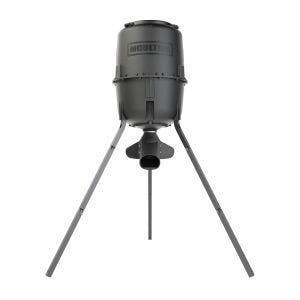 | Budget value pick: Moultrie 250 lb Gravity Feeder | Gravity | 250 pounds, per manufacturer listing | None | Buyers who want large capacity and simple operation at the lowest practical tier | No scheduling or measured dispensing; deer eat at their own pace |

| Overall value pick: Boss Buck 200 Gravity Feeder | Gravity | 200 pounds, per manufacturer and retailer listings | None | Most hunters who want adjustable flow, rain-shedding ports, and a tall tripod design | Smaller hopper than the Moultrie 250, so refill frequency depends on use |
| Around 100 dollars tier | Usually small gravity or basic timed | Generally smaller | Gravity: none; basic timed: batteries | First feeders, short seasons, easy-access sites | Frequent refills, fewer weather and durability margins | |
| Around 200 dollars tier | Gravity, often mid-size | Mid-size to large | Usually none for gravity | The value sweet spot for most properties | Still no scheduling; capacity must be matched to the site | |
| Around 350 dollars tier | Larger gravity or capable timed | Larger | Timed: batteries, sometimes solar-ready | Remote sites, longer seasons, protein programs | Timed models add power and parts costs | |
| Around 700 dollars tier | Large, timed, or app-controlled | Large | Batteries and often solar | Remote management, multiple sites, precise control | Highest purchase and maintenance cost; features may go unused |
Two points in that table deserve emphasis before the tier-by-tier detail. First, capacity is not the same as value. A 250-pound hopper is valuable only if the feed inside it is consumed before moisture, mold, insects, or spoilage become a problem, and only if the feeder site can support the weight, the height, and the filling method that a large hopper requires. Second, the absence of electronics is itself a feature with a price attached — or rather, with several prices removed. No timer to program, no motor to jam, no battery to replace, and no solar panel to clean or align. For a hunter who visits often and feeds in a straightforward way, those removals are worth more than a schedule the hunter would never change.
What Each Budget Tier Actually Buys
Budget tiers are useful only if they describe real differences in what you get, not just bigger numbers on a price tag. The tiers below describe what each spending bracket typically buys in the current market, what it does not buy, and who should stop at that tier rather than stretching to the next one. Remember that these are planning brackets. A specific model may sit above or below a bracket at a given retailer on a given day, and a sale, a bundle, or a shipping charge can move a model across a bracket line. Use the brackets to compare categories, then check the actual current price of the specific model you are considering.
The Around 100 Dollars Tier: Getting Started Without Overcommitting
At around 100 dollars, you are buying access to feeding, not refinement. Feeders in this bracket are typically smaller gravity feeders or basic timed feeders with modest hoppers. The honest appeal of this tier is low risk: if you are not sure how much you will feed, how often you will visit, or whether deer will use a particular location at all, a lower-cost feeder lets you learn those answers without a large outlay. It is also the right tier for a short, defined season — for example, a hunter who feeds for a few weeks before and during a season and then removes or empties the feeder — because the feeder does not need to survive a full year of weather, or to hold months of feed, in order to do its job.
The limits of this tier are equally clear, and they are worth stating plainly so a buyer does not mistake a low price for a bargain that it is not. A smaller hopper means more frequent refills, and frequent refills matter most exactly where they are hardest: at remote sites, on large properties, and during wet or cold weather when every trip is slower. Smaller and lighter feeders can also be more vulnerable to wind, to tipping, and to disturbance by hogs, raccoons, and other animals, depending on the design and the site. Basic timed feeders in this bracket may use simpler motors and timers, with fewer weather-sealing details, and the cost of batteries — plus the time spent replacing them — should be counted from the start rather than discovered later. None of this makes the tier a bad choice. It makes it a choice with a specific job: prove the location, learn your feeding pattern, and keep the investment proportionate to an unproven site.
A buyer should stop at this tier when several conditions are true at once. The feeder site is easy to reach, so refilling is a short trip rather than an expedition. The feeding period is short or seasonal, so the feeder will not sit loaded through months of rain and humidity. The buyer is testing a new location and would rather move or replace a lower-cost feeder than commit to a permanent installation. And the buyer is comfortable with hands-on maintenance, including checking the feeder often, because a smaller feeder rewards attention and punishes neglect more quickly than a larger one. If any of those conditions fails — if the site is remote, the season is long, or visits are rare — the money saved at this tier is often spent again in travel, in feed waste, or in an early replacement, and the next tier is the better value even though it costs more.
There is also a second, quieter value in this tier that is easy to overlook: it teaches the buyer what matters on their own land. After a season with a basic feeder, a hunter knows whether deer actually use the location, whether hogs are a problem, whether wind moves the feeder, whether rain reaches the feed, and how quickly feed is consumed. That knowledge is worth more than any review, because it is specific to one property. A buyer who starts here and then upgrades is not wasting money; they are buying information. A buyer who starts here and stays here because the site turns out to be easy, short-season, and well used is not settling; they have found the right tier.
The Around 200 Dollars Tier: The Value Sweet Spot for Most Hunters
The around 200 dollars tier is where this guide’s overall value argument concentrates, and for a straightforward reason: it is the lowest tier at which a buyer can commonly get a well-built, mid-size to large gravity feeder with meaningful weather and flow details, without paying for electronics that many hunters do not need. The Boss Buck 200 Gravity Feeder sits in the spirit of this tier as a design, and the Moultrie 250 lb Gravity Feeder represents the budget end of the same value logic at a larger capacity. What the tier buys, in general terms, is a feeder that can hold enough feed to meaningfully reduce refill trips, that stands tall enough for deer to feed comfortably while keeping the hopper above ground moisture and disturbance, and that includes flow control or port design intended to reduce spillage and rain entry.
Flow control deserves a closer look, because it is one of the few features that directly affects feed cost. A gravity feeder does not measure portions. Deer eat what is available at the ports, and the rate at which feed reaches the ports depends on the port design, the feed type, and the adjustment setting. An adjustable sleeve or similar control lets the owner narrow or widen flow for corn versus protein pellets, and for different pellet sizes. That adjustability does not turn a gravity feeder into a timed feeder, and it should not be sold as if it does. What it does is give the owner a practical lever: if feed is disappearing too quickly, the flow can be narrowed; if deer are not getting enough feed, it can be widened. Over a season, that lever can matter more than a small difference in hopper size, because feed that spills, clumps, or is eaten by non-target animals is feed paid for and wasted.
Port design matters for the same reason. Ports that are angled to slow feeding, that include drain holes to shed rainwater, and that include an overhang to reduce spillage are not cosmetic details. They address the three most common ways gravity feed loses value: feed that falls to the ground and is wasted, feed that gets wet and clumps or spoils, and feed that is consumed too quickly by animals other than deer. The Boss Buck 200’s published port description — 10-inch ports, a 10-degree angle for slow feeding, drain holes, and a 1-inch overhang — is a useful example of what to look for, and a buyer comparing any gravity feeder should ask the same questions of any model: how does the port slow feed, how does it shed water, and how does it limit spillage? If a product description does not answer those questions, that silence is itself information.
Height and stability belong in the same conversation. A tripod feeder that stands on 75-inch legs, as the Boss Buck 200 does, or with a 6-foot fill height, as the Moultrie 250 does, is tall enough that filling does not require a ladder in ordinary use, and tall enough that the hopper sits above the reach of many smaller animals and above ground-level moisture. Height also affects stability: a taller feeder on uneven ground needs level placement, secure legs, and attention to wind exposure. Value at this tier therefore includes the site work around the feeder — choosing level ground, clearing the area, and checking legs after storms — because a well-built feeder on a poor site will still disappoint, and a mid-tier feeder on a good site will often outperform a premium feeder on a bad one.
Buyers who should stop at this tier include most hunters feeding one or two sites that they can reach regularly, hunters running a seasonal corn program, and landowners who want a protein-capable gravity feeder without committing to a timed or app-controlled system. Buyers who should look past this tier are those whose sites are genuinely remote, whose feeding program runs for many months, or who need measured dispensing to control intake, limit non-target consumption, or coordinate feeding with hunting schedules. For those buyers, the next tiers are not luxuries; they are the price of a program that actually works at distance.
The Around 350 Dollars Tier: Capacity and Control for Longer Programs
At around 350 dollars, the buyer is paying for one of two different kinds of expansion: more capacity in a gravity design, or a capable timed feeder with a larger hopper and better weather and power details than a basic timed model. Those are very different purchases, and confusing them is one of the easiest ways to overspend. A larger gravity feeder at this tier is still a gravity feeder: it holds more feed, it still needs no power, and it still does not schedule or measure dispensing. Its value is in fewer trips and longer intervals between refills, which matters most at sites that are hard to reach or that are fed over a long season. A timed feeder at this tier is a different tool: it adds scheduling, measured dispensing, and, in some models, solar readiness, and it adds the costs and maintenance that come with those features.
The larger-gravity route at this tier makes sense when the feeding goal is continuous availability rather than scheduled portions. Protein feeding through spring and summer, for example, is often a continuous-availability program: the goal is to keep feed available over months, not to dispense a measured amount at dawn and dusk. In that kind of program, a larger hopper reduces the number of trips, reduces the chance of an empty feeder during a critical period, and spreads the fixed cost of each trip — fuel, time, wear on a vehicle — over more feed. The trade-off is that more feed sits in the hopper for longer, so moisture protection, lid sealing, and feed freshness become more important, not less. A buyer who chooses a larger gravity feeder should also plan for how feed will be transported in bulk, how the hopper will be filled safely at height, and how the feeder will be emptied and cleaned if feed does become damp or stale. Capacity without a filling and cleaning plan is not value; it is a larger container for the same problems.
The timed route at this tier makes sense when control is the point. A timed feeder dispenses feed at set times, in set amounts, which can reduce waste from free feeding, limit the time feed sits exposed, and coordinate feeding with the times deer are most active or with hunting plans. It can also reduce non-target consumption, because feed is available only during dispensing windows rather than continuously. Those are real advantages, and they justify the extra cost when they match a real management goal. They do not justify the extra cost when the owner would leave the timer on a single default schedule all season, or when the feeder site is visited so often that scheduling adds nothing. Before paying for a timed feeder at this tier, a buyer should be able to state, in one sentence, what schedule they need and why free feeding would not achieve the same result. If that sentence is hard to write, the gravity route at the same tier is probably the better value.
Power is the hidden price of the timed route, and it should be budgeted at purchase, not discovered later. Timed feeders need batteries, and battery life depends on dispensing frequency, temperature, battery type, and motor load. Solar panels can extend battery life and reduce replacement trips, but they add purchase cost, need sunlight and a clear mounting position, and still need occasional cleaning and connection checks. Replacement parts also enter the picture at this tier in a way they do not for gravity feeders: timers, motors, spinner plates, and wiring are all parts that can fail, and a model with readily available parts from the manufacturer or major retailers is worth more than a model with a slightly lower price but no clear parts channel. A buyer at this tier should check, before buying, whether the timer, motor, and spinner plate for the specific model are sold separately, and whether the manufacturer states a warranty that covers them. That check takes minutes and can save a full replacement later.
Buyers who should stop at this tier include landowners running a longer protein or corn program at a site they visit monthly rather than weekly, hunters managing a remote site where a larger hopper meaningfully reduces trips, and anyone who has a specific scheduling need that free feeding cannot meet. Buyers who should not stop here are those who need remote control, multiple-site management, or data on feeding activity; those needs belong in the next tier, and buying a capable but non-connected timed feeder as a substitute will only lead to a second purchase later.
The Around 700 Dollars Tier: Remote Management and Precision, at a Price
At around 700 dollars, the buyer is no longer buying a feeder alone. They are buying a system: a large hopper, a timed dispensing mechanism, a power system that often includes solar charging, and, in app-controlled models, remote scheduling, remote status checks, and sometimes activity data. The value question at this tier is therefore sharper than at any lower tier, because the price is high enough that unused features are expensive, and the system is complex enough that maintenance cannot be ignored. This tier is good value only when the system solves a problem that a simpler feeder cannot solve, and when the owner will actually use the remote and scheduling features often enough to justify their cost.
Remote management is the clearest justification. If a feeder sits on land hours away, if the owner manages several sites, or if access is seasonal or restricted, the ability to change a schedule, check battery status, or confirm that a feeder is operating without driving to the site can save multiple trips per season. Each saved trip has a real value in fuel, time, and vehicle wear, and over several seasons those savings can offset a higher purchase price. Remote management also has a less obvious value: it lets the owner respond to changing conditions — a weather event, a change in deer activity, a need to pause feeding — without waiting for the next visit. That responsiveness is difficult to price, but it is real for a landowner who cannot visit often.
Precision is the second justification, and it should be distinguished from novelty. Precision means dispensing a controlled amount at controlled times, consistently, over a long period. That control can reduce feed waste, manage intake, and support a structured feeding program in a way that free feeding cannot. Novelty, by contrast, is the appeal of controlling a feeder from a phone because it is possible, even when the schedule never changes and the owner visits weekly. A buyer at this tier should be honest about which one they are buying. If the schedule, once set, will not change for months, and if visits are frequent, a non-connected timed feeder at the previous tier delivers the same dispensing for less money. The app is not free; it is paid for in purchase price, in power consumption, in software setup, and in the time spent learning and maintaining it.
The risks at this tier also deserve plain language. More components mean more points of failure: a solar panel, a charge controller, a battery, a timer, a motor, a communications module, and the wiring between them. A failure in any one component can stop the feeder, and diagnosing that failure remotely is harder than diagnosing a gravity feeder, where the problem is usually visible. App-controlled feeders also depend on cellular coverage at the feeder site, which cannot be assumed in rural or wooded locations, and on the manufacturer’s app and service continuing to be supported. A buyer at this tier should check coverage at the actual site, not at the nearest town, and should understand what the feeder does if connectivity is lost — whether it continues on its last schedule, stops, or needs a manual reset. Those answers are part of the purchase decision, not details to discover after installation.
Buyers who should consider this tier include multi-site managers, remote landowners, and anyone running a structured, long-season program where remote changes and precise dispensing have a measurable effect on feed use or on site visits. Buyers who should avoid this tier include first-time feeder owners, short-season hunters, and anyone whose property is visited weekly and whose feeding goal is simple availability. For those buyers, the around 700 dollars tier does not buy better feeding; it buys complexity, and complexity is the opposite of value when it is not needed.
The Budget Value Pick in Detail: Moultrie 250 lb Gravity Feeder
The Moultrie 250 lb Gravity Feeder earns the budget value pick in this guide because it combines the largest capacity among the named picks with the simplest operation. According to the manufacturer’s listing, the feeder holds 250 pounds of feed, has a 6-foot fill height, uses no electronics or batteries, and supports both protein feeding in the spring and corn feeding in the fall. The legs are powder-coated steel, and the lid is a twist-lock design that is fully detachable for filling. Those details, taken together, describe a feeder whose value proposition is straightforward: hold a lot of feed, require no power, and be easy to fill without a ladder in ordinary use.
Capacity is the headline, but it should be understood correctly. A 250-pound hopper does not mean 250 pounds of feed will always be consumed efficiently, and it does not mean the feeder can be ignored for months. It means the interval between refills can be longer than with a smaller hopper, provided feed is being consumed and provided moisture and freshness are managed. The benefit is practical: fewer trips carrying heavy bags, fewer disturbances at the site, and less chance of arriving to find an empty feeder during a period when deer are using the site heavily. The cost of that benefit is also practical: each refill involves more feed, more weight, and more care to keep feed dry while filling, and a full hopper is heavier and more demanding on legs, ground, and placement than a smaller one.
The absence of electronics is the second half of the value case, and it is worth more than it first appears. A gravity feeder has no timer to program, no motor to jam with debris or moisture, no battery to check or replace, and no wiring to corrode. That simplicity reduces both the purchase-adjacent costs — batteries, replacement timers, replacement motors — and the less visible costs of ownership, such as trips made only to diagnose a feeder that stopped dispensing, or seasons disrupted because a timer failed at the wrong time. Simplicity is not the same as invulnerability: a gravity feeder still needs its lid checked, its ports checked for clogs or damage, its legs checked for stability, and its hopper cleaned if feed becomes damp. But those tasks are visible, quick, and do not require parts or tools beyond ordinary maintenance.
The Moultrie 250’s feed flexibility is also relevant to value, because it affects how many seasons and programs one feeder can serve. A feeder designed for both corn and protein pellets can serve a fall corn program and a spring protein program without a second purchase, provided the owner adjusts for the different feed types and checks flow and port behavior for each. That flexibility does not mean every feed type behaves identically in the same feeder; pellet size, dust, and moisture sensitivity all affect flow, and an owner switching feeds should observe the feeder after the change rather than assuming it will behave as before. Flexibility is valuable when it is managed, and it is a source of waste when it is assumed.
Where the Moultrie 250 is less strong is exactly where gravity feeders in general are less strong: it does not schedule, measure, or limit dispensing. Deer eat at their own pace, and non-target animals can access feed at the ports. If a buyer’s goal requires measured portions, timed availability, or limiting feed to specific windows, a gravity feeder — however large — will not deliver that goal, and the money saved on electronics will be spent in extra feed or in a later switch to a timed model. The Moultrie 250 is therefore best understood as the best value for a specific job — large-capacity, simple, continuous feeding — rather than as a universal answer.
Pros and Cons: Moultrie 250 lb Gravity Feeder
Pros:
- Large 250-pound hopper capacity, per the manufacturer listing, which can reduce refill frequency compared with smaller feeders.
- No electronics or batteries required, which removes battery, timer, and motor replacement costs from ownership.
- Designed for both corn feeding in the fall and protein feeding in the spring, per the manufacturer listing, so one feeder can serve different seasonal programs.
- 6-foot fill height, per the manufacturer listing, which is intended to make filling easy without a ladder in ordinary use.
- Powder-coated steel legs and a detachable twist-lock lid, per the manufacturer and retailer listings, which address stability and lid security as practical concerns.
Cons:
- No scheduling or measured dispensing, so feed availability is continuous and intake is not controlled by the owner.
- A large hopper requires more feed per refill, more care to keep feed dry during filling, and more attention to freshness over time.
- Gravity ports are accessible to non-target animals in a way that a timed, closed dispensing system is not.
- Weight and size at full capacity demand level ground, stable placement, and a realistic plan for transporting and lifting feed.
The Overall Value Pick in Detail: Boss Buck 200 Gravity Feeder
The Boss Buck 200 Gravity Feeder earns the overall value pick in this guide because it pairs a substantial 200-pound capacity with the flow and port details that most directly protect feed value. According to manufacturer and retailer listings, the feeder stands on 75-inch legs, holds up to 200 pounds of non-salt-based feed such as corn and protein pellets, uses an adjustable three-way inner sleeve to control flow for different feed shapes and sizes, and uses 10-inch feeder ports with a 10-degree angle for slow feeding, drain holes to shed rainwater, and a 1-inch overhang to reduce spillage. Those specifications describe a feeder designed around a specific problem: how to make gravity feeding slower, drier, and less wasteful, without adding electronics.
The adjustable sleeve is the feature that most distinguishes this feeder’s value logic from a simple gravity hopper. Corn and protein pellets do not flow identically, and pellet sizes vary. A fixed opening that works well for corn may flow too quickly or too slowly for pellets, and a fixed opening chosen for pellets may not suit corn. The three-way inner sleeve lets the owner adjust flow for the feed in use, which is a practical, season-by-season lever on feed consumption. It is not a timer, and it does not measure portions, but it does let the owner respond to what they observe at the site: if feed is disappearing faster than intended, the flow can be narrowed; if deer are not accessing enough feed, it can be widened. That responsiveness, over a season, is a form of control that a fixed gravity feeder does not offer.
The port design complements the sleeve by addressing what happens after feed leaves the hopper. Angled ports slow feeding, which spreads availability over time and reduces the chance that a single visit empties a port quickly. Drain holes give rainwater a path out rather than letting it pool and soak feed, which matters in wet climates and during prolonged rain. The overhang at the end of each port reduces the amount of feed that falls to the ground during feeding, which directly reduces waste. None of these details eliminates waste or weather exposure entirely — a gravity port is, by design, open to the elements and to animals — but each one reduces a known loss, and together they make the feeder’s effective feed cost lower than its sticker price alone would suggest.
Capacity and height should be weighed together for this model. Two hundred pounds is substantial, but it is less than the Moultrie 250’s 250 pounds, so a buyer choosing the Boss Buck 200 over the Moultrie 250 is trading some capacity for flow control and port design. Whether that trade is worthwhile depends on the site. At a site where feed waste, rain exposure, or rapid consumption is the main problem, flow and port design may matter more than an extra 50 pounds of capacity. At a site where refill trips are the main problem and feed waste is minimal, the larger hopper may matter more. The 75-inch leg height, meanwhile, places the hopper high enough for comfortable deer feeding and for filling without a ladder in ordinary use, while also requiring level ground and stable placement, especially on slopes or in wind-exposed locations.
Two cautions belong in any honest discussion of this feeder. First, Boss Buck’s hopper line is 200, 350, 600, and 1,200 pounds; there is no 250-pound or 500-pound Boss Buck feeder, and a buyer who sees those capacities attributed to Boss Buck elsewhere should treat that listing with skepticism and verify the model number. Second, Boss Buck publishes no throw or spread distance for this gravity feeder, and none is stated here. Gravity feeders do not throw feed, so a spread distance would be a category error as well as an invented number. Buyers planning placement should plan around port access and deer approach, not around a dispersal radius that does not apply.
Pros and Cons: Boss Buck 200 Gravity Feeder
Pros:
- 200-pound capacity, per manufacturer and retailer listings, which is substantial for a mid-tier gravity feeder.
- Adjustable three-way inner sleeve, per manufacturer and retailer listings, which lets the owner control flow for corn and for different pellet shapes and sizes.
- 10-inch ports with a 10-degree angle, drain holes, and a 1-inch overhang, per manufacturer and retailer listings, which address slow feeding, rain shedding, and spillage together.
- 75-inch legs, per manufacturer and retailer listings, which provide height for deer feeding and for filling without a ladder in ordinary use.
- No electronics or batteries required, which removes power-related purchase and maintenance costs.
- Designed for non-salt-based corn and protein pellets, per manufacturer and retailer listings, which covers the two most common feeding programs.
Cons:
- Smaller hopper than the Moultrie 250, so refill intervals will be shorter at the same rate of feed use.
- No scheduling or measured dispensing, so intake is not controlled by time or portion.
- Salt-based mineral supplements may damage the feeder, per manufacturer and retailer listings, so feed choice is constrained.
- Gravity ports remain open to weather and to non-target animals, even with drain holes and overhangs.
Where to find the Boss Buck 200: Boss Buck products are sold through dealer channels rather than through an Amazon link in this article. Check current availability and pricing through bossbuck.com and through major outdoor retailers such as Cabela’s and Sportsman’s Guide, and confirm the model number and capacity before ordering, since Boss Buck’s hopper line is 200, 350, 600, and 1,200 pounds.
Gravity Versus Timed: Where the Value Really Diverges
The gravity-versus-timed decision is the single largest value decision most buyers will make, larger than the choice between two gravity models or two timed models. It is also the decision most often made backwards: buyers compare features first and goals second, and end up paying for scheduling they never use or, conversely, buying a gravity feeder for a program that actually needed control. The comparison below separates what each type does, what it costs over time, and what kind of program each one serves best.
| Factor | Gravity Feeder | Timed Feeder |
|---|---|---|
| How feed is delivered | Continuously available at ports; deer eat at their own pace | Dispensed at set times, in set amounts, by a motor and spinner plate |
| Power needed | None | Batteries, and often solar charging for longer programs |
| Parts that can fail | Lid, ports, legs, hopper — visible, mechanical parts | Timer, motor, spinner plate, wiring, battery, and, where fitted, solar panel and controller |
| Feed waste risk | Higher if flow is wide, ports spill, or non-target animals feed freely | Lower when schedules and portions are set carefully; higher if settings are wrong or the motor jams |
| Best program fit | Continuous availability, seasonal corn, spring and summer protein | Measured portions, timed availability, coordinated hunting schedules |
| Maintenance rhythm | Check lid, ports, legs, and feed condition on visits | Check power, timer settings, motor, and dispensing on visits, plus battery replacement |
| Remote-site fit | Strong when capacity is large, because there is little to fail between visits | Strong when remote control is fitted, because settings can change without a visit; weaker without it, because a failed timer may sit unnoticed |
Gravity’s value advantage is simplicity compounded over time. Every season without a battery purchase, without a timer failure, and without a trip made only to diagnose electronics is a season in which the gravity feeder’s total cost stays close to its purchase price plus feed. That advantage grows with the number of feeders owned, because each timed feeder multiplies the battery, parts, and diagnostic burden, while each gravity feeder adds only the same visible checks. For a landowner with several sites, that multiplication effect alone can make gravity the better value even before feed waste is considered.
Timed feeding’s value advantage is control, and control has a price that is worth paying only when control changes an outcome. If deer are consuming feed too quickly, if hogs or raccoons are taking a large share, if feed is spoiling because it sits exposed too long, or if hunting plans depend on deer activity at specific times, then scheduled, measured dispensing can reduce waste enough to offset its own costs. The key test is whether the buyer can describe the waste or the timing problem that scheduling will solve. A buyer who cannot describe that problem is not buying control; they are buying the idea of control, and the idea is cheaper than the feeder but less useful.
There is also a middle path that buyers sometimes overlook: start with gravity, learn the site, and add timed capacity only where the site proves it needs it. A property with three feeding sites does not need three timed feeders on day one. It may need one timed feeder at the site where control matters most, and gravity feeders at the other two, where continuous availability is sufficient. That mixed approach is often the best value of all, because it spends the timed premium only where timed features earn it, and it avoids the common mistake of standardizing on the most expensive category for every site out of habit.
App-controlled feeders extend the timed argument to remote management, and the same test applies with even greater force. Remote scheduling, battery status, and activity information are valuable when the owner cannot visit, manages multiple sites, or needs to respond to changing conditions between visits. They are not valuable when the owner visits weekly, when the schedule never changes, or when cellular coverage at the site is unreliable. Before paying the app-controlled premium, check coverage at the actual feeder location, understand what the feeder does when connectivity drops, and ask whether the remote features will be used monthly or merely admired at setup. A feature used monthly can justify its price; a feature admired once cannot.
Pros and Cons: Gravity Feeding as a Value Strategy
Pros:
- No power system to buy, maintain, or replace, which keeps total cost close to purchase price plus feed.
- Fewer failure points, which matters most at remote sites visited infrequently.
- Continuous availability, which suits seasonal corn and long protein programs without scheduling complexity.
- Simpler diagnosis: most problems are visible at the lid, ports, legs, or hopper.
Cons:
- No control over timing or portion size, so intake and waste depend on port design, flow setting, and animal behavior.
- Feed sits exposed at ports, which increases weather and non-target animal exposure compared with a closed timed system.
- Flow must be managed by observation and adjustment, not by a program, which requires visits and attention.
Pros and Cons: Timed and App-Controlled Feeding as a Value Strategy
Pros:
- Scheduled, measured dispensing can reduce waste and coordinate feeding with deer activity and hunting plans.
- App-controlled models can change schedules and check status remotely, saving trips for remote and multi-site owners.
- Closed dispensing between scheduled times can reduce continuous non-target access compared with open gravity ports.
Cons:
- Higher purchase price plus ongoing battery, solar, and replacement-part costs.
- More failure points, including timer, motor, wiring, and, where fitted, communications and charging components.
- Dependence on battery condition, and for app models, on cellular coverage and continued app support at the actual site.
- Features that go unused — remote changes never made, schedules never adjusted — are pure cost with no return.
Capacity Versus Refill Math: A Framework, Not a Promise
Capacity marketing often implies a simple story: bigger hopper, fewer refills, better value. The arithmetic behind that story is simple, but the conclusion is not automatic, because refill interval depends on how much feed leaves the feeder each day, and that rate depends on deer numbers, other animals, feed type, season, weather, and port settings — none of which can be assumed from a product listing. The honest way to use capacity math is as a framework into which you put your own observed use, not as a promise attached to a model.
The framework is one division: hopper capacity in pounds, divided by feed used per day in pounds, equals the number of days a full hopper will last, before waste, spoilage, and clogging are considered. That is all. If a 200-pound hopper loses 5 pounds per day in a hypothetical illustration, the arithmetic gives 40 days. If the same hopper loses 10 pounds per day in a different hypothetical illustration, the arithmetic gives 20 days. If it loses 2 pounds per day, the arithmetic gives 100 days. Those are illustrations of the division, not observations about any herd, any site, or any model, and they should not be quoted as refill intervals. The point of showing them is to make the sensitivity visible: a small change in daily use changes the refill interval dramatically, which is why a capacity number alone cannot tell you how often you will refill.
| Hopper Capacity | Illustrative Daily Use (Hypothetical Only) | Arithmetic Result | What It Means in Practice |
|---|---|---|---|
| 200 pounds | 5 pounds per day | 40 days | A monthly visit rhythm may be sufficient, if feed stays fresh and dry |
| 200 pounds | 10 pounds per day | 20 days | Visits roughly every three weeks, or a larger hopper, may be needed |
| 250 pounds | 5 pounds per day | 50 days | Longer interval than the 200-pound example at the same use rate |
| 250 pounds | 10 pounds per day | 25 days | Still a frequent rhythm at higher use, despite the larger hopper |
Three practical lessons follow from that framework, and they matter more than any single row of the table. First, the largest capacity gain comes from matching hopper size to visit frequency, not from buying the largest hopper available. If you visit weekly, a smaller hopper that you refill weekly is not a burden, and a very large hopper may simply hold feed longer than freshness allows. If you visit monthly, a larger hopper that bridges the gap between visits is valuable, but only if feed stays dry and fresh for that interval. Second, feed freshness sets an upper limit on useful capacity that no marketing number mentions. Feed that sits through rain, humidity, and heat can clump, mold, or attract insects, and a hopper full of spoiled feed is not a saving; it is a loss plus a cleaning job. Third, the cost of a refill trip is not just fuel. It is time, vehicle wear, disturbance at the site, and the risk of arriving to find a problem that a more frequent visit would have caught earlier. A larger hopper that reduces trips is therefore valuable in ways that go beyond feed weight, but only up to the point where freshness and site disturbance still favor the longer interval.
How should a buyer use this framework before buying? Start with what is known, not what is hoped. If you already feed, use your own recent feed use as the daily figure, even if it is rough, and divide each candidate hopper size by it. If you do not yet feed, start with the smallest feeder that fits a short trial, observe actual use over several weeks, and then choose a long-term hopper size from observed data rather than from a guess. Observe after changing feed types, because corn and protein pellets may be consumed at different rates and may flow differently through the same ports. Observe after weather changes, because rain, cold, and heat all affect deer activity and feed condition. And revisit the calculation seasonally, because a hopper size that fits a fall corn program may not fit a spring protein program, and vice versa.
One more capacity consideration is often missed: filling capacity is not the same as usable capacity. A hopper that holds 250 pounds when filled to the brim may be difficult to fill safely to that level without spilling, without a stable stance, or without feed bridging and clogging near the top. An owner who fills to a comfortable, safe level rather than to the absolute maximum is using less than the stated capacity, and the refill interval should be calculated from the comfortable fill level, not the marketing maximum. That distinction is not a criticism of any model; it is a reminder that specifications describe a container, while ownership describes a routine, and value lives in the routine.
Total Cost of Ownership: The Price Beyond the Price Tag
Total cost of ownership is the most important value concept in this guide, and the most often ignored, because it is less visible than a price tag and less exciting than a feature list. It is simply the sum of everything a feeder costs over its useful life: purchase price, shipping where applicable, feed, power, replacement parts, maintenance supplies, travel to the site, and eventual replacement. A feeder that looks cheap at checkout can be expensive over three seasons, and a feeder that looks expensive at checkout can be cheap over five seasons, depending on how those other costs behave. The table below lists each cost category, what drives it, and how gravity and timed feeders typically differ.
| Cost Category | What Drives It | Gravity Feeder | Timed or App-Controlled Feeder |
|---|---|---|---|
| Purchase price | Model, capacity, build, retailer, shipping | Usually lower for comparable capacity | Usually higher, reflecting motor, timer, and electronics |
| Feed | Feed type, local price, waste, spoilage, non-target consumption | Waste depends on port design, flow setting, and animal pressure | Waste can be lower with careful scheduling, higher if settings are wrong |
| Power | Battery type, dispensing frequency, temperature, solar use | None | Recurring battery cost; solar adds purchase cost but can reduce battery cost |
| Replacement parts | Timer, motor, spinner plate, lid, legs, ports | Mainly lid, legs, and ports over a long life | Timer, motor, spinner plate, and wiring, plus battery replacement |
| Maintenance supplies | Cleaning, lubrication where specified, lid seals | Basic cleaning and inspection | Basic cleaning plus electrical checks and connection care |
| Travel and time | Distance, visit frequency, refill weight, diagnostics | Driven mainly by refill frequency and capacity | Driven by refill frequency plus battery and diagnostic visits |
| Replacement | Durability, weather, animal damage, parts availability | Longer life when build and site are good; parts are simpler | Life depends on electronics durability and parts availability |
Feed is the largest cost category for almost every feeder owner, and it dwarfs the purchase price over time. That fact reframes the entire value question. If feed is the dominant cost, then the feeder that reduces waste, spoilage, and non-target consumption by even a small percentage can be worth more than the feeder with the lowest purchase price, even if the saving is difficult to measure precisely on a single site. Port design, flow adjustment, lid sealing, and site placement are therefore not minor details; they are the levers on the largest cost in the system. A buyer who focuses only on purchase price while ignoring feed waste is optimizing the smallest part of the budget and neglecting the largest.
To make total cost concrete without inventing numbers, use a simple annual worksheet with your own figures. Write down the purchase price you actually paid, including shipping. Add the feed you expect to buy in a year, using your local feed price and your best estimate of use, and then add a waste allowance as a separate line so it is visible rather than hidden inside the feed total. Add battery costs for timed feeders, using the battery type and the replacement frequency stated by the manufacturer or observed on your site. Add a parts allowance — even a modest one — for any feeder with electronics, because timers and motors are wear items over years, not lifetime components. Add travel cost by multiplying your round-trip distance and your per-mile or per-trip estimate by the number of visits you expect. The total is not a prediction; it is a comparison tool. Run the same worksheet for a gravity option and for a timed option, with the same feed and travel assumptions, and the difference will show whether the timed premium is buying control that saves feed and trips, or buying features that cost money without changing either.
Two total-cost traps deserve specific warning. The first is the cheap timed feeder trap: a low-priced timed feeder whose timer or motor fails early, whose parts are not sold separately, or whose battery consumption is high can cost more in its first two years than a mid-tier gravity feeder that simply keeps working. The second is the premium gravity trap: a very large, very expensive gravity feeder bought for a site that is visited weekly, where a smaller feeder would have sufficed, ties up money in capacity that is never needed and ties up feed in a hopper for longer than freshness favors. Both traps share the same root cause: buying a category before defining the job. The worksheet above prevents both, because it forces the buyer to state feed use, visit frequency, and power costs before choosing a model.
Durability and parts availability are the long tail of total cost, and they are worth checking before purchase rather than after failure. A feeder made from materials suited to outdoor exposure, with legs and hardware that resist corrosion, will generally last longer than a feeder that looks similar but uses thinner materials or unprotected hardware. A feeder whose lid, legs, ports, timer, and motor are sold as separate parts is more repairable than a feeder that must be replaced whole when one component fails. Warranty terms also matter, but they should be read as what they are: a manufacturer’s statement of coverage for a defined period, not a guarantee of lifetime. The Moultrie 250’s manufacturer listing states a one-year warranty, for example, which is useful information for planning, but it does not mean the feeder will fail after one year or last indefinitely; it means the buyer should understand what is covered and for how long, and should plan maintenance accordingly.
When to Spend More, and When Not To
Spending more is justified when the extra money buys a specific, describable improvement in an outcome you care about. It is not justified when it buys a larger number, a newer feature, or a more impressive specification that does not change what happens at your site. The lists below are designed as a decision check: if several items in the first list apply to you, spending more is likely good value; if several items in the second list apply, spending more is likely waste.
Spend More When:
- Your feeder site is remote, hard to reach, or visited infrequently, so larger capacity or remote management genuinely reduces trips or prevents empty-feeder periods.
- You run a long-season program, such as months of protein feeding, where capacity and durability matter more than they do for a short season.
- You need measured, scheduled dispensing to control intake, reduce waste, limit non-target consumption, or coordinate with hunting plans, and free feeding has already shown those problems at your site.
- You manage multiple sites, where remote control or consistent, repairable timed models reduce the total management burden across all sites.
- Your site has specific challenges — heavy rain, high winds, hog pressure, or uneven ground — that a better-built feeder with stronger legs, better sealing, or better port design addresses directly.
- You have already used a basic feeder at the site and know, from observation, which limitation is costing you feed, trips, or reliability.
Do Not Spend More When:
- Your site is easy to reach and visited weekly, so a smaller hopper and frequent refills are not a burden.
- Your feeding period is short and defined, so a feeder does not need to survive a full year loaded or to hold months of feed.
- You have not yet proven the location, and a lower-cost feeder would teach you whether deer use the site before a larger investment.
- The extra features — remote control, app data, solar charging — would be set once and never changed, or would duplicate a visit you already make.
- The larger capacity would hold feed longer than freshness allows at your site, turning capacity into spoilage risk rather than convenience.
- You are buying a second feeder for a site that already works well with a simpler model, and the upgrade is driven by novelty rather than by a problem at that site.
Scenario thinking helps turn those lists into a decision. Consider a hunter with a single site ten minutes from home, who feeds corn for six weeks in the fall and visits twice a week. For that hunter, a mid-tier gravity feeder is likely the best value, and a premium app-controlled feeder would add cost without changing any outcome, because visits are already frequent and the season is short. Consider a landowner with a site two hours away, visited monthly, running protein through spring and summer. For that landowner, a larger gravity feeder or a capable timed feeder with solar support may be the best value, because the cost of an extra trip, or of an empty feeder during a critical month, exceeds the price difference. Consider a manager with four sites across a property, who needs to coordinate feeding and reduce total visits. For that manager, a consistent timed or app-controlled approach across sites may be the best value, even at a higher per-feeder price, because the system saving is larger than any single feeder saving. The same feeder can therefore be good value in one scenario and poor value in another, and the scenario, not the specification sheet, is what decides.
Buyer Checklist: Before You Spend Anything
Use this checklist in order, before comparing models. It is designed to prevent the most common value mistakes: buying the wrong category, buying the wrong capacity, placing a feeder on a poor site, and discovering a legal or practical constraint after purchase.
Step 1: Define the Job
- What is the feeding goal: seasonal corn attraction, long-season protein support, herd maintenance, or another specific goal?
- How long will the program run: a few weeks, a season, or most of the year?
- Does the goal require scheduled, measured dispensing, or is continuous availability sufficient?
- How many sites will be fed, and will they use the same type of feeder or a mixed approach?
Step 2: Know the Site
- How far is the site, how is it reached, and how often can you realistically visit in all weather?
- Is the ground level, sloped, wet, or exposed to wind, and where will the feeder stand?
- Are hogs, raccoons, bears, or other animals active at the site, and how will they affect an open gravity port versus a closed timed system?
- Is there cellular coverage at the exact feeder location, if an app-controlled model is being considered?
- Have you checked the current feeding and baiting rules for your state, county, and season, since rules vary and change?
Step 3: Match Capacity to Visits and Freshness
- Using your own observed or conservatively estimated daily feed use, divide each candidate hopper size by that figure to estimate refill intervals.
- Compare those intervals with your realistic visit frequency, not your ideal visit frequency.
- Consider freshness: will feed sit in the hopper through rain, humidity, and heat for the full interval, and how will you check it?
- Plan filling: how will feed be transported, lifted, and poured safely at the feeder’s height, and what is your comfortable fill level?
Step 4: Count Total Cost, Not Just Purchase Price
- List purchase price including shipping, expected annual feed cost, battery cost for timed models, and a parts allowance.
- Estimate travel cost from distance and expected visits, and include diagnostic visits for timed models.
- Check whether timers, motors, spinner plates, lids, legs, and ports are sold separately for the specific model.
- Read the warranty terms and understand what is covered, for how long, and what is excluded.
Step 5: Compare Flow, Ports, and Build Before Comparing Prices
- For gravity feeders, how is flow adjusted for different feed types, and how do ports slow feeding, shed water, and limit spillage?
- For timed feeders, how is the timer programmed, how is the motor protected from debris and moisture, and what happens if power or connectivity fails?
- What materials are used for the hopper, legs, and hardware, and are they suited to your climate and exposure?
- Is the lid secure against animals and wind, yet easy for you to open and close during filling?
Step 6: Plan Placement and Maintenance
- Choose level ground with good deer approach and with room to fill and inspect the feeder safely.
- Plan a first-month observation routine: check flow, port behavior, feed condition, leg stability, and animal activity after installation and after any feed change.
- Plan cleaning: how will the hopper and ports be emptied and cleaned if feed becomes damp, and what supplies will you keep on site or bring on visits?
- Plan for the off-season: will the feeder be emptied, cleaned, covered, or removed, and where will it be stored?
Mistakes That Erase Value, Even With a Good Feeder
A good feeder can still be poor value if it is bought, placed, or maintained in ways that waste feed or shorten its life. The mistakes below are common, and each one is avoidable with a small amount of planning.
The first mistake is buying capacity before proving the location. A large feeder at a site deer rarely use is not an investment; it is a large container of feed that sits, spoils, or feeds non-target animals. Prove the location with observation, with a smaller feeder, or with a short trial before committing to a large installation. The second mistake is ignoring feed type. Corn and protein pellets flow differently, spoil differently, and attract different animals. A feeder setting that works for one may waste the other, and switching feeds without observing the result is a common source of waste. The third mistake is neglecting the lid and ports. A lid left ajar, a port clogged with damp feed, or a drain hole blocked with debris can spoil a hopper or stop feeding entirely, and these are the problems most often found on a visit that could have been prevented by a two-minute check on the previous visit.
The fourth mistake is placing a feeder on poor ground. A feeder on a slope, in a hollow that collects water, or in a wind corridor will tip, flood, or sway more than the same feeder on level, drained ground. Site choice is free, and it affects every other aspect of value. The fifth mistake is overfilling for freshness. Filling a large hopper to the brim before a long absence feels efficient, but if feed sits through weeks of humidity and rain, the saving in trips can be lost to spoilage. Fill to a level that matches the interval until your next visit, not to the maximum the hopper can hold. The sixth mistake is forgetting the law. Feeding and baiting rules vary by state, by county, by season, and by disease-management zone, and they change. A feeder placed in violation of current rules is not a value purchase at any price. Check current rules before placing any feeder, and recheck them when seasons or zones change.
The seventh mistake is buying electronics for a problem that observation has not confirmed. A timed feeder bought to solve waste that is actually caused by a wide flow setting, a poor site, or hog pressure will not solve the waste, because the waste was not a scheduling problem. Diagnose first, using a gravity feeder and observation, and buy timing only when timing is the diagnosis. The eighth mistake is standardizing too early. Buying the same premium feeder for every site before knowing which sites need premium features wastes money at the sites that would have worked well with a simpler model. A mixed fleet, chosen site by site, is often the best value fleet of all.
Setting Up a Value Feeder So It Stays Good Value
Setup is where value is either protected or lost, and it costs little beyond attention. Start with ground: choose a level spot with good drainage, with enough clear space around the feeder for deer to approach from more than one direction and for you to walk around it during filling and inspection. Avoid hollows where water collects, slopes where a tripod can shift, and tight spots where deer feel trapped. If the ground is soft after rain, consider whether the legs will sink or shift, and revisit the placement after the first heavy rain rather than assuming the initial placement will hold all season.
Assemble and inspect before filling, not after. Check that legs are secure and even, that the lid closes fully and locks as designed, that ports are clear and undamaged, and that any adjustable sleeve moves through its range and stays at the setting you choose. Fill gradually at first, rather than to full capacity, and observe how feed flows through the ports for the feed type you are using. That first observation is the baseline for every later adjustment: if feed flows too quickly, narrow the setting; if it flows too slowly or bridges, widen it slightly and check again. A feeder that is adjusted by observation in the first week will waste less feed over the season than a feeder left at a default setting all year.
Maintenance for a gravity feeder is simple, but it must be regular. On each visit, check the lid, check the ports for clogs or damage, check leg stability, and look at feed condition inside the hopper if the design allows it without disturbing the site excessively. After storms, check sooner rather than later, because wind and rain are the most common causes of sudden problems. At the end of a feeding program, empty the hopper, clean out dust and damp feed, and leave the feeder clean and dry for storage or for the next program. A feeder stored dirty, with damp feed inside, starts the next season with mold, insects, and clogged ports already in place, and no purchase price can compensate for that start.
For timed feeders, add power checks to the same routine: battery condition, timer settings, motor and spinner plate condition, and, where fitted, solar panel cleanliness and connection security. Keep a spare set of the correct batteries and, where practical, a spare timer or motor if the model is used at a remote site where a failure would otherwise mean weeks without feeding. Record the settings you use, the feed type, and the date of each visit in a simple notebook or phone note. That record turns vague impressions — “feed seems to go fast” — into usable data for the next season’s capacity and schedule decisions, and it costs nothing beyond a minute per visit.
Frequently Asked Questions About Deer Feeder Value
What is the best deer feeder for the money in 2026?
For most hunters and landowners, the best value is a large-capacity gravity feeder, because it removes battery, timer, and motor costs while holding enough feed to reduce refill trips. The Moultrie 250 lb Gravity Feeder is the budget value pick in this guide for its 250-pound capacity and simple, battery-free operation. The Boss Buck 200 Gravity Feeder is the overall value pick for buyers who value adjustable flow and rain-shedding ports. The right choice between them depends on whether capacity or flow control matters more at your specific site, and whether you need scheduling, which neither gravity feeder provides.
Is a gravity feeder better value than a timed feeder?
It depends on the program. Gravity is usually better value when the goal is continuous availability, when visits are regular, and when no measured schedule is needed, because it has no power costs and fewer parts to fail. Timed feeding is usually better value when measured portions, scheduled availability, or remote management solves a specific problem — such as excessive waste, non-target consumption, or a remote site that cannot be visited often. Buying a timed feeder without such a problem adds cost without adding value, and buying a gravity feeder for a program that needs control can waste feed in a different way.
How much should I spend on a deer feeder?
Spend according to the tier that matches your site and program, not according to a single number. Around 100 dollars can suit a first feeder, a short season, or an easy-access site. Around 200 dollars is the value sweet spot for most hunters, where a well-built gravity feeder with good flow and port design is commonly available. Around 350 dollars suits longer programs, larger capacity, or capable timed feeding. Around 700 dollars suits remote management, multiple sites, or precise, long-season control. In every case, count total cost — feed, power, parts, and travel — not just the purchase price, and check the current price of the specific model before buying, since prices change.
Does a bigger hopper always mean better value?
No. A bigger hopper means fewer refills only if feed is consumed before it spoils, and only if the refill interval matches your visit frequency. Feed that sits through rain, humidity, and heat can clump or mold, and a very large hopper at a site visited weekly may hold feed longer than freshness allows. Use the capacity framework in this guide — hopper capacity divided by your own observed daily feed use — and choose a hopper size that bridges your visits without holding feed far beyond them.
What does total cost of ownership include for a deer feeder?
Total cost includes purchase price and shipping, feed, power for timed models, replacement parts, maintenance supplies, travel and time for visits, and eventual replacement. Feed is usually the largest cost over time, which is why port design, flow adjustment, lid sealing, and site placement — the factors that affect waste and spoilage — matter more than small differences in purchase price. For timed feeders, add battery costs and a parts allowance for timers and motors, and check whether those parts are sold separately for the specific model.
Can one feeder handle both corn and protein pellets?
Some feeders are designed for both, including the two named gravity picks in this guide, according to their manufacturer and retailer listings. That does not mean both feeds behave identically in the same feeder. Pellet size, dust, and moisture sensitivity affect flow, so after switching feeds, observe port behavior and adjust flow settings as needed rather than assuming the previous setting will work. Also check manufacturer guidance on feed types: for example, Boss Buck listings state that salt-based mineral supplements may damage the Boss Buck 200, so feed choice should follow the manufacturer’s guidance for the specific model.
When is it worth paying for an app-controlled feeder?
An app-controlled feeder is worth its premium when remote management solves a real problem: a distant site, multiple sites, or a need to change schedules between visits. It is less likely to be worth the premium when visits are weekly, when the schedule never changes, or when cellular coverage at the exact feeder site is unreliable. Before buying, check coverage at the site, understand what the feeder does if connectivity is lost, and be honest about whether remote features will be used regularly or only at setup.
Do Boss Buck feeders come in 250-pound or 500-pound sizes?
No. Boss Buck’s hopper line is 200, 350, 600, and 1,200 pounds. There is no 250-pound or 500-pound Boss Buck feeder. If a listing attributes those capacities to Boss Buck, verify the model number and the manufacturer before buying, since the capacity and the model may be mismatched.
What is the most common value mistake when buying a deer feeder?
The most common mistake is buying a category before defining the job: choosing a timed or app-controlled feeder because it looks advanced, or choosing a very large gravity feeder because it looks like a bargain, without first stating the feeding goal, the visit frequency, the site conditions, and the total cost. A short checklist — goal, site, capacity versus visits, total cost, flow and port design, and placement plan — prevents most of these mistakes and takes less time than returning or replacing the wrong feeder.
Verdict: The Best Deer Feeder for the Money
Verdict: For most hunters in 2026, the best deer feeder for the money is the Boss Buck 200 Gravity Feeder, because it combines a substantial 200-pound capacity with adjustable flow control and port design — a three-way inner sleeve, angled ports, drain holes, and spillage-reducing overhangs — that directly protects feed value, all without the power, timer, and motor costs of a timed system. It is the overall value pick, not because it is the cheapest feeder or the largest feeder, but because the features it adds over a basic gravity feeder are the features that reduce waste and maintenance over time, and the features it omits are the features most hunters in this category do not need.
If budget is the top priority and capacity matters more than flow adjustment, the Moultrie 250 lb Gravity Feeder is the budget value pick: a larger 250-pound hopper, no electronics or batteries, and a design for both corn and protein feeding, at the lowest practical tier for a large gravity feeder. Choose it when refill trips are the main burden, when the site is visited infrequently, and when continuous availability is the goal. Choose a timed or app-controlled feeder only when you can state the scheduling or remote-management problem it solves, and choose a premium tier only when that problem is real at your site.
Whatever you choose, let the site and the program decide the tier, let total cost decide between close options, and check the current price, model number, and feed guidance for the specific model before you buy. A feeder bought for the right job, placed on good ground, and maintained with simple, regular checks will deliver more value over several seasons than a more expensive feeder bought for the wrong job and neglected. That is the whole argument of this guide, and it is the argument to carry into the store.
Next steps: compare the full field in Best Deer Feeders, explore gravity designs in Best Gravity Deer Feeders, or, if your program needs scheduling, review timed options in Best Automatic Deer Feeders.
Affiliate disclosure repeated: Best Deer Feeders may earn a commission if you buy through a link on this page, at no extra cost to you. Check current prices, availability, model numbers, and local feeding and baiting rules before placing any feeder.
Products mentioned in this guide
Moultrie 250 lb Gravity Deer Feeder
Check Price on Amazon →Confirm price and availability on AmazonAs an Amazon Associate, we earn from qualifying purchases.


