Best American Hunter Deer Feeders
As an Amazon Associate, I earn from qualifying purchases. This guide is research-based: I have not hands-on tested these feeders, and nothing here is a claim that I have. Capacities, timers, and power requirements below come from manufacturer and retailer listings for the exact model named, and where listings disagree, the disagreement is stated rather than smoothed over. Prices are deliberately left out, because feeder prices move often and an undated price is worse than no price. Before you order, check the model number, the battery the listing names, and whether feeding deer is legal where you hunt.
In this guide: Quick Answer | At-a-glance comparison | How to choose an American Hunter feeder | Ranked reviews (8 products) | Accessories: the Varmint Buster | Cost and ownership math | FAQs | Verdict
Quick Answer: Which American Hunter Feeder Should You Buy?
Buy the American Hunter XDE-Pro 30-gallon tripod feeder (model AH-225XDE) if you want one American Hunter feeder that covers the most ground: a 30-gallon nesting hopper, a digital timer with a large LCD display, two preconfigured Q-Set programs, feeding from 1 to 16 times per day at 1 to 60 seconds per run, and three 8-foot sectional heavy-duty metal legs. It is the most complete, ready-to-stand American Hunter package in this roundup, and it is the only product here with an Amazon link I could verify against the approved list, so it is the only one with a Check Price button in this article. If your site is remote and you hate battery chores, the SunSlinger 350-pound tripod feeder (AH-SS350) is the solar-charger alternative. If you want the simplest, cheapest-to-run option with no electronics at all, the American Hunter 30-gallon gravity feeder (AH-225GRAV) is the pick. If you already own a barrel or bucket, buy a kit instead of a whole feeder: the R-Pro kits for a simple analog or digital timer, the SunSlinger kit for solar charging, or the Econ kit for the lightest, AA-powered job.
American Hunter is the feeder brand sold through the combined Boss Buck and American Hunter store at bossbuck.com, under GSM Outdoors. Boss Buck’s own About page puts it plainly: for over 25 years, Boss Buck and American Hunter have built game feeders for everyone from the wildlife hobbyist to the professional game manager, and Boss Buck is the maker of the patented Non-Typical Wildlife Feeders that convert from gravity to automatic in minutes. That shared parentage matters when you shop, because American Hunter kits, Boss Buck parts, and the Varmint Buster accessory cross over between the two names. It also matters when you search for help: this site already covers American Hunter manuals, the SunSlinger in depth, and American Hunter controls compared with GameWinner controls, and those guides are linked below where they answer the next question a buyer usually asks.
One warning that belongs at the top, not buried in a footnote: American Hunter feeders are not bear-proof, and nothing in this guide calls them bear-proof. A feeder that survives raccoons is not the same as a feeder that survives a bear, and no varmint guard changes that. Likewise, a varmint guard reduces losses to raccoons and other small feed thieves; it does not guarantee zero loss. If bears are active on your property, the honest move is to check your state wildlife agency’s current guidance before you put any feeder out, and to treat attractant control as part of the feeder decision, not an afterthought.
The ranking below is built on a simple rule: a complete feeder that stands on its own ranks above a kit, because most buyers want to feed deer, not assemble a system; a kit that solves a real problem, such as solar charging or fitting an existing barrel, ranks above a kit that only duplicates another kit’s job; and a product whose specifications could not be verified for the exact model was not ranked at all. That is also why only one product carries an Amazon button. An Amazon link is shown only when the exact product behind the ASIN has been verified, and the only American Hunter ASIN that cleared that check is B0875WN63Q, the 30-gallon XDE-Pro. Every other product is described fully, with its model number, so you can find it by model number at a dealer, but no button has been invented for it. That is a deliberate gap, and it is better than a wrong link.
Best American Hunter Deer Feeders at a Glance
| Product | Best for | Capacity / key spec | Type | Photo |
|---|---|---|---|---|
| 1. XDE-Pro 30-Gallon Tripod (AH-225XDE) | Best overall American Hunter feeder | 30 gallons; 1–16 feeds/day, 1–60 seconds | Tripod spin feeder | 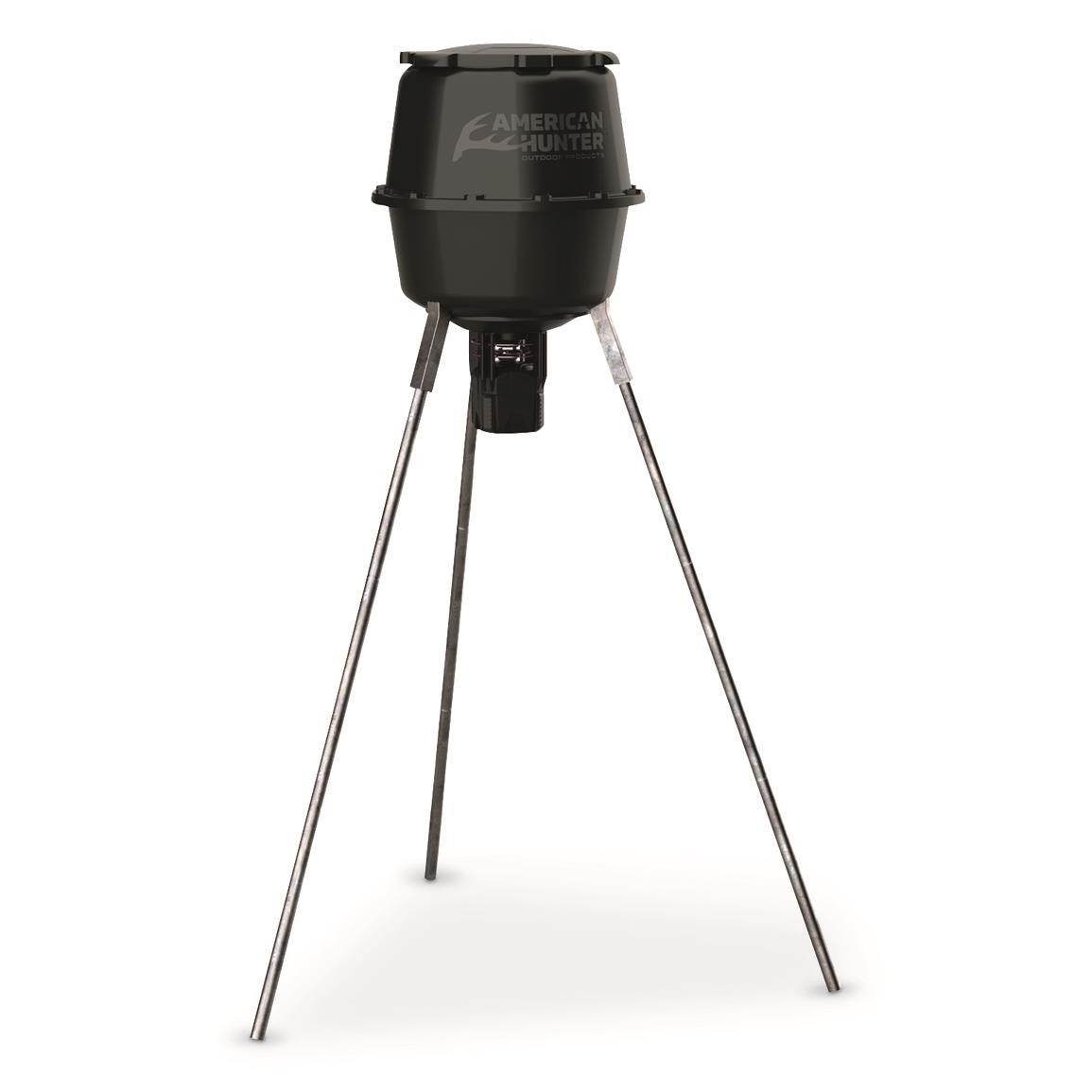 |
| 2. SunSlinger 350-lb Tripod (AH-SS350) | Best solar-charging tripod | 350 lb; built-in 6V solar charger | Tripod spin feeder | |
| 3. Nesting Hopper Gravity Feeder (AH-225GRAV) | Best no-electronics feeder | 30 gallons (225 lb); three 8-inch feed tubes | Gravity tripod | |
| 4. SunSlinger Kit (AH-SSLNG-KIT) | Best kit for an existing barrel, with solar | Integrated solar panel; metal spin plate | Feeder kit | |
| 5. R-Pro Digital Kit (30591) | Best digital kit for an existing container | Digital timer; 1–30 seconds; varmint guard | Feeder kit | |
| 6. R-Pro Analog Kit (30590) | Best simple analog kit | Analog clock timer; 1–30 seconds; varmint guard | Feeder kit | |
| 7. 5-Gallon Digital Hanging Bucket (AH-XDE40B) | Best small hanging feeder | 5 gallons (40 lb); 1–16 feeds/day | Hanging spin feeder | |
| 8. Econ Kit (AH-ECON-KIT) | Best lightweight, AA-powered kit | AA power; 1–4 feeds/day, 1–30 seconds | Feeder kit |
Blank photo cells are deliberate. This article does not substitute a photo of a different model, and it does not reuse Amazon product photos. Where no verified photo of the exact model was available, the cell stays blank. One product photograph is shown in this guide: the XDE-Pro, in the table below and in its review, taken from this site’s own media library.
How to Choose an American Hunter Feeder
Start with the job: timed corn, free-choice protein, or a small hanging site?
American Hunter’s range splits cleanly into three jobs, and picking the wrong job is the most common buyer mistake. Timed spin feeders throw feed on a schedule: they suit corn and sites where you want deer to arrive at predictable times, such as near a stand. Gravity feeders let deer eat on their own schedule through tubes: they suit protein pellets and free-choice feeding, and they need no timer, battery, or programming at all. Hanging bucket feeders suit small sites, tight budgets, and places where a tripod would be awkward or conspicuous. The XDE-Pro and the SunSlinger tripods are timed spin feeders. The AH-225GRAV is a gravity feeder. The 5-gallon bucket is a timed hanging feeder. The kits are not feeders at all until you bolt them to a container, and that distinction decides half the purchase: if you already own a sound barrel, a kit is the cheaper route; if you do not, a complete feeder is usually the simpler route, because the hopper, legs, lid, and kit are matched to each other.
Feed type narrows it further. Corn flows through spin plates and gravity tubes alike, but protein pellets and larger feeds need a check against the feed’s own size and the feeder’s tube or plate design. Retailer listings for the R-Pro kits warn against feed with mineral dust and against grains or pellets larger than 0.63 cm, which is a useful reminder that not every feed suits every mechanism. If you plan to feed protein, gravity is the natural American Hunter route, and the gravity feeder’s three tubes give more than one deer access at once. If you plan to feed corn on a schedule, a spin feeder with a timer you can actually program is the natural route, and the timer’s range matters more than its brand name.
Read the timer before you buy the feeder
American Hunter timers look similar on a product page and behave differently in the field, so compare four numbers: feeds per day, seconds per run, days-of-week control, and battery type. The XDE-Pro gives 1 to 16 feeds per day at 1 to 60 seconds, with two Q-Set presets for quick setup, and a large LCD. The SunSlinger kit gives 1 to 16 feeds per day with an easy-touch digital timer, days-of-week selection, and a built-in 6V solar charger. The R-Pro kits give an adjustable 1 to 30 seconds, with the standalone kit listings describing up to 24 feed times per day, while the 50-pound hanging bucket bundle built around the R-Pro is described as 1 to 4 times per day. That is not a contradiction to paper over: the kit and the bucket bundle are different products with different timer descriptions, and you should confirm which one the listing you are buying actually describes. The Econ kit is the narrowest timer here, at 1 to 4 custom times per day at 1 to 30 seconds, which is plenty for a single morning-and-evening pattern and thin for a manager who wants many small scatterings across the day.
Battery type is the second timer question, and it is where buyers get surprised. The XDE-Pro, the SunSlinger kit, and the R-Pro kits all name a 6V battery that is not included: DE-30045 for the XDE-Pro and the R-Pro kits, DE-30008 for the SunSlinger 350 tripod. The 5-gallon bucket runs on a 6V spring-top lead-acid battery, also not included. The Econ kit is the exception, running on AA batteries with a solar-panel accessory plug-in. Boss Buck’s own troubleshooting page adds a practical warning that applies across these 6V and 12V systems: a timer’s battery indicator can read full at 6V while a 12V motor still will not turn, so a weak or wrong-voltage battery looks like a dead timer when it is neither. Buy the battery the model names, keep a spare, and if the motor will not spin, check voltage before you blame the timer. Solar charging helps, but Boss Buck also warns that extreme cold can drain a battery even with a solar panel connected, so solar is a battery-life extender, not a guarantee.
Capacity, legs, and the refill trip you will actually make
Capacity numbers need translating before they mean anything. American Hunter lists its big hoppers in gallons, and retailers convert those gallons into pounds of feed, but the conversion depends on the feed: shelled corn and protein pellets do not weigh the same per gallon. The gravity feeder is the clearest case, because its listings agree on both numbers: 30 gallons, 225 lb. The XDE-Pro’s listings agree on 30 gallons but differ on the pound equivalent, with one major retailer listing 200 lb, so this article prints the gallon figure the listings agree on and does not pretend the pound figure is settled. The SunSlinger tripod is listed directly in pounds at 350 lb, with a heavy-duty steel hopper rather than a nesting polymer hopper. For planning, ignore the headline number and ask a simpler question: how many days between refills at the schedule you will actually run? A 30-gallon hopper run twice a day at short durations lasts far longer than the same hopper run sixteen times a day at long durations, and a remote site that you visit monthly needs a different answer from a backyard site you pass daily. Legs matter the same way: the XDE-Pro and SunSlinger tripods use three 8-foot sectional heavy-duty metal legs, while the gravity feeder uses three 6-foot sectional legs, so the spin feeders stand taller and need a steadier, more level footing, and a taller feeder is harder to fill without a step or a ladder.
Varmint protection: guard, cage, and the accessory that is not a feeder
Almost every American Hunter kit in this roundup includes some form of varmint protection, but the forms differ and the words matter. The XDE-Pro uses a simple spin plate with a metal varmint guard. The SunSlinger kit uses a metal spin plate with an integrated metal varmint guard and a fully enclosed varmint cage in its digital-kit description, plus an optional shocking circuit that is not included. The R-Pro kits have a varmint guard built in and are pre-wired for the Varmint Buster BL-VB1. The Econ kit has a built-in varmint guard with an optional shocking circuit. None of this makes a feeder varmint-proof, and the honest way to read it is as layers: a guard blocks the spin plate, a cage encloses more of the mechanism, and a shocking circuit adds a deterrent for persistent raccoons. The Varmint Buster itself is a guard accessory, not a feeder, and it is covered in its own section below rather than ranked, because ranking an accessory against feeders would mislead buyers about what it does. For the full varmint picture, including guards, placement, and hogs, see the site’s varmint-guard guide linked at the end of this article.
1. American Hunter XDE-Pro 30-Gallon Tripod Feeder (AH-225XDE) — Best Overall
The XDE-Pro is the best overall American Hunter feeder because it is the only complete American Hunter package here that combines a large hopper, a genuinely programmable digital timer, and a tall tripod stand in one matched system. The 30-gallon nesting hopper uses a twist-lock mounting mechanism with an easy-open lid, so filling is a lid-and-pour job rather than a disassembly job, and the nesting design keeps the package compact for transport before assembly. The timer is the star: an EZ-Touch digital timer with a large LCD display, a simple spin plate that broadcasts in a full 360-degree pattern, two Q-Set preconfigured settings for quick setup, and full adjustment from 1 to 16 feeds per day at 1 to 60 seconds per run. That range covers both the hunter who wants one dawn scattering and the manager who wants several small scatterings spread across the day, and the Q-Sets mean a first-time owner does not have to build a schedule from scratch on day one. The unit is pre-wired for an American Hunter solar panel, which is the right upgrade for a site you visit rarely, and it stands on three 8-foot sectional heavy-duty metal legs, which keep the spin plate high enough to broadcast cleanly and the feed clear of ground moisture.
The honest weaknesses start with the battery and the height. The recommended DE-30045 battery is not included, so the feeder is not ready to run out of the box, and a buyer who forgets the battery has a handsome tripod with no schedule. Eight-foot sectional legs are an advantage for broadcast and a chore for filling and for setup on uneven ground: you need a level spot, a firm footing, and a safe way to reach the lid, and sectional legs need their joints checked as part of routine maintenance rather than assumed tight forever. The 30-gallon hopper is large but not enormous, so a heavy schedule on a busy site will still need regular refills, and the pound equivalent of 30 gallons is not settled across listings, so buyers who plan in pounds should weigh their own feed rather than trust a converted number. Finally, the XDE-Pro is a spin feeder, not a free-choice feeder: deer eat when the timer says so, which is exactly right for patterning deer near a stand and exactly wrong for a manager who wants deer feeding at will all day. For that job, the gravity feeder below is the better American Hunter choice, and the article says so plainly rather than stretching the XDE-Pro to cover every job.
Pros:
- 30-gallon nesting hopper with twist-lock mounting and easy-open lid
- EZ-Touch digital timer with large LCD and two Q-Set presets
- 1 to 16 feeds per day at 1 to 60 seconds per run
- 360-degree spin-plate broadcast
- Pre-wired for an American Hunter solar panel; three 8-foot sectional metal legs
Cons:
- Recommended DE-30045 battery not included
- 8-foot legs make filling and setup harder on uneven ground
- Pound equivalent of 30 gallons differs across retailer listings
- Timed feeding only; no free-choice option
- No varmint-proof claim; guard reduces, not eliminates, losses
From the field: the only owner-experience evidence reproduced here is an aggregate, not a quotation. One major retailer’s listing for this feeder showed a 4.1 rating across 23 reviews at the time of checking on 2 November 2026. That is a middling-to-good aggregate, not a verdict, and no individual review is quoted because individual reviews were not verified for this guide. Treat it as a prompt to read current reviews for the exact model number AH-225XDE before ordering, especially on timer setup and leg assembly, which are the two topics that most often separate a smooth first weekend from a frustrating one.
| Spec | Detail |
|---|---|
| Model | AH-225XDE (also listed as AH-225XDEPRO) |
| Capacity | 30 gallons (nesting hopper) |
| Timer | EZ-Touch digital, large LCD, 2 Q-Set presets |
| Feeds per day | 1 to 16 |
| Run duration | 1 to 60 seconds |
| Broadcast | Simple spin plate, 360 degrees |
| Legs | Three 8-foot sectional heavy-duty metal legs |
| Power | Recommended DE-30045 battery, not included; pre-wired for solar panel |
| Type | Tripod spin feeder |
2. American Hunter SunSlinger 350-lb Tripod Feeder (AH-SS350) — Best Solar-Charging Tripod
The SunSlinger 350 tripod is the American Hunter feeder for a remote site where battery chores are the real cost. Its headline is the built-in 6V solar charger on the SunSlinger spinner kit, paired with an easy-touch digital timer, feeding 1 to 16 times per day, with days-of-week selection so the feeder can rest on days you do not hunt. The hopper is heavy-duty steel at 350 lb, which is a larger, tougher container than the XDE-Pro’s 30-gallon nesting hopper, and it stands on three 8-foot sectional heavy-duty galvanized steel legs with metal leg mounts. The kit itself brings a metal spin plate and is pre-wired for the remote activator AH-RMT, so a manager who wants to trigger a feeding on demand has a path to add one. If your feeder sits an hour from home and you visit monthly, the combination of a big steel hopper, a solar charger, and a programmable timer is a coherent answer to the three problems remote feeders actually have: running dry, running flat, and running on the wrong schedule.
The weaknesses are practical, not theoretical. The required 6V rechargeable battery, DE-30008, is not included, so solar charging does not remove the battery purchase; it only stretches the battery you buy. Solar charging is also not a cure for deep cold: Boss Buck’s own troubleshooting guidance warns that extreme cold can drain a battery even with a solar panel connected, so a northern winter site still needs a battery check in the plan. The steel hopper is heavier and tougher than a polymer hopper, but it is also heavier to handle during assembly, and the listing notes the item ships without a shipping box, which is a detail worth confirming with the seller before delivery day. One retailer’s listing showed this model as out of stock when checked on 2 November 2026, with a 3.3 aggregate rating across 9 reviews; both facts are dated snapshots, not permanent truths, and both argue for checking current stock and current reviews for model AH-SS350 before you commit. Finally, the SunSlinger tripod’s timer description in retailer listings is less precise than the XDE-Pro’s on run duration, so if your plan depends on exact seconds per run, confirm the current kit’s run-time range in the manual for the exact kit version you receive.
Pros:
- 350-lb heavy-duty steel hopper for long intervals between refills
- Built-in 6V solar charger on the SunSlinger kit
- Easy-touch digital timer, 1 to 16 feeds per day, days-of-week selection
- Metal spin plate; pre-wired for remote activator AH-RMT
- Three 8-foot sectional galvanized steel legs with metal mounts
Cons:
- Required DE-30008 battery not included
- Solar charging does not prevent cold-weather battery drain
- Steel hopper is heavy to handle during assembly
- One retailer listing showed out of stock on 2 November 2026; check current stock
- Run-duration range is less precisely stated in retailer listings than the XDE-Pro’s
From the field: the aggregate evidence for this model is thin and mixed. One major retailer’s listing showed a 3.3 rating across only 9 reviews at the time of checking on 2 November 2026. Nine reviews cannot carry a verdict, and a 3.3 average should prompt questions, not a dismissal: read those reviews for the exact model AH-SS350, look for patterns on assembly, timer setup, and solar charging, and weigh a single consistent complaint more heavily than a single glowing one. No individual review is quoted here, because individual reviews were not verified for this guide.
| Spec | Detail |
|---|---|
| Model | AH-SS350 |
| Capacity | 350 lb |
| Hopper | Heavy-duty steel |
| Timer | Easy-touch digital timer (SunSlinger kit) |
| Feeds per day | 1 to 16 |
| Days | Can feed different days of the week |
| Solar | Built-in 6V solar charger |
| Legs | Three 8-foot sectional heavy-duty galvanized steel legs, metal leg mounts |
| Power | Requires 6V rechargeable battery DE-30008, not included; pre-wired for remote activator AH-RMT |
| Type | Tripod spin feeder |
This product has no Check Price button in this article: no ASIN for the exact model AH-SS350 was verified against the approved list, so no Amazon link has been invented for it. Search dealers by the model number AH-SS350.
3. American Hunter Nesting Hopper Gravity Feeder (AH-225GRAV) — Best No-Electronics Feeder
The gravity feeder is the simplest American Hunter feeder and, for many properties, the wisest one. It has no timer, no battery, no motor, and no programming: a 30-gallon nesting hopper, listed at 225 lb of feed, feeds through three 8-inch feed tubes, each 3.5 inches in diameter and set at a 9-degree angle, with an anti-spillage lip and a hooded overhang that shields feed from weather. It stands on three 6-foot sectional heavy-duty metal legs. Deer eat when they choose, more than one deer can use the three tubes, and there is nothing electronic to fail, freeze, or forget to charge. For protein feeding, for a site you visit rarely, and for an owner who would rather spend time scouting than programming, that simplicity is not a compromise; it is the feature. The polymer housing is described by retailers as impact- and water-resistant, and the twist-lock mounting keeps the hopper and gravity head matched to each other.
Simplicity has its own costs, and they should be stated. Gravity feeding means no schedule control: you cannot pattern deer to a dawn feeding, you cannot shut feeding off on a given day without emptying or blocking the tubes, and feed sits in the tubes exposed to weather and to every animal that can reach them, not just deer. Hogs and raccoons can use gravity tubes, and a gravity feeder on a hog-heavy property needs placement and protection thinking that a timed spin feeder partly avoids by keeping feed locked up between scatterings. The 6-foot legs are shorter than the spin feeders’ 8-foot legs, which makes filling easier but also puts feed within easier reach of animals you do not want. Capacity planning is also less forgiving: a gravity feeder empties at the rate deer eat, not at the rate you program, so a busy site can drain 30 gallons faster than a timed schedule would, and a quiet site can leave feed sitting long enough to spoil in wet weather. Check tubes and feed condition on every visit, and do not assume a full hopper means fresh feed.
Pros:
- No timer, battery, motor, or electronics to fail
- 30 gallons (225 lb) with three feed tubes for multiple deer
- Anti-spillage lip and hooded overhang protect feed
- Minimal maintenance; set up, load, and let gravity work
- Shorter 6-foot legs make filling easier than 8-foot tripods
Cons:
- No schedule control; cannot pattern deer to set times
- Feed is accessible around the clock, including to hogs and raccoons
- Feed can spoil if a quiet site leaves it sitting in wet weather
- Drain rate depends on deer activity, not on a program
- No varmint-proof claim; tubes are an open invitation without placement planning
From the field: no verified individual owner experiences are reproduced for this model in this guide, and no aggregate rating is claimed for it, because none was verified for the exact model AH-225GRAV at drafting time. That absence is stated rather than filled with a plausible-sounding anecdote. Before buying, read current reviews for AH-225GRAV with attention to tube clogging with your chosen feed, leg stability on soft ground, and lid sealing in heavy rain, which are the three topics that most often decide whether a gravity feeder earns its simplicity.
| Spec | Detail |
|---|---|
| Model | AH-225GRAV |
| Capacity | 30 gallons (225 lb) |
| Feed tubes | Three 8-inch tubes, 3.5-inch diameter, 9-degree angle |
| Feed protection | Anti-spillage lip; hooded overhang |
| Hopper | Nesting hopper, impact- and water-resistant polymer housing (retailer description) |
| Legs | Three 6-foot sectional heavy-duty metal legs |
| Power | None; no timer or electronics |
| Type | Gravity tripod feeder |
This product has no Check Price button in this article: no ASIN for the exact model AH-225GRAV was verified against the approved list, so no Amazon link has been invented for it. Search dealers by the model number AH-225GRAV.
4. American Hunter SunSlinger Kit (AH-SSLNG-KIT) — Best Kit for an Existing Barrel, with Solar
The SunSlinger kit is the SunSlinger tripod’s brain sold on its own, and it is the right buy when you already own a sound barrel or hopper and do not want to pay for another one. It is a digital feeder kit with an integrated solar panel and a varmint cage, a metal spin plate, an industrial-grade motor with jam protection, and a weather-resistant housing, designed to mount on feeder barrels by twist lock or flat mount. The timer gives up to 16 feedings per day with adjustable run times, a large LCD display with memory backup in current kit descriptions, and days-of-week selection, and it is pre-wired for the remote activator AH-RMT. It requires a 6V spring-top battery, sold separately, and the integrated solar panel charges that battery in daylight. For a hunter with a good 55-gallon drum or a Boss Buck-style barrel already on the property, this kit turns a container into a programmable, solar-assisted feeder for far less effort than building a timer system from parts.
The kit’s weaknesses are the weaknesses of every kit: fit, power, and responsibility. Twist-lock or flat mounting covers many barrels, but not every barrel, and a poor seal between kit and container lets moisture and insects into feed that a matched factory feeder would have kept dry. The 6V battery is sold separately, so the kit is not a complete feeder on arrival, and solar charging depends on panel orientation: the kit’s own manual guidance stresses positioning the feeder so the integrated solar panel receives maximum direct sunlight through the day, which means a shaded timber edge that looks perfect for deer may be a poor spot for charging. The kit’s run-time range is also described differently across sources, with some kit descriptions giving 1 to 60 seconds and some tripod-bundle listings giving 1 to 30 seconds, so this article does not print a single run-time figure for the standalone kit as settled fact; confirm the range in the manual for the kit version you receive. Finally, a kit inherits its container’s weaknesses: a rusted, dented, or thin-walled barrel will not become a good feeder because a good kit was bolted to it.
Pros:
- Integrated solar panel for continuous 6V battery charging
- Up to 16 feedings per day with days-of-week selection
- Metal spin plate; industrial-grade motor with jam protection
- Twist-lock or flat mounting fits many barrels
- Built-in metal varmint guard and varmint cage; pre-wired for remote activator AH-RMT
Cons:
- 6V spring-top battery sold separately
- Solar charging needs direct sunlight; shaded sites charge poorly
- Fit and sealing depend on the condition of your container
- Run-time range differs across kit descriptions; confirm in your manual
- Kit alone is not a feeder; you must supply a sound hopper or barrel
From the field: no verified individual owner experiences are reproduced for the standalone kit in this guide. The site’s own SunSlinger guide covers this kit’s setup and timer in depth, and it is the better place to continue once you have decided the kit route is right, because setup details such as mounting, panel orientation, and timer programming matter more for a kit than for a complete feeder. Link: the SunSlinger guide at https://bestdeerfeeders.com/sunslinger-deer-feeders/.
| Spec | Detail |
|---|---|
| Model | AH-SSLNG-KIT |
| Timer | Digital, up to 16 feedings per day, days-of-week selection, large LCD (current kit descriptions) |
| Solar | Integrated solar panel (6V charging) |
| Spin plate | Metal spin plate; industrial-grade motor with jam protection |
| Mounting | Twist lock or flat mount |
| Protection | Metal varmint guard; varmint cage; optional shocking circuit (not included) |
| Power | 6V spring-top battery, sold separately; pre-wired for remote activator AH-RMT |
| Type | Feeder kit (requires a container) |
This product has no Check Price button in this article: no ASIN for the exact model AH-SSLNG-KIT was verified against the approved list, so no Amazon link has been invented for it. Search dealers by the model number AH-SSLNG-KIT.
5. American Hunter R-Pro Digital Kit (30591) — Best Digital Kit for an Existing Container
The R-Pro Digital kit is the workhorse digital kit in the American Hunter range: a digital clock timer with a varmint guard built in, an adjustable feed rate from 1 to 30 seconds, a powder-coated No Blow slinger, a weather-resistant housing, and a fit for most feed containers. It is pre-wired for the Varmint Buster BL-VB1 and the solar panel BL-R680-S, and it requires a 6V battery, recommended DE-30045, not included. Standalone kit listings describe feeding 1 to 24 times per day, which is a wider daily range than the XDE-Pro’s 1 to 16, and for a manager who wants many small scatterings, that range is a genuine advantage. The digital clock timer is easier to set precisely than an analog pin timer, especially for a schedule with several different times, and the built-in varmint guard means the kit arrives with its most important protection already in place rather than as an add-on to remember later.
The weaknesses follow the same logic as every kit. You must supply a container, and the kit is only as good as the container’s seal, lid, and mounting surface. The 6V battery is not included, and the solar panel that would keep it charged is a separate accessory, BL-R680-S, also not included, so the out-of-the-box cost is kit plus battery plus, realistically, a panel for a remote site. The No Blow slinger resists wind and grain trickle by design, but no slinger design eliminates waste in high wind, and a site on an exposed ridge will still scatter more feed than the same kit in a sheltered hollow. Retailer listings also warn against mineral-dust feed and against grains or pellets larger than 0.63 cm for R-Pro-based feeders, so check your feed size before you blame the kit for a jam. Finally, the R-Pro Digital and R-Pro Analog kits differ only in their timer style, so a buyer who does not care about digital precision is paying for a feature they will not use; the analog kit below is the honest alternative.
Pros:
- Digital clock timer with varmint guard built in
- Adjustable feed rate 1 to 30 seconds
- Standalone kit listings describe 1 to 24 feed times per day
- Powder-coated No Blow slinger; weather-resistant housing
- Pre-wired for Varmint Buster BL-VB1 and solar panel BL-R680-S; fits most containers
Cons:
- 6V battery (recommended DE-30045) not included
- Solar panel BL-R680-S is a separate accessory
- Requires a sound container; kit alone is not a feeder
- Feed-size limits: avoid mineral dust and grains or pellets over 0.63 cm (retailer guidance)
- Digital precision is wasted on a buyer who only wants one or two daily feedings
From the field: no verified individual owner experiences are reproduced for this kit in this guide, and no aggregate rating is claimed for it. Before buying, check current reviews for model 30591 with attention to digital timer setup, varmint-guard fit on your container type, and battery life at your chosen schedule, which are the topics that most often decide whether a kit feels like an upgrade or a project.
| Spec | Detail |
|---|---|
| Model | 30591 (R-Pro Digital) |
| Timer | Digital clock timer and guard |
| Feed times | 1 to 24 times per day (standalone kit listings) |
| Feed rate | Adjustable 1 to 30 seconds |
| Slinger | Powder-coated No Blow slinger |
| Guard | Varmint guard built in; pre-wired for Varmint Buster BL-VB1 |
| Power | Requires 6V battery, recommended DE-30045, not included; pre-wired for solar panel BL-R680-S |
| Fit | Fits most feed containers; weather-resistant housing |
| Type | Feeder kit (requires a container) |
This product has no Check Price button in this article: no ASIN for the exact model 30591 was verified against the approved list, so no Amazon link has been invented for it. Search dealers by the model number 30591.
6. American Hunter R-Pro Analog Kit (30590) — Best Simple Analog Kit
The R-Pro Analog kit is the same proven kit as the digital version with an analog clock timer instead of a digital one, and for many owners that is a feature, not a downgrade. It carries the same core specification: adjustable feed rate from 1 to 30 seconds, varmint guard built in, easy installation on most feed containers, weather-resistant housing, powder-coated No Blow slinger, pre-wiring for the Varmint Buster BL-VB1 and the solar panel BL-R680-S, and a required 6V battery, recommended DE-30045, not included. Standalone kit listings describe feeding 1 to 24 times per day. An analog timer is set with pins and a clock face rather than menus, which some owners find faster to understand, easier to teach to a helper, and less intimidating in cold weather with gloves on. It also has fewer electronic failure modes than a digital display: there is no LCD to fade, no menu to lose your place in, and no memory to worry about beyond the clock itself.
The trade-offs are the mirror image of the digital kit’s strengths. An analog timer is harder to set to an exact minute than a digital timer, and a schedule with many different times is fiddlier to build with pins than to type into a digital timer. The analog kit shares the digital kit’s other costs: a container to supply, a battery to buy, and a solar panel to add if the site is remote. It also shares the feed-size guidance, so mineral-dust feed and oversized pellets are still a jam risk. One more distinction matters and is easy to miss: the 50-pound hanging feeder bundle built around the R-Pro is described by retailers as feeding 1 to 4 times per day, which is a different product from the standalone kit described here. If a listing shows 1 to 4 times per day, you are looking at the bucket bundle, not the standalone kit, and you should buy the one whose schedule range matches your plan rather than assuming they are interchangeable.
Pros:
- Analog clock timer: simple, glove-friendly, no menus or LCD to fail
- Adjustable feed rate 1 to 30 seconds
- Standalone kit listings describe 1 to 24 feed times per day
- Varmint guard built in; No Blow slinger; weather-resistant housing
- Pre-wired for Varmint Buster BL-VB1 and solar panel BL-R680-S; fits most containers
Cons:
- Less precise than a digital timer for exact-minute schedules
- Many-time schedules are fiddlier to build with pins
- 6V battery (recommended DE-30045) not included
- Requires a sound container; kit alone is not a feeder
- Do not confuse with the 50-pound bucket bundle, described as 1 to 4 times per day
From the field: no verified individual owner experiences are reproduced for this kit in this guide, and no aggregate rating is claimed for it. Before buying, check current reviews for model 30590 with attention to pin-setting ease, clock accuracy over a season, and varmint-guard fit, and confirm whether the listing you are buying is the standalone kit or the bucket bundle, because the two are routinely confused.
| Spec | Detail |
|---|---|
| Model | 30590 (R-Pro Analog) |
| Timer | Analog clock timer and guard |
| Feed times | 1 to 24 times per day (standalone kit listings) |
| Feed rate | Adjustable 1 to 30 seconds |
| Slinger | Powder-coated No Blow slinger |
| Guard | Varmint guard built in; pre-wired for Varmint Buster BL-VB1 |
| Power | Requires 6V battery, recommended DE-30045, not included; pre-wired for solar panel BL-R680-S |
| Fit | Fits most feed containers; weather-resistant housing |
| Type | Feeder kit (requires a container) |
This product has no Check Price button in this article: no ASIN for the exact model 30590 was verified against the approved list, so no Amazon link has been invented for it. Search dealers by the model number 30590.
7. American Hunter 5-Gallon Digital Hanging Bucket Feeder (AH-XDE40B) — Best Small Hanging Feeder
The 5-gallon digital hanging bucket is the American Hunter feeder for a small site, a tight budget, or a first feeder. It is a 5-gallon bucket with a 40-pound feed capacity, made from durable, weather-resistant plastic with a waterproof lid, hanging hardware, and a digital timer that programs 1 to 16 feedings per day on different days of the week at an adjustable feed rate of 1 to 30 seconds. It runs on a 6V spring-top lead-acid battery, not included, and it is portable in a way no tripod feeder is: hang it from a limb or a post, move it when deer patterns shift, and take it down at season’s end without disassembling legs. For a backyard edge, a small food plot, a youth hunter’s first site, or a trial location you are not yet sure about, a hanging bucket answers the question without committing to a tripod, a big hopper, or a big refill job.
The limits are capacity and exposure. Five gallons, or 40 pounds, is a small reserve: on a busy site, or on a schedule with many daily feedings, it empties fast, and a hanging feeder that runs dry between visits teaches deer to stop checking it. Hanging also puts the feeder at the mercy of its hang point: a weak limb, a slipping wire, or a low hang invites raccoons and makes the feeder easier for hogs to reach than a tall tripod, and a bucket swinging in wind scatters differently from a fixed tripod. The battery is not included, and a 6V spring-top battery is a specific purchase, not a household spare. The bucket’s plastic construction is weather-resistant, not indestructible, and a hanging bucket in a bear-active area is the most vulnerable feeder in this roundup, not the most protected. Buy it for a small, watched site, and do not ask it to do a big tripod’s job.
Pros:
- 5 gallons (40 lb) in a portable, easy-to-move hanging bucket
- Digital timer: 1 to 16 feedings per day, days-of-week selection
- Adjustable feed rate 1 to 30 seconds
- Durable weather-resistant plastic with a waterproof lid
- Simple to hang, move, and remove at season’s end
Cons:
- Small capacity empties fast on a busy site or a heavy schedule
- 6V spring-top battery not included
- Hanging position is more vulnerable to raccoons and hogs than a tall tripod
- Wind swing affects scatter compared with a fixed tripod
- Most vulnerable feeder here in bear-active areas; not bear-proof
From the field: no verified individual owner experiences are reproduced for this model in this guide, and no aggregate rating is claimed for it. Before buying, check current reviews for model AH-XDE40B with attention to hang-point stability, lid sealing in rain, and battery life at your schedule, and plan your refill visits around the 40-pound capacity rather than around a tripod feeder’s refill rhythm.
| Spec | Detail |
|---|---|
| Model | AH-XDE40B |
| Capacity | 5 gallons (40 lb) |
| Material | Durable, weather-resistant plastic; waterproof lid |
| Timer | Digital, 1 to 16 feedings per day, days-of-week selection |
| Feed rate | Adjustable 1 to 30 seconds |
| Power | 6V spring-top lead-acid battery, not included |
| Mounting | Hanging, with hanging hardware |
| Type | Hanging spin feeder |
This product has no Check Price button in this article: no ASIN for the exact model AH-XDE40B was verified against the approved list, so no Amazon link has been invented for it. Search dealers by the model number AH-XDE40B.
8. American Hunter Econ Kit (AH-ECON-KIT) — Best Lightweight, AA-Powered Kit
The Econ kit is the lightest, simplest American Hunter kit, and its advantage is a power source every owner already understands: AA batteries. It is a compact, efficient feeder kit with a metal spin plate, a built-in varmint guard, a rail mount for optional accessories, a solar-panel accessory plug-in, twist-lock or flat mounting, and an EZ-Touch digital timer with 1 to 4 custom feed times at 1 to 30 second run times, plus reverse polarity protection. It is the kit for a small barrel, a short-season site, a backup feeder, or an owner who does not want to buy, charge, and store a 6V battery. Its compact size and light weight, listed at 1.3 pounds for the kit, also make it the easiest kit to carry to a remote hang point and the easiest to swap between containers.
The Econ kit’s limits are the price of its simplicity. Four feed times per day is enough for a dawn-and-dusk pattern and not enough for a manager who wants many small scatterings, and AA batteries, while convenient, are a recurring cost and a weaker power reserve than a 6V battery for a heavy schedule or a cold season. Retailer descriptions of the Econ line vary: older Economy listings describe a photocell timer and a 6V spring-top battery, while current AH-ECON-KIT listings describe AA power and an EZ-Touch digital timer. Both descriptions exist in the market, so check the model number AH-ECON-KIT and the timer description on the listing you are buying rather than assuming every Econ kit is the same kit. The related 5-gallon nesting hopper with Econ kit, model AH-NF-ECON, pairs this kit with a collapsible 5-gallon hopper for a hanging station, and it is worth knowing about if you want the Econ kit with a matched container rather than hunting for a barrel; it is mentioned here rather than ranked separately because its kit is the same Econ kit ranked in this section. Finally, the Econ kit’s plastic housing is light and weather-resistant, not heavy-duty metal, so it suits a sheltered or watched site better than an exposed, hog-heavy one.
Pros:
- AA battery power: no 6V battery to buy, charge, or store
- Compact and light (kit listed at 1.3 lb); easy to carry and swap
- Metal spin plate with built-in varmint guard
- EZ-Touch digital timer, 1 to 4 custom times, 1 to 30 seconds, reverse polarity protection
- Twist-lock or flat mounting; rail mount; solar-panel accessory plug-in
Cons:
- Only 1 to 4 feed times per day; thin for many-scattering schedules
- AA batteries are a recurring cost and a weaker reserve than 6V
- Older Economy listings describe a different timer and power source; verify model AH-ECON-KIT
- Plastic housing is light, not heavy-duty metal
- Kit alone is not a feeder; you must supply a container (or buy the AH-NF-ECON hopper bundle)
From the field: no verified individual owner experiences are reproduced for this kit in this guide, and no aggregate rating is claimed for it. Before buying, check current reviews for model AH-ECON-KIT with attention to AA battery life at your schedule, timer ease of use, and varmint-guard effectiveness on your container, and confirm the listing describes the AA digital version rather than the older photocell Economy version.
| Spec | Detail |
|---|---|
| Model | AH-ECON-KIT |
| Timer | EZ-Touch digital, 1 to 4 custom times |
| Run duration | 1 to 30 seconds |
| Spin plate | Metal spin plate; built-in varmint guard |
| Mounting | Twist lock or flat mount; rail mount for accessories |
| Power | AA batteries; solar-panel accessory plug-in; reverse polarity protection |
| Weight | Kit listed at 1.3 lb |
| Type | Feeder kit (requires a container) |
This product has no Check Price button in this article: no ASIN for the exact model AH-ECON-KIT was verified against the approved list, so no Amazon link has been invented for it. Search dealers by the model number AH-ECON-KIT.
Also Considered, Not Ranked
Two American Hunter products deserve a mention without a ranking, because ranking them would mislead. The first is the Heavy Duty Spin Kit, model 20558, a metal-housed kit with a high-torque industrial motor, a heavy-duty No Blow slinger, a metal downspout, and a digital timer feeding 1 to 8 times per day at 1 to 30 seconds, with three spread speeds at 3000, 3300, and 3800 RPM, running on 6V or 12V batteries, and memory that preserves settings for 30 minutes after power loss. It is a serious kit for a builder who wants spread-speed control, but it duplicates the R-Pro and SunSlinger kits for most buyers and its spread-speed feature needs a container and a use case that justifies it, so it is noted here for builders rather than ranked for general buyers. The second is the 50-pound hanging feeder bundle built around the R-Pro, a durable metal bucket in Realtree AP camouflage with a built-in pest guard and a No Blow powder coating, described as feeding 1 to 4 times per day at 1 to 30 seconds on a 6V spring battery. It is a complete hanging feeder, but its timer description and its bucket capacity overlap the 5-gallon bucket and the R-Pro kits closely enough that ranking it separately would double-count the same idea; buyers who want it should search by its R-Pro bucket description and confirm whether the listing is the analog or digital version.
Accessory, Not a Feeder: The Varmint Buster (BL-VB1)
The Varmint Buster, model BL-VB1, is a guard accessory, not a ranked feeder, and it is mentioned here only so buyers do not mistake it for one. It is the accessory the R-Pro kits are pre-wired for, and its job is to add a shocking deterrent circuit to a feeder that already has a varmint guard, for raccoons and other persistent feed thieves that a passive guard does not stop. The Econ kit’s optional shocking circuit is the same idea in a different kit. A shocking guard is a deterrent, not a guarantee, and it does not make a feeder bear-proof, hog-proof, or maintenance-free; it also adds a component that needs its own power and its own checks. If raccoons are emptying your feeder between visits, the Varmint Buster is worth discussing with a dealer for your exact kit model, and the site’s varmint-guard guide covers the broader protection picture, including placement and hogs, better than any single accessory description can. Do not buy it expecting a feeder, and do not rank it against feeders, because it feeds nothing.
Cost and Ownership Math (No Prices, by Design)
Because this article prints no prices, the cost math here is about quantities you can plan, not dollars you cannot verify. Start with spin time, because spin time drives battery life and feed use together. A feeder running twice a day at 10 seconds per run spins 20 seconds per day, or 140 seconds per week; the same feeder running 16 times a day at 30 seconds spins 480 seconds per day, or 3,360 seconds per week, which is 24 times as much spin time. That single comparison explains why two owners with the same feeder report wildly different battery life and feed use: the schedule, not the feeder, is usually the difference. If your battery is dying fast, shorten run times or cut feedings before you blame the battery, and if your feed is vanishing fast, do the same before you blame the varmint guard.
Next, count the purchases beyond the feeder itself, because the feeder is rarely the whole cost. The XDE-Pro, the SunSlinger tripod, the R-Pro kits, and the 5-gallon bucket each need a 6V battery that is not included, and the SunSlinger tripod and the XDE-Pro benefit from a solar panel that is also not included. The Econ kit needs AA batteries, which are cheaper per purchase and more frequent per season. Every kit needs a container if you do not already own one, and every tripod needs a level site, a safe filling method for an 8-foot feeder, and leg-joint checks as part of maintenance. A gravity feeder needs none of those electrical purchases, but it needs more frequent feed-condition checks, because feed sits in open tubes rather than locked in a hopper between scatterings. Over a season, the cheapest feeder to buy is not always the cheapest feeder to own, and the feeder that needs the fewest visits is often the cheapest in time even when it costs more on day one.
Refill planning follows the same logic. A 30-gallon hopper and a 350-pound hopper sound like different worlds, and they are, but the planning question is the same: how many days does your schedule last? Work backwards from your visits. If you visit monthly, you need a hopper and a schedule that last a month at your deer density, and a gravity feeder’s drain rate, which follows deer appetite, is harder to predict than a spin feeder’s drain rate, which follows your program. If you visit weekly, a 5-gallon bucket may be plenty, and its small capacity becomes a feature, because feed stays fresh. The mistake to avoid is buying capacity for a visit pattern you do not have: a huge hopper on a weekly-visited site holds stale feed, and a small bucket on a monthly-visited site holds an empty promise. Match hopper to visits first, timer to deer pattern second, and brand loyalty last.
Finally, budget for the unglamorous consumables: feed itself, which dwarfs feeder cost over a season on any busy site; a spare battery, because a feeder that stops in peak season costs more in lost patterning than a spare battery costs in a shop; and replacement parts, because spin plates, timers, and lids wear out and Boss Buck’s parts line exists precisely because feeders are maintained, not just bought. The site’s Boss Buck parts guide, linked below, is the right next stop once you own a feeder, because knowing the part number before something breaks is worth more than knowing it after.
Frequently Asked Questions About American Hunter Deer Feeders
What is the best American Hunter deer feeder overall?
The XDE-Pro 30-gallon tripod feeder (AH-225XDE) is the best overall pick in this guide: a 30-gallon nesting hopper, an EZ-Touch digital timer with a large LCD and two Q-Set presets, 1 to 16 feeds per day at 1 to 60 seconds, and three 8-foot sectional metal legs. It is also the only product here with a verified Amazon link. For a remote site, the SunSlinger 350 tripod with its built-in solar charger is the alternative; for no electronics at all, the 30-gallon gravity feeder is the alternative.
Are American Hunter and Boss Buck the same company?
They are sister brands under GSM Outdoors, sold through the combined Boss Buck and American Hunter store at bossbuck.com. Boss Buck’s own About page describes over 25 years of Boss Buck and American Hunter feeder development, and parts and accessories, including the Varmint Buster, cross between the two names. Check the exact model number when you order, because the brand name alone does not identify the product.
What is the difference between the XDE-Pro and the SunSlinger kit?
The XDE-Pro is a complete tripod feeder with a 30-gallon hopper, a digital timer, and legs, while the SunSlinger kit is a feeder kit that needs a container: it adds a digital timer, an integrated solar panel, a metal spin plate, and a varmint cage to a barrel you already own. The SunSlinger 350 tripod combines a steel hopper with the SunSlinger kit. Buy the complete feeder if you own no container; buy the kit if you own a sound barrel.
What battery does an American Hunter feeder need?
It depends on the model, and the battery is almost never included. The XDE-Pro and the R-Pro kits name the DE-30045 battery, the SunSlinger 350 tripod names the DE-30008 rechargeable battery, the 5-gallon bucket uses a 6V spring-top lead-acid battery, and the Econ kit uses AA batteries. Buy the battery the exact model names, keep a spare, and check voltage before blaming a timer that will not spin a motor.
How do I program an American Hunter feeder timer?
Digital timers, including the XDE-Pro’s EZ-Touch timer and the SunSlinger kit’s easy-touch timer, are set through their LCD displays, with the XDE-Pro offering two Q-Set presets for quick setup. Analog R-Pro timers are set with a clock face and pins. The full programming walkthrough lives in this site’s American Hunter manuals guide, linked below, which covers manuals and timer setup for American Hunter feeders in depth.
What is the American Hunter R-Pro feeder kit?
The R-Pro is a feeder kit that bolts onto most feed containers, with a varmint guard built in, a powder-coated No Blow slinger, an adjustable feed rate of 1 to 30 seconds, and pre-wiring for the Varmint Buster BL-VB1 and the solar panel BL-R680-S. It comes in a digital version (30591) and an analog version (30590). Standalone kit listings describe 1 to 24 feed times per day, while the 50-pound hanging bucket bundle built around the R-Pro is described as 1 to 4 times per day, so confirm which product a listing describes.
What is the SunSlinger feeder kit, and does it need a battery?
The SunSlinger kit (AH-SSLNG-KIT) is a digital feeder kit with an integrated solar panel, a metal spin plate, an industrial-grade motor with jam protection, and a varmint cage, mounting by twist lock or flat mount on a feeder barrel. Yes, it still needs a battery: a 6V spring-top battery, sold separately, which the integrated solar panel charges in daylight. Solar charging extends battery life; it does not remove the battery, and shaded sites charge poorly.
Is there an American Hunter gravity feeder with no timer?
Yes: the American Hunter Nesting Hopper Gravity Feeder (AH-225GRAV) has no timer, battery, motor, or electronics. It is a 30-gallon (225 lb) hopper feeding through three 8-inch tubes on three 6-foot sectional metal legs. Deer eat on their own schedule, which suits protein feeding and low-maintenance sites, but it also means no schedule control and feed accessible around the clock, including to hogs and raccoons.
What is the Varmint Buster, and is it a feeder?
No, the Varmint Buster (BL-VB1) is a guard accessory, not a feeder. The R-Pro kits are pre-wired for it, and its job is to add a shocking deterrent circuit to a feeder that already has a varmint guard, for persistent raccoons. It feeds nothing on its own, it does not make a feeder bear-proof, and it needs its own power and checks. It is covered as an accessory in this guide, not ranked against feeders.
Are American Hunter feeders bear-proof?
No. Nothing in this guide calls any American Hunter feeder bear-proof, because no varmint guard, cage, or shocking circuit in this range is a bear-proof claim. A feeder that reduces raccoon losses is not a feeder that survives a bear. In bear-active areas, check your state wildlife agency’s current guidance before putting any feeder out, and treat attractant control as part of the decision.
Can I use an American Hunter kit on a 55-gallon drum?
Yes, with a fit check. The R-Pro kits are described as fitting most feed containers, the SunSlinger kit mounts by twist lock or flat mount, and the Econ kit offers twist-lock or flat mounting. The container must be sound, with a sealing lid and a mounting surface the kit can bolt to securely; a rusted or thin-walled drum will not become a good feeder because a good kit was bolted to it. The site’s 55-gallon drum feeder kit guide, linked below, covers this route in more detail.
Is it legal to use a deer feeder where I hunt?
That depends on your state, and sometimes on your county or property rules, and it can change with season and with disease regulations. Feeding and baiting rules vary widely, and a feeder that is legal for wildlife watching may not be legal for hunting, and vice versa. Check your state wildlife agency’s current regulations before you buy, set up, or fill any feeder, and recheck them each season rather than assuming last year’s rules still apply.
Verdict: The American Hunter Lineup, in One Paragraph Each
Best overall: XDE-Pro 30-gallon tripod (AH-225XDE). The most complete American Hunter package here, and the only one with a verified Amazon link in this article.
Runner-up for remote sites: SunSlinger 350-lb tripod (AH-SS350). A big steel hopper with a built-in solar charger for sites you visit rarely.
Runner-up for simplicity: Nesting Hopper Gravity Feeder (AH-225GRAV). No electronics, no battery, no schedule; just a 30-gallon hopper and three tubes.
Runner-up for existing barrels: SunSlinger Kit (AH-SSLNG-KIT). Solar-assisted digital control for a barrel you already own.
Runner-up for kit buyers: R-Pro Digital (30591) and R-Pro Analog (30590). Same proven kit, digital precision or analog simplicity; pick the timer you will actually enjoy setting.
Runner-up for small sites: 5-gallon digital hanging bucket (AH-XDE40B). Portable, affordable in spirit, and limited to 40 pounds, so plan refills honestly.
Runner-up for light duty: Econ Kit (AH-ECON-KIT). AA-powered, compact, and simple, for small barrels and short-season sites.
Legality reminder: check your state wildlife agency’s current feeding and baiting rules before you buy, set up, or fill any feeder, and remember that no feeder in this guide is bear-proof.
Related Guides on This Site
Continue with the guides this roundup builds on: the best deer feeders money page for the full market picture; SunSlinger deer feeders for the SunSlinger kit’s setup and timer in depth; American Hunter feeder manuals for manuals and timer setup; American Hunter vs GameWinner game feeder controls for a timer and motor comparison; best gravity deer feeders if the gravity route appeals; best deer feeder varmint guard for raccoon and hog protection; best deer feeder kit for a 55-gallon drum if you are building on a barrel; Boss Buck feeders for the sister brand’s full range; Boss Buck feeder parts for spares; best tripod deer feeders and best hanging deer feeders for the wider tripod and hanging markets; best deer feeder timer and how to program a deer feeder timer for timer help; deer feeder solar panel for charging; and best automatic deer feeders for the automatic market as a whole.
Products mentioned in this guide
American Hunter XDE-Pro 30-Gallon Feeder
Check Price on Amazon →Confirm price and availability on AmazonAs an Amazon Associate, we earn from qualifying purchases.