
Best Solar Panel for Trail Camera (2026)
As an Amazon Associate I earn from qualifying purchases.
Updated November 2, 2026 · by Zia
The short answer
Quick answer: Match the panel to your camera’s voltage and plug first. The Herd360 G2 Solar Power Pack is the safe pick for mixed brands, with 6V, 9V and 12V outputs. On Moultrie EDGE cameras, buy the Moultrie 3.4W Solar Power Pack. On Tactacam Reveal cameras, buy the Reveal Folding Solar Panel.
If you own more than one brand of trail camera, or you are not sure which panel your camera takes, buy the Herd360 G2 Solar Power Pack. It is the only panel in this guide with selectable 6V, 9V and 12V outputs and a plug kit that covers the major camera brands, so it survives the two mistakes that kill most solar setups: the wrong voltage and the wrong plug. If you run Moultrie EDGE cameras, buy Moultrie’s own 3.4W Solar Power Pack instead — it locks onto the EDGE power system with a screw-locking USB-C connection and reports solar status in the Moultrie app. If you run Tactacam Reveal cameras, the Reveal Folding Solar Panel is the matching unit. The comparison table below puts all eight panels side by side; the four-step flowchart after it walks you through the compatibility checks in order.
One warning up front, because it decides more purchases than any spec on this page: a plug that fits does not mean a panel is compatible. Several cameras share the same 5.5 x 2.1 mm barrel plug at different voltages, and at least one major camera family (the original Spartan GoCam) runs on 6V while most modern cellular cameras run on 12V. Read your camera’s manual for its power input before you order anything, and use the plug table in the “How to choose” section to cross-check.
Three fast choices
Herd360 G2 Solar Power Pack. 10W panel, 25,000 mAh battery, 6V / 9V / 12V outputs, and plugs for Browning, Spypoint, Stealth Cam, Moultrie, Tactacam, Spartan and more. The safe pick for a mixed fleet.
Moultrie 3.4W Solar Power Pack. 12V output, 3,350 mAh power bank, IP65 housing, varmint-resistant cables, and a screw-locking USB-C connection made for every EDGE camera.
Tactacam Reveal Folding Solar Panel. Two 3.6W panels for 7.2W total, a 4,900 mAh lithium battery, and a fold-flat design for packing into remote spots. Built for Reveal and Defend cameras, and most other 12V cellular cameras.
Before you buy: check your camera’s voltage first. A 12V panel on a 6V camera is the wrong purchase even if the plug fits. The original Spartan GoCam, the Covert Blackhawk and the Camojojo Trace are 6V cameras; most current cellular cameras from Moultrie, Tactacam, Stealth Cam, Browning and Spypoint are 12V. When in doubt, the Herd360 G2 or GardePro SP350 lets you select the voltage instead of guessing.
Solar panels at a glance
Prices are deliberately left out of this guide. Panel prices move by retailer and season, and we will not print a price we cannot verify on a live page at publish time. Every link below goes to the manufacturer or a US retailer listing where you can check the current price.
| Panel | Best for | Panel + battery | Output | Fits | Details |
|---|---|---|---|---|---|
| Herd360 G2 Solar Power Pack | Mixed camera fleets | 10W panel; 25,000 mAh lithium battery | 6V / 9V / 12V selectable | Most brands via plug kit; not Moultrie EDGE 3 / 3 Pro on the barrel plug (USB-C cable sold separately) | Herd360 → |
| Moultrie 3.4W Solar Power Pack | Moultrie EDGE cameras | 3.4W panel; 3,350 mAh power bank | 12V | EDGE, EDGE Pro, EDGE 2, EDGE 2 Pro (USB-C to barrel jack cable included) | Check price |
| Moultrie 10W Solar Power Pack | Shaded or low-sun sites | 10W panel; 3,350 mAh power bank | 12V | EDGE, EDGE Pro, EDGE 2, EDGE 2 Pro | See today’s price |
| Tactacam Reveal Folding Solar Panel | Reveal / Defend owners; remote pack-ins | Two 3.6W panels (7.2W total); 4,900 mAh lithium battery | 12V / 2A | All Reveal cameras, Defend cameras, most other 12V cellular cameras | Amazon → |
| Stealth Cam Sol-Pak | Any camera with a 12V jack | 12V amorphous panel; 1,000 / 3,000 / 5,000 mAh versions | 12V | Any camera with an external 12V DC jack | Amazon → |
| Spartan GoLive Solar Kit with Battery | Spartan GoLive / GoLive 2 | 10W or 15W panel; 12V external battery + battery box | 12V | GoLive and GoLive 2 only (separate kits exist for GoCam and GoCam 2) | Spartan Camera → |
| Browning Solar Camera Power Pack (BTC-SBP12) | All Browning cameras | Solar panel; 6 AA NiMH rechargeable batteries, stepped up to 12V | 12V | All Browning trail camera models; twist-lock 5.5 x 2.1 mm plug | View on Amazon |
| GardePro SP350 Solar Panel | Multi-voltage value | 12W max panel; 5,200 mAh battery | 6V / 9V / 12V selectable | 5.5 x 2.1 mm and 4.0 x 1.7 mm plugs; IP65 | View on Amazon |
Pick the right panel in four steps
- Step 1 — Read your camera’s power input. Open the manual (not the marketing page) and find three things: input voltage (6V or 12V), connector type (barrel jack size, screw collar, or USB-C), and whether the camera runs from external power first or shares the load with internal batteries. If you run a Moultrie EDGE camera, go to the Moultrie 3.4W or 10W Solar Power Pack.
- Step 2 — Match the voltage, not just the plug. A 5.5 x 2.1 mm plug is used by both 6V and 12V cameras. If your camera is 6V (original Spartan GoCam, Covert Blackhawk, Camojojo Trace), you need a 6V-capable system such as the Herd360 G2 or GardePro SP350 set to 6V — not a 12V-only panel.
- Step 3 — Size the panel for your shade, not your summer. A panel in a shaded food plot or a north-facing hollow can see two hours of direct sun where an open-field setup sees six. Shaded site or a cellular camera sending video? Step up to a 10W-or-bigger panel, or a panel with a large battery such as the Herd360 G2 (25,000 mAh). See the shade section below before you decide.
- Step 4 — Decide whether you need a battery box too. Some cameras cannot take a panel directly. The Spartan GoCam 2, for example, cannot connect directly to a solar panel at all — it needs Spartan’s 12V battery box plus a 10W or 15W panel. If your camera’s spec sheet says “battery box required,” buy the kit, not the panel alone.
How we picked
We did not field-test these panels, and this guide does not pretend otherwise. What we did: we read manufacturer pages, manuals and US retailer listings for every panel below, and cross-checked connector and voltage claims against at least two sources where possible. Retailer listings often present panels as if any panel fits any camera, older forum advice describes panels that have since been replaced, and brand blogs recommend only their own panel. So every pick below states its voltage, its connector, and which cameras it actually fits, and the universal picks are ranked first precisely because most hunters run more than one brand.
What we did not do: we did not invent runtime figures, prices, or test results. Where a manufacturer states a figure — such as Moultrie’s “up to 9 days without sunlight” for its power packs — we attribute it to the manufacturer. Where owner evidence was thin, we say so in the product’s field note instead of filling the gap with invented enthusiasm.
The panels, reviewed
Best for most cameras · Universal
1. Herd360 G2 Solar Power Pack — best for most cameras
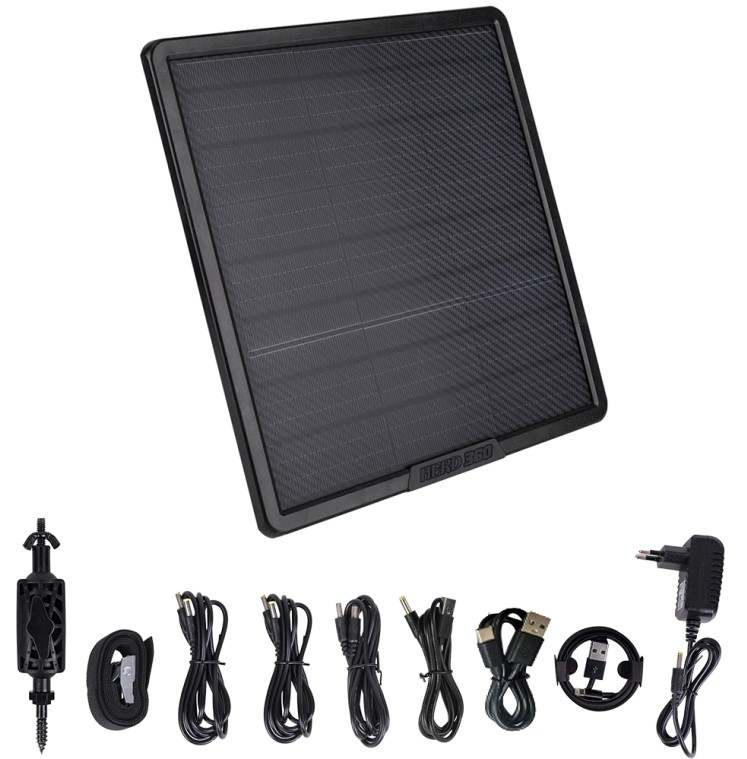
The Herd360 G2 is the panel to buy when you run more than one brand of camera, or when you are buying a panel before you have settled on a camera. Its case for the top spot is not wattage — at 10W it ties the Moultrie 10W pack — it is the combination of a very large battery and a genuinely universal connection system. The pack pairs a 10W solar charger with a 25,000 mAh (92.5 Wh) lithium battery and offers 6V, 9V and 12V DC outputs, plus USB and USB-C outputs for phones and tablets. That battery is roughly seven times the capacity of Moultrie’s 3,350 mAh power bank, which matters most on the exact setups where solar struggles: shaded sites, cellular cameras sending video, and long gaps between visits.
The second reason it leads is the plug chart, which is the most honest compatibility document we found from any panel maker. Herd360 publishes which plug fits which camera: the 4.0 x 1.7 mm plug fits the original Spartan GoCam (6V), all Tactacam Reveal (12V), WiseEye, Barn Owl and Covert Blackhawk (6V); the 5.5 x 2.1 mm plug fits all Browning, all Spypoint, all Stealth Cam, all Moultrie except the EDGE 3 and 3 Pro, and all Muddy cameras; and a threaded 5.5 x 2.1 mm collar version fits Spartan Ghost, GoLive 1, GoLive 3, GoCam 2 and Lumen 2. A separate Moultrie USB-C cable covers the EDGE 3 family, which moved to USB-C power input. That chart is the whole compatibility lesson in one table: same plug family, different voltages, different cameras — and Herd360 is the only maker here that spells it out.
🧑🌾 From the field: A Mississippi Sportsman field column singles out the Herd360 Solar Pack as a unit the author has run long-term, describing the panel as practically indestructible and noting the condition that applies to every panel on this page: it needs three to four hours of full sun daily to hold charge on a camera running continuous video transmission. That sun requirement, not the battery size, is the binding constraint on a video-heavy cellular setup.
- Pros: Selectable 6V / 9V / 12V output covers 6V cameras other panels cannot run; 25,000 mAh battery is the largest here; published plug-by-brand chart; IP66 weather sealing; USB-C output for other devices.
- Cons: Barrel plug does not fit Moultrie EDGE 3 / 3 Pro cameras (USB-C cable is a separate option); larger battery means a heavier pack to hang; you must set the voltage yourself — set it wrong and you have bought the wrong system.
| Spec | Detail |
|---|---|
| Panel | 10W solar charger |
| Battery | 25,000 mAh / 92.5 Wh lithium |
| Outputs | 6V, 9V, 12V DC; USB and USB-C |
| Weather sealing | IP66 |
| In the box | G2 solar power supply, wall charger, USB-C cable, multiple DC output cables, 360° swivel tree mount |
Best for Moultrie EDGE · Brand-matched
2. Moultrie 3.4W Solar Power Pack — best for Moultrie EDGE cameras
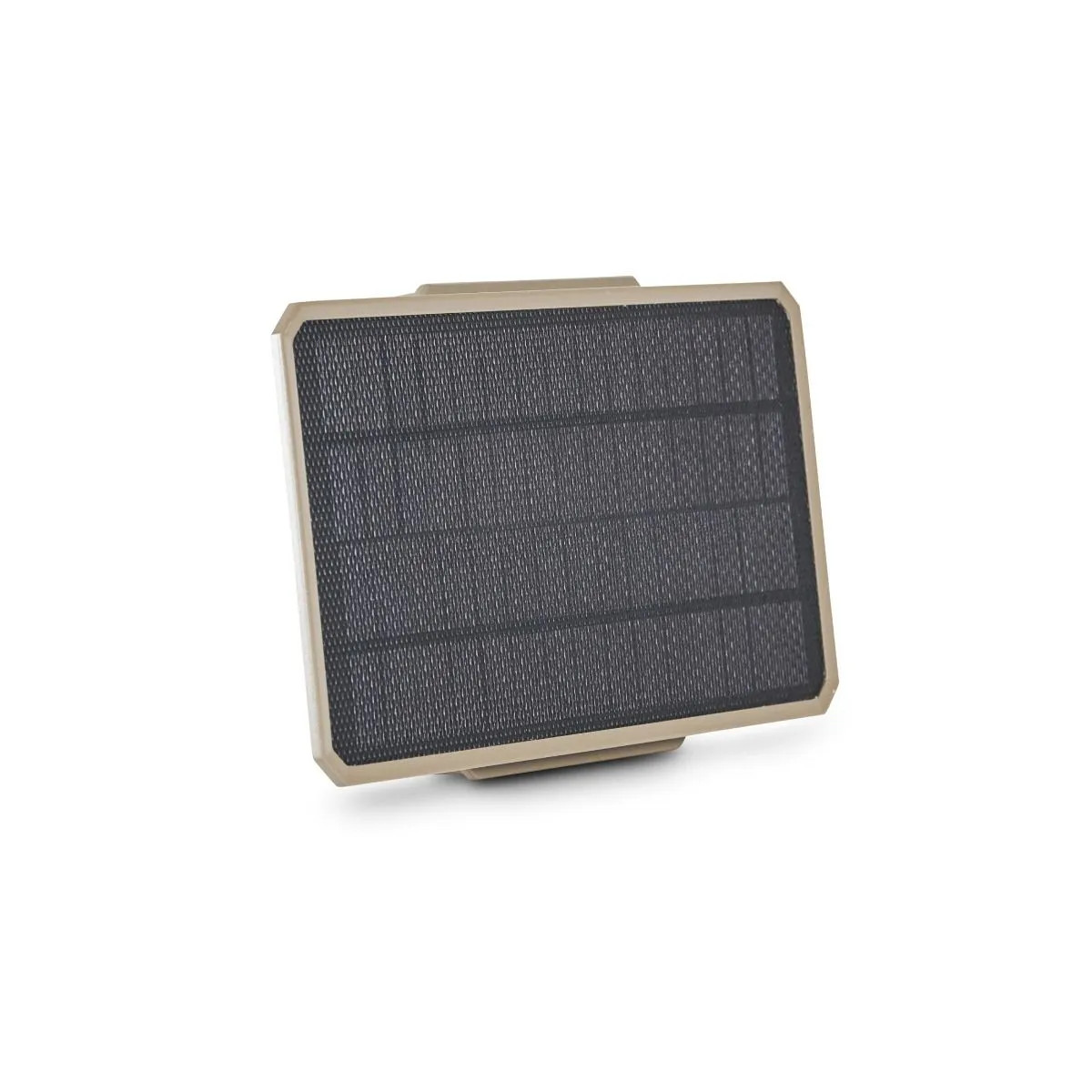
Moultrie’s 3.4W Solar Power Pack (model MMA-14126) is the default panel for the EDGE family, and it is the one panel here whose connection system was designed for a specific camera line rather than adapted to it. It outputs 12V, carries a 3,350 mAh power bank, and connects to EDGE, EDGE Pro, EDGE 2 and EDGE 2 Pro cameras with a screw-locking USB-C connector plus an included USB-C to barrel jack cable. Moultrie states the pack generates three times more power than standard solar panels, holds a full charge for up to approximately nine days without sun, and recharges fully with one hour of full sun. The housing is IP65 water-resistant, the cables are varmint-resistant, and the included angled mounting bracket and adjustable strap are made for aiming the panel at the sun rather than at the camera.
The honest weakness is capacity: 3,350 mAh is a small buffer compared with the Herd360 G2’s 25,000 mAh or the Tactacam folding panel’s 4,900 mAh, so this pack leans harder on daily sun than the bigger packs do. Its strength is integration. Paired with an EDGE 3 camera, Moultrie’s newer Solar Power Pack II generation adds solar charge reporting in the Moultrie app; and the EDGE Solar camera itself (a separate camera with an integrated panel) shows where Moultrie is heading — power as part of the camera system, not an add-on. If every camera you run is an EDGE, this is the panel that fits without adapters, guesswork, or a plug chart.
🧑🌾 From the field: Retailer listings for this pack repeat Moultrie’s own guidance rather than owner reports, so we will not dress that up as field evidence: the consistent, verifiable owner-facing facts are the screw-locking connection (built to stop the cable working loose, the most common physical failure on a hung panel) and the angled bracket (built to aim the panel independently of the camera). Both address real failure modes that show up in solar troubleshooting guides: loose connections and panels aimed
at the camera’s view instead of the sun.
- Pros: Made for the whole EDGE line; screw-locking USB-C connection resists disconnects;
IP65 housing and varmint-resistant cables; angled bracket for sun aiming; compact and light at about 1.05 lb. - Cons: 3,350 mAh buffer is small next to universal packs; 12V only — no use on 6V cameras; EDGE 3 / 3 Pro owners should confirm USB-C cable fit before ordering.
| Spec | Detail |
|---|---|
| Panel | 3.4W |
| Battery | 3,350 mAh power bank |
| Output | 12V |
| Sunlight to recharge | 1 hour of full sun (manufacturer-stated) |
| Runtime without sun | Approximately 9 days (manufacturer-stated) |
| Weather sealing | IP65 |
| Dimensions / weight | 8.66 in x 5.24 in x 2.48 in; 1.05 lb |
| In the box | Power pack, angled mounting bracket, USB-C to elbow barrel jack cable, adjustable strap, quick start guide |
Best for shaded sites · Brand-matched
3. Moultrie 10W Solar Power Pack — best for shaded sites
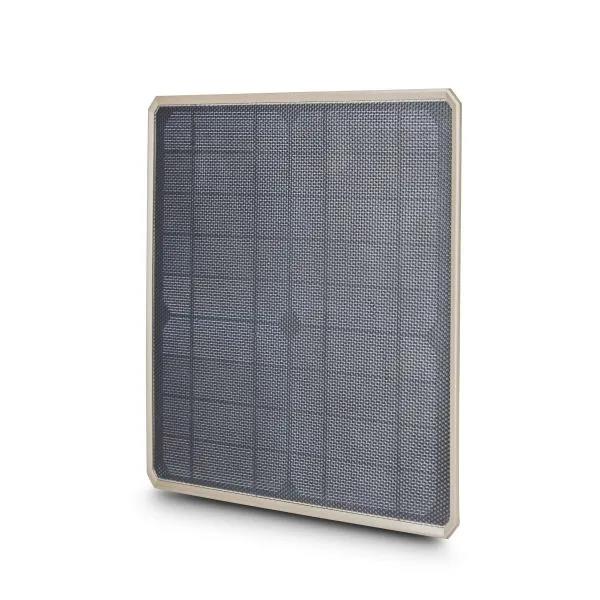
The 10W Solar Power Pack (model MMA-14137) is the same system as the 3.4W pack with roughly three times the panel: same 12V output, same 3,350 mAh power bank, same EDGE compatibility, same IP65 housing and varmint-resistant cables, same screw-locking USB-C connection. The difference is how fast it recovers. Moultrie states the 10W panel fully recharges with 25 minutes of full sun, against one hour for the 3.4W panel, and describes the larger panel as the right choice for shadier environments or areas with less annual sunlight. That is the correct way to read wattage on this page: a bigger panel does not give your camera more power, it gives your battery more chances to refill on a short or broken-sun day.
The trade-off is size and weight — about 1.74 lb and a panel roughly 11.1 in x 9.7 in, against the 3.4W pack’s 8.7 in x 5.2 in — and the fact that the battery buffer is unchanged. If your site is deeply shaded, a bigger panel alone may still not be enough; that is the case for pairing a big panel with a big battery (the Herd360 G2) or for moving the panel to a sunnier tree with a longer cable run. But for an EDGE owner whose site is marginal rather than hopeless — dappled canopy, a hollow that loses the sun early — the 10W pack is the smallest change that fixes the most common complaint, which is a camera that dies in late season when days shorten.
🧑🌾 From the field: The pattern behind this pick comes from solar troubleshooting guidance generally: partial shade is the first thing every panel manual tells you to check when charging falls short, and winter sun angle is the second. A panel sized for summer sun on an open field is undersized for the same tree in December. The 10W pack is Moultrie’s answer to that seasonal shortfall inside its own ecosystem.
- Pros: Same EDGE integration as the 3.4W pack; recharges in 25 minutes of full sun (manufacturer-stated); better buffer against short winter days and broken canopy; IP65 and varmint-resistant cables.
- Cons: Same 3,350 mAh battery as the 3.4W pack — bigger panel, not bigger storage; larger and heavier; 12V EDGE-only fit.
| Spec | Detail |
|---|---|
| Panel | 10W |
| Battery | 3,350 mAh power bank |
| Output | 12V |
| Sunlight to recharge | 25 minutes of full sun (manufacturer-stated) |
| Runtime without sun | Approximately 9 days (manufacturer-stated) |
| Weather sealing | IP65 |
| Dimensions / weight | 11.14 in x 9.69 in x 2.87 in; 1.74 lb |
| In the box | Power pack, angled mounting bracket, USB-C to elbow barrel jack cable, adjustable strap, quick start guide |
Best folding panel · Portable
4. Tactacam Reveal Folding Solar Panel — best folding panel

Tactacam’s folding panel is the most powerful panel in this guide by wattage: two 3.6W panels for 7.2W total, with a built-in 4,900 mAh lithium battery, a 12V / 2A output, LED battery indicators, and a folding design made for packing into remote locations. Tractor Supply’s listing states it is compatible with all Reveal cameras, Defend cameras, and most other 12V cellular cameras, and that it can directly power a Reveal camera or charge the Reveal Battery Belt or Lithium Cartridge. That last point matters: this panel is both a camera power source and a charger for Tactacam’s own battery accessories, which makes it the hub of a Reveal power system rather than a single-purpose panel.
The weakness to know about is not in this panel but in Tactacam’s app behavior, and it is the single most useful real-life warning on this page. Tactacam’s own support documentation for its earlier large solar panel states that the app will always display a 100% battery level when the camera is powered by the solar panel, even if the panel’s internal battery is nearly empty — the real charge level is read from the indicator lights on the panel itself. If you run Reveal cameras on solar, trust the lights on the panel, not the number in the app, and keep AA batteries in the camera as backup, exactly as Tactacam recommends. The folding panel’s own manual troubleshooting repeats the shade warning found in every panel manual: partial shade significantly reduces charging efficiency, and heavily treed sites produce intermittent charging even with a panel designed for varied conditions.
🧑🌾 From the field: The folding design is the field story here. A rigid 10W panel is awkward to carry into a remote hollow along with a camera, a mount and a pack of batteries; a panel that folds flat and opens on site is the difference between a panel that gets deployed and one that stays in the truck. The trade-off is that a folding panel has a hinge and a seam, so inspect the fold and the cable entry for wear at the end of each season.
- Pros: Highest wattage here (7.2W); 4,900 mAh battery; folds for transport; charges Reveal Battery Belt and Lithium Cartridge as well as powering the camera; LED battery indicators.
- Cons: 12V only; the app’s 100% display while on solar can mislead you about real charge; folding design adds a wear point to inspect.
| Spec | Detail |
|---|---|
| Panel | Two 3.6W panels, 7.2W total |
| Battery | 4,900 mAh lithium |
| Output | 12V / 2A |
| Compatibility | All Reveal cameras, Defend cameras, most other 12V cellular cameras |
| Also charges | Reveal Battery Belt, Reveal Lithium Cartridge |
| In the box | Folding panel, DC power cable, USB-C charging cable, bracket |
Best universal 12V pack · Any 12V jack
5. Stealth Cam Sol-Pak — best universal 12V pack
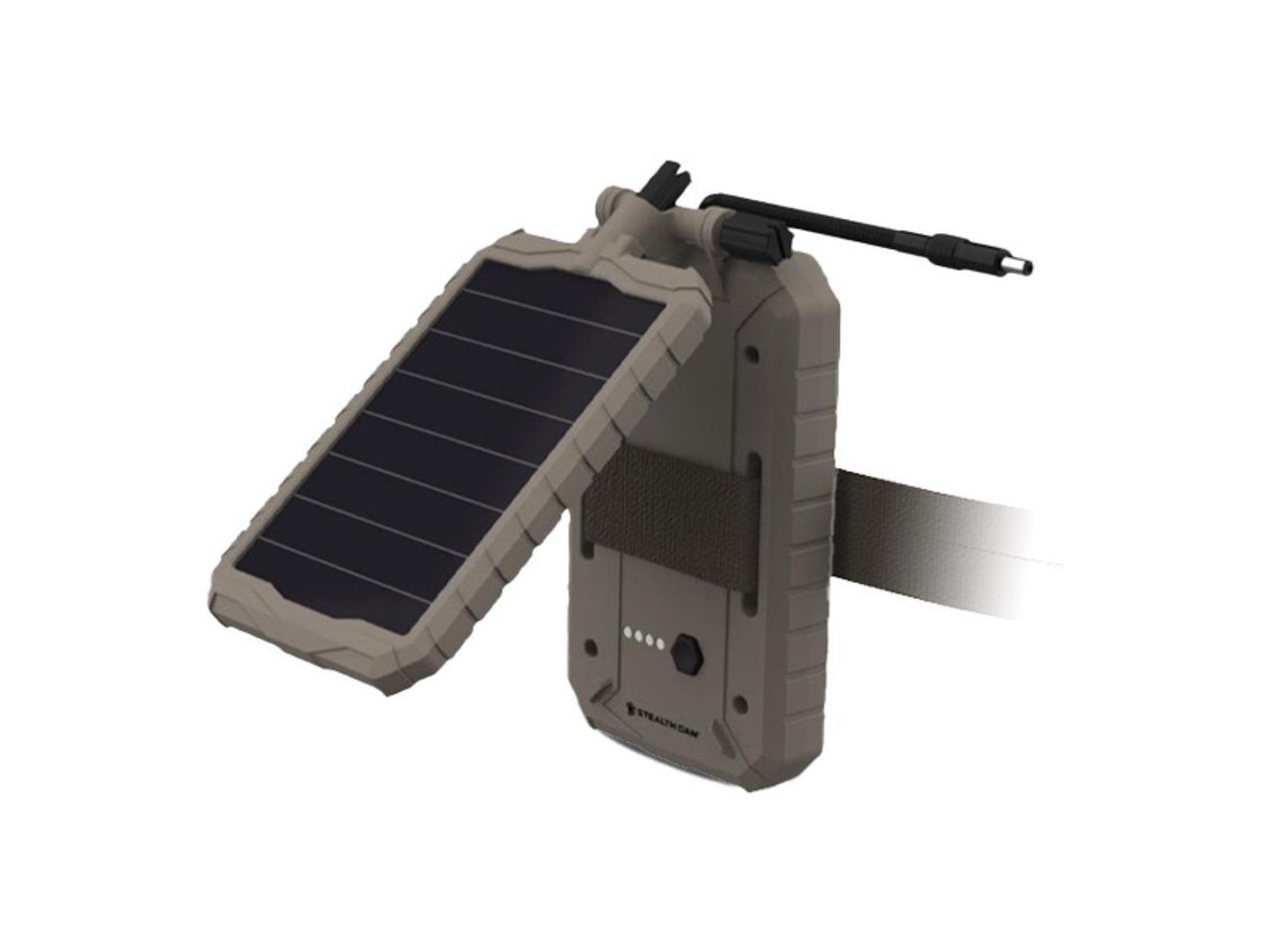
The Stealth Cam Sol-Pak is the simplest universal answer in this guide: a 12V amorphous solar panel with a built-in lithium battery, a 10-foot insulated metal cable, and a stated fit for any camera with an external 12V DC jack. It comes in three battery sizes depending on the listing — 1,000 mAh in the original specification, 3,000 mAh in the widely sold two-pack version, and 5,000 mAh in the largest version — so check which capacity you are actually buying, because the name is the same and the battery is not. The amorphous panel is the notable technical choice: amorphous cells are marketed for low-light performance, and Stealth Cam’s own materials claim the panel keeps working through back-to-back days of low light. The adjustable T-swivel brackets let you aim the panel independently of the camera, and multiple panels can be linked through the 12V DC input for more capacity.
The weakness is that the Sol-Pak is a 12V-only system with no voltage selection, so it cannot run a 6V camera, and its smallest 1,000 mAh version is a thin buffer for a cellular camera sending video — buy the 3,000 or 5,000 mAh version for a cellular deployment. The other thing to verify is stock: Bass Pro Shops lists the Sol-Pak as not available online at the time of writing, while other US retailers carry it, so check availability across retailers rather than assuming your first choice has it.
🧑🌾 From the field: The Sol-Pak manual’s troubleshooting table is refreshingly direct and matches every other panel manual we read: if the pack is not charging, the causes are insufficient sunlight, a dirty panel, or a loose connection; if the camera is not receiving power, the pack battery is depleted, the cable is not connected properly, or the camera’s 12V jack is at fault. Those three checks — sun, clean panel, tight connection — resolve most “my solar panel doesn’t work” reports before any warranty call is needed.
- Pros: Fits any camera with a 12V DC jack, any brand; amorphous panel aimed at low-light days; 10-foot metal-shielded cable resists varmints; panels can be linked for more capacity; LED battery indicator.
- Cons: 12V only — no 6V cameras; battery capacity varies by version (1,000 / 3,000 / 5,000 mAh) under one name, so verify before buying; availability varies by retailer.
| Spec | Detail |
|---|---|
| Panel | 12V amorphous solar panel |
| Battery | 1,000 / 3,000 / 5,000 mAh lithium-ion, depending on version |
| Output | 12V DC |
| Cable | 10 ft insulated metal cable with Secure Lock DC plug |
| Mounting | Adjustable T-swivel brackets, nylon strap, serrated brackets |
| Extras | LED battery indicator; micro-USB charging port; 12V DC input to link panels |
Best Spartan system · Kit required
6. Spartan GoLive Solar Kit — best Spartan system
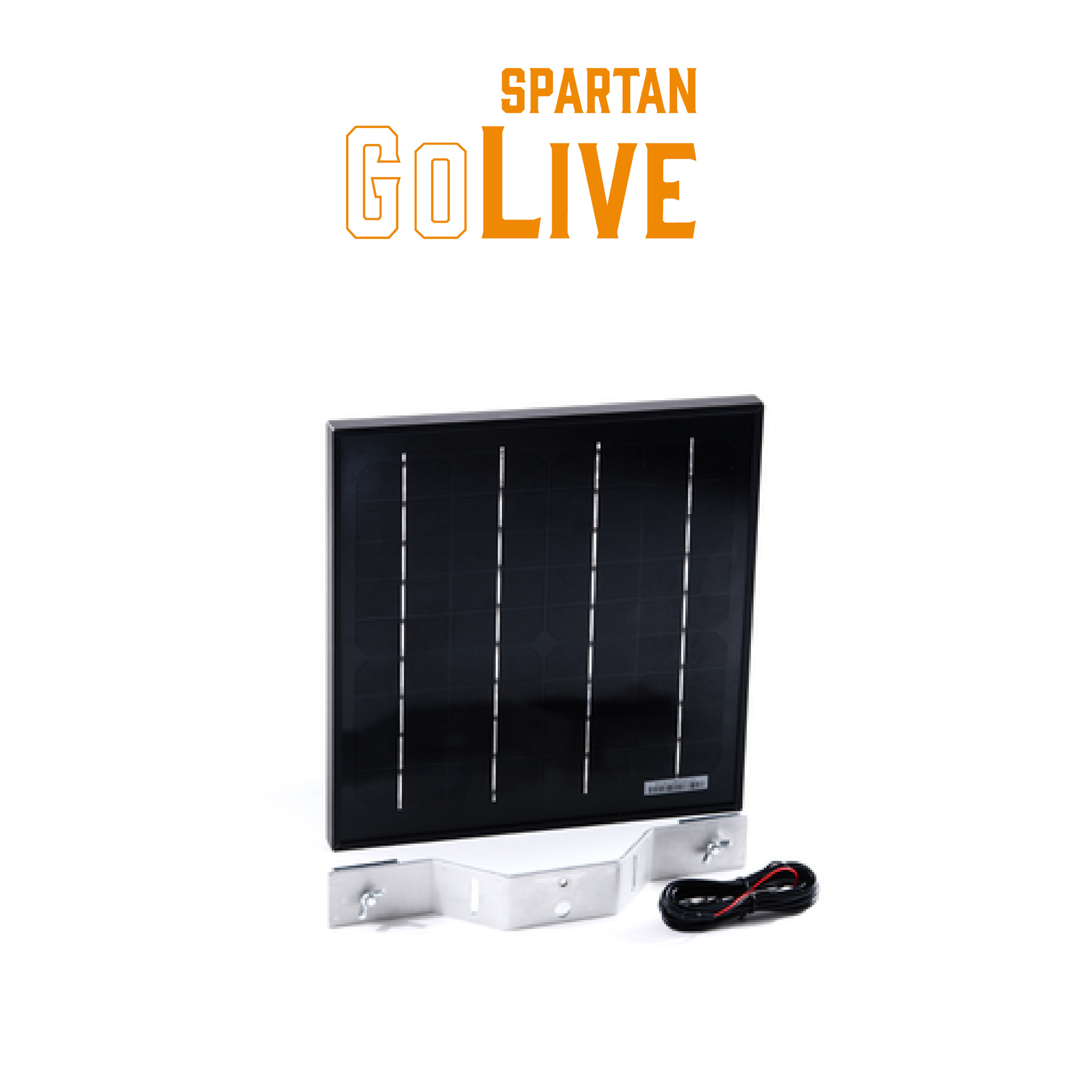
Spartan is the brand where buying “a solar panel” is most likely to go wrong, because Spartan’s cameras do not all take a panel the same way — and the distinction is documented on Spartan’s own spec sheets. The GoLive M connects directly to a 10W or 15W solar panel and charges its 5,300 mAh internal battery. The GoCam 2, by contrast, cannot connect directly to a solar panel at all: its spec sheet states solar compatibility as a 12V battery box plus a 10W or 15W panel. Buy a bare panel for a GoCam 2 and you have bought half a system. Spartan sells the complete answer as a kit per camera family — the GoLive Solar Kit with Battery, the GoCam Solar Kit with Battery, and the GoCam 2 Solar Kit with Battery — each containing the matching battery box, a 12V external battery, a panel bracket, and a 10W or 15W panel. The panel-only GoLive Solar Panel Kit (10W or 15W plus bracket and power cable) exists for owners who already have the battery box.
The strength of the kit approach is that it removes the two failure modes at once: the battery box gives the system real storage (a 12V external battery, not a small pack), and the panel keeps that battery topped up. The weakness is cost and specificity: a kit is priced as a system, and a GoLive kit does not fit a GoCam 2, so a mixed Spartan fleet needs a kit per camera family. Note also the Spartan power behavior documented by Trailcampro for the older HCO Spartan cameras: once anything is plugged into the external battery jack, the camera draws only from external power. That means an undersized external system is worse than no external system at all on those cameras, because the internal AAs stop being a fallback.
🧑🌾 From the field: A reviewer on Spartan’s own store, running seven GoLive cameras on these panels, reports both the 10W and 15W units keeping cameras fully operational over years, and states that with lithium AA batteries as backup the cameras went over a year without a battery-maintenance visit. That is a store review, not a controlled test, but it is consistent with the kit logic: panel plus battery box plus AA backup is the belt-and-suspenders setup that survives a bad-sun month.
- Pros: Complete kit removes guesswork — battery box, 12V battery, bracket and panel matched to your camera family; 10W or 15W panel choice; GoLive M direct-connect option; documented multi-year owner experience on the store page.
- Cons: Kits are camera-family specific — a GoLive kit will not fit a GoCam 2; a bare panel is not a complete system for GoCam 2; kit pricing is system pricing, not panel pricing.
| Spec | Detail |
|---|---|
| Panel | 10W or 15W |
| Battery | 12V external battery in battery box (kit); GoLive M internal battery 5,300 mAh |
| Output | 12V |
| Kit contents | Battery box, 12V external battery, solar panel bracket, solar panel |
| Fits | GoLive Solar Kit: GoLive and GoLive 2. Separate kits for GoCam, GoCam 2, Eclipse / Lumen, GoLive 3 |
| Watch out | GoCam 2 cannot connect directly to a solar panel — battery box required |
Best for Browning · Warranty-safe
7. Browning Solar Camera Power Pack (BTC-SBP12) — best for Browning cameras
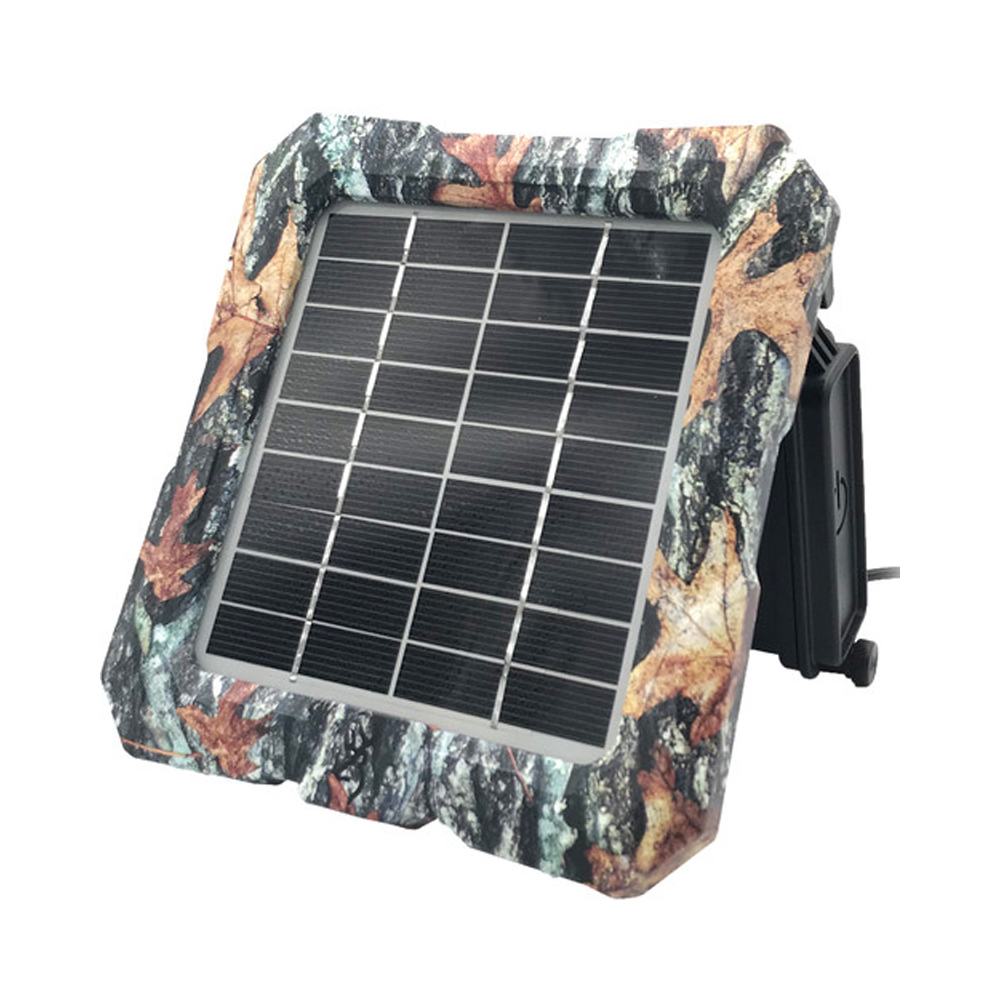
Browning’s Solar Camera Power Pack (model BTC-SBP12) is the only panel in this guide whose maker ties it to warranty: Trailcampro’s Browning listing states that the Solar Camera Power Pack and the non-solar Browning Power Pack are the only approved external power sources for use with Browning cameras’ 12V DC input, and that using any unapproved power source can potentially void the warranty. Whether or not you weigh warranty heavily, that statement settles the compatibility question for Browning owners — this is the panel Browning itself approves, and it fits all Browning trail camera models.
The design is different from the lithium packs above: the unit carries six AA NiMH rechargeable batteries that the solar cell keeps recharged, and a step-up converter takes the 7.2V from the battery pack and converts it to a constant 12V at the DC plug. The plug is a twist-lock 5.5 mm outside / 2.1 mm inside barrel, 10.5 mm long, with a 15 mm DC plug converter, and Browning’s manual adds a genuinely useful field feature: a test button whose LED bar graph shows both the battery state of charge (press and release) and the current the solar cells are generating (press and hold). That second test is the fastest way to answer “is this panel actually producing power in this spot?” without guessing. The manual also notes the panel fully charges itself in the field within a few hours of full sunlight, and that batteries should be installed in both the camera and the power pack when using it.
🧑🌾 From the field: The honest gap here is owner evidence: retailer listings for the SBP12 repeat Browning’s specification rather than owner reports, and we found no substantive owner thread about this pack to quote. What we can verify is the design logic — NiMH AAs are cheap to replace, the step-up converter guarantees 12V even as the pack discharges, and the solar-current test button turns placement from guesswork into a reading. For a Browning owner, those three facts plus the warranty statement are enough to decide.
- Pros: The Browning-approved external power source (warranty-relevant); fits all Browning models; step-up converter holds a constant 12V; solar-current test button shows real output on site; AA NiMH batteries are cheap to replace.
- Cons: Browning-only fit; NiMH AA capacity is smaller than the lithium packs here; panel wattage is not published on the listings we verified, so compare on battery behavior, not watts.
| Spec | Detail |
|---|---|
| Panel | High-efficiency solar cell (wattage not published on verified listings) |
| Battery | 6 AA NiMH rechargeable batteries, stepped up from 7.2V to 12V |
| Output | 12V DC, twist-lock plug (5.5 mm OD / 2.1 mm ID, 10.5 mm; converter 15 mm) |
| Dimensions | 7 in x 6 in x 2 in |
| Field test | LED bar graph: tap for battery charge, hold for solar current |
| Use note | Install batteries in both the camera and the power pack |
Best multi-voltage value · 6/9/12V
8. GardePro SP350 Solar Panel — best multi-voltage panel
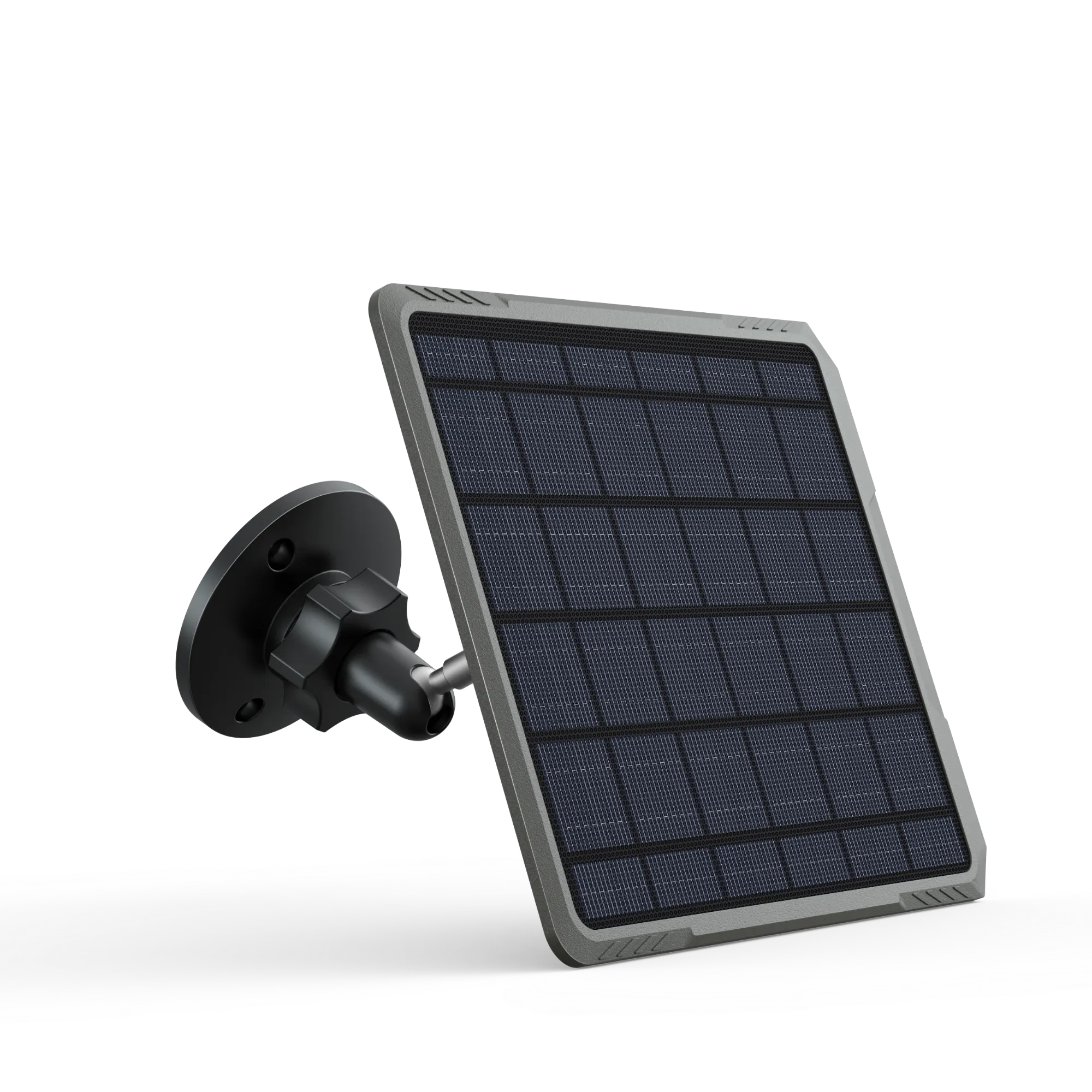
The GardePro SP350 is the second multi-voltage panel in this guide and the value alternative to the Herd360 G2: a 12W maximum-output panel with a 5,200 mAh battery, selectable 6V, 9V or 12V output (2A at 6V, 1.3A at 9V, 1A at 12V), IP65 sealing, a 4-meter cable, and both 5.5 x 2.1 mm and 4.0 x 1.7 mm plugs. Trailcampro sells it bundled with the GardePro T5WF camera and a 32GB SD card, and lists the panel’s full specifications on the bundle page. The 12W headline is the highest maximum output in this guide, but read it correctly: at 12V the output current is 1A, which is 12W at the top of its range, and real output depends on sun exactly as with every other panel here.
The weakness is evidence depth. Unlike the brand-name panels above, the SP350’s specifications come from a single retailer bundle listing, and we found no manual or owner thread for the panel itself to cross-check against. That does not make the specifications wrong — they are specific, internally consistent, and plausible — but it does mean this pick carries a thinner evidence base than the Moultrie, Tactacam, Stealth Cam, Spartan and Browning picks. Buy it for the voltage selection and the price-to-spec ratio, not for a deep owner record, and verify the output voltage setting against your camera’s manual before first use.
🧑🌾 From the field: Trailcampro’s staff note on the bundle praises the T5WF camera itself (“the best white LED trail camera we have ever reviewed”), not the panel, and we will not borrow a camera compliment for a panel. For the panel, the verifiable facts are the specifications above and the bundle context: it is sold as a working camera-plus-panel system by a specialist trail camera retailer, which is a meaningful signal even without an owner thread.
- Pros: Selectable 6V / 9V / 12V output; 12W maximum output; 5,200 mAh battery; two plug sizes in the box; IP65; long 4-meter cable for reaching sun.
- Cons: Specifications verified from a single retailer bundle listing — thinner evidence base than the brand-name picks; sold bundled with a camera, so check standalone availability; you must set the voltage yourself.
| Spec | Detail |
|---|---|
| Panel | 12W maximum output |
| Battery | 5,200 mAh / 3.7V |
| Output | 6V / 2A, 9V / 1.3A, 12V / 1A |
| Plugs | 5.5 x 2.1 mm, 4.0 x 1.7 mm |
| Cable | 4 meters | Weather sealing | IP65 |
| Dimensions | 17.5 x 14.8 x 2.8 cm |
| Operating temperature | -4 to 140 °F / -20 to 60 °C |
Video guides
These two videos show the setups described above.
Moultrie 3.4W Solar Power Pack overview
Moultrie’s own pack walkthrough — panel, power bank, locking connection and bracket.
Moultrie EDGE series setup
How the EDGE camera line sets up, including its power accessories.
What solar power really costs
A solar panel is not free power — it is prepaid power. The honest comparison is not panel versus batteries, it is panel plus its battery versus seasons of disposable batteries plus the trips to swap them. We print no prices in this section because panel and battery prices move by retailer; check the retailer links above for current figures. The cost structure below is what owners actually report.
| Cost item | What owners report | Notes |
|---|---|---|
| The panel or kit itself | One purchase, per camera | Kits (Spartan) cost more than panels because they include a battery box and a 12V battery; universal packs sit between a bare panel and a kit. |
| Disposable AA batteries, without solar | Repeated purchases every season, per camera | A cellular camera eats AAs far faster than a non-cellular camera; video transmission is the expensive mode. This is the cost solar is really replacing. |
| Rechargeable AAs as backup | One purchase, reused for years | Tactacam, Spartan and Browning all recommend keeping AAs in the camera as backup even with a panel. Budget for them; they are cheap insurance against a sunless week. |
| Cellular data plan | Monthly, per camera, forever | Solar does not remove this cost. Spartan notes its data plan charges are recurring, and every cellular brand charges a plan on top of power. Factor it into the per-camera annual cost. |
| Trips to the camera | Fuel, time, and scent in the hunting area | This is the cost hunters feel most. A panel that keeps a camera running through the season saves visits, which is also why a failed panel hurts twice: you lose pictures and you make a trip. |
| Replacement cables and mounts | Occasional | Varmint-chewed cables are a real expense; packs with metal-shielded or varmint-resistant cables (Sol-Pak, Moultrie packs) cost more up front and less over time. |
The takeaway: a panel pays for itself fastest on a cellular camera on a remote property — high battery burn, expensive visits, long season. It pays slowest on a non-cellular camera ten minutes from the house, where a set of lithium AAs lasts most of a season anyway. Buy solar where the visits are expensive, not where the batteries are cheap.
How to choose: the compatibility checks that matter
1. Read the power input before anything else
Every camera manual states its external power input, and that one line decides your panel. You need three facts: voltage (6V or 12V), connector (barrel size, screw collar, or USB-C), and whether the camera runs from external power first. Moultrie’s EDGE 3 moved to USB-C power input, which is why Herd360’s barrel-plug chart excludes the EDGE 3 and 3 Pro and offers a separate USB-C cable. Spartan’s GoCam 2 cannot take a panel directly at all. Spypoint’s LINK-MICRO-S runs from external power until it is depleted and then switches to internal power — and its built-in solar panel will not charge an external battery. None of this is on the marketing page. It is all in the manual, and it is all decisive.
2. The plug trap: same plug, different voltage
The 5.5 x 2.1 mm barrel plug is the most common trail camera power connector, and it is used by both 6V and 12V cameras. Herd360’s own chart proves the point: the same plug family covers the 6V original Spartan GoCam and the 12V Tactacam Reveal, Browning, Spypoint, Stealth Cam and Moultrie lines. A plug that slides in and lights up the camera is not proof of compatibility — a 12V supply on a 6V camera is the wrong purchase even when it fits. The reverse mistake is quieter: a 6V supply on a 12V camera simply will not run it, and you will blame the panel. If your camera is 6V, buy a selectable-voltage system (Herd360 G2 or GardePro SP350) and set it to 6V. If you do not know your camera’s voltage, find out before ordering — not after.
3. Shade is the real specification
Panel wattage is measured in full sun. Your camera lives under trees. A solar sizing guide written for camera deployments puts the gap plainly: a non-cellular camera in standby draws roughly 0.5 to 1.5 watt-hours per day, while the same camera with 4G LTE uploading video climbs to roughly 8 to 15 watt-hours per day — a tenfold spread — and a shaded site harvests two to three hours of usable sun where an open site harvests five to six. A Mississippi Sportsman field column gives the same rule from the hunting side: a solar panel needs three to four hours of full sun daily to hold charge on a camera running continuous video. The practical checks follow from that. Face the panel south in the northern hemisphere. Tilt it roughly 30 to 45 degrees. Mount it above the camera on its own bracket so you can aim it at the sun instead of at the game trail. And judge the site in the worst month — December sun, not July sun — because a panel sized for summer is undersized for the same tree in winter, when days are short and the sun rides low. If your site cannot give the panel three honest hours of direct sun, buy the bigger panel, the bigger battery, or both — or accept that you will still be swapping batteries.
4. Internal battery versus external battery: know which one the panel feeds
There are three architectures on this page, and confusing them causes most “solar doesn’t work” complaints. First, integrated solar cameras (Spypoint LINK-S, Moultrie EDGE Solar): the panel is built into the camera and charges the camera’s own battery. Second, panel-with-battery packs (Moultrie power packs, Stealth Cam Sol-Pak, Tactacam folding panel, Herd360 G2, GardePro SP350, Browning SBP12): the panel charges its own battery, and the camera runs from that battery through the cable. Third, battery-box systems (Spartan kits): the panel charges a 12V external battery in a box, and the camera runs from the box. The traps: a panel-with-battery does not recharge your camera’s internal AAs — it replaces them as the power source while it is connected. Spypoint’s LINK-MICRO-S built-in panel will not charge an external battery you attach. Tactacam’s app shows 100% whenever the camera runs on a solar panel, regardless of the panel’s real charge — read the panel’s own indicator lights. And on some Spartan cameras, plugging anything into the external jack means the camera draws only from external power, so a small or shaded external system is worse than none. Match the architecture to your camera, not just the plug.
5. Feeder solar panels are not camera solar panels
This distinction matters on this site because we cover both. A deer feeder solar panel powers a feeder’s motor and timer — a 6V or 12V feeder system with its own battery and charge controller, covered in our deer feeder solar panel guide. A trail camera solar panel powers a camera’s electronics through a camera power jack or USB-C. The voltages overlap and the panels look alike, but the connectors, the loads and the manuals are different, and a feeder panel is not a verified substitute for a camera panel. If you run both feeders and cameras on a property, keep the two power systems separate in your head and in your shopping cart. For cameras with app control and cellular features, see also our trail camera app-control guide.
Resources
Related guides on this site, all live:
- Deer feeder solar panels: match the whole power system — feeder power is a different system from camera power; read this before buying a panel for a feeder.
- Best deer feeder with camera and app control — cellular cameras, Bluetooth versus cellular control, and Feed Hub compatibility.
- Best deer feeders — the main roundup, for the feeder your camera watches.
- Best gravity deer feeders
- Best automatic deer feeders
- Best tripod deer feeders
- Best deer feeder timer
- Best deer feeder batteries, 6V and 12V — the battery companion to any solar setup.
- Deer feeder replacement motor
- Best deer feeder parts and accessories
- Best hanging deer feeders
- Best corn feeders for deer
- Best protein deer feeders
- How to program a deer feeder timer, step by step
- Deer feeder not working? Diagnose it in this order — the same diagnose-in-order method applies to a dead solar setup: sun, connection, battery, camera.
Outside references used for this guide:
- Mississippi Sportsman: field notes on solar camera power — the three-to-four-hours-of-full-sun rule for continuous video.
- Solar sizing guide for cameras — cellular versus standby power draw and the case for sizing to the worst week, not the average.
- Trailcampro: Browning solar panel power pack — plug dimensions and the approved-power-source note.
FAQ
What size solar panel do I need for a trail camera?
Size it for your worst week, not your best day. A non-cellular camera in standby uses very little power, while a cellular camera uploading video uses roughly ten times as much. As a practical rule: a 3.4W to 5W panel with a battery suits a photo-only cellular camera in good sun; step up to a 10W panel, or a panel with a large battery such as the Herd360 G2, for video-heavy cameras or shaded sites. The binding constraint is hours of direct sun on the panel, not the wattage number on the box.
Will any solar panel work with any trail camera?
No. Three things must match: voltage (6V or 12V), connector (barrel size, screw collar, or USB-C), and architecture (whether the camera takes a panel directly or needs a battery box). A plug that fits is not proof of compatibility — the same 5.5 x 2.1 mm plug is used by both 6V and 12V cameras. Check your camera’s manual for its power input, then match all three.
What is the difference between 6V and 12V trail cameras?
It is the voltage the camera’s external power jack expects. Most current cellular cameras from Moultrie, Tactacam, Stealth Cam, Browning and Spypoint are 12V. Some older or specific models are 6V, including the original Spartan GoCam, the Covert Blackhawk and the Camojojo Trace. A 12V panel must not be used on a 6V camera. If your camera is 6V, buy a selectable-voltage panel such as the Herd360 G2 or GardePro SP350 and set it to 6V.
Does a solar panel charge my camera’s internal battery?
Usually no. Most external panels charge their own built-in battery, and the camera runs from that battery while connected — the panel replaces your AAs as the power source rather than recharging them. The exceptions prove the rule: Spypoint’s LINK-MICRO-S built-in panel charges its own LIT-10 pack, and Spypoint states that built-in panel will not charge an external battery you attach. Always check whether the panel feeds the camera, its own battery, or both.
Why does my Tactacam app say 100% when the panel is nearly dead?
Tactacam’s own support documentation states that the app always displays 100% battery when the camera is powered by a solar panel, even if the panel’s internal battery is nearly empty. Read the charge from the indicator lights on the panel itself, and keep AA batteries in the camera as backup, exactly as Tactacam recommends.
How much direct sunlight does a trail camera solar panel need?
Plan on three to four hours of full, direct sun per day for a camera running continuous video, per a Mississippi Sportsman field column on solar camera power. Photo-only cameras need less. Partial shade sharply reduces charging — every panel manual we read lists shade as the first thing to check when charging falls short — and winter sun sits lower and shorter, so judge your site in December, not July.
Can I use a solar panel in a shaded food plot?
Yes, with a bigger system. Mount the panel on its own bracket above or away from the camera so it can face south and catch sun the camera’s tree does not get, use the longest cable you can (the Stealth Cam Sol-Pak gives you 10 feet, the GardePro SP350 gives you 4 meters), and step up to a 10W-or-bigger panel with a large battery. If the site cannot deliver three honest hours of direct sun even then, solar will not carry a video-heavy camera there — plan on battery swaps.
Do I still need AA batteries if I have a solar panel?
Yes, as backup. Tactacam recommends AA batteries as backup even with its solar panel. Browning’s manual instructs you to install batteries in both the camera and the power pack. Spartan’s kit approach pairs the panel with a 12V external battery and expects AA backup as well. The panel handles the normal load; the batteries handle the sunless week.
What connector does my trail camera use?
Most cameras use a 5.5 x 2.1 mm barrel plug, but the details vary: Browning uses a twist-lock 5.5 x 2.1 mm plug; Spartan GoLive and GoCam 2 use a threaded collar version; some cameras use a 4.0 x 1.7 mm plug (Tactacam Reveal, WiseEye, Covert Blackhawk, original Spartan GoCam); Reconyx and some Ridgetec cameras use 4.8 x 1.7 mm; and Moultrie EDGE 3 and 3 Pro use USB-C. Herd360 publishes a plug-by-brand chart that covers most of these — check it against your manual.
Will a solar panel work in winter?
It works, but with less margin. Days are shorter, the sun rides lower, snow can cover the panel, and cold reduces battery capacity — one solar sizing guide notes lead-acid batteries lose 30 to 50 percent of capacity below freezing, while lithium iron phosphate retains far more. That is one reason the lithium packs in this guide are the right chemistry for a northern winter deployment. Clear snow off the panel, face it south, and expect the shortest days to be the binding constraint.
Is a solar panel better than a battery box?
They solve different problems. A battery box adds capacity; a panel adds recharging. A box alone eventually runs flat; a panel alone has no buffer for a sunless week. The best systems combine them — Spartan’s kits are exactly that combination, and the panel-with-battery packs on this page are the same idea in one unit. If you must choose one, choose the panel for a sunny site and the box for a shaded one.
Is a feeder solar panel the same as a trail camera solar panel?
No. A deer feeder solar panel powers a feeder’s motor and timer system; a trail camera solar panel powers a camera through its power jack or USB-C. Voltages overlap and the panels look alike, but the connectors, loads and manuals differ. See our deer feeder solar panel guide for feeder power, and keep the two systems separate when shopping.
Final verdict: the best solar panel for trail camera setups
Buy the panel that matches your camera’s power input, not the panel with the biggest wattage number. For most hunters, that means the Herd360 G2 Solar Power Pack: selectable voltage, the biggest battery here, and a plug chart that covers nearly every brand. Moultrie EDGE owners should buy Moultrie’s own 3.4W pack — or the 10W pack for a shaded site — because the locking connection and app integration remove the two most common failure points. Tactacam Reveal owners should buy the folding panel, and read its charge from the panel’s lights, not the app. Spartan owners must buy the kit for their exact camera family, and Browning owners should buy the SBP12, the approved power source for their cameras.
Whatever you buy, hang the panel for the sun, not for the camera: south-facing, tilted, clear of branches, with its own bracket and cable run. Check the connection twice — loose plugs and shade cause more dead cameras than bad panels ever will. And keep AA batteries in the camera. Solar handles the season; batteries handle the week the sun does not show up.
Last updated: October 25, 2026.
Products mentioned in this guide
See this product on Amazon
Check Price on Amazon →Confirm price and availability on AmazonSee this product on Amazon
Check Price on Amazon →Confirm price and availability on AmazonSee this product on Amazon
Check Price on Amazon →Confirm price and availability on AmazonSee this product on Amazon
Check Price on Amazon →Confirm price and availability on AmazonAs an Amazon Associate, we earn from qualifying purchases.


