
Hog Trap Trigger: Trip-Wire, Rooter, and Remote Triggers Compared
Note: This post links directly to manufacturers and university extension pages so you can check current prices and availability. It contains no Amazon links, and we earn no commission from the links in this article.
Your 30-second trigger route
2026 hog-trap trigger guide • 7 triggers & systems • prices checked Oct 2026
Decide who chooses the moment the gate drops — you, by phone, or the hogs, by wire — then match the trigger to your gate and your signal.
SIGNAL ▸ GATE ▸ WHO DROPS IT
JAGER PRO M.I.N.E. — watch live, then drop the gate from the app.
Hog Trap Trigger — adds remote firing to the gate you have.
Pig Brig Trap Trigger — call or text to drop the net; it won’t fire a steel gate.
DIY trip wire or root stick — materials only, but the hogs choose the moment.
In this guide:
- The short answer
- At-a-glance comparison table
- Decision flowchart: pick your trigger in four steps
- How we picked
- Trigger types explained
- Hog trap triggers reviewed
- Watch: remote drops and whole-sounder captures
- What a hog trap trigger really costs
- How to choose a hog trap trigger
- Conditioning and trap-shyness: the part most buyers skip
- Common trigger mistakes
- Resources hub
- Frequently asked questions
- Final verdict
The short answer
If you want the best chance of catching a whole sounder at once, a cellular remote hog trap trigger is the strongest choice, because a person — not a pig stepping on a wire — decides when the gate drops. The JAGER PRO M.I.N.E. Live Stream Camera System is our top pick in this guide because it pairs live viewing with an app-based gate drop, so you can wait until the animals you can actually see are all inside before you act. If you have no reliable cell signal, a tight budget, or a single small trap, a well-set trip wire or root stick still catches hogs — but you accept the trade-off that the hogs, not you, choose the moment the gate closes. If you have not picked a gate yet, start with our parent guide to hog trap gates before choosing a trigger.
The comparison table below puts every trigger in this guide side by side. Read it first, then use the flowchart to narrow the list to one or two options before you spend anything.
Fast choices: pick by your situation
Every trigger below has its photo (where the guide has one), its trade-off in one line, and a button to the maker or dealer page this guide already links to, plus a link to the full review.
Best for whole-sounder capture
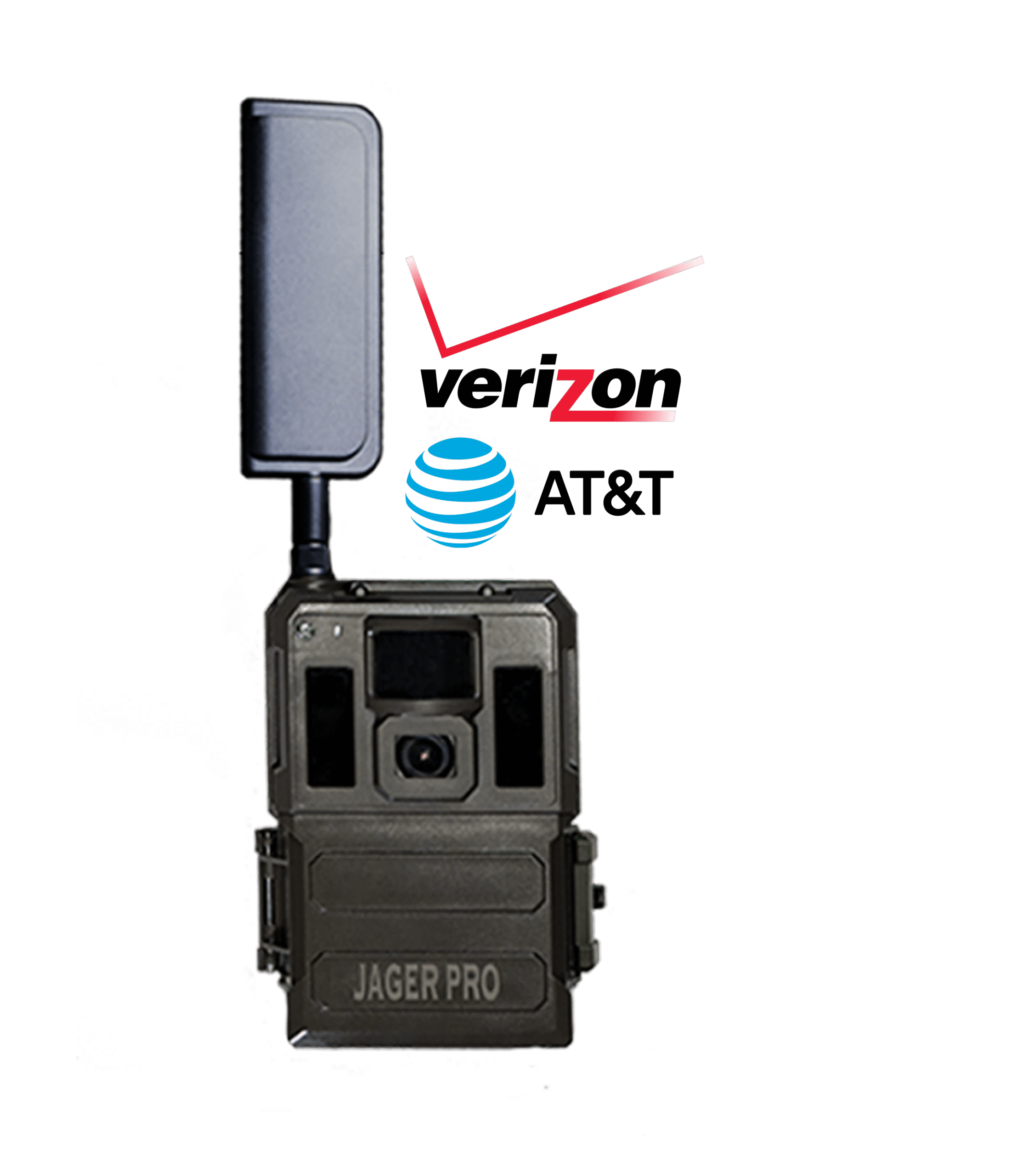
JAGER PRO M.I.N.E. Live Stream Camera System
Live viewing plus an app gate drop, so you wait until the sounder you can see is all inside before you act.
Caution: Needs Verizon or AT&T signal; the $599 camera system price excludes the data plan.
Best for adding remote firing to a gate you already own
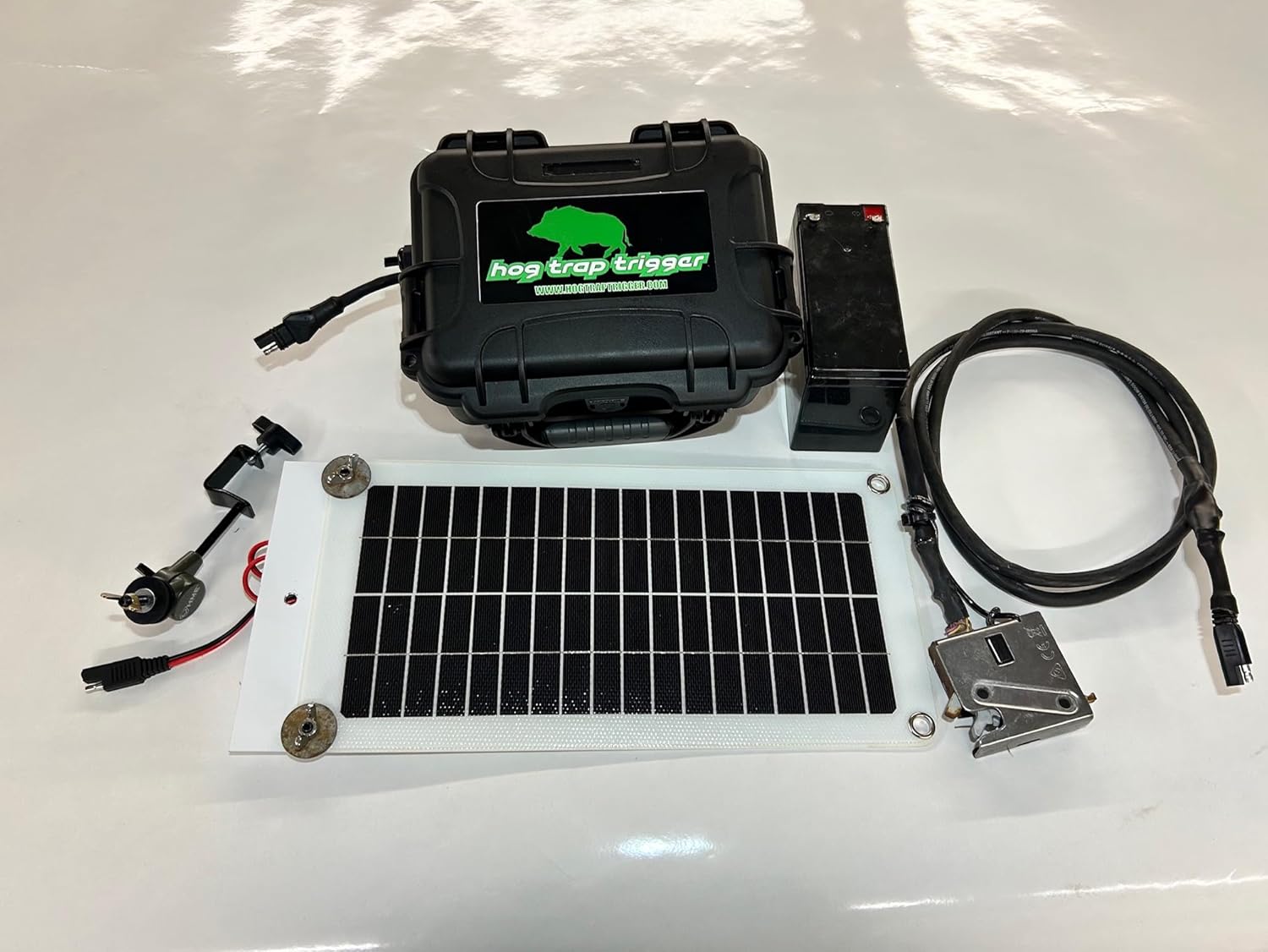
Hog Trap Trigger (Standard and Solar)
The simplest cellular option here to describe: a trigger unit that adds remote firing to an existing gate.
Caution: The maker’s product page is short, so depth of detail is limited; the first year of cell service is included.
Best phone-call trigger for a drop gate
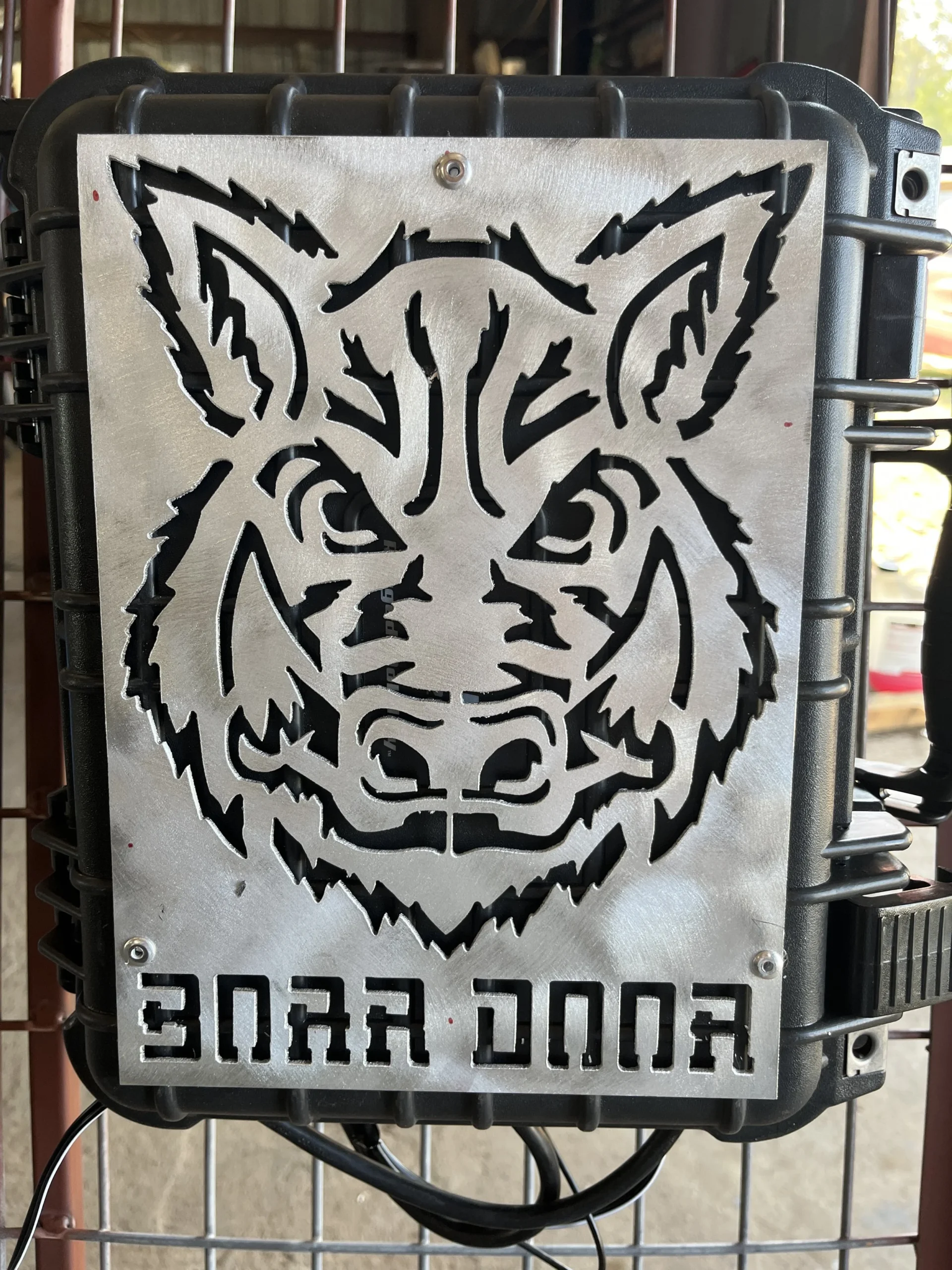
J4 Welding Boar Door Cell-Activated Trigger
Phone-call firing with no app: call the unit and the gate drops, with a year of cell service included.
Caution: The trigger-only package does not include the gate.
Best remote trigger for a net trap
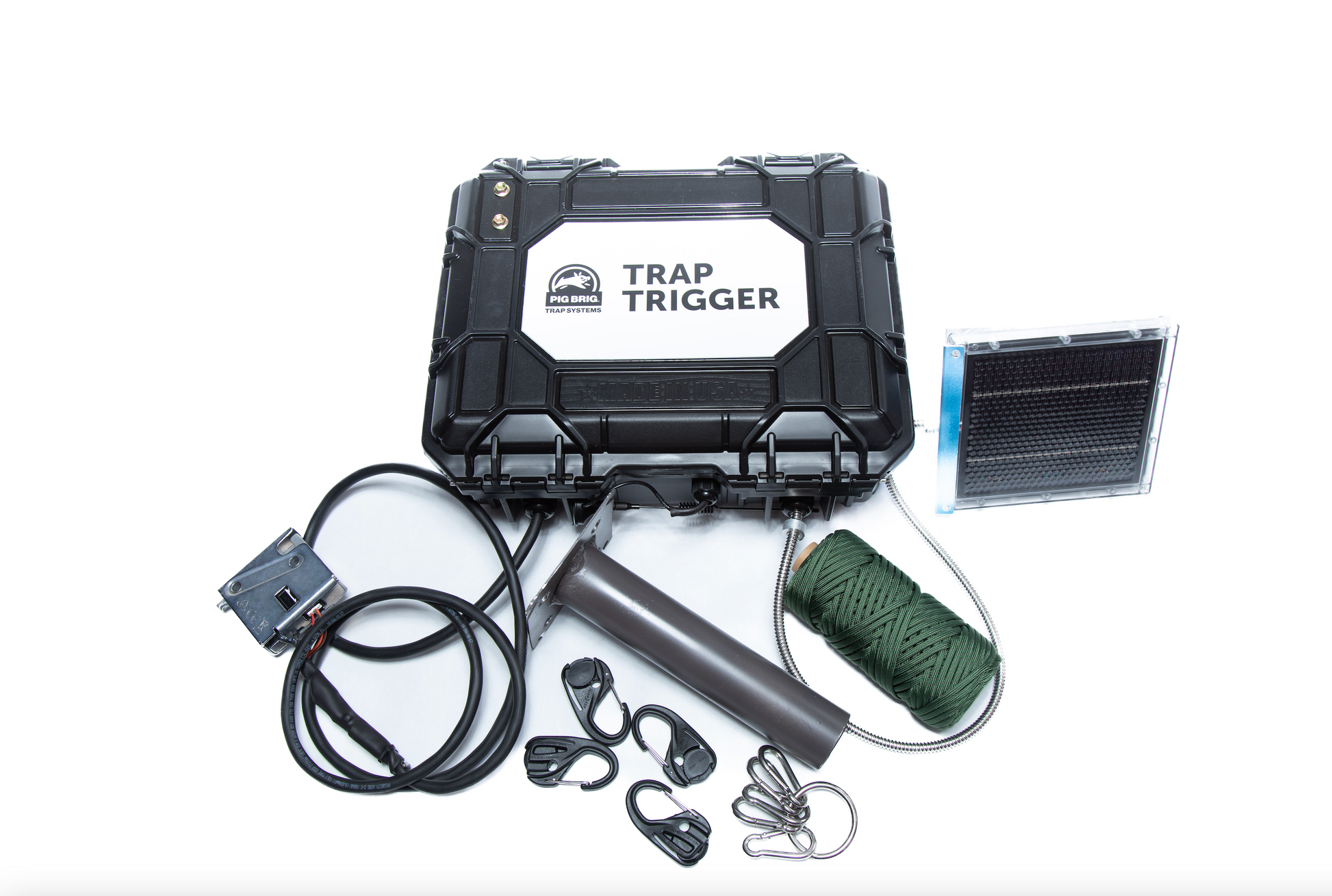
Pig Brig Trap Trigger
Call or text to drop a Pig Brig net, moving a trap from conditioning to capture without driving to the site.
Caution: Fits the Pig Brig net system only — it does not fire a steel drop gate.
Best low-monthly-cost cellular gate

Hogg Boss Gate with Electronic Control Unit
Cellular control unit, long-range antenna, and solar panel, with a maker-claimed $5-per-month SIM cost.
Caution: No price was listed on the product page checked — request current pricing.
Best no-signal, lowest-cost triggers
DIY trip wire and root stick
Materials only: wire, line, and a release pin, or rebar and cord — no signal, battery, plan, or app needed.
Caution: The hogs choose the moment the gate closes, not you.
Best for large professional jobs (with a pricing warning)
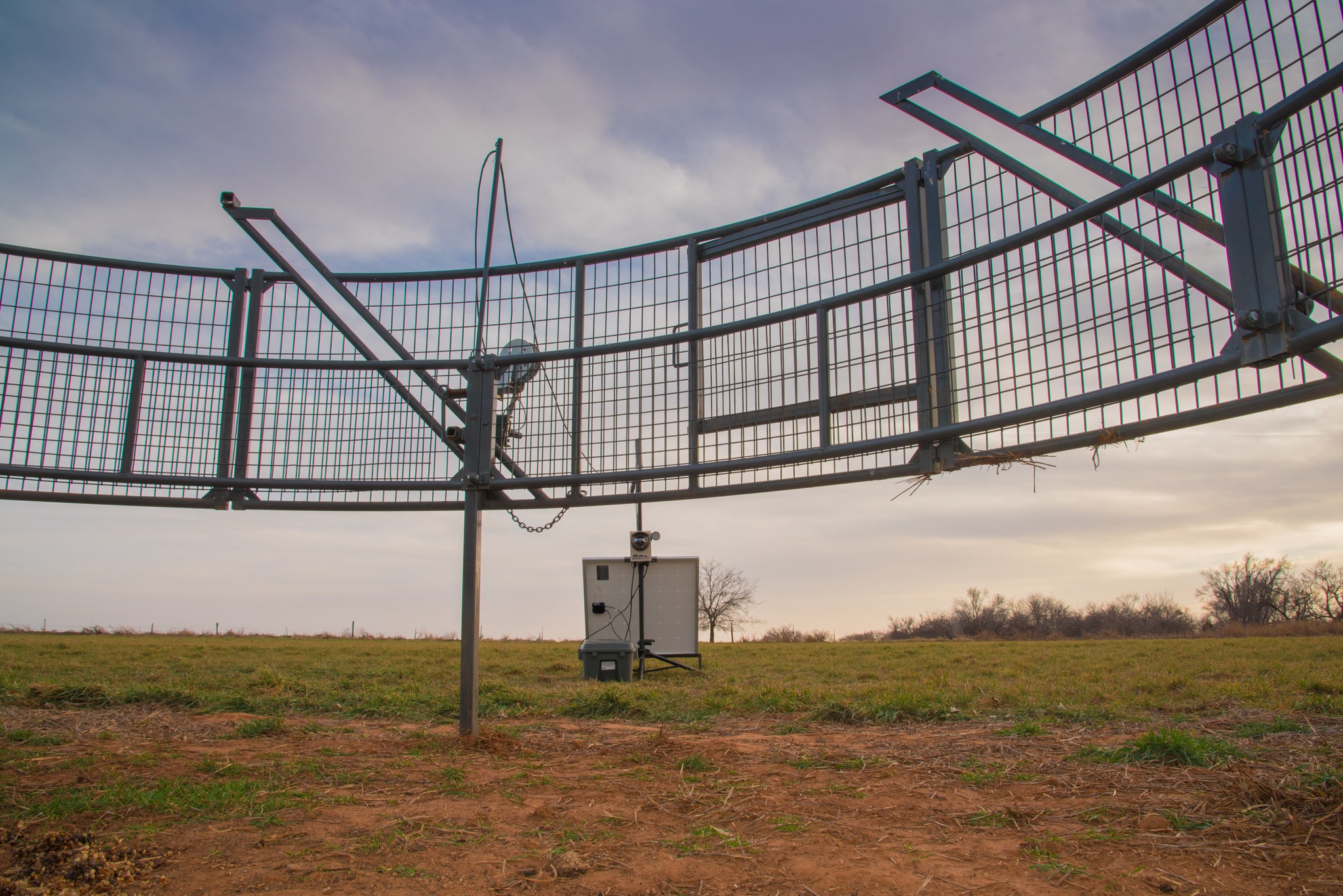
BoarBuster remote drop system
A suspended-ring enclosure a remote operator watches and drops over the whole sounder.
Caution: Current price was not verified — check the dealer site before you buy.
At-a-glance comparison table
| Photo | Trigger / system | Best for | How it fires | Gate it fits | Cell signal needed? | Price (checked October 2026) | Buy / check |
|---|---|---|---|---|---|---|---|
|
JAGER PRO M.I.N.E. Live Stream Camera System | Whole-sounder capture; trap-shy sounders | App / phone command after live viewing | M.I.N.E. drop gate | Yes — Verizon or AT&T | $599 camera system (checked October 2026); data plan listed separately | Check price and current data plans at JAGER PRO → |
|
Hog Trap Trigger (Standard / Solar) | Adding remote firing to an existing gate | Cellular trigger unit | Existing hog trap gate (check fit with the maker) | Yes | $799 standard; $999 with solar charger (checked October 2026); first year of cell service included | Check current details at Hog Trap Trigger → |
|
J4 Welding Boar Door Cell-Activated Trigger | Phone-call firing on a drop gate, without an app | Phone call | Drop gate (sold with gate, or trigger-only for an existing gate) | Yes | $1,000 trigger-only; $1,350 with 6-foot gate (checked October 2026); one year of cell service included | Check the Boar Door packages at J4 Welding → |
|
Pig Brig Trap Trigger | Remote net drop for trap-shy pigs; no app | Call or text | Pig Brig net system (not a steel drop gate) | Yes — AT&T | $1,550 (checked October 2026); first year of AT&T service included | Check the Trap Trigger at Pig Brig → |
|
Hogg Boss Gate with Electronic Control Unit | Low monthly cost cellular firing | Phone call to the control unit | Hogg Boss drop gate | Yes | Price not listed on the product page we checked in October 2026 — check with the maker; SIM service described as $5 per month | Check the Hogg Boss gate and request current pricing → |
| DIY trip wire | Low-cost corral and box traps; no-signal ground | Hog contacts a wire or line | Drop gate, saloon door, root door | No | Materials only; no product price applies | ||
| DIY root stick (rooter stick) | Delaying the drop until adults root for bait | Rooting moves a stick from behind set stakes | Sliding drop gate (best fit) | No | Materials only; no product price applies | ||
|
BoarBuster remote drop system | Large, professional whole-sounder jobs | Remote operator watches and drops a suspended enclosure | BoarBuster suspended-ring enclosure | Yes | Current price not verified in October 2026 — check the dealer site before budgeting | Read the BoarBuster dealer FAQ → |
Prices above are October 2026 snapshots from the manufacturer pages linked in each row, except where the row itself says the price was not listed. Prices, service plans, and included parts change, so confirm them on the maker’s page before you order. No Amazon listing was used for any product in this guide, because no Amazon Amazon listing for these trap triggers could be verified when this guide was written.
Decision flowchart: pick your trigger in four steps
- Step 1 — Do you have usable cell signal at the trap site? If yes, keep reading toward a cellular trigger. If no, skip straight to a trip wire, root stick, or a net system that needs no signal, such as the standard Pig Brig setup without its optional trigger. A cellular trigger without signal is an expensive paperweight.
- Step 2 — Is your main problem trap-shy hogs, or just hogs in general? If hogs have already been educated by a partial catch, choose a trigger you control yourself — the JAGER PRO M.I.N.E. camera system, the Hog Trap Trigger, the J4 Boar Door trigger, or the Pig Brig Trap Trigger. If hogs are still naive to traps, a trip wire or root stick can work.
- Step 3 — What gate do you already own? A sliding drop gate pairs naturally with a root stick or a cellular latch. A saloon-style or root door pairs most smoothly with a trip wire, according to Mississippi State University Extension. A net system needs its own trigger, not a gate latch. Match the trigger to the gate first; do not buy a trigger and hope an adapter exists.
- Step 4 — How far is the trap, and how often can you visit? If the trap is a long drive away, the fuel and time saved by remote viewing and remote firing is the real value of a cellular system, and it is worth pricing honestly against the hardware cost. If the trap is behind the house and you can check it daily, a manual trigger keeps the whole job simpler and cheaper.
How we picked
We did not test these triggers in the field, and this guide makes no claim that we did. Instead, we aggregated what the people who design, sell, and study these systems actually publish: manufacturer product pages and manuals, Mississippi State University Extension’s Wild Pig Info pages, Texas A&M AgriLife Extension’s trigger guide by Billy Higginbotham, the University of Arkansas System Division of Agriculture’s feral hog trapping guide, and public forum threads where trappers describe what went right and wrong. Where a manufacturer page was thin — the Hog Trap Trigger page, for example, lists prices and the included first year of service but little technical detail — we say so rather than filling the gap with guesses.
Three weaknesses in competing roundups shaped this guide. First, many articles list triggers without saying which gate each one fits, which is the detail that decides whether a purchase works at all. Second, several guides quote old system prices as if they were current. We dropped any price we could not tie to a page checked when this guide was written in October 2026, including the often-repeated 2015 BoarBuster figure. Third, most trigger articles treat the trigger as the whole job, when extension sources consistently say conditioning — getting the whole sounder comfortable entering and leaving the trap unharmed — matters at least as much as the hardware. That is why conditioning gets its own section here.
What we did not do: invent capture rates, invent prices, invent owner reviews, or present a manufacturer’s marketing claim as an independent result. Where a number comes from a manufacturer — for example, JAGER PRO’s account of trip-wire failures — we attribute it to JAGER PRO. Where it comes from extension, we name the extension source. Readers who want to check any claim can follow the source list that accompanies this article.
Trigger types explained
A hog trap trigger is simply the mechanism that decides when the door closes. Everything else — panels, bait, cameras, service plans — supports that one decision. Get the decision wrong and you catch two pigs, educate ten, and spend weeks rebuilding trust at that site. Get it right and the same panels and bait do the job they were built for.
Trip-wire triggers: the hog pulls the trigger
A trip wire is a line or wire strung across one corner or the rear section of the trap, run around one side of the trap, and attached to a pin, hook, or prop stick on the door, in Mississippi State Extension’s description. Once enough pressure is put on the line, the release lets the door fall. Sensitivity can be adjusted by tightening or loosening the wire. Mississippi State adds two practical details that separate a working trip wire from a frustrating one: suspend the wire 16 to 20 inches above the ground across the rear section to reduce early trips by raccoons, opossums, and small pigs, and use one continuous length of wire with saloon-style and root doors, because the action of pulling the prop or releasing the door panels works more smoothly and reliably that way.
Texas A&M’s Higginbotham guide goes further on routing. The wire should run above hog height from the gate along a series of T-posts to about three-quarters of the way to the back of the trap, then angle down and run about 12 inches high and parallel to the ground for about 5 to 10 feet before attaching to the back of the trap. The idea is that the sounder feeds its way to the back, so more pigs are inside when the bait along the wire is eaten and the trap trips. Higginbotham also recommends braided saltwater fishing line of at least 60-pound test in the critical area where pigs meet the wire, because braid does not stretch like monofilament and its small, dark diameter is harder for pigs to detect than heavier material. He is candid about the limit of the method: he describes a boar crossing a heavy tripwire eight times in 20 minutes before finally tripping it, because the animal simply knew the wire was there.
The University of Arkansas guide adds the same caution in different words. The wire leading to the trigger should be high enough that an adult hog’s back can pass underneath without tripping the gate early, and bait placement matters as much as wire height: avoid placing bait under the trip wire itself, or a jostled hog will set the trap while most of the sounder is still outside. Trip wires are, in short, cheap, simple, and proven — Mississippi State calls both the root stick and the trip wire proven mechanisms — but the pig controls the timing, and that is the whole weakness.
Root-stick (rooter) triggers: rooting pulls the trigger
A root stick uses the pig’s own feeding behavior as the release. Mississippi State describes two sections of rebar, or two sticks called set stakes, driven into the ground at a 45-degree to 60-degree angle with the ends pointing away from the trap door. A rope or cord runs from the drop door to the middle of a strong stick or piece of scrap lumber — the root stick — which is wedged behind the set stakes to hold the door open. Bait goes around and on top of the root stick. When feeding and rooting pigs push the root stick out from behind the stakes, the door falls. Because the system depends on gravity, Mississippi State says it is best suited to a sliding drop door.
Texas A&M’s version fills a baited post hole and places the rooter stick over the top, so rooting to reach the bait moves the stick and closes the gate. The delay is the point. Subadult pigs do not root nearly as much as adults, Higginbotham writes, so a rooter stick can delay gate closure until adult pigs enter and the rest of the bait inside the trap has been eaten. The University of Arkansas guide agrees: a root stick relies on rooting to lift a stick propped behind angled stakes, subadults root less than adults, and that reduces the risk of a premature trip — but root sticks are less effective in sandy or loose soil, or in hard, rocky ground where stakes are difficult to drive.
Mississippi State’s comparison is the clearest rule of thumb in this guide: trip wires are more sensitive to disturbance, while root sticks are less sensitive and require more effort from pigs and non-target animals to spring the trap. If pigs seem to avoid the root stick on purpose, or if your soil will not hold stakes, switch to a trip wire. Sensitivity is not a virtue in itself. The right sensitivity is the one that waits for the animals you actually want.
Tire, trough, and bucket triggers: delay by making hogs work
Two more manual triggers from the extension literature deserve a mention, because they solve the same timing problem in a different way. The University of Arkansas guide describes an old-tire trigger: larger hogs can be trained to push or flip old automobile tires containing bait, while younger pigs lack the strength. A small tire in the 13- to 16-inch range works well, and the tire should be baited inside the pen before the trip wire is set, so hogs get used to it. When the trap is set, a trigger wire from the tire joins the main tripwire. The rooter and tire triggers both delay the trip, the guide explains, simply because pigs have to work harder to get at the remaining bait.
The trough trigger, in Higginbotham’s guide, is a bait-filled trough whose movement — pushed up or down — trips the gate through a connecting tripwire. It came from the smaller box traps that appeared in the early 1980s, and Higginbotham calls it the least discriminating of the triggers he discusses, because smaller pigs — the ones most likely to enter first — can set it off while adults are still outside. The elevated-bucket trigger in the Arkansas guide works on a similar principle: a heavy bucket on a stand, next to a T-post with a looped trigger wire, tips or moves when disturbed and fires the gate. These are legitimate options for a box trap or a small pen, but for whole-sounder work they share the trip wire’s core flaw: the first animal to move the trigger, whatever its age, ends the night’s trapping.
Remote and cellular triggers: a person pulls the trigger
A remote trigger moves the decision from the pig to the operator. A cellular camera or control unit at the trap sends photos or video to a phone, tablet, or computer, and the operator sends a command back — through an app, a text, or a phone call, depending on the system — to release the gate. Mississippi State Extension describes the high-end version plainly: the camera sends real-time images to a smartphone or email address, and the gate is triggered shut with a single text code sent to the camera, so the user can monitor the trap and decide when to close the gate without leaving home or the office.
The advantages are exactly the weaknesses of manual triggers, reversed. Non-target animals are not caught, because a human decides. The whole sounder can be counted inside before the gate drops. Fuel, time, and daily driving fall, because the trap does not need a physical visit to be checked. The disadvantages are equally plain, and Mississippi State names them: monthly SIM costs, dependence on cell signal and distance from towers, and higher upfront cost. The University of Arkansas guide puts numbers on the running cost in general terms, describing monthly fees of $20 to $70 for a dedicated cellular service tied to a trigger system, and warns that such systems can be ineffective where cellular reception is unavailable, sometimes even with a booster antenna raised 10 or 15 feet. Individual products in this guide fall inside, below, or above that range, so check the product’s own plan rather than assuming the extension range applies to it.
There is one more distinction worth making. Some “remote” systems are camera-plus-latch systems, where the camera and the latch are one product. Others are trigger-only control units that work with a camera you already own. Hogg Boss, for example, says its gate requires a 12-volt battery and a cellular trail camera, and that it works with any cellular trail camera. JAGER PRO’s system is the integrated kind: camera, app, and gate designed together. Pig Brig’s trigger is the net kind: it drops a net, not a gate. Buying the wrong kind for the enclosure you own is the most expensive mistake in this category, so the comparison table and every product section below lead with gate fit.
Continuous-catch doors and the “no trigger” option
Not every hog trap uses a trigger at all. Saloon doors, root doors, and other continuous-catch (one-way) doors let hogs push in after the door has closed, and the Pig Brig net system has no gate to close in the first place: pigs root under a raised net to reach bait, and the net’s shape and anchors are meant to keep them in. Pig Brig’s own FAQ puts it bluntly: there is no trigger, because the system is trigger-free and uses pigs’ rooting instincts for continuous catch. That design removes the timing decision entirely, which is a genuine advantage on ground with no cell signal or in brush where a rigid corral will not fit. It also means the optional Pig Brig Trap Trigger is a different kind of product from the gate triggers in this guide: it converts a conditioning setup into a capture setup remotely, rather than firing a steel door.
One caution from research belongs here, because it tempers the continuous-catch promise. An Auburn University and USDA Wildlife Services study presented at a wildlife damage management meeting, covering 26 corral traps in Alabama, found that after a door closed with part of a sounder inside, sounder members remaining outside made repeated visits to the closed trap but rarely entered: entry rates were 16.4 percent for root doors, 0.9 percent for saloon doors, and 1.9 percent for trainer doors, out of 222 pig opportunities. In other words, a continuous-catch door is not a reliable second chance after a partial catch. The first drop still matters most.
Hog trap triggers reviewed
The products below are ordered by the job they do best, not by price. Each section states the gate it fits, what is actually included, what it costs as checked in October 2026, and where the evidence is thin. No scores are given, because no score for these products could be sourced honestly.
1. JAGER PRO M.I.N.E. Live Stream Camera System — Best for whole-sounder capture
JAGER PRO’s M.I.N.E. system — the name stands for Manually Initiated Nuisance Elimination — is the most fully documented remote trigger in this guide, and the best fit for a landowner whose main problem is a large or trap-shy sounder on ground with good cell coverage. The camera is the trigger’s brain: motion at the bait site sends photos or video to a phone, tablet, or computer through the JAGER PRO app, and the operator drops the gate from the app when the sounder is counted inside. The company’s own trigger-selection page states the logic directly: optimum success comes from verifying the entire sounder is feeding inside the enclosure from the transmitted photo, and non-target species are not captured because a human makes the decision to close the gate.
The camera specifications published on the product page are specific enough to plan around. It captures up to 8-megapixel photos and 1080p HD video, with a blackout flash rated for clear night images up to 60-plus feet, a 1.2-second trigger speed, and live streaming in 15-minute increments before the stream must be restarted. It runs on 12 AA batteries, often for several months according to the maker, or can be paired with the company’s solar power supply. It supports up to a 128-gigabyte microSD card and is offered for Verizon and AT&T networks. The gate it fires is an 8-foot-wide drop gate with no threshold, with openings 40 inches tall by 96 inches wide, built from 2-inch by 4-inch welded 6-gauge steel, and panels 68 inches tall. The base Sergeant package forms a 32-foot-diameter enclosure, and the Corporal single-gate package a 30-foot-diameter enclosure, both expandable with extra panels.
✅ Pros
- Live viewing plus app gate drop: you decide the moment, and you can wait for stragglers.
- Wide, threshold-free gate opening is designed to help trap-shy adults enter during conditioning.
- Detailed published specs (photo, video, flash range, battery, carriers) make planning possible before purchase.
❌ Cons
- Needs Verizon or AT&T signal at the trap; weak signal undermines the whole system.
- Data plan is a separate, ongoing cost — the product page lists plans from $55 per month for up to 5 gigabytes on the Live Stream camera listing.
- Highest learning curve here: app, camera settings, gate setup, and conditioning all have to be right together.
- Camera price does not buy a complete trap; panels, gate, and control box are separate parts of the package.
🧑🌾 From the field: Public discussion of remote systems consistently returns to the same trade. On HuntTalk, one poster describing a professional remote setup — panels, two gates, two cameras, and a remote trigger, at about $7,000 all-in for the operator’s rig — called it the best setup they had seen, adding that used patiently it would get the whole sounder. Another HuntTalk poster warned from experience that setting a trap three days running and catching a single boar, then three boars, then a sow-and-shoat group educated the ground: patience and leaving the trap open during conditioning mattered more than the hardware. JAGER PRO’s own case write-ups make the same point from the other side, describing whole-sounder removals within days of building an enclosure at most bait sites once conditioning is complete — a manufacturer claim, not an independent test, and it should be read that way.
| Spec | Detail |
|---|---|
| Trigger method | Cellular camera + app gate command; handheld remote for on-site captures on the wider M.I.N.E. system |
| Camera | Up to 8MP photos, 1080p HD video, blackout flash to 60+ feet, 1.2-second trigger speed |
| Live stream | On-demand through the app, in 15-minute increments |
| Power | 12 AA batteries; optional solar power supply |
| Networks | Verizon and AT&T versions offered |
| Gate opening | 40 inches tall by 96 inches wide; no threshold |
| Price (checked October 2026) | $599 for the Live Stream Camera System; data plan listed separately |
Check price and current data plans at JAGER PRO →
2. Hog Trap Trigger (Standard and Solar) — Best for adding remote firing to a gate you already own
The product sold as the Hog Trap Trigger, at hogtraptrigger.com, is the simplest cellular option in this guide to describe — and the hardest to evaluate in depth, because the manufacturer’s product page is short. It lists two versions: a Standard Trigger Unit at $799 and a Hog Trap Trigger with Solar Charger at $999, both checked in October 2026. The solar version includes the standard unit plus a solar panel with a battery, and the first year’s cell service plan is included in the purchase price of the unit. That is the full extent of what the product page states, and we will not invent a carrier, a range, an app, or a gate-compatibility list the maker does not publish there.
What that means in practice is a homework step before ordering: contact the maker (the page lists a phone number) and confirm, in writing, which gate and latch your existing trap uses, which carrier serves your trap site, what the service costs after the included first year, and whether the trigger fires by call, text, app, or all three. A trigger-only purchase lives or dies on those four answers. The price position is useful context: at $799 to $999 with a year of service included, it sits below the J4 trigger-only package and well below the Pig Brig trigger, but without the camera, gate, and app integration that the JAGER PRO system bundles. If your gate is sound, your panels are sound, and you only need to move the firing decision from the pig to your phone, that narrower job is exactly what a trigger-only unit is for.
✅ Pros
- Trigger-only purchase: no need to replace a gate and panels that already work.
- First year of cell service included in the purchase price.
- Solar version bundles panel and battery for sites without easy battery swaps.
- Lower upfront cost than the integrated camera-and-gate systems in this guide.
❌ Cons
- Manufacturer page publishes little technical detail — carrier, firing method, and gate fit must be confirmed before ordering.
- No camera is mentioned on the product page, so viewing the trap may need a separate cellular camera.
- Renewal cost after the included first year is not stated on the product page we checked.
🧑🌾 From the field: There is no reliable body of independent owner reviews for this specific unit in the sources checked for this guide, and we will not manufacture one. The honest field note is the general one that applies to every trigger-only cellular unit: owners’ complaints about remote triggers in forums cluster around signal and service surprises — a site that shows bars on a phone but drops a trigger command, or a renewal bill that was not in the first-year budget — rather than around the latch itself. Test the unit at the actual trap site, with the gate rigged but the trap open and un-baited for capture, before the first real set.
| Spec | Detail |
|---|---|
| Trigger method | Cellular trigger unit (firing method to confirm with the maker) |
| Versions | Standard Trigger Unit; version with solar charger (panel + battery) |
| Service | First year of cell service included in the purchase price |
| Price (checked October 2026) | $799 standard; $999 with solar charger |
| Not stated on the product page | Carrier, firing method, gate compatibility, renewal price |
Check current details at Hog Trap Trigger →
3. J4 Welding Boar Door Cell-Activated Trigger — Best phone-call trigger for a drop gate
J4 Welding, a family-owned welding and fabrication shop, sells its Boar Door system in three layers, which makes it easy to buy only what you lack. The trigger-only package is the Boar Door Cell-Activated Trigger at $1,000, checked in October 2026. The maker describes it plainly: using cellular technology, the trigger drops a hog gate upon a simple phone call, and the package includes the trigger mechanism, one year of cell service, a 12-volt battery, and a solar panel to keep the battery charged. The price includes shipping, and the listing states clearly that it does not include the gate or camera. That clarity is a virtue — it prevents the most common trigger-only disappointment.
The next layer up is the 6-foot Boar Door Hog Gate and Trigger Package at $1,350, which pairs the signature 6-foot-wide drop gate with the cell-activated trigger, one year of cell service, a 12-volt battery, and a solar panel, and can be set up with any panel combination or used to replace an old gate. The full 8-panel Boar Door hog trap package is listed at $3,500 and includes the 6-foot drop gate, the trigger, a 12-volt battery, a solar panel, eight 8-foot-wide by 5-foot-tall heavy-duty panels, and a solar-powered security camera for viewing hogs before dropping the trap, with nearly 400 square feet inside. On the maker’s Boar Door page, the trigger-only package is described as hooking up to any drop gate for immediate trapping, and the gate package notes an upgrade to an 8-foot-wide gate with a winch system for easier trapping, plus optional two- or three-gate configurations.
✅ Pros
- Phone-call firing: no app to learn, and no separate camera app required for the trigger itself.
- Trigger-only, gate-plus-trigger, and full-trap packages let you buy only the missing layer.
- One year of cell service, battery, and solar charging included in the trigger package.
- Trigger-only price includes shipping, as stated on the maker’s listing.
❌ Cons
- Trigger-only package includes neither gate nor camera — viewing the trap needs a separate camera.
- Cell signal at the trap is still required; a phone-call trigger is not a no-signal solution.
- Renewal cost after the included first year is not stated on the pages we checked.
🧑🌾 From the field: No independent review set for the Boar Door trigger was found in the sources checked, so this section reports the maker’s framing rather than owner verdicts. The design choice that matters for buyers is the phone call itself. For a landowner who wants remote firing without managing another app, a call is the simplest interface in this guide. For a landowner who wants to see the sounder before firing, the call alone is not enough — pair it with a cellular camera, or step up to the full package that includes one, and budget for that camera’s own service plan.
| Spec | Detail |
|---|---|
| Trigger method | Cellular trigger fired by a phone call |
| Trigger-only includes | Trigger mechanism, one year of cell service, 12V battery, solar panel; shipping included |
| Trigger-only excludes | Gate and camera |
| Gate package | 6-foot-wide drop gate + trigger + one year of service + 12V battery + solar panel |
| Price (checked October 2026) | $1,000 trigger-only; $1,350 with 6-foot gate; $3,500 eight-panel trap package |
Check the Boar Door packages at J4 Welding →
4. Pig Brig Trap Trigger — Best remote trigger for a net trap
The Pig Brig Trap Trigger is the odd one out in this guide, and that is why it belongs here. It does not fire a steel gate. It drops a Pig Brig net. Pig Brig’s base system is trigger-free by design — pigs root under a raised net to reach bait, and the net is meant to hold them — so the optional trigger exists for a different moment: moving a trap from conditioning mode to capture mode without driving to the site. Call or text the unit, the maker says, and the trigger drops the net while pigs are relaxed and feeding. There is no app required, which keeps the interface as simple as the J4 phone call.
The published package is thorough. It runs on the AT&T cell network, with the first year of service included, plus solar and battery power. The box includes a weatherproof box, solar panel, two 12-volt batteries, 100 feet of paracord, an antenna, five D-type clips, four quick-release cam clips, a steel ring, a T-post mount, and a latch release mechanism. The price on the product page checked in October 2026 is $1,550. An earlier Pig Brig listing for the same trigger put annual renewal at $240 per year; confirm the current renewal figure before ordering, because service pricing is the part of this category that changes most often. The instruction manual adds a practical field test worth copying for any cellular trigger: text a test code to confirm the latch fires, and text a separate code to confirm power and service without firing, with a signal-strength reply that tells you whether the site’s signal is consistent enough to trust.
✅ Pros
- Call-or-text firing with no app to install or learn.
- Built for the trap-shy case: fire only when pigs are relaxed and feeding.
- Complete kit in one box, including solar, two batteries, paracord, and mounting hardware.
- Manual includes a no-fire signal test, so you can verify service before a real set.
❌ Cons
- Only fits the Pig Brig net system; it is not a gate latch for a steel corral.
- AT&T network only, according to the product page — check AT&T coverage at your site, not just “cell signal” in general.
- Highest trigger-only price in this guide, and renewal is an ongoing cost to confirm.
🧑🌾 From the field: Pig Brig’s own materials describe the trigger’s target user precisely — owners who are far from their traps and want to switch from conditioning to capture without a drive — and forum discussion of net traps generally stresses the same point as steel-trap discussion: the net still needs conditioning time under it before the drop. A remote net drop does not rescue a site where hogs never learned to feed comfortably under the raised net. Do the conditioning first, with the net up and harmless, and treat the trigger as the last step, not the first.
| Spec | Detail |
|---|---|
| Trigger method | Call or text; no app required; drops the Pig Brig net |
| Network | AT&T; first year of service included |
| Power | Solar panel + two 12V batteries; weatherproof box |
| Includes | 100 ft paracord, antenna, clips, steel ring, T-post mount, latch release mechanism |
| Price (checked October 2026) | $1,550; renewal listed at $240 per year on an earlier Pig Brig listing — confirm current renewal |
Check the Trap Trigger at Pig Brig →
5. Hogg Boss Gate with Electronic Control Unit — Best low-monthly-cost cellular gate
Hogg Boss markets its gate as the most cost-effective cellular-controlled hog trapping system in the industry, and the running-cost figure is the reason to take that claim seriously enough to check. The gate includes a cellular control unit, a long-range antenna, and a solar panel. New units come with a SIM card that can be activated online and, according to the maker, costs only $5 per month to operate. It works with 4G LTE and 3G networks and can be operated using any cell phone from any carrier. Once hogs have entered the trap, the operator simply calls the number associated with the trap to fire the gate, and only programmed numbers can trigger the system.
The gate itself is designed around the same whole-sounder logic as the other cellular systems here. It offers an opening 8 feet wide with over 40 inches of throat height, with the threshold eliminated, and the maker says the gate design and dimensions draw on multiple university studies and are meant to be less off-putting to trap-shy sows. The modular design breaks down without tools, with no individual component weighing more than 60 pounds, so one person can set it up. Two requirements must be budgeted separately: the gate requires a 12-volt battery and a cellular trail camera, and the portable corral system is sold separately. The product page we checked in October 2026 did not list a gate price, so this guide lists no price for it. That is not a criticism of the product; it is the verify-or-drop rule applied evenly. Get a written quote, including the camera and corral you still need, before comparing it to the all-in packages above.
✅ Pros
- $5-per-month SIM service as described by the maker is the lowest running cost in this guide.
- Any cell phone on any carrier can fire it; only programmed numbers can trigger it.
- Wide, threshold-free 8-foot opening aimed at trap-shy sows.
- Tool-free breakdown with no component over 60 pounds suits a one-person setup.
❌ Cons
- No gate price on the product page checked — total cost cannot be compared without a quote.
- Requires a separate 12-volt battery and cellular trail camera, each with its own cost and service.
- Portable corral sold separately, so the gate price alone is not a working trap price.
🧑🌾 From the field: Hogg Boss gates appear frequently in trapper discussion, usually in the same breath as the “most cost-effective cellular” claim, but the sources checked for this guide contained no verifiable, product-specific owner review set to quote, so none is invented here. The practical question for a buyer is the total system cost: gate plus battery plus camera plus camera service plus $5-per-month SIM, plus panels. If that total still beats the integrated packages, the low monthly figure is a real advantage over years of use. If it does not, the headline monthly number was never the whole price.
| Spec | Detail |
|---|---|
| Trigger method | Cellular control unit fired by a phone call; only programmed numbers can trigger it |
| Gate opening | 8 feet wide, over 40 inches throat height; no threshold |
| Setup | Modular, tool-free breakdown; no component over 60 pounds |
| Service | SIM described as $5 per month; 4G LTE and 3G |
| Requires separately | 12-volt battery; cellular trail camera; portable corral sold separately |
| Price (checked October 2026) | Not listed on the product page — request a quote |
Check the Hogg Boss gate and request current pricing →
6. DIY trip wire and root stick — Best no-signal, lowest-cost triggers
Not every trigger is a product, and the two manual triggers in this guide deserve a full entry rather than a footnote, because for many small properties they are the right answer. A trip wire costs little more than wire, line, and a release pin or prop, and a root stick costs little more than rebar or lumber and cord. Both are proven mechanisms in Mississippi State Extension’s wording, both need no signal, no battery, no service plan, and no app, and both work on ground where a cellular system would be useless.
The honest accounting is the time cost. Manual triggers require daily trap checks — JAGER PRO notes that land managers must physically check traps daily, and Mississippi State’s baiting page says a set trap must be checked daily, preferably in early to midmorning, both for humane reasons and because trapped animals get time to figure out escapes and damage the trap. Fuel and driving time are the recurring bill, and a partial catch can cost far more than fuel: it can educate the sounder that remains. The Georgia Outdoor News forum thread on a Tractor Supply hog trap shows the manual-trigger learning curve in miniature. The posters caught 46 hogs after deer season, replaced cords and zip ties that large hogs destroyed, disabled the traps for a week to let hogs feed inside comfortably, and only then set the trigger with a pile of corn at the rear — and the biggest hogs, which had avoided capture until then, finally entered. Conditioning did the work; the trip cord only finished it.
✅ Pros
- Near-zero hardware cost; no signal, battery, or monthly fee.
- Trip wire fits drop gates, saloon doors, and root doors; root stick fits sliding drop gates best.
- Simple to build, repair, and adjust in the field.
- Proven over decades of use across the Southern hog belt.
❌ Cons
- The pig decides when the gate drops — partial catches and educated survivors are the known risk.
- Non-target animals (deer, raccoons, opossums, turkeys, squirrels) can trip the gate.
- Daily physical checks and driving time are mandatory, not optional.
- Root sticks struggle in very loose, sandy, or hard, rocky soil where stakes will not hold.
🧑🌾 From the field: The forum record is consistent on one point: manual triggers reward the trapper who waits. The Georgia Outdoor News posters’ week of disabled traps, the HuntTalk poster’s warning about setting too soon three days running, and Mississippi State’s 1-to-2-week prebaiting guidance all describe the same discipline. If you cannot give a site that patience — because the trap is far away, or because you cannot check it daily — a manual trigger is not the cheap option. It is the option that charges you in time and in educated hogs instead of dollars.
| Spec | Detail |
|---|---|
| Trip wire height (MSU) | 16 to 20 inches above ground across the rear section; one continuous length for saloon and root doors |
| Trip wire routing (Texas A&M) | Above hog height along T-posts to about 3/4 of the way back, then about 12 inches high for 5 to 10 feet |
| Root stick stakes (MSU) | Rebar or sticks at 45 to 60 degrees, ends pointing away from the door |
| Best gate fit | Trip wire: drop gate, saloon door, root door. Root stick: sliding drop gate |
| Price | Materials only |
Build guidance: Mississippi State Extension — Trigger Mechanisms and Texas A&M AgriLife Extension — Selecting a Manual Pig Trap Trigger (PDF).
7. BoarBuster remote drop system — Best for large professional jobs (with a pricing warning)
BoarBuster, sold through W-W Livestock Systems, is a different shape of trap altogether: a suspended-ring enclosure that a remote operator watches and drops over the sounder, rather than a gate that swings or slides shut. The Noble Foundation’s development work with Tactical Electronics produced a cell-phone- and internet-based camera view and trigger system, and the widely repeated account of the system describes an operator triggering the corral while watching remotely, with the outside ring falling to the ground and the inner ring staying elevated to prevent hogs jumping out. One account reports 44 hogs caught at one time, and a BoarBuster video verified for this guide shows 26 feral hogs caught on a ranch near the Red River in Love County, Oklahoma, remotely observed and activated by a human operator.
The pricing warning matters more than the product description. The $5,995 figure for trap and camera, plus a projected $69-per-month cellular fee, comes from 2015-era material, and this guide does not present it as a current price. A current dealer FAQ instead directs buyers to check the price on the dealer’s shop page, with tax and freight quoted at purchase and an optional monthly service plan charged separately. That is the correct way to budget for BoarBuster in 2026: get the current shop price, the freight quote, and the current service plan in writing. The system’s place in this guide is for the buyer who needs the largest single-drop capacity and professional support, and who is willing to pay a professional-system price for it — not for the buyer looking for a trigger to bolt onto an existing corral.
✅ Pros
- Remote operator watches and drops the enclosure — the same whole-sounder logic as cellular gate triggers, at larger scale.
- Suspended-ring design avoids a gate threshold that trap-shy hogs might refuse.
- Non-target animals are not caught, because a human decides when to drop.
❌ Cons
- Current price not verified in October 2026; the often-quoted $5,995 figure is from 2015 and is not used as a current price here.
- Professional-scale system, not a trigger add-on for an existing trap.
- Freight and monthly service are separate costs to confirm.
🧑🌾 From the field: Forum discussion of BoarBuster from its launch period repeatedly lands on the same sentence: pricey, but worth it if annual hog losses are higher than the system cost. That is the right frame, and it is the frame to apply with current numbers, not 2015 numbers. Price the damage — rooted pasture, ruined food plots, damaged feeders and fences — before pricing the trap, and the professional systems stop looking expensive, or they confirm that a manual trigger and patience are the right call for a smaller problem.
| Spec | Detail |
|---|---|
| Trigger method | Remote operator drops a suspended-ring enclosure after watching by camera |
| Demonstrated in verified video | 26 hogs in one drop, Love County, Oklahoma (Noble Research Institute video) |
| Price (checked October 2026) | Not verified — check the dealer shop page; tax and freight quoted at purchase |
Read the BoarBuster dealer FAQ →
Watch: remote drops and whole-sounder captures
Video helps more with triggers than with most feeder topics, because the difference between trigger types is a timing difference — and timing is visible. All three videos below were verified through YouTube’s oEmbed service when this guide was written in October 2026. Watch the gate drop in each one and notice what the operator waited for before acting.
BoarBuster Feral Hog Trap Drop — 26 hogs, remotely activated
A remotely observed and human-activated drop on a ranch near the Red River in Love County, Oklahoma. Useful for seeing how a suspended enclosure, rather than a swinging gate, closes over a sounder.
JAGER PRO — 153 Hogs Removed (compilation)
A month’s compilation of integrated wild pig control work using JAGER PRO systems, from monitoring and conditioning through capture. Useful for seeing how many separate decisions — site, bait, conditioning, timing — sit behind each single gate drop.
JAGER PRO — Landfill Infested with Feral Hogs, Part 1
A 27-pig sounder at a city landfill, captured with a remote drop gate system after recon, bait-site setup, and sounder behavior analysis. Useful for seeing why the operator waits for a full count inside before dropping, even when the first pigs enter early.
What a hog trap trigger really costs
A trigger price is never the job price. The table below separates the trigger from the rest of the system, using only figures sourced when this guide was written. Where a figure is a range from extension guidance rather than a product price, it is labeled as such.
| Cost item | What owners and sources report | Notes |
|---|---|---|
| Manual trigger (trip wire / root stick) | Materials only | Wire, line, cord, rebar or lumber, release pin or prop. The real cost is daily visits and fuel. |
| JAGER PRO Live Stream Camera System | $599 (checked October 2026) | Camera system only; panels, gate, and control box are part of the wider package. Data plan listed separately at $55 per month for up to 5 GB on the camera listing. |
| Hog Trap Trigger | $799 standard; $999 with solar charger (checked October 2026) | First year of cell service included. Renewal price not stated on the product page checked. |
| J4 Boar Door trigger | $1,000 trigger-only; $1,350 with 6-foot gate (checked October 2026) | One year of cell service, 12V battery, and solar panel included; shipping included on the trigger-only listing. Gate and camera excluded from trigger-only. |
| Pig Brig Trap Trigger | $1,550 (checked October 2026) | First year of AT&T service included. Renewal listed at $240 per year on an earlier Pig Brig listing — confirm current renewal. |
| Hogg Boss gate | Gate price not listed (checked October 2026); SIM described as $5 per month | Requires a 12V battery and a cellular trail camera, plus panels or a corral sold separately. |
| Cellular service in general (extension range) | $20 to $70 per month (University of Arkansas guide) | General range for a dedicated cellular service tied to a trigger system, not a quote for any single product above. Individual products fall below, inside, or above it. |
| Fuel and time (manual triggers) | Daily visits; distance-dependent | Mississippi State Extension stresses counting time and fuel, not just upfront cost, when choosing a door and trigger. |
| Bait | Ongoing; corn is the usual starting bait | Mississippi State recommends starting with whole-kernel dried corn, available at local feed and seed stores, and experimenting if pigs visit without eating it. |
The takeaway is simple, and Mississippi State states it directly: do not judge a trigger by its upfront cost alone. A $799 trigger that saves forty miles of driving a day for a month can be cheaper than a free trip wire. A $1,550 trigger on a trap you visit twice a year can be dearer than both. Price the trigger, the service plan, the camera if one is needed, the gate and panels if they are not already owned, and the driving — then decide.
How to choose a hog trap trigger
Match the trigger to the gate before anything else
Start with the gate you own or plan to buy, and work backward. Mississippi State’s guidance is the checklist: a root stick depends on gravity and fits a sliding drop door best; a trip wire works best with a multicatch door, and the action of pulling the prop from a saloon-style door or releasing root-door panels works more smoothly and reliably with a trip wire; a trip wire for saloon and root doors should be one continuous length. A cellular latch must physically fit your gate’s release, and a net trigger must fit your net. If a maker cannot confirm fit for your gate in writing, that is not a minor detail to sort out after delivery. It is the purchase decision.
Match the trigger to your signal, honestly
Walk the trap site with your phone and check the actual carrier your chosen system uses — AT&T for Pig Brig, Verizon or AT&T for JAGER PRO, any carrier’s phone for firing a Hogg Boss gate but a cellular camera still needed for viewing. “Bars at the house” is not signal at the trap. The Pig Brig manual’s signal test is a model for every system: confirm power and service with a no-fire test before the first real set, and if the reply is slow or the signal reading is low, move the trap, raise the antenna, or choose a non-cellular trigger. The University of Arkansas warning belongs on every shopping list: cellular systems can fail where reception is unavailable, sometimes even with a booster antenna 10 or 15 feet up.
Match the trigger to the sounder, not just the property
A naive sounder and an educated sounder are different jobs. Naive hogs that have never met a trap can be caught with a trip wire or root stick, provided conditioning is done properly and bait is placed so the sounder feeds its way to the back of the trap. An educated sounder — animals that survived a partial catch, or older pigs that have learned to avoid enclosures — needs a human-controlled drop, a wide and threshold-free gate, and a longer conditioning period. Mississippi State notes that trap-shyness is especially true for older pigs and pigs previously trapped and released. Buying a more expensive trigger without lengthening the conditioning period wastes the trigger’s advantage.
Match the trigger to your checking schedule and local rules
Remote triggers reduce visits, but they do not remove responsibility. Extension sources consistently describe daily trap checks, and JAGER PRO notes that user-generated photos can serve as legal proof that traps are checked daily and fully operational — which also implies that the legal duty to check remains. This guide does not state any state’s trapping law, season, check interval, baiting rule, or carcass-disposal rule, because those rules differ by state and change. Before you set any trap, check the rules with your own state wildlife agency, and confirm baiting rules in particular: Mississippi State warns that game laws on baiting vary between states and that you should check the baiting regulations for the state where you will be trapping. A trigger that is legal and effective in Texas or Georgia may not be set up the same way where you trap.
Conditioning and trap-shyness: the part most buyers skip
If this guide has one message that matters more than any product recommendation, it is this: conditioning is the trigger’s partner, and skipping it is how sounders get educated. Mississippi State Extension’s baiting page describes prebaiting as an important component of successful pig trapping that is often overlooked. Prebaiting both attracts pigs to the trap site and, more importantly, gets all the pigs in a sounder conditioned to entering and leaving the trap unharmed. Usually 1 to 2 weeks of prebaiting is necessary before the entire sounder will enter the trap, and sometimes 2 weeks pass and some pigs still have not entered.
Trap-shyness, in Mississippi State’s description, is the reason for that patience. Some pigs in a sounder initially do not feel comfortable entering a trap and will stay outside while others readily enter and feed. This is especially true for older pigs and pigs previously trapped and released. If the trap is set too soon, the members of the sounder you do not catch will have become educated and can be more difficult, if not impossible, to capture later. The remedy Mississippi State suggests is practical: remove the door and create a larger opening until pigs become conditioned to regularly entering and leaving, and consider a larger trap, which may appear less confining to trap-shy pigs.
The baiting method during conditioning is specific, and it is also the method that makes a manual trigger work at all. Tie or prop the trap door securely open so pigs can come and go. Place bait on the ground inside the trap and scattered immediately around it, with a larger amount — about 1 to 2 gallons of shelled corn — just inside the entrance to entice pigs in. Once pigs are on the bait, maintain a constant supply inside the trap so they have something to eat on every visit; a spin-cast automatic feeder suspended over the trap during prebaiting reduces the time and effort of keeping it baited and minimizes human disturbance. When the trap is finally set, do not bait heavily around the trigger mechanism. Bait heavily along the inside of the trap opposite the trigger side, and place only a small amount — half a gallon to a gallon — around the trigger itself. The idea is that pigs gravitate to the larger pile, more pigs enter to feed, and pigs pushed aside from the main pile switch to the trigger bait and eventually spring the trap. Mississippi State says this strategy can raise trapping success from one or two animals to ten or more.
That same logic explains why a remote trigger is so powerful and why it still needs conditioning. A remote trigger lets you wait until the camera shows the whole sounder inside, but the camera can only show you what conditioning has already achieved. If only half the sounder trusts the enclosure, the most expensive camera in this guide will still show you half a sounder. The trap site, the bait, the open door, and the waiting are the capture. The trigger is only the moment you choose to end it.
For readers managing deer as well as hogs, conditioning has a second audience worth remembering. Feeders and bait sites draw deer, raccoons, and other animals, and the same non-target visitors that trip a manual trigger will also learn a bait site. Our guides to keeping hogs and other animals off deer feeders, and to choosing feeder timers and solar panels that keep bait delivery consistent, are linked in the resources hub below — not because a feeder replaces a trap, but because a consistent bait supply during conditioning is easier to maintain with a feeder than with a bucket.
Common trigger mistakes
Setting the trap before the whole sounder enters freely. This is the mistake every extension source names first, in different words. A partial catch educates the survivors. Wait for photographic evidence — from a trail camera or a cellular camera — that all the hogs are entering and feeding in the trap before you set the trigger.
Baiting heavily around the trigger. Too much bait at the trigger fires the trap while most of the sounder is still outside, especially with a drop door. Keep the main bait pile opposite the trigger and only a small amount at the trigger itself.
Running the trip wire where pigs meet it first. A wire at hog-back height along the entrance side, or bait piled under the wire, fires early. Route the wire above hog height along the side, drop it only near the back, and keep bait off the wire itself.
Buying a cellular trigger for a no-signal site. Test the actual carrier at the actual site, with a no-fire signal test if the system offers one, before the first real set. A booster helps sometimes; it is not a guarantee.
Buying a trigger that does not fit the gate. Confirm gate fit, latch type, and — for net systems — net compatibility in writing before ordering. A trigger-only purchase that needs a different gate is not a bargain.
Forgetting the service plan in the budget. First-year-included plans end. JAGER PRO’s camera data plan, Pig Brig’s renewal, Hogg Boss’s $5-per-month SIM, and the general $20-to-$70 extension range are all different numbers for different products. Put the year-two cost in the budget before year one.
Leaving a set trap unchecked. A set trap must be checked daily, preferably in early to midmorning, according to Mississippi State. Remote viewing helps you know when to go; it does not replace going, and it does not replace knowing your state’s check rules.
Assuming a continuous-catch door fixes a partial catch. Research on Alabama corral traps found low re-entry rates after a door closed with part of a sounder inside. Treat the first drop as the drop that matters, and do not count on latecomers pushing in afterward.
Resources hub
Authority sources for trigger setup, conditioning, and baiting:
- Mississippi State University Extension — Trigger Mechanisms (root sticks and trip wires)
- Mississippi State University Extension — Baiting and Prebaiting (conditioning and trap-shyness)
- Texas A&M AgriLife Extension — Selecting a Manual Pig Trap Trigger, by Billy Higginbotham (PDF)
- University of Arkansas System Division of Agriculture — Do-It-Yourself Feral Hog Trapping Strategies (MP537, PDF)
- JAGER PRO — Hog Trapping: Trigger Selection (trip wires, root sticks, cellular remote control)
- Georgia Outdoor News Forum — Tractor Supply hog trap thread (conditioning and trip-cord experience)
- HuntTalk — Help! Hog trap with cam and remote gate (remote-setup discussion)
More from Best Deer Feeders (all pages already live on the site):
- Best Hog Trap Gates — the parent guide to gates and triggers
- Best Deer Feeders — the main buying guide
- Best Gravity Deer Feeders
- Best Tripod Deer Feeders
- Best Deer Feeder Timer
- Best Protein Deer Feeders
- Keep Raccoons, Hogs, and Pigs Off Your Deer Feeder
- Deer Feeder Solar Panel
- Best Deer Feeder with Camera and App Control
Before you trap, check baiting, checking, and disposal rules with your own state wildlife agency. This guide does not state any state’s trapping law, and rules differ by state.
Frequently asked questions
What is a hog trap trigger?
A hog trap trigger is the mechanism that releases a trap door or drops a net or enclosure once hogs are inside. Manual triggers — trip wires, root sticks, tire triggers, trough triggers, and bucket triggers — are fired by the hogs themselves. Remote and cellular triggers are fired by a person, through an app, a text, or a phone call, after viewing the trap by camera.
Which hog trap trigger is best for catching a whole sounder?
A cellular remote trigger gives the best control over timing, because a person waits until the sounder is counted inside before firing. That is why the JAGER PRO M.I.N.E. camera system leads this guide for whole-sounder work. No trigger guarantees a whole sounder, though — conditioning the sounder to enter and feed freely before the trap is set matters at least as much as the trigger.
What is the difference between a trip wire and a root stick?
A trip wire is a line the hog contacts while feeding, which pulls a pin, hook, or prop and drops the door. A root stick is a stick wedged behind angled set stakes and tied to the door; rooting pigs push it out from behind the stakes and the door falls by gravity. Mississippi State Extension describes trip wires as more sensitive to disturbance and root sticks as less sensitive, requiring more effort from the pigs to spring the trap.
What gate does a root stick trigger fit?
A sliding drop door. Mississippi State Extension states that the root stick trigger depends on gravity and is best suited for use with a sliding drop door. Trip wires, by contrast, work most smoothly with saloon-style and root (multicatch) doors, using one continuous length of wire.
How high should a hog trap trip wire be?
Mississippi State Extension recommends suspending the trip wire across the rear section of the trap 16 to 20 inches above the ground, which reduces early trips by raccoons, opossums, and small pigs. Texas A&M’s guide routes the wire above hog height along the side of the trap to about three-quarters of the way back, then about 12 inches high and parallel to the ground for 5 to 10 feet at the back.
Do I need cell signal for a hog trap trigger?
Only for cellular triggers. Trip wires, root sticks, tire triggers, and the standard Pig Brig net system need no signal at all. Cellular systems — JAGER PRO, Hog Trap Trigger, J4 Boar Door, Pig Brig Trap Trigger, and Hogg Boss — all need usable signal at the trap site, on the carrier the system uses. Test signal at the site before buying.
How long should I condition hogs before setting the trigger?
Mississippi State Extension says usually 1 to 2 weeks of prebaiting is necessary before the entire sounder will enter the trap, and sometimes 2 weeks pass and some pigs still have not entered. Do not set the trigger until camera evidence shows the whole sounder entering and feeding freely. Setting too soon educates the pigs you miss, and they can become much harder to catch later.
Why did my trip wire catch only part of the sounder?
The most common causes are bait piled around the trigger instead of opposite it, a wire routed where pigs meet it early, and a trap set before conditioning was complete. JAGER PRO’s trigger-selection page describes trip-wire examples that missed 16 of 38 hogs and captured only 6 of 11 piglets, attributing the failures to pigs controlling the timing. Moving the main bait pile opposite the trigger, raising and rerouting the wire, and waiting longer during conditioning address the usual causes.
Can a cellular hog trap trigger catch non-target animals?
It can, but far less often than a manual trigger, because a person decides when to fire after viewing the trap. That is the central advantage Mississippi State and JAGER PRO both describe for remote systems. It is not a guarantee: misidentification on a poor night photo, or firing while a deer or raccoon is inside, still happens if the operator rushes. Wait for a clear view and a full count.
How much does a hog trap trigger cost per month?
Manual triggers cost nothing per month beyond bait and fuel for daily checks. Cellular triggers add a service plan: Hogg Boss describes a $5-per-month SIM, JAGER PRO’s Live Stream camera listing shows data plans from $55 per month for up to 5 gigabytes, Pig Brig’s earlier listing put renewal at $240 per year, and the University of Arkansas guide gives a general $20-to-$70-per-month range for a dedicated trigger service. Always confirm the current plan for the exact product you buy, including what happens after any included first year.
Is a hog trap trigger legal in my state?
That depends on your state, and this guide does not state any state’s law. Trapping, baiting, trap-check intervals, and carcass disposal rules differ by state and change over time. Check with your own state wildlife agency before building, baiting, or setting any trap, and confirm baiting rules in particular before you prebait.
What should I do with hogs after the trap fires?
Plan removal before you set the trap, not after it fires. Mississippi State notes that a set trap must be checked daily, preferably in early to midmorning, and that trapped animals left too long get time to escape or damage the trap. Have transport, dispatch, and disposal arrangements — consistent with your state’s rules — ready before the first set, and clear the trap promptly after a catch so the site can be rebaited for the next sounder.
Final verdict
Buy the trigger that matches your gate, your signal, and your patience — in that order. For most landowners chasing a whole sounder, that means the JAGER PRO M.I.N.E. Live Stream Camera System: live viewing plus an app gate drop is the strongest timing control in this guide. If you already own a good gate and only need remote firing, the Hog Trap Trigger at $799 to $999, or the J4 Boar Door trigger at $1,000 trigger-only, buys that control more simply — by phone call in J4’s case, with no app to learn. If your trap is a Pig Brig net, the Pig Brig Trap Trigger is the only remote option in this guide that fits it. If you want the lowest monthly cost and are willing to get a quote and supply your own camera and corral, the Hogg Boss gate deserves that quote. And if you have no signal, a small trap, and the discipline to condition properly and check daily, a trip wire or root stick — built to the extension guidance in this article — remains a legitimate, proven choice, not a compromise to apologize for.
Whatever you buy, do the unglamorous part first: bait the site, prop the door open, and wait until the whole sounder feeds inside without fear. The trigger only decides the moment. Conditioning decides whether there is anything worth deciding about.
Check your state wildlife agency’s trapping and baiting rules before you set any trap. Prices in this guide are October 2026 snapshots from the linked manufacturer pages, except where a row states that no price was listed — confirm current prices and service plans before ordering.
Last updated: October 25, 2026.


