Bear-Resistant Deer Feeder (2026)
Disclosure: As an Amazon Associate I earn from qualifying purchases. Some links below go to Amazon; manufacturer links are included so you can check specs yourself. No feeder maker paid for a recommendation.
A bear-resistant deer feeder is built to survive a bear’s curiosity, not to stop a determined bear forever. This guide explains what a bear-resistant deer feeder can and cannot do, when wildlife agencies say to stop feeding altogether, and five heavy-duty stand-and-fill feeders worth a look if you feed deer in bear country.
Your 30-second bear-country route
2026 bear-country guide • 5 heavy steel feeders • agency guidance first
If a bear already found your feeder, take it down. If you feed anyway, buy heavy steel, lock the lid and anchor it.
Buying anchors or parts on Amazon? Prime members get fast, free delivery on eligible items, and new members may qualify for a free trial. See Prime options →
BEAR ACTIVITY ▸ ANCHOR ▸ BEST FIT
Stop feeding — take it down and clean up every kernel until the bear moves on.
Orion Modular 450 lb with the MAX Anchor Kit — 12-month Bear/Hog Proof Guarantee, anchored only.
All Seasons 1,000 lb HD — fully enclosed electronics; no written bear guarantee found.
Boss Buck Stand & Fill Sled 300 lb — the portable steel option.
On this page:
- The short answer
- At-a-glance comparison table
- Decision flowchart: should you even keep feeding?
- Is a bear-resistant deer feeder the same as bear-proof?
- When to remove the attractant entirely
- How we picked
- Bear-resistant deer feeder reviews
- Videos: bears, feeders, and staying safe
- What a bear-country feeder really costs
- How to choose
- Secure storage, setup, and incident reporting
- Resources hub
- FAQ
- Final verdict
Short answer: If a bear has already found your feeder, the best feeder is no feeder — take it down, clean up every kernel, and keep it down until the bear moves on. If you are setting up in bear country and you are going to feed anyway, buy heavy steel, lock the lid, and anchor the feeder so it cannot be tipped or dragged: the Orion Modular 450 lb, anchored with its MAX Anchor Kit, is the only feeder in this guide whose maker puts a written bear-damage guarantee behind that setup.
Guarantee at a glance
Orion Modular 450 lb — written 12-month Bear/Hog Proof Guarantee. The guarantee applies only when the feeder is anchored with the MAX Anchor Kit ($57). Check price at Orion Hunting Products →
All Seasons 1,000 lb HD — no written bear-damage guarantee found. “Bear-Proof” is the maker’s product title; we found no written bear-damage guarantee behind it. Check price at All Seasons Feeders →
Top picks: bear-resistant deer feeders at a glance

1. Orion Modular Stand and Fill 450 lb
Best for bear country with a written guarantee
Check price at Orion Hunting Products →
Order the MAX Anchor Kit with it ($57): the written 12-month Bear/Hog Proof Guarantee applies only to anchored feeders.

2. All Seasons Feeders 1,000 lb HD Stand & Fill
Best for maximum capacity with fully enclosed electronics

3. All Seasons Feeders 600 lb EZ Stand & Fill
Best ranch-scale feeder on a mid-range budget

4. Boss Buck Stand & Fill Sled 300 lb
Best portable steel feeder you can tow and anchor
5. Texas Hunter Stand & Fill 650 lb Trophy (TF650L4)
Best big steel broadcast feeder with a lockable control compartment
The short answer
If a bear has already found your feeder, the best feeder is no feeder — take it down, clean up every kernel, and keep it down until the bear moves on. If you are setting up in bear country and you are going to feed anyway, buy heavy steel, lock the lid, and anchor the feeder so it cannot be tipped or dragged: the Orion Modular 450 lb, anchored with its MAX Anchor Kit, is the only feeder in this guide whose maker puts a written bear-damage guarantee behind that setup.
Read the comparison table below before you spend anything, and read the agency guidance first — a feeder that survives a bear is useless if the bear keeps coming back for the corn it throws.
This guide is built around one uncomfortable fact that every wildlife agency repeats: no feeder is truly bear-proof. What you can buy is resistance — steel, locks, and anchors that make the feed hard enough to reach that the bear gives up and moves on — plus habits that remove the reward altogether. The products below are ranked by how honestly their bear features are documented, not by how loudly they use the word “proof.”
At-a-glance comparison table
| Photo | Product | Best for | Capacity / key spec | Price snapshot (October 2026) | Check price |
|---|---|---|---|---|---|
|
|
Orion Modular Stand and Fill 450 lb | Bear country with a written guarantee | 450 lb; 16-gauge steel; 41-inch fill height | $1,029 at the manufacturer; MAX Anchor Kit $57 | Check price at Orion Hunting Products → Order the MAX Anchor Kit with it ($57): the written 12-month Bear/Hog Proof Guarantee applies only to anchored feeders. |
|
|
All Seasons Feeders 1,000 lb HD Stand & Fill | Maximum capacity and fully enclosed electronics | 1,000 lb; 100% 16-gauge steel; locking lid | $1,500 at the manufacturer; freight calculated at checkout | Check price at All Seasons Feeders → |
|
|
All Seasons Feeders 600 lb EZ Stand & Fill | Ranch-scale feeding on a mid-range budget | 600 lb; galvanized metal; 40-foot spread | $549.99 at the listing dealer | Compare steel stand-and-fill feeders on Amazon → |
|
|
Boss Buck Stand & Fill Sled 300 lb | Portable steel feeder you can tow and anchor | 300 lb; powder-coated steel; lockable steel lid | $449.99 at the listing retailer | Check price at Outdoors for Less → |
|
Texas Hunter Stand & Fill 650 lb Trophy (TF650L4) | Big steel broadcast feeder with a lockable control compartment | 650 lb; galvanized steel; 4-foot legs with stakes | Check at the manufacturer or a dealer | Check the 650 lb range at Texas Hunter Products → |
Prices above are snapshots from manufacturer and retailer pages fetched in October 2026. They will change, and freight on the heaviest feeders is often calculated at checkout, so treat every figure as a starting point and confirm before ordering.
Orion sizes: one platform, three capacities
Orion sells the same Modular Stand and Fill platform in three sizes. Prices below are snapshots from shop.huntorion.com fetched October 28, 2026; confirm before ordering.
| Size | Fill height | Price snapshot (October 28, 2026) | Best for |
|---|---|---|---|
| 450 lb | 41 inches | $1,029 | Regular refills, solo filling, or running more than one feeder |
| 750 lb | 49 inches | $1,227 | A back forty through most of a season |
| 1050 lb | 58 inches | $1,429 | Rarely visited leases |
All three share the same platform and take 300 lb hopper extensions, so you can size up later without buying a new feeder.
Check the 450 at Orion Hunting Products →
Order the MAX Anchor Kit with it ($57): the written 12-month Bear/Hog Proof Guarantee applies only to anchored feeders.
Decision flowchart: should you even keep feeding?
- Step 1 — Has a bear already visited? If yes, remove the feeder and all spilled feed now, clean the area, and store feed in a secure building. Do not buy a tougher feeder first. A tougher feeder that still throws corn keeps the bear coming — see when to remove the attractant entirely.
- Step 2 — Is feeding legal where you are? Feeding and baiting rules vary by state and sometimes by county, and some states ban feeding outright. Check your state wildlife agency before you buy anything. If feeding is restricted, stop here — the best feeder is the one you never set out.
- Step 3 — Can you anchor it and lock it? If you can drive anchors, use a low, wide, steel feeder with a locking lid and a real anchor kit. That points to the Orion 450 with the MAX Anchor Kit.
- Step 4 — Do you need capacity more than portability? For remote leases you visit rarely, step up to the All Seasons 1,000 lb HD. For a feeder you tow behind an ATV and move between spots, take the Boss Buck Sled 300 and anchor it at each stop.
Is a bear-resistant deer feeder the same as bear-proof? No — and the difference matters
Short version: “bear-proof” means a bear cannot get in, ever. “Bear-resistant” means a bear has a hard time getting in, and usually gives up. Nobody who tests containers for a living uses the first word. The Grizzly & Wolf Discovery Center in West Yellowstone, which tests containers with live grizzly bears for the Interagency Grizzly Bear Committee (IGBC), prefers the phrase “bear resistant” precisely because, in the words of its container testing coordinator, “we don’t believe that anything out there is bear proof” — given unlimited time, a bear will eventually get into pretty much everything.
The IGBC itself is explicit: approval means a product met minimum standards for how much effort a grizzly must expend, and it does not guarantee the product is bear-proof or will never be breached.
That distinction is not pedantry; it is the whole buying logic for this category. A deer feeder is a much softer target than a tested food-storage canister. It sits outside for months, it throws feed on the ground on a timer, and it smells like corn from a long way off. No feeder on the market carries IGBC certification that we could verify — IGBC certifies food-storage containers, coolers, and trash cans, not deer feeders — so any feeder sold as “bear-proof” is using the word as marketing, not as a certification. Treat it that way.
What “resistant” looks like in a feeder comes down to four features, and you should check for all four before you believe any claim:
- Steel, not plastic, in the parts a bear can reach. Sixteen-gauge powder-coated or galvanized steel is the standard on the serious feeders in this guide. A roto-molded plastic barrel can be a fine deer feeder, but it is not a bear feeder — claws and teeth go through plastic, and a bear’s weight will crack it.
- A lid that locks. A lid that just sits on top is a serving platter. Look for lockable latches, a locking lid, or a lid secured with a screw-in knob — and actually use the lock every time you fill.
- Electronics that are enclosed, not exposed. Motors, batteries, timers, and wiring hanging under a barrel are the first things a bear rips off. The better feeders put all of it inside the hopper or inside a locked compartment.
- Anchoring that stops tipping and dragging. This is the feature most buyers skip, and it is the one that decides whether a visit ends in a dent or a disaster. A bear that cannot open a feeder will try to tip it, roll it, or drag it. Four pound-in anchors rated at 800 pounds of pull-out force each — the Orion MAX Anchor Kit specification — are what “anchored” actually means. A couple of tent stakes are not anchoring.
There is also a fifth factor no product page will sell you: height and isolation. Hunters on forums have hung feeders from steel cables strung between trees, sometimes with spinning PVC sleeves on the cable to stop climbing, and even that has failed — one long-running account describes bears climbing a leaning aspen to reach a cable-hung feeder, then later tearing the winch apart so the barrel dropped to them.
Another hunter’s buddy hung a feeder on a cable between two trees about 12 feet apart after bears tore up his first feeder; it worked for a while, but the bears kept coming, the deer vacated the area entirely, and he eventually took the feeder down altogether. The lesson repeats in every thread: a clever mount delays a bear; it does not defeat one. And a feeder that keeps bears hanging around can cost you the deer you put it out for.
One more honest note on language in this guide. Two manufacturers in this article use the word “proof” in their own product names and pages — Orion calls its guarantee a “Bear/Hog Proof Guarantee” and All Seasons titles its heavy-duty feeder a “Bear-Proof Deer Feeder.” We report those names and guarantees as the manufacturers’ own claims, with their conditions attached, and we do not adopt them as our own verdict.
Where a feeder maker makes no bear claim at all — Boss Buck and Texas Hunter in this guide — we say so plainly, and rank those feeders on their steel, locks, and anchoring instead of on a word they never used.
When to remove the attractant entirely
This section matters more than any product pick, so read it before you buy anything. A tougher feeder is plan B. Plan A is not feeding a bear.
When a bear has already found your feeder, take it down. Every state agency says the same thing in different words: remove the attractant, and the bear usually moves on. New York’s Department of Environmental Conservation (DEC) notes a case in Chemung County where a bear left the area once there was no food available, and its standing advice is to empty feeders, clean up spilled seed, and let nature feed the birds from spring through fall.
Florida’s Fish and Wildlife Conservation Commission (FWC) puts it just as bluntly: “If bears don’t find a food source in the neighborhood, they’ll move on.” Missouri’s Department of Conservation warns that once a bear is fed — intentionally or accidentally — it can lose its fear of people, become a threat, and end up destroyed, because a habituated bear often cannot be safely relocated: “a fed bear is a dead bear.”
Season matters, but it is not a safe window. Agencies most often tell residents to keep feeders down from spring through fall, when bears are active — Missouri and New York both frame it as April through November for bird feeders, and New Jersey’s fall guidance notes that bears preparing to den need huge amounts of food and will home in on scents from long distances.
But fall is also hunting season, which is exactly when most deer feeders go out. There is no season in which a corn feeder in bear country is risk-free; there are only seasons in which the risk is higher. In Florida, where bears do not den as long, FWC notes that adults may need roughly 20,000 calories a day in fall, which is why fall is the worst time to leave an unsecured feeder standing.
What “remove” actually means. Taking the barrel down is step one, not the whole job. Clean up spilled feed on the ground — spilled corn is still a meal, and it teaches the bear to check that spot. Store bagged feed in a sealed container inside a sturdy building, not in an open bag in a shed or garage.
Clean grills and smokers, bring pet food indoors, and put garbage in a sturdy building or a certified bear-resistant container, out only on the morning of pickup. FWC’s BearWise basics list all six habits together for a reason: bears do not distinguish between your deer corn, your trash, and your dog’s bowl. Fix one attractant and leave the others, and the bear stays.
When removal is not optional but legal. Feeding bears intentionally is illegal in many states — Florida and New Jersey both state it plainly, with New Jersey citing fines of up to $1,000 — and unintentional feeding can still create liability and enforcement problems, especially where a feeder has already drawn complaints.
Separately, deer feeding and baiting rules of their own vary by state and county: some states allow feeding but not hunting over bait, some ban feeding outright, and some restrict it by disease zone. Never guess at this. Your state wildlife agency’s website and its local office are the authority, and if you are on public land, the land manager’s food-storage rules override everything else — national parks and many national forests require approved bear-resistant containers or hanging, and some prohibit attractants outright.
How long to keep it down. Fairfax County’s wildlife guidance, cited in Virginia reporting, advises keeping feeders down for three to four weeks after a bear visit. Treat that as a minimum, not a promise: if the bear returns, the clock restarts. Some hunters in bear-heavy areas — including the Florida hunters in one long forum thread who found bears wrecking most feeders — simply stop feeding corn in bear season and switch to other management, noting that deer also left areas where bears were hanging around. If your feeder is keeping bears on your property and pushing deer off it, it is failing at its only job.
The alternative that is not a feeder at all: electric fencing. Where you must protect something bears want — an apiary, a chicken coop, a garden, or a feed storage area — agencies consistently recommend electric fencing over a stronger box. Missouri, Florida, and New York all list it, and BearWise publishes a dedicated bulletin on electric fences for keeping bears out, including energizer guidance of at least 6,000 volts and 0.5 output joules (0.7 for grizzlies) in its chicken bulletin.
A fence around a feeder station is a legitimate option for a fixed site, but check local rules and install it properly — a fence with vegetation shorting it out, or an energizer that is too weak, is decoration. And a fence does not make an illegal feeder legal.
How we picked
We started from the agency guidance, not from a product catalog. The structure of this guide — attractant removal first, equipment second — follows the BearWise basics published by state wildlife agencies and the food-storage rules published by the National Park Service. Only then did we look at feeders, and we applied a verify-or-drop rule to every claim: a feature is in this guide only if it appears on a manufacturer page, a retailer listing, or a manual we actually opened. If a feeder’s bear claim could not be traced to a source, the claim was dropped or the feeder was dropped with it.
Three weaknesses in the usual “bear-proof feeder” roundup shaped this one. First, most roundups repeat the word “proof” without ever defining it, so we defined it from the IGBC testing program and the testers who run it. Second, most roundups rank plastic barrel feeders alongside steel ones as if the material did not matter, so we ranked steel, locks, and anchoring first and treated everything else as secondary.
Third, most roundups never tell you to take the feeder down, so we made removal the first recommendation and the flowchart’s first step. What we did not do: we did not test these feeders against bears, we did not invent owner experiences, and we did not score them — there is no score bar in this guide, because no score we could print would be genuinely sourced.
A note on evidence quality, because it varies a lot here. Orion and All Seasons publish detailed specifications and explicit bear language on their own pages, so their cards are the most specific. Boss Buck and Texas Hunter publish solid steel-feeder specifications but no bear-specific claim, so their cards say exactly that and judge them on construction. Model-specific owner reviews for the heavy steel feeders are thin — these are freight-shipped, low-volume products, not mass-market tripods — so where owner evidence is thin, this guide says so instead of padding the card with generic praise.
Bear-resistant deer feeder reviews
1. Orion Modular Stand and Fill 450 lb — Best for bear country with a written guarantee
The Orion 450 is the only feeder in this guide whose maker backs a bear claim with a written, conditional guarantee, and that is why it leads the list. Orion builds the feeder from powder-coated 16-gauge US-sourced steel, wraps the base in a hexagonal cage, and keeps the profile low and wide so hogs rooting underneath and bears pushing from the side have a hard time tipping it.
The hopper fills at 41 inches — standing flat-footed on the ground, no ladder, no bag lifted overhead — and a 12-volt solar-charged battery with an 8Ah AGM cell runs a timer with six settings and up to six feeds a day, throwing feed up to 60 feet in diameter with the heaviest concentration around 20 feet. The Eliminator spinner plate and the base cage are what keep raccoons and squirrels to eating only what the feeder throws, rather than what it stores.
The honest weakness is the condition attached to the guarantee. Orion’s 12-month Bear/Hog Proof Guarantee applies only when the feeder is anchored with the MAX Anchor Kit — four pound-in anchors rated at 800 pounds of pull-out force each — and the maker says so repeatedly on its own page, including that the kit “is what makes the feeder immovable, and it is required for the 12-month Bear/Hog Proof Guarantee.” Buy the feeder without the kit and you have a strong steel feeder with a 10-year limited warranty against defects, but no bear guarantee at all.
The other weaknesses are practical: at $1,029 plus freight, it is a serious purchase; it ships by LTL freight with lift-gate service and a delivery appointment, and your delivery address must be reachable by a semi-truck; and Orion itself cautions that protein pellets and mixed feeds can swell and clog the motor in humidity, recommending corn, soybeans, and similar dried feeds instead.
✅ Pros
- Written 12-month bear/hog damage guarantee when anchored with the MAX Anchor Kit — the strongest bear backing we verified
- 16-gauge powder-coated steel with a hexagonal base cage; low, wide, tip-resistant stance
- Ground-level filling at 41 inches; no ladder
- Solar-charged 12V system, no mid-season battery swaps; expandable in 300 lb increments
❌ Cons
- Guarantee is void in practice without the anchor kit — the kit is not optional in bear country
- $1,029 plus LTL freight; needs semi-truck access for delivery
- Protein pellets and mixed feeds can clog in humidity, per Orion’s own feed guidance
- 225 lb shipping weight on a pallet — not a walk-in feeder
🧑🌾 From the field: Retailer reviews are few but directly on point. One owner who reported losing most previous feeders to bears wrote that the Orion is “built like a tank,” that with the recommended anchors the bears had not been able to damage it after a week out, and that the only complaint was the base cage blocking spread so most feed landed within about a 5-foot circle.
A second owner noted there is “not a single piece of plastic; it’s all heavy gauge metal,” that it was described as black-bear-proof, and that large hogs gave it no trouble either. Two reviews are not a track record, and a week is not a season — but both reviews name the same thing that matters: steel plus anchors, not steel alone.
| Spec | Detail |
|---|---|
| Capacity | 450 lb (750 lb and 1,050 lb versions share the platform; fill heights 49 and 58 inches) |
| Construction | Powder-coated 16-gauge US-sourced steel; hexagonal base cage; EPDM gaskets |
| Power | 12V solar-charged battery, 8Ah AGM cell |
| Timer / spread | 6 settings, up to 6 feeds per day; up to 60-foot diameter, concentrated around 20 feet |
| Anchoring | MAX Anchor Kit (FDR1000550): four pound-in anchors, 800 lb pull-out force each; required for the guarantee |
| Shipping | 225 lb including pallet; LTL freight with lift-gate service and delivery appointment |
| Warranty | 10-year limited warranty on defects; 12-month Bear/Hog Proof Guarantee with the anchor kit |
| Price snapshot | $1,029 at the manufacturer; MAX Anchor Kit $57 (October 2026) |
Check price at Orion Hunting Products →
Order the MAX Anchor Kit with it ($57): the written 12-month Bear/Hog Proof Guarantee applies only to anchored feeders.
2. All Seasons Feeders 1,000 lb HD Stand & Fill — Best for maximum capacity with fully enclosed electronics
All Seasons Feeders titles this feeder a “Bear-Proof Deer Feeder” on its own product page, and the construction behind the title is genuinely heavy: 100% 16-gauge steel, a locking lid, reinforced construction, and a fully enclosed design that keeps motors, batteries, timers, and wiring completely protected from bears, aoudad, hogs, raccoons, and other destructive wildlife, in the manufacturer’s own description.
That enclosed-electronics point matters more than it sounds — on many feeders the timer and motor hang exposed under the barrel, and that is exactly what a bear tears off first. The feeder is solar-powered, fills standing on the ground like every Stand & Fill, and holds 1,000 pounds, which makes it the right shape for a remote lease you visit rarely.
The honest weaknesses start with the word in the title. All Seasons publishes no written bear-damage guarantee for this feeder that we could find — no equivalent of Orion’s conditional guarantee, no time limit, no stated remedy — so the “Bear-Proof” in the product name is marketing language, not a warranty term, and this guide does not treat it as one.
The second weakness is cost and logistics: $1,500 at the manufacturer, with shipping calculated at checkout from real carrier rates, and heavy steel feeders ship on pallets or fully assembled, so freight is a real part of the price. The third is evidence: the manufacturer page we fetched gives the construction story but little detail on timer settings, spread, or fill height, so we print only what it states and no more.
✅ Pros
- 100% 16-gauge steel with a locking lid and reinforced construction
- Fully enclosed design — motor, battery, timer, and wiring protected inside, not hanging exposed
- 1,000 lb capacity with ground-level filling; solar-powered
- Maker in business since 1987, with dealer pickup available in San Antonio, Texas
❌ Cons
- No written bear-damage guarantee found — the “Bear-Proof” title is the maker’s marketing, not a warranty
- $1,500 plus freight calculated at checkout; heavy steel ships on pallets
- Manufacturer page gives fewer published specs (no spread or timer detail verified) than Orion’s
- Model-specific owner reports on bear encounters are thin
🧑🌾 From the field: Model-specific owner evidence for the 1,000 lb HD is thin, and we will not dress that up. What exists is brand-level: All Seasons has sold feeders since 1987, and on our main buying guide the brand’s timer and feeder units rate 4.9 out of 5 across 48 owner reviews, including one timer reported lasting more than seven years and one owner running thirteen units. That speaks to longevity, not to bear resistance — do not read it as a bear test.
| Spec | Detail |
|---|---|
| Capacity | 1,000 lb |
| Construction | 100% 16-gauge steel; locking lid; reinforced, fully enclosed design |
| Electronics | Motor, battery, timer, and wiring enclosed and protected from wildlife |
| Power | Solar-powered (per manufacturer product title) |
| Fill | Stand & Fill — filled from the ground without a ladder |
| Price snapshot | $1,500 at the manufacturer; shipping calculated at checkout (October 2026) |
Check price at All Seasons Feeders →
3. All Seasons Feeders 600 lb EZ Stand & Fill — Best ranch-scale feeder on a mid-range budget
The 600 lb EZ is the working-ranch version of the All Seasons stand-and-fill idea: heavy-duty galvanized metal, filled from the ground without a ladder, with the timer, battery, motor, and all wiring inside the hopper and away from varmints, and a sliding lid with side channels and a screw-in star knob to secure it. The QuadCast spinner plate throws an even 40-foot spread at roughly 1.5 pounds of corn per 4 seconds, and a lid-mounted 12-volt solar panel keeps the battery charged out of reach. Steel skids make it easy to relocate, which matters if you need to move a feeder away from a spot a bear has learned.
The honest weaknesses: All Seasons markets this one as “varmint & hog resistant,” not bear-resistant, and this guide keeps that distinction — galvanized metal and an enclosed control box are real bear-relevant features, but the maker does not claim bear resistance for it. The battery is not included, despite the solar panel on the lid, so budget for a 12-volt battery. And at the dealer listing we verified, the feeder is sold in-store only and is not shippable, which limits who can actually buy it at the listed price; check All Seasons’ dealer locator for a dealer near you.
✅ Pros
- Heavy-duty galvanized metal; timer, battery, motor, and wiring all inside the hopper
- Sliding lid with side channels and a screw-in star knob — a real lid closure, not a loose cap
- Ground-level filling at about 5 feet tall; steel skids for relocation
- Even 40-foot spread from the QuadCast plate; solar panel mounted on the lid
❌ Cons
- No bear-specific claim from the maker — rated varmint and hog resistant, not bear-resistant
- 12V battery not included
- Listed dealer sells in-store only; not shippable at that price
- Model-specific bear-encounter reports are thin
🧑🌾 From the field: No model-specific bear reports were verified for the 600 EZ, and the retailer listing carries no owner reviews we could cite. The most relevant field evidence is the design itself: owners of the wider All Seasons line report multi-year service, and the EZ’s enclosed electronics and secured sliding lid are the two features that most often separate a feeder that survives a curious raccoon from one that survives a season. That is a design judgment, not a bear test, and it is labeled as one.
| Spec | Detail |
|---|---|
| Capacity | 600 lb of corn |
| Construction | Heavy-duty galvanized metal; steel skids |
| Spread | 40 feet, QuadCast spinner; about 1.5 lb per 4 seconds |
| Power | 12V solar panel mounted on lid; battery not included; EZ digital timer |
| Lid / controls | Sliding lid with side channels, screw-in star knob; timer and battery under the lid |
| Height | Approximately 5 feet tall; low-profile, ground-level filling |
| Price snapshot | $549.99 at the listing dealer, in-store only (October 2026) |
Compare steel stand-and-fill feeders on Amazon →
4. Boss Buck Stand & Fill Sled 300 lb — Best portable steel feeder you can tow and anchor
Boss Buck’s sled feeder is the portability pick: a powder-coated steel hopper on a towable sled, filled from the ground, with a 12-volt kit and solar panel already in the box, a feed window so you can read the level without opening the lid, and — the bear-relevant part — a steel lid with two lockable latches, a varmint guard grating, and tow hook holes plus anchor mounts for stability.
The timer offers two quick-set programs or 16 custom slots with adjustable durations, and the redesigned spin plate and diverter spread feed evenly. North American Deer Hunter’s Josh Honeycutt names the Stand & Fill his best overall feeder, which is the strongest third-party endorsement any feeder in this guide carries.
The honest weaknesses: Boss Buck makes no bear claim for this feeder, and its sled design cuts both ways — tow hook holes that let you move it with an ATV also mean a bear has something to grab and drag if you do not use the anchor mounts. The 300 lb capacity is the smallest in this guide, so on a remote lease it means more refill trips.
And the money-page evidence for this feeder notes the spread pattern needs adjustment, wind still causes some waste, and the solar panel needs occasional cleaning to keep charging well — small things, but they are the difference between a feeder that runs all season and one that quietly stops.
✅ Pros
- Powder-coated steel with a lockable steel lid (two latches) and anchor mounts
- Towable sled — move it with an ATV, then anchor it at the new spot
- 12V kit and solar panel included in the box; 16 programmable timer slots
- Feed window reads the level without opening the lid
❌ Cons
- No bear-specific claim from the maker — judge it on steel, locks, and anchoring, not on a bear promise
- Sled mobility works against you if the anchor mounts go unused
- 300 lb is the smallest capacity here — more refill trips on remote ground
- Spread needs tuning and the solar panel needs cleaning, per published field notes
🧑🌾 From the field: Beyond the North American Deer Hunter endorsement, the retailer listing carries a 4.5 rating from 2 ratings — thin, and we report it as thin. The most useful field note is the negative one: wind waste and a solar panel that needs cleaning are exactly the kind of small failures that leave a feeder throwing inconsistently, which in turn leaves corn on the ground longer and the scent up longer. In bear country, a feeder that runs clean is part of the bear plan, not just a convenience.
| Spec | Detail |
|---|---|
| Capacity | 300 lb (600 lb sled version also sold) |
| Construction | Powder-coated steel hopper and sled; varmint guard grating |
| Lid | Steel lid with two lockable latches; feed-level window |
| Power | 12V automatic feeder kit, enclosed timer and battery; solar panel included |
| Timer | 2 Quick Set programs + 16 programmable slots; adjustable durations |
| Anchoring / mobility | Tow hook holes and anchor mounts |
| Price snapshot | $449.99 at the listing retailer (October 2026); 12V battery status varies by listing — confirm |
Check price at Outdoors for Less →
5. Texas Hunter Stand & Fill 650 lb Trophy (TF650L4) — Best big steel broadcast feeder with a lockable control compartment
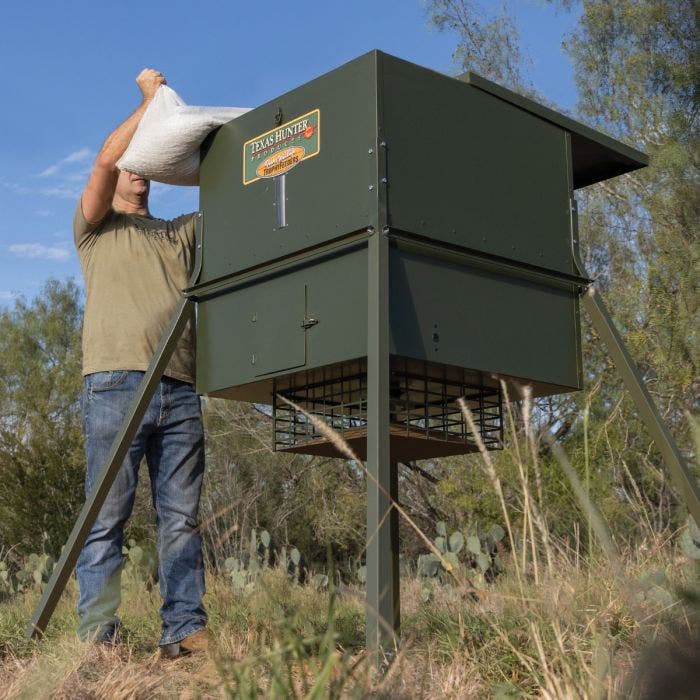
Texas Hunter’s 650 lb Trophy is a heavy galvanized steel broadcast feeder with a powder-coated finish, a one-piece leakproof design, and a lockable compartment that stores the battery and timer — the enclosed-electronics feature this guide looks for.
The EZ Set digital timer programs 1 to 9 feedings a day with run times from 1 to 60 seconds, a high-torque 12-volt motor drives a centrifugal stainless steel spinner plate that opens only when feeding, and a large varmint guard provides feed protection. The 4-foot-leg version (TF650L4) comes with footpads and stabilizing stakes, and two built-in sight glasses let you read the level from a distance. The battery is included and the unit is prewired for an optional solar charger.
The honest weaknesses: Texas Hunter makes no bear claim for this feeder, and “stabilizing stakes” are not the same as a rated anchor kit — if you buy this feeder for bear country, budget separately for real ground anchors and treat the included stakes as positioning aids, not bear protection. The 650 lb hopper is also a lot of feed to lose in one tipping, which is precisely why anchoring matters more as capacity grows. And model-specific bear feedback is thin; this card rests on construction and the lockable compartment, not on bear encounters.
✅ Pros
- Heavy-duty galvanized steel with a powder-coated finish; one-piece leakproof design
- Lockable compartment for battery and timer; large varmint guard
- 650 lb capacity with 4-foot legs, footpads, and stabilizing stakes
- 12V battery included; solar-ready; timer saves its schedule if the battery is disconnected
❌ Cons
- No bear-specific claim from the maker
- Included stabilizing stakes are not a rated bear anchor kit — add real anchors for bear country
- 650 lb is a large single loss if the feeder is tipped — anchoring is not optional
- Model-specific bear-encounter reports are thin; check pricing at the manufacturer or a dealer
🧑🌾 From the field: No verified owner bear reports for the TF650L4 were found when this guide was written, so this card carries none. What the retailer and manufacturer listings do establish is the build: galvanized steel, a lockable control compartment, and a varmint guard are the same three features that show up on every feeder in this guide that has any chance against a bear. The gap is anchoring, and it is a gap you close at installation, not at checkout.
| Spec | Detail |
|---|---|
| Capacity | 650 lb |
| Construction | Galvanized steel, powder-coated finish; one-piece leakproof design |
| Timer / power | EZ Set digital timer, 1–9 feedings per day, 1–60 seconds; 12V rechargeable battery included; solar-ready |
| Feed protection | Large varmint guard; centrifugal stainless steel spinner plate opens only when feeding |
| Legs / stability | 4-foot heavy-duty legs, footpads, stabilizing stakes (TF650L4) |
| Level reading | Two built-in sight glasses |
| Price snapshot | Not verified on a live page when this guide was written — check at the manufacturer or a dealer |
Check the 650 lb range at Texas Hunter Products →
Where to check each feeder
1. Orion Modular Stand and Fill 450 lb
Best for bear country with a written guarantee
Check price at Orion Hunting Products →
Order the MAX Anchor Kit with it ($57): the written 12-month Bear/Hog Proof Guarantee applies only to anchored feeders.
2. All Seasons Feeders 1,000 lb HD Stand & Fill
Best for maximum capacity with fully enclosed electronics
3. All Seasons Feeders 600 lb EZ Stand & Fill
Best ranch-scale feeder on a mid-range budget
4. Boss Buck Stand & Fill Sled 300 lb
Best portable steel feeder you can tow and anchor
5. Texas Hunter Stand & Fill 650 lb Trophy (TF650L4)
Best big steel broadcast feeder with a lockable control compartment
Videos: bears, feeders, and staying safe
Every video below was verified through YouTube’s oEmbed endpoint when this guide was written. If a video ever stops loading, the text around it still stands on its own.
Orion Modular Stand and Fill feeder overview
Shows the steel construction, hexagonal base cage, and ground-level filling described in the Orion card.
All Seasons EZ Stand & Fill feeder
All Seasons Feeders video on the Quad-Cast spinner used across the EZ line.
How to use bear spray — Wyoming Game and Fish Department
If you are filling feeders in bear country, carry bear spray and know how to use it before you need it. This is the agency video, not a product demo.
Staying safe in bear country — International Bear Association
General bear-country behavior: awareness, distance, and what to do when you meet a bear. Watch it before your first fill trip, not after your first encounter.
What a bear-country feeder really costs
The sticker price is the smallest part of the decision. A feeder that gets tipped once can cost you the feeder, the feed, and the rest of the season’s deer activity in that spot. Orion’s own product page makes the point in its own way, describing a bear flattening a feeder in October and dumping a full load of corn on the ground — the load is the loss, not just the repair bill.
| Cost item | What owners report / what listings show | Notes |
|---|---|---|
| Feeder | $449.99 (Boss Buck Sled 300) to $1,500 (ASF 1,000 lb HD), October 2026 snapshots | Confirm before ordering; freight is often extra on the heavy steel models |
| Anchor kit | $57 for Orion’s MAX Anchor Kit (four anchors, 800 lb pull-out force each) | The cheapest item on the page and the one that activates Orion’s bear guarantee — do not skip it |
| Freight | Orion ships LTL with lift-gate service and a delivery appointment; ASF calculates freight at checkout from carrier rates | Your address must be reachable by a semi-truck for Orion; dealer pickup avoids freight for ASF |
| Battery (where not included) | ASF 600 EZ runs on 12V but the battery is not included | Budget for a 12V battery even though the solar panel is in the box |
| One tipped feeder | A full hopper on the ground, plus a bear that has now learned your feeder pays off | The second visit is the expensive one — it is the one that habituates the bear |
| Removing the feeder | Free, plus the cost of storing feed securely and cleaning spilled feed | Still the cheapest and most effective bear measure in this guide |
Takeaway: if you are choosing between a $450 steel feeder with no anchors and a $1,029 steel feeder with a $57 anchor kit and a written guarantee, the anchor kit is doing more work than the price gap suggests. And if you are choosing between any feeder and taking the feeder down for a month, taking it down costs nothing and is the only option the agencies recommend first.
Total to first fill
Freight is the sticker shock on heavy steel feeders, so here is each feeder with its freight and anchor position in one row. No freight figure is quoted where the maker or dealer does not quote one.
| Feeder | Snapshot price | Freight note | Anchor / extra | Total framing |
|---|---|---|---|---|
| Orion Modular 450 lb | $1,029 | LTL freight with lift-gate service and a delivery appointment; address must be reachable by a semi-truck | MAX Anchor Kit $57 | $1,086 before freight — the only row with a written bear-damage guarantee |
| All Seasons 1,000 lb HD | $1,500 | Freight calculated at checkout | No anchor kit quoted | $1,500 plus freight calculated at checkout |
| All Seasons 600 lb EZ | $549.99 | In-store only at this dealer | 12V battery not included | $549.99 plus a 12V battery |
| Boss Buck Sled 300 lb | $449.99 | Check at the listing retailer | Anchor mounts used; kit price not quoted | $449.99 plus anchors |
| Texas Hunter 650 lb Trophy | Check at the manufacturer or a dealer | Check at the manufacturer or a dealer | Real ground anchors added — the included stakes are not a bear anchor kit | Check at manufacturer/dealer |
How to choose
Steel first, everything else second
Start with the hopper material and the lid, because those are the parts a bear tests. Sixteen-gauge steel shows up on both bear-named feeders in this guide for a reason: it is thick enough to resist claws and teeth for a meaningful time, while still light enough to ship and assemble. Galvanized steel, as on the Texas Hunter and the ASF EZ, adds corrosion resistance on top of strength.
Plastic barrels, open troughs, and unlatched lids are disqualifiers in bear country no matter how good the timer is. After steel and lid, check that the electronics are enclosed — inside the hopper or inside a locked compartment — because an exposed motor is a handle a bear can pull.
Anchoring is a purchase, not an afterthought
Budget the anchor kit with the feeder, on the same order. The pattern in owner reports is consistent: feeders fail when they tip or drag, not when a bear patiently unpicks a latch. Four pound-in anchors at a rated pull-out force, a low wide stance, and a feeder that sits close to the ground together make tipping hard; any one of them alone does not.
If your feeder’s maker sells no anchor kit, buy rated ground anchors separately and install them before the first fill, not after the first visit. And remember the sled warning: a feeder designed to be towed is a feeder designed to be moved, so its anchors matter more, not less.
Capacity is a risk calculation, not just convenience
A 1,000 lb hopper means fewer refill trips to a remote lease, but it also means a single tipping dumps 1,000 pounds of corn — a bigger reward that teaches a bear faster. A 300 lb sled means more trips but a smaller loss and a feeder you can move away from a learned spot.
Match capacity to how often you can actually visit: if you can only reach the lease a few times a season, the big steel feeder plus anchors is the honest choice; if you visit weekly, the smaller feeder you can move, empty, and clean is often the smarter one. Either way, never fill a feeder in bear country and walk away for months without checking it — an unvisited feeder is an unmonitored attractant.
Broadcast vs. gravity in bear country
Broadcast feeders throw feed on a timer, which limits how much is on the ground at any one time and lets you feed only in daylight hours when you choose. Gravity feeders offer feed around the clock, which is convenient for deer and equally convenient for a bear that visits at night.
That does not make gravity feeders wrong — the ASF protein-style gravity feeders are steel and lockable — but it does mean a gravity feeder in bear country needs its ports, lid, and anchoring to be right, because the feed is always available. If bears are already visiting, a timed broadcast feeder that throws a small amount during the day is the lower-risk pattern, and removing the feeder entirely is lower risk still.
Secure storage, setup, and incident reporting
Store feed like it is bait, because to a bear it is. Keep bagged corn and protein in sealed, airtight containers inside a sturdy building — a garage with a closed door, a shed with a latch a bear cannot pry, or a locked storage room.
Do not leave open bags in a carport, do not stack bags where a bear can smell them through a thin shed wall and tear in, and never store feed in the feeder’s own hopper over a period when you are not feeding. Clean up around the storage area too: spilled kernels by the shed door are a trail of breadcrumbs to the main supply.
Set the feeder up like you expect a visit. Pick open ground where you can see the feeder from a distance and a bear cannot approach unseen through thick cover right up to it. Anchor before filling, lock the lid every time, and set the timer to throw only what deer will clean up before dark — FWC’s BearWise guidance makes the same point for wildlife feeders generally: if a feeder stays up, put out only enough for wildlife to finish before dark.
Check the feeder on every visit for claw marks, bent latches, and disturbed anchors, and treat any sign as a warning, not a curiosity: tighten, repair, or remove before the next visit, not after it.
If a bear visits, report it — and know who to call before you need to. Agencies ask for reports because a bear that visits one property usually visits the neighbors next, and early reports let agencies work on attractant removal while the problem is still small. New York’s DEC asks residents to report nuisance bears immediately to DEC dispatch, and notes that unreported nuisance bears can quickly become a safety hazard with bad outcomes for people and bears alike. New Jersey’s Fish & Wildlife runs a 24-hour toll-free hotline for black bear damage or nuisance behavior at 1-877-WARN-DEP (1-877-927-6337).
Washington’s Department of Fish & Wildlife takes emergency dangerous-wildlife complaints through 911 and non-emergency complaints at 877-933-9847 or through its online report form. California’s Department of Fish and Wildlife takes black bear incidents through its Wildlife Incident Reporting system.
Those numbers are examples from the agencies we cited — your state will have its own channel, so look it up and save it before the season, and call 911 for any immediate threat to people. Never approach a bear, never try to scare one off at close range, and never feed one to make it go away: feeding a bear that is already a problem makes the next visit worse, and in many states it is illegal.
On public land, the land manager’s rules win. National Park Service food-storage rules require approved bear-resistant containers or hanging in many parks, and feeding wildlife is prohibited in parks regardless of what feeder you own. National forest orders vary by forest and can prohibit attractants outright. A deer feeder that is legal on your private lease may be illegal on the public parcel across the fence. Check with the specific park or forest before you set anything out, and never assume a feeder marketed as “bear-proof” satisfies a food-storage order — those orders name approved containers, and deer feeders are not on those lists.
Resources hub
- Best Deer Feeders 2026: 16 Top-Rated Models Compared — the main buying guide, including the Boss Buck Stand & Fill and All Seasons 600 EZ in a wider field
- Best Gravity Deer Feeders — gravity options for comparison, including steel vs. plastic hoppers
- Best Tripod Deer Feeders — why tripods are a poor choice where bears can push them over
- Best Deer Feeder Timer — timer options if you are upgrading an existing feeder’s controls
- Best Protein Deer Feeders — protein and gravity heads, including the All Seasons protein line
- Keep Raccoons, Hogs, and Pigs Off Your Deer Feeder — varmint guards, cages, and the hog problem that overlaps with bears
- Deer Feeder Solar Panel — keeping a 12V feeder charged in a remote spot
- Best Deer Feeder with Camera and App Control — camera monitoring so you know what visited, and when
- National Park Service: How Do I Use a Bear Canister? (Grand Teton) — how approved bear-resistant storage actually works, and why a closed, locked container is the whole system
- National Park Service: Bears and Food Storage (Voyageurs) — prevent access, never feed bears, report incidents promptly
- New York DEC: Be BearWise This Spring — remove feeders spring through fall, secure garbage, clean grills
- Missouri Department of Conservation: Be BearWise — April-through-November feeder guidance, electric fencing, and why a fed bear is a dead bear
- Florida FWC: Living with Florida Black Bears videos — including a video specifically on making wildlife feeders bear-resistant
- Outdoor Life: How Bear Cans Are Certified as “Bear Resistant” — the live-bear IGBC testing behind the term, and why testers reject “bear-proof”
Key facts: bear-resistant is not bear-proof
Bear-proof means a bear cannot get in, ever. Bear-resistant means a bear has a hard time getting in and usually gives up. The IGBC, which certifies bear-resistant containers through live-bear testing, states explicitly that approval does not guarantee a product is bear-proof or will never be breached. No deer feeder we could verify carries IGBC certification, which applies to food-storage containers, coolers, and trash cans, not feeders.
FAQ
Is a bear-resistant deer feeder the same as bear-proof?
No. Bear-proof means a bear cannot get in, ever. Bear-resistant means a bear has a hard time getting in and usually gives up. The IGBC, which certifies bear-resistant containers through live-bear testing, states explicitly that approval does not guarantee a product is bear-proof or will never be breached. Treat any feeder sold as “bear-proof” as marketing language, and judge it on steel, locks, and anchoring instead.
Is there a truly bear-proof deer feeder?
No — not by any standard a wildlife agency would recognize. No deer feeder we could verify carries IGBC certification, which applies to food-storage containers, coolers, and trash cans, not feeders. The closest thing in this guide is the Orion 450 with its MAX Anchor Kit, which carries a written 12-month manufacturer guarantee against bear and hog damage that disables the feeder — a guarantee with one stated condition, not a claim of invincibility.
Should I take my deer feeder down if a bear visits?
Yes — that is the first recommendation from every agency cited in this guide. Remove the feeder, clean up all spilled feed, store bagged feed in a secure building, and keep the feeder down until the bear moves on. Guidance from Fairfax County suggests three to four weeks as a minimum after a visit, and the clock restarts if the bear returns. A tougher feeder that still throws corn keeps the bear coming.
What months should feeders stay down in bear country?
Missouri and New York agencies frame bird-feeder removal as April through November, when bears are active, and New Jersey’s fall guidance warns that bears preparing to den need huge amounts of food. But fall is also deer season, so there is no risk-free window for a corn feeder in bear country — only higher- and lower-risk periods. Check your own state agency’s current seasonal guidance rather than relying on a calendar.
What actually makes a feeder bear-resistant?
Four things, in order: a steel hopper (16-gauge is the standard on the serious feeders here), a lid that genuinely locks, electronics enclosed inside the hopper or a locked compartment, and rated ground anchors that stop tipping and dragging. Height and isolation help, but forum reports show bears defeating cable-hung feeders by climbing leaning trees and tearing winches apart — a cable-hung feeder still smells like corn, still throws feed, and still teaches bears to visit. If bears are already visiting, take it down.
Does the Orion bear guarantee cover any setup?
No. Orion’s 12-month Bear/Hog Proof Guarantee applies only when the feeder is anchored with the MAX Anchor Kit — four pound-in anchors rated at 800 pounds of pull-out force each. Without the kit, the feeder still carries a 10-year limited warranty against defects, but no bear guarantee. The kit costs $57 on Orion’s own page, which makes skipping it a false economy.
Is the All Seasons 1,000 lb HD really bear-proof?
All Seasons titles it a “Bear-Proof Deer Feeder” and builds it from 100% 16-gauge steel with a locking lid and fully enclosed electronics. But we found no written bear-damage guarantee, time limit, or remedy published for it, so this guide treats the title as the maker’s marketing and ranks the feeder on its construction. If a written guarantee matters to you, that distinction points to Orion.
Can I just hang my feeder from a cable between two trees?
It can help, but it is not a solution on its own. Hunters report bears climbing out along cables, climbing leaning trees to reach cable-hung feeders, and tearing winches apart so barrels drop to the ground. Spinning PVC sleeves on the cable stop some climbing, and tin on the trunks helps, but a cable-hung feeder still smells like corn, still throws feed, and still teaches bears to visit. If bears are already visiting, take it down.
Will an electric fence protect my feeder station?
Electric fencing is the option agencies recommend most consistently for fixed sites — apiaries, coops, gardens, and storage areas — and BearWise publishes dedicated guidance on it, including energizer minimums of 6,000 volts and 0.5 output joules (0.7 for grizzlies) in its chicken bulletin. A fence must be properly installed and maintained: vegetation shorting it out or an undersized energizer makes it decoration. A fence also does not make an illegal feeder legal.
How do I report a bear problem?
Report promptly to your state wildlife agency — early reports let agencies work on attractant removal while the problem is small. Examples from agencies cited here: New York DEC dispatch for nuisance bears, New Jersey’s 24-hour hotline at 1-877-WARN-DEP (1-877-927-6337), Washington’s non-emergency line at 877-933-9847, and California’s Wildlife Incident Reporting system. Call 911 for any immediate threat to people. Look up your own state’s channel before the season and save it.
Is it legal to feed deer where bears live?
It depends on your state and sometimes your county — and on whether you are on private or public land. Some states allow feeding but not hunting over bait, some ban feeding outright, and some restrict it by disease zone. Separately, feeding bears intentionally is illegal in many states, with fines of up to $1,000 in New Jersey. Never guess: check your state wildlife agency and, on public land, the land manager’s food-storage rules before you set a feeder out.
Why does this guide have no Amazon links or scores?
Because no Amazon listing for these feeders could be verified when this guide was written — Amazon listing pages block agent access — and this guide drops unverified links rather than guessing them. Product links go to manufacturer and retailer pages instead. There are no score bars because no score we could print would be genuinely sourced; the ranking rests on documented construction, locks, anchoring, and the one written guarantee we verified.
Final verdict
Start with the agency advice, not the shopping. If a bear has found your feeder, take it down, clean up, store your feed securely, and report the visit to your state wildlife agency. If you are setting up in bear country and feeding is legal where you are, buy the Orion Modular 450 lb with the MAX Anchor Kit — it is the only feeder here with a written bear-damage guarantee, and the guarantee’s condition is the whole point: steel plus rated anchors.
Check price at Orion Hunting Products →
Order the MAX Anchor Kit with it ($57): the written 12-month Bear/Hog Proof Guarantee applies only to anchored feeders.
If you need maximum capacity for a rarely visited lease, the All Seasons 1,000 lb HD gives you 1,000 pounds of fully enclosed steel, with the honest caveat that its “Bear-Proof” title carries no written guarantee we could find. For a mid-range ranch feeder, the All Seasons 600 lb EZ is the value pick; for a feeder you tow and move, the Boss Buck Sled 300 with its anchor mounts used; and for a big steel broadcast feeder with a lockable control compartment, the Texas Hunter 650 lb Trophy — with real ground anchors added, because its included stakes are not a bear anchor kit.
One last reminder, because it is the line this whole guide stands on: no feeder is truly bear-proof, and a feeder that keeps a bear coming back is worse than no feeder at all. The steel, the lock, and the anchors buy you resistance. Removing the attractant buys you the result. Use them in that order.
Last updated: October 25, 2026.