
Best Pond Fish Feeders for Bass & Catfish Ponds (2026)
Note: This guide links to manufacturer and retailer pages so you can check current prices and availability. This guide contains Amazon affiliate links. As an Amazon Associate we earn from qualifying purchases.
As an Amazon Associate I earn from qualifying purchases.
Updated November 2, 2026 · by Zia
Quick answer: For most private bass, bluegill and catfish ponds up to about half an acre, buy the Texas Hunter 70 lb Directional Fish Feeder. It throws pellets 45 feet from the bank or dock and its timer runs up to 9 feedings a day. Bigger water suits the 250 lb version.
Pond feeders sold on Amazon
- Three Seconds Solar Automatic Fish Feeder: a solar pond feeder built for fish ponds. Check price on Amazon
- Moultrie All-in-One Hanging Directional Feeder: a hanging directional feeder that throws feed in one direction, useful from a dock or bank post. Check price on Amazon
 Moultrie 250 lb Pro Hunter III Directional Tripod: a larger directional tripod feeder for bigger ponds. Check price on Amazon
Check capacity and throw direction against your pond before you buy. As an Amazon Associate we earn from qualifying purchases.
On this page:
- The short answer
- At-a-glance comparison table
- Which fish feeder for pond owners? A 4-step decision
- How we picked
- 1. Texas Hunter 70 lb Directional Fish Feeder — Best for most ponds
- 2. Texas Hunter 175 lb Directional Fish Feeder — Best for mid-size ponds
- 3. Texas Hunter 250 lb Directional Fish Feeder — Best for large ponds and lakes
- 4. Moultrie 30-Gallon Quick-Lock Directional Tripod — Best budget directional feeder
- 5. Moultrie 6.5-Gallon FeedCaster Fish Feeder — Best hanging dock feeder
- 6. Sweeney Koi Cafe Automatic Koi Feeder — Best for koi and garden ponds
- 7. Sweeney 125 lb Automatic Directional Feeder — Best for precise pellet feeding
- 8. Pond King Floating Fish Feeder — Best for fluctuating water levels
- Watch: directional fish feeders in action
- Pond fish feeding vs. deer feeding: what changes
- What a pond fish feeder really costs
- How to choose a fish feeder for your pond
- Resources
- Frequently asked questions
- Final verdict
The short answer
If you want one fish feeder for a pond and do not want to overthink it, buy the Texas Hunter 70 lb Directional Fish Feeder. It throws feed in a wide 45-foot by 20-foot wedge out over the water from a dock or a pond bank, runs on a 12-volt rechargeable battery with an optional solar charger, and its timer programs up to 9 feedings a day. For most private ponds up to about half an acre, that combination of throw distance, capacity, and scheduling covers the job, and the larger 175 lb and 250 lb versions of the same feeder cover bigger water without changing how anything works.
The table below compares all eight feeders in this guide side by side. If your pond is a small koi or garden pond, skip straight to the Sweeney Koi Cafe. If your water level rises and falls a lot, skip to the Pond King Floating Fish Feeder, which rides the water instead of standing on a fixed bank. The rest of this guide explains feed types, delivery styles, power, and timers in plain language so you can match the feeder to your pond rather than to a brand name.
At-a-glance comparison table
| Product | Best for | Capacity (fish feed) | Delivery type | Power | Where to check |
|---|---|---|---|---|---|
| Texas Hunter 70 lb Directional Fish Feeder (DF125) | Most ponds up to about 1/2 acre | 70 lb fish feed (125 lb corn) | Directional blower, 45 ft x 20 ft wedge | 12V rechargeable battery; solar charger optional | See on Amazon → |
| Texas Hunter 175 lb Directional Fish Feeder (DF300) | Mid-size ponds, fewer refills | 175 lb fish feed (300 lb corn) | Directional blower, 45 ft x 20 ft wedge | 12V rechargeable battery; solar charger optional | See at Texas Hunter → |
| Texas Hunter 250 lb Directional Fish Feeder (DF425) | Large ponds, lakes, community docks | 250 lb fish feed (425 lb corn) | Directional blower, 45 ft x 20 ft wedge | 12V rechargeable battery; solar charger optional | See on Amazon → |
| Moultrie 30-Gallon Quick-Lock Directional Tripod (MFG-13281) | Budget directional feeding; also feeds deer | Up to 200 lb of corn (check pellet capacity with Moultrie) | Directional spinner, narrow 30-degree path | 6V battery (sold separately); solar port | See at Moultrie → |
| Moultrie 6.5-Gallon FeedCaster Fish Feeder | Hanging on a dock or post over small water | Up to 50 lb of feed | Directional shroud, straight path to about 25 ft | 6V battery; solar-panel ready | See Moultrie feeder kits → |
| Sweeney Koi Cafe Automatic Koi Feeder | Koi and backyard garden ponds | Up to 10 lb of koi food | Hanging broadcast over a small area | 6V rechargeable battery; solar charger optional | See at Webb’s Water Gardens → |
| Sweeney 125 lb Automatic Directional Feeder | Precise pellet feeding from a dock | 125 lb (measured in corn; pellets weigh less per fill) | Auger + impeller, 30-degree arc, 5 to 50 ft | 12V battery; solar charger included on this version | See at Marvin Gardens → |
| Pond King Floating Fish Feeder | Ponds with rising and falling water levels | 100 lb of feed | Spin cast, mostly straight down with some feed to about 3 ft | 12V battery with solar panel included | See at Pond King → |
A note on capacities: several manufacturers rate their hoppers in corn, and corn is denser than fish pellets, so the same hopper holds fewer pounds of fish feed than of corn. Texas Hunter states both numbers plainly (70 lb of fish feed equals 125 lb of corn, for example). Pond King makes the same point in its own FAQ, noting that its stated weights are true pellet weights based on 3/4-inch pellets. Whenever you compare two feeders, compare their fish-feed numbers, not their corn numbers, or the bigger-sounding feeder may actually hold less of what you feed.
Which fish feeder for pond owners? A 4-step decision
- Step 1 — How big is your water? A garden or koi pond under a few hundred square feet needs a small hanging feeder, not a 250 lb steel hopper. Go to the Sweeney Koi Cafe. A private pond up to about half an acre suits the Texas Hunter 70 lb. Larger ponds and lakes suit the 175 lb or 250 lb Texas Hunter, or the Pond King Floating feeder.
- Step 2 — Does your water level move? If your pond rises and falls with rain and drought, a fixed bank or dock feeder can end up too high above the water, and its throw pattern changes. Choose the Pond King Floating Fish Feeder, which rises and falls with the water. If your level is stable, any dock or bank feeder works.
- Step 3 — What are you feeding? Floating pellets for bluegill, catfish, and koi suit every feeder here. If you feed larger pellets, check the maximum pellet size: Pond King handles up to 3/4-inch pellets, and Sweeney’s directional feeder handles 1/8-inch to 1/2-inch pellets. If you also throw shelled corn for deer or ducks, the Texas Hunter line is explicitly rated for both fish feed and corn.
- Step 4 — How much power hassle will you accept? If you hate hauling batteries home to charge, buy a feeder with a solar charger included or add one at purchase: the Sweeney 125 lb directional version and the Pond King feeders include solar, while Texas Hunter and Moultrie offer it as an add-on. If the feeder sits near an outlet or you visit often, a battery-only setup is fine.
How we picked
There is no single comparison roundup of pond fish feeders from the big outdoor retailers, which is exactly the gap this guide fills. Stores sell these feeders one at a time, and most “best pond fish feeder” pages online recycle the same small garden-pond gadgets. We built this guide from a different direction: manufacturer product pages and manuals, retailer listings from US dealers, pond-management advice from Pond King, and feeding guidance from the Texas A&M AgriLife Extension Service. Every specification below traces to one of those sources, and the source list that accompanies this article lists them.
Three weaknesses in the existing coverage shaped our picks. First, most roundups ignore the difference between corn capacity and fish-feed capacity, so buyers overestimate how much feed a hopper holds. We state both numbers wherever the manufacturer does. Second, most roundups treat every feeder as a generic “automatic feeder” and never explain directional versus broadcast versus floating delivery, even though that choice decides whether feed lands on the water or on your dock. We organized the guide around delivery type. Third, most roundups quote prices that are out of date the week they publish. We do the opposite: where a price could not be verified on a live page when this guide was written, we omit it and link you to the retailer instead, so you see the real current price rather than a stale one.
What we did not do: we did not test these feeders ourselves, we did not invent owner experiences, and we did not assign scores. Where we could find genuine owner feedback in retailer reviews or pond-owner write-ups, we paraphrase it and say where it came from. Where independent owner feedback is thin for a product, we say so plainly. Prices in this guide are dated manufacturer list prices, so check the seller for the current price.
1. Texas Hunter 70 lb Directional Fish Feeder — Best for most ponds
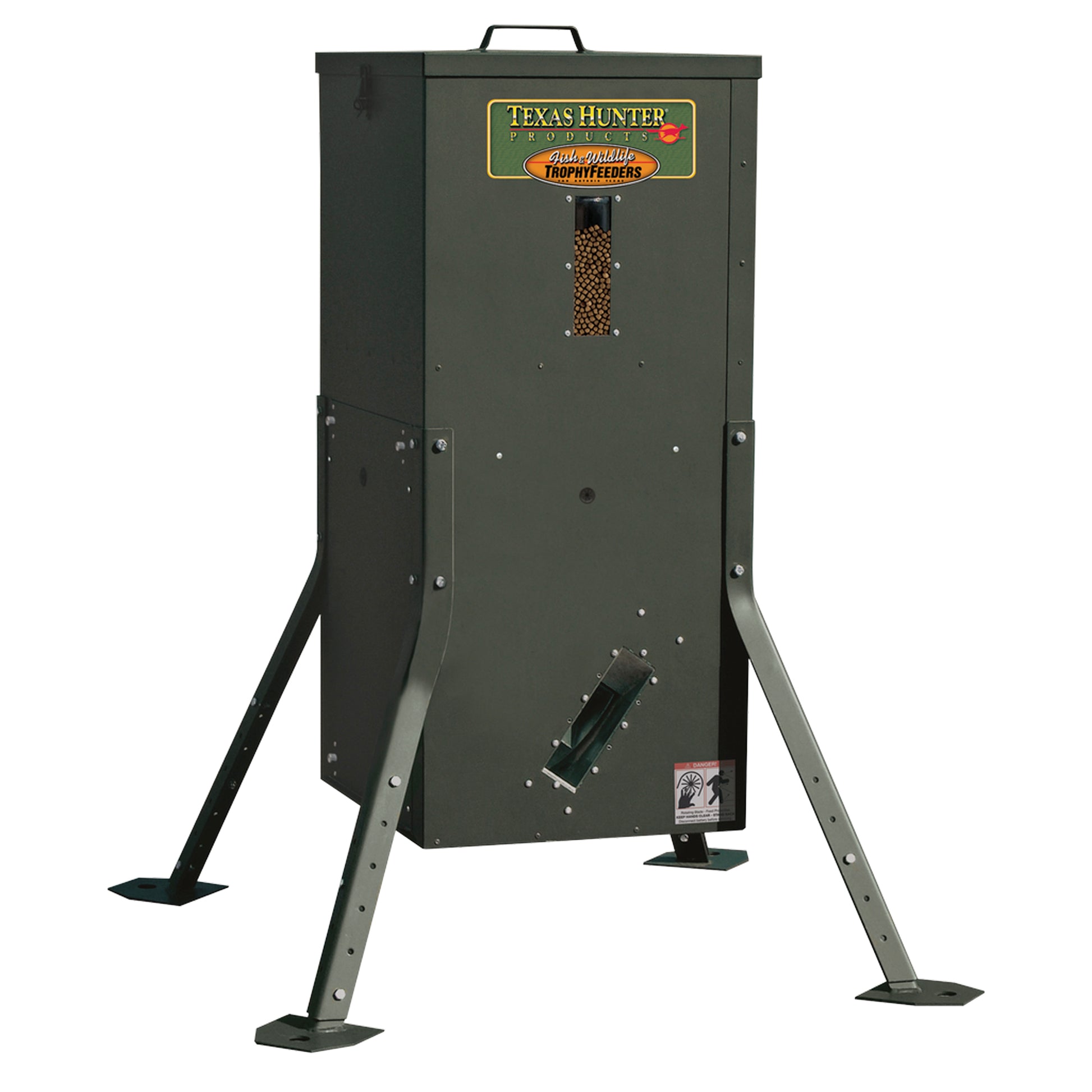
The Texas Hunter 70 lb Directional Fish Feeder, model DF125, is the small end of Texas Hunter’s directional line, and it is the feeder we would put on most private ponds. It holds 70 lb of fish feed or 125 lb of corn, and it throws feed with a patented centrifugal air blower in a wedge-shaped pattern 45 feet long and 20 feet wide. That pattern matters: instead of scattering feed in a circle, half of which would land on the bank, the blower pushes a sheet of feed out over the water and keeps it off the ground within about three to five feet of the feeder. The result is a defined feeding zone that fish learn to visit, which is also what makes a good fishing spot.
The feeder runs on a 12-volt rechargeable battery and Texas Hunter’s DFT12 digital timer, which schedules 1 to 9 feedings per day with run times from 1 to 60 seconds. You buy it in two leg configurations: straight legs with footpads for bolting to a dock, or adjustable angled legs for leveling on a sloped pond bank, with stakes included for bank setups. The hopper is powder-coated galvanized steel, it has two built-in sight gauges so you can check the feed level from either side, and the lid locks. Texas Hunter backs the feeder with a 1-year warranty and the DFT12 timer with a 5-year limited warranty. The optional SP2W 2-watt solar charger mounts on any side of the feeder and is the single add-on most owners should buy, because it ends the routine of pulling the battery to charge it.
✅ Pros
- Wide 45 ft x 20 ft directional pattern puts feed on the water, not the bank
- Handles floating pellets, sinking pellets, and shelled corn
- Dock legs or adjustable bank legs; lockable lid and sight gauges
- Up to 9 feedings a day with 1 to 60 second run times
- Dual-motor blower reaches full speed before feed releases, so little feed dribbles at the base
❌ Cons
- Solar charger is optional, not included, on the standard versions
- 70 lb of fish feed means regular refills on heavily stocked ponds
- Steel construction is heavier to move than a plastic hopper feeder
- Premium price compared with small hanging feeders
🧑🌾 From the field: A retailer review from a buyer named Charlie, published on a Texas Hunter dealer site, reports the feeder arrived well packaged, was easy to assemble and set up, and felt solidly built, and he specifically recommends adding the solar charger because it removes the need to monitor and charge the battery. A dealer listing also notes that a lake manager in Huntsville, Alabama runs six Texas Hunter Pro Series fish feeders on her docks to grow bluegill. Those are dealer-published accounts, not independent testing, but they match the design story: this is a set-and-forget feeder once the solar charger is on it.
| Spec | Detail |
|---|---|
| Capacity | 70 lb fish feed / 125 lb corn |
| Feed pattern | Directional wedge, 45 ft long x 20 ft wide |
| Timer | DFT12 digital, 1–9 feedings/day, 1–60 seconds each |
| Power | 12V rechargeable battery included; SP2W solar charger optional |
| Mounting | Straight dock legs (DF125DL) or adjustable bank legs (DF125AL) |
| Construction | Powder-coated galvanized steel; lockable lid; two sight gauges |
| Warranty | Feeder 1 year; DFT12 timer 5 years limited |
Verdict: The best fish feeder for pond owners with a dock or a stable bank and up to about half an acre of water. Buy the leg set that matches where it will stand, and add the solar charger.
2. Texas Hunter 175 lb Directional Fish Feeder — Best for mid-size ponds
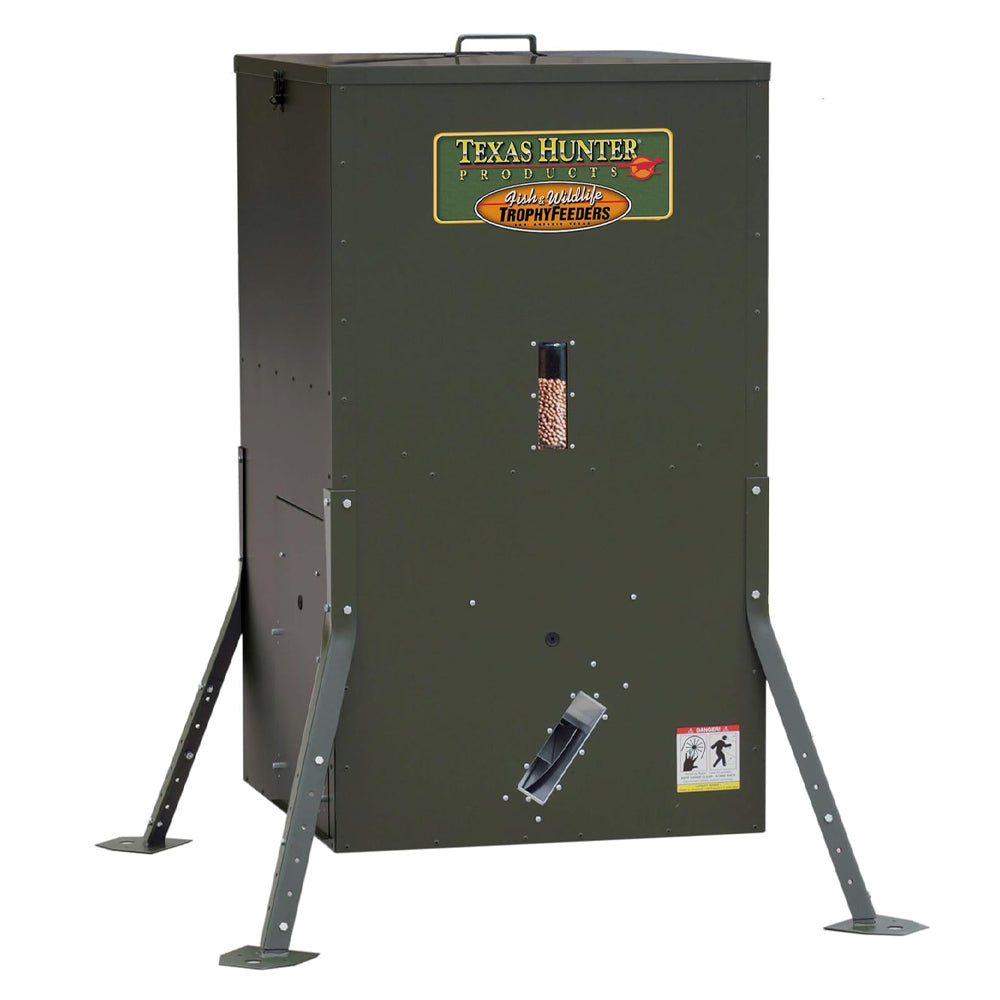
The 175 lb Texas Hunter is the same directional machine as the 70 lb model with a bigger hopper: 175 lb of fish feed or 300 lb of corn, the same 45-foot by 20-foot wedge pattern, the same DFT12 timer with up to 9 feedings a day, and the same choice of straight dock legs or adjustable bank legs. Nothing about the daily routine changes. What changes is how often you refill it, which is the real reason to step up. On a pond where the 70 lb feeder needs refilling every week or two in peak season, the 175 lb version stretches that to a month or more depending on how much you throw per feeding, and fewer refill trips mean fewer chances to spill feed, forget a refill, or disturb a feeding pattern fish have learned.
Retailer listings describe this size as a good fit for half-acre to one-acre ponds, or for lighter use on one to two acres, and dealer bundles increasingly include the solar charger in the box. The construction is the same powder-coated galvanized steel with a lockable lid and sight gauges, and the same two-motor blower design that gets the blower to full speed before releasing feed. The trade-offs are the obvious ones: a bigger, heavier feeder costs more, needs a firmer footing on a bank, and is more feeder than a small pond needs. Do not buy capacity you will not use, because fish feed stored for months in a hot, humid hopper goes stale, and stale feed is feed fish ignore.
✅ Pros
- Same proven directional blower and timer as the 70 lb model
- 175 lb of fish feed cuts refill frequency sharply
- Dock or adjustable bank legs, lockable lid, sight gauges
- Well matched to 1/2-acre to 1-acre ponds
❌ Cons
- Heavier and harder to reposition than the 70 lb model
- Overkill for small ponds; feed can sit too long in a lightly stocked pond
- Solar charger may still be an add-on depending on the bundle
🧑🌾 From the field: We could not verify detailed independent owner write-ups specifically for the 175 lb size when this guide was written, so we will not invent any. The owner feedback we did verify for this feeder family concerns the 70 lb model and the shared blower, timer, and leg design (see above), and those parts are common across the line. If you buy this size, the honest expectation is the 70 lb feeder’s behavior with fewer refill days.
| Spec | Detail |
|---|---|
| Capacity | 175 lb fish feed / 300 lb corn |
| Feed pattern | Directional wedge, 45 ft long x 20 ft wide |
| Timer | DFT12 digital, 1–9 feedings/day, 1–60 seconds each |
| Power | 12V rechargeable battery; solar charger optional or bundled by dealer |
| Mounting | Straight dock legs or adjustable bank legs |
| Construction | Powder-coated galvanized steel; lockable lid; sight gauges |
| Warranty | Feeder 1 year; DFT12 timer 5 years limited |
Verdict: Buy this size when the 70 lb feeder would need refilling more often than you want to visit the pond. Same feeder, fewer refill days.
3. Texas Hunter 250 lb Directional Fish Feeder — Best for large ponds and lakes
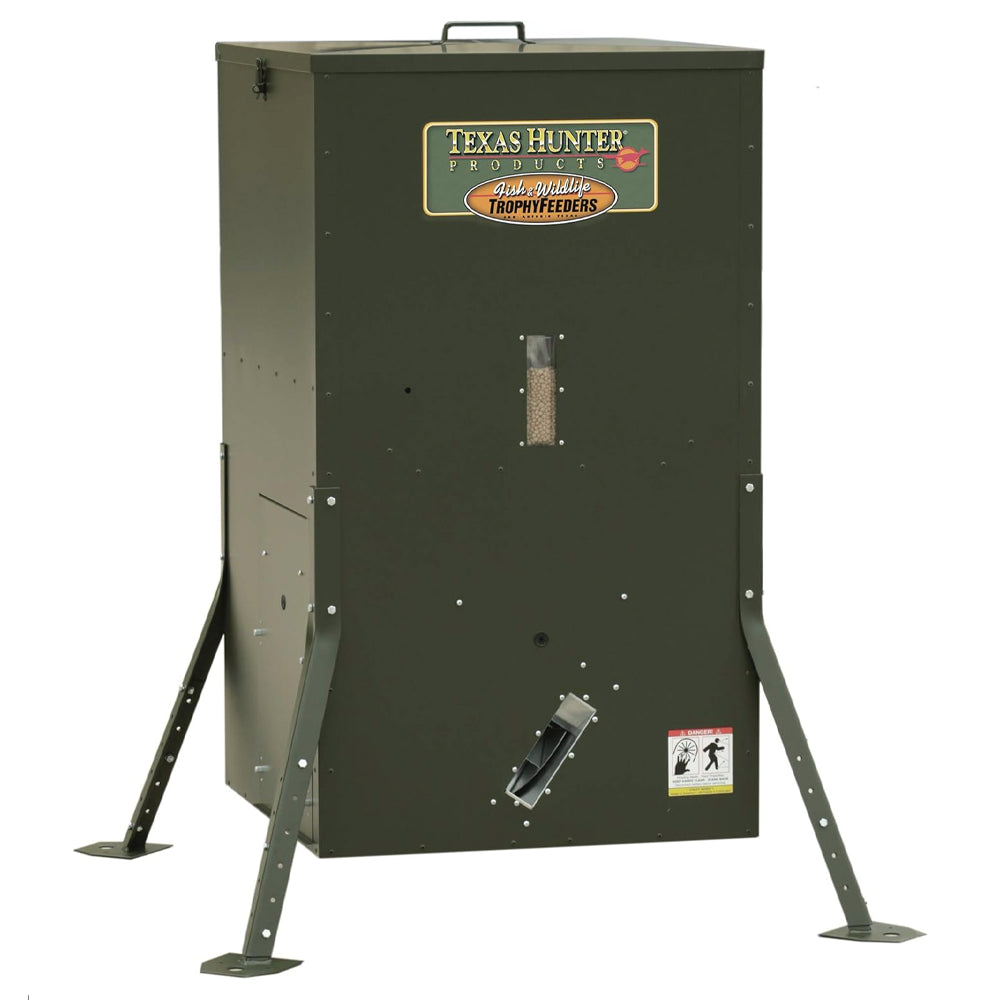
The 250 lb Texas Hunter, model DF425, is the top of the line: 250 lb of fish feed or 425 lb of corn in a 28-inch by 28-inch by 50-inch hopper of heavy 20-gauge galvanized steel with a hunter-green powder-coated finish. It keeps the same directional blower, the same 45-foot by 20-foot wedge, and the same DFT12 timer, but it adds a low-profile 11-gauge powder-coated steel leg set, a quick-release access panel with a clear-view funnel, two sight gauges readable from either side, and a fill height under five feet so you can fill it without a ladder. Retailers describe it as the right size for ponds and lakes over one acre, for monthly refill targets, and for camp and community docks where several people fish the same feeding zone.
The engineering detail worth knowing is the two-motor design. One motor runs the centrifugal air blower and the other manages feed release, and the blower reaches full speed before feed is released. That is what keeps feed from dribbling out at the base of the feeder and piling up where fish do not feed and raccoons do. The lid locks, the timer and battery doors lock, and the leg footpads let you bolt the unit to a pier or dock, with four heavy-duty stakes included for bank setups. The solar charger is still an add-on on the standard versions, and on a feeder this size it is close to mandatory: a 250 lb feeder that stops because of a dead battery wastes the whole point of buying big.
✅ Pros
- Largest capacity in the line: 250 lb of fish feed
- Under 5 ft tall, so filling does not need a ladder
- Lockable lid, timer door, and battery door; bolt-down footpads and bank stakes
- Two sight gauges and a clear-view funnel for easy level checks
- Same 45 ft x 20 ft wedge that concentrates fish in one fishable zone
❌ Cons
- The most expensive and heaviest feeder in this guide
- Needs a solid dock or well-prepared bank footing
- Solar charger sold separately on standard versions
- Far too much feeder for a small or lightly stocked pond
🧑🌾 From the field: As with the 175 lb model, we found no detailed independent owner write-ups specific to the 250 lb size that we could verify when this guide was written. Verified owner feedback for the family comes from the 70 lb model and concerns the shared blower, timer, and build quality. Dealer listings for the 250 lb size emphasize the same points owners praise on the smaller model: the throw pattern, the lockable construction, and the set-and-forget timer once solar is added.
| Spec | Detail |
|---|---|
| Capacity | 250 lb fish feed / 425 lb corn |
| Hopper dimensions | 28 in. wide x 28 in. long x 50 in. high |
| Feed pattern | Directional wedge, 45 ft long x 20 ft wide |
| Timer | DFT12 digital, 1–9 feedings/day, 1–60 seconds each |
| Power | 12V rechargeable battery included; SP2W solar charger optional |
| Mounting | Straight dock legs (DF425DL) or adjustable bank legs (DF425AL); footpads and stakes included |
| Construction | 20-gauge galvanized steel, powder-coated; lockable lid, timer door, and battery door |
| Warranty | Feeder 1 year; DFT12 timer 5 years limited |
Verdict: The right feeder for big water, heavy stocking, or a shared dock where refills are a chore. Add the solar charger at purchase.
4. Moultrie 30-Gallon Quick-Lock Directional Tripod — Best budget directional feeder
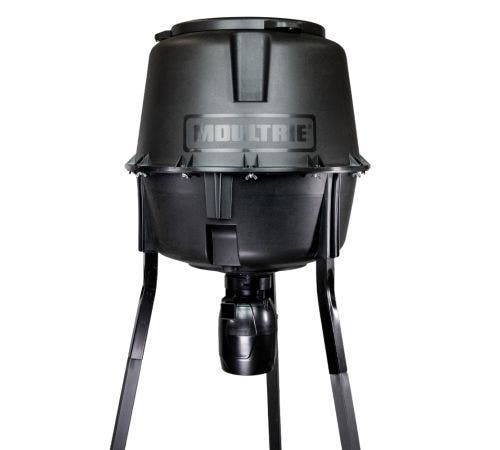
Moultrie’s 30-Gallon Fish & Deer Quick-Lock Directional Tripod, SKU MFG-13281, is the budget way into directional pond feeding, and it is also the only feeder in this guide that genuinely does double duty for deer. The 30-gallon UV-resistant polymer hopper holds up to 200 pounds of corn, and the included Quick-Lock Directional Feeder Kit casts feed in a narrow 30-degree path rather than a full circle. Moultrie describes it as ideal for feeding into ponds or along roads and trails, and the leg brackets are angled more narrowly than on its broadcast tripods so the feeder can sit well on a dock or a pond bank. The fill height is six feet, so you can fill it from ground level, and assembly is tool-free.
The timer programs up to 10 feedings a day at 1 to 60 seconds each, and an agitating spinner plate breaks up clumps before feed is cast, which Moultrie says makes it well suited to fish feed and similar textured feeds. It runs on one 6-volt 5Ah battery, sold separately, with an external power port for a solar accessory. Two honest cautions belong here. First, Moultrie rates this feeder in corn, so confirm the fish-pellet capacity with Moultrie before assuming it holds 200 lb of pellets; it will hold less by weight, as Pond King explains for the industry generally. Second, this is a polymer tripod, not a steel hopper: it is lighter and cheaper, and it will not feel as bulletproof as a Texas Hunter. For a pond owner who also hunts deer and wants one feeder design for both jobs, that trade is easy to accept.
✅ Pros
- Lowest-cost directional feeder in this guide; Moultrie’s own site listed it at $179.99 (checked October 2026)
- Dual purpose: casts into ponds and along trails for deer
- Up to 10 feedings a day, 1–60 seconds each
- Tool-free assembly; 6 ft fill height
- Agitating spinner plate reduces clogs from textured fish feed
❌ Cons
- Battery sold separately; solar accessory sold separately
- Rated in corn (200 lb) — fish-pellet capacity will be lower
- Narrow 30-degree path covers less water than Texas Hunter’s 45 ft x 20 ft wedge
- Polymer hopper is lighter duty than steel directional feeders
🧑🌾 From the field: We found few independent owner reviews specific to this directional tripod that we could quote when this guide was written, and we will not dress up retailer marketing copy as owner experience. What is verifiable is Moultrie’s own positioning: this feeder exists because its broadcast tripods waste feed when all you need is one direction, and the directional kit is the fix. If you already run Moultrie tripods for deer, the shared Quick-Lock system and familiar timer are a genuine advantage.
| Spec | Detail |
|---|---|
| Capacity | 30 gallons; up to 200 lb of corn (confirm pellet capacity with Moultrie) |
| Feed pattern | Directional, narrow 30-degree path |
| Timer | Digital, up to 10 feedings/day, 1–60 seconds each |
| Power | One 6V 5Ah battery (sold separately); external solar port |
| Mounting | Tripod with narrowly angled leg brackets for docks and banks |
| Construction | UV-resistant tapered polymer hopper; 6 ft fill height |
| Price snapshot | $179.99 on moultrie.com (checked October 2026) |
Verdict: The best value directional feeder, and the natural pick if you already feed deer with Moultrie tripods. Budget for the battery and, ideally, a solar panel.
5. Moultrie 6.5-Gallon FeedCaster Fish Feeder — Best hanging dock feeder
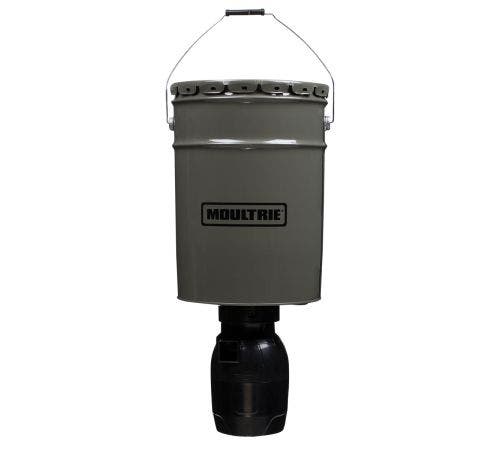
The Moultrie FeedCaster is the small, hanging answer to pond feeding: a 6.5-gallon metal bucket with a weathered dock finish that holds up to 50 lb of feed and hangs from a plant hook, nail, or small chain. A directional shroud casts fish food in a straight path out to about 25 feet, which is enough to clear a dock and put feed on open water without throwing it across the pond. The digital timer programs up to 6 feed times a day at 1 to 20 seconds each, and the unit runs on one 6-volt battery. It is solar-panel ready, and Moultrie’s own solar panel or Feeder PowerPanel extends battery life.
The FeedCaster’s own manual adds useful detail: the feeder ships factory-set to feed at 7:00 AM and 6:00 PM for six seconds, the battery level is displayed every seven seconds, and Moultrie recommends replacing the battery when the reading falls to 25 percent or below. It also includes a spill guard to keep feed off the dock. That spill guard matters more than it sounds: feed rotting on dock boards draws raccoons and rats, and a feeder that keeps the dock clean is a feeder you will keep using. The honest limitation is capacity and throw. Fifty pounds and 25 feet suit a small pond, a cove, or a dock fishing spot; they do not suit a two-acre lake, and a hanging bucket is easier for a determined raccoon to investigate than a locking steel hopper, so hang it where you can see it and where the shroud points at water.
✅ Pros
- Hangs anywhere: hook, nail, or chain, no legs or footing needed
- Directional shroud throws a straight path to about 25 ft
- Spill guard keeps feed off the dock
- Simple timer with factory presets (7 AM and 6 PM, 6 seconds)
- Attractive metal bucket that suits a residential dock
❌ Cons
- Only 50 lb capacity and 6 feedings a day, versus 9–10 on bigger feeders
- 25 ft throw is short for large ponds
- 6V battery and solar panel sold separately
- Hanging design is less varmint-proof than a locking steel hopper
🧑🌾 From the field: We found few independent owner reviews specific to the FeedCaster that we could quote when this guide was written, so this section stays factual: the manual, not marketing, is the source for the factory settings, battery display, and spill guard described above. Older roundups have repeatedly picked this feeder as an editor’s choice for small ponds, which tells you more about how long it has been around than about any single owner’s experience.
| Spec | Detail |
|---|---|
| Capacity | 6.5 gallons; up to 50 lb of feed |
| Feed pattern | Directional shroud, straight path to about 25 ft |
| Timer | Digital, up to 6 feedings/day, 1–20 seconds each; factory preset 7 AM and 6 PM for 6 seconds |
| Power | One 6V battery; solar-panel ready (Moultrie solar panel or Feeder PowerPanel, sold separately) |
| Mounting | Hanging: plant hook, nail, or small chain; spill guard included |
| Construction | Metal bucket with Weathered Dock finish |
Verdict: The best hanging feeder for a small pond or a single dock fishing spot. Cheap to buy, easy to hang, and limited in exactly the ways its size suggests.
6. Sweeney Koi Cafe Automatic Koi Feeder — Best for koi and garden ponds
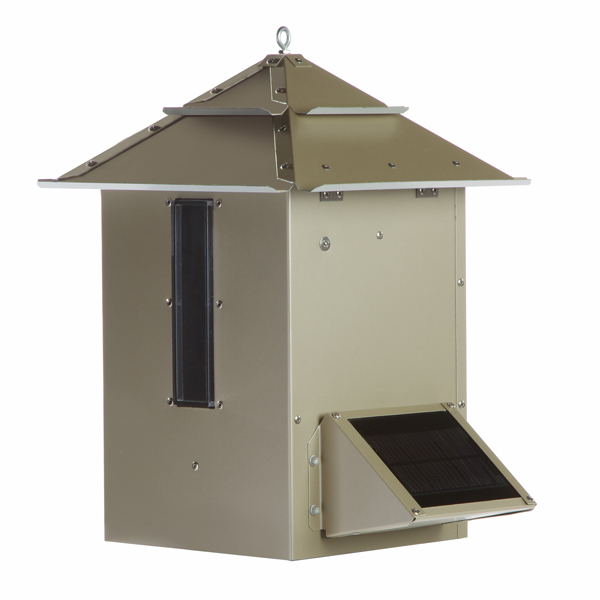
The Sweeney Koi Cafe is the only feeder in this guide designed for ornamental ponds rather than sport-fish ponds, and that changes everything about it. It holds up to 10 lb of standard koi food in a compact 16-inch by 16-inch by 17-inch housing weighing 13 lb, and it hangs over a koi pond or water garden. Its premium AFT3 timer feeds up to 24 times a day, far more often than any sport-fish feeder, because koi and goldfish do best on many small meals rather than two big ones. An adjustable feed-flow lever and a per-feeding duration setting let you dial in a small, consistent portion, and a built-in sight gauge shows the feed level at a glance.
It runs on a 6-volt rechargeable battery, and the battery charger is sold separately, which is an easy detail to miss at checkout. The optional SX6 solar charger, in a matching colored cover, keeps the battery topped up and is the practical choice for a feeder that runs all season. It comes in three colors, Oriental Red, Hartford Green, and Champagne, so it can sit visibly in a landscaped garden without looking like farm equipment. The limitation is obvious: 10 lb of food and a small throw suit a backyard pond, not a farm pond. It is also worth noting the conflicting capacity notes in retailer listings, which describe both 10 lb and 4 to 6 lb depending on pellet size and density. Treat 10 lb as the headline rating and expect less with large, light pellets.
✅ Pros
- Up to 24 small feedings a day, ideal for koi and goldfish
- Adjustable flow lever for precise small portions
- Sight gauge, 6V rechargeable battery, optional solar charger
- Compact and garden-friendly in three colors
- Hangs over the pond, so no dock or bank construction needed
❌ Cons
- Only about 10 lb capacity; useless for sport-fish ponds
- Battery charger sold separately; solar charger sold separately
- Retailer listings disagree on capacity by pellet type (10 lb headline vs. 4–6 lb for some feeds)
- Small throw; must hang directly over the feeding area
🧑🌾 From the field: We found few independent owner reviews for the Koi Cafe that we could quote when this guide was written, so we rely on the retailer and manufacturer specifications above. The design itself tells the story: a feeder with 24 daily feedings and a flow lever is built for owners who watch their fish eat and adjust portions by eye, which is exactly how koi keepers feed.
| Spec | Detail |
|---|---|
| Capacity | Up to 10 lb of koi food (retailers note 4–6 lb for some pellet types) |
| Feed pattern | Hanging broadcast over the pond below the feeder |
| Timer | Premium AFT3 timer, up to 24 feedings/day |
| Power | 6V rechargeable battery included; charger sold separately; optional SX6 solar charger |
| Mounting | Hanging over koi pond or water garden |
| Dimensions | 16 in. long x 16 in. wide x 17 in. high; 13 lb |
| Colors | Oriental Red, Hartford Green, Champagne |
Verdict: The only sensible pick in this guide for a koi or goldfish pond. Buy the charger and the solar panel with it, not after it.
7. Sweeney 125 lb Automatic Directional Feeder — Best for precise pellet feeding
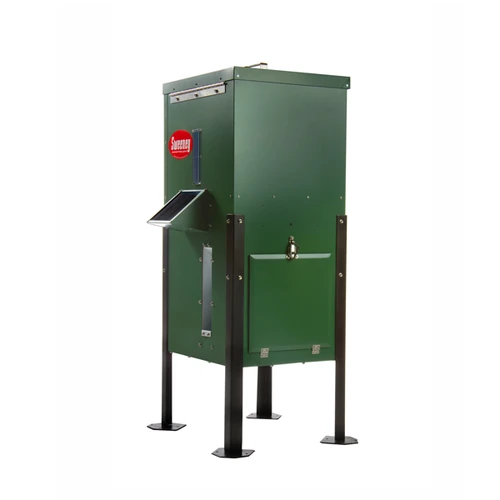
Sweeney’s 125 lb Automatic Directional Feeder is the precision instrument of this guide. Where Texas Hunter uses a centrifugal blower, Sweeney uses an auger to move feed from the hopper to an impeller, which then blows it into the water. The company says the auger is precise and consistent and will not damage the feed, and the vertical impeller broadcasts feed between 5 and 50 feet in a pie-shaped pattern covering about 30 degrees of arc. That adjustable distance matters: on a small dock you can throw 10 feet, and on a big pond you can throw 50, with adjustable motor speeds and casting distances for each feeding.
The premium timer feeds up to 24 times a day with customizable duration, adjustable motor speeds, and a built-in battery tester, and the version we link includes the solar charger, with solar panel ports on all sides of the feeder. It handles a wide range of feed sizes, 1/8-inch to 1/2-inch pellets, on a 12-volt battery, and the dock version has straight legs with pads and anchoring hardware for mounting to a dock. Two cautions: the 125 lb rating is measured in corn, and Sweeney says so plainly, so fish pellets will weigh less per fill; and this is a dock feeder first, so if you have no dock you need the bank-leg version or a different feeder. For a pond owner who feeds expensive pellets and wants every pellet to land at a chosen distance, the auger design is the strongest argument in this guide.
✅ Pros
- Auger delivery is precise and gentle on pellets
- Adjustable throw from 5 to 50 ft, with per-feeding motor speed control
- Up to 24 feedings a day with a built-in battery tester
- Solar charger included on this version; solar ports on all sides
- Handles 1/8-inch to 1/2-inch pellets
❌ Cons
- 125 lb rating is in corn; pellet fills weigh less
- Dock-leg version needs a dock; bank setups need the other leg set
- Less widely stocked by US dealers than Texas Hunter or Moultrie
- No verified owner reviews found when this guide was written
🧑🌾 From the field: We found few independent owner reviews for this feeder when this guide was written, and we say so rather than inventing any. The verifiable evidence is the design: an auger plus impeller is a fundamentally more controlled delivery system than a spinner plate, and Sweeney’s own specifications emphasize that control in a way spinner-plate makers do not.
| Spec | Detail |
|---|---|
| Capacity | 125 lb (measured in corn; fish pellets somewhat less) |
| Feed pattern | Pie-shaped, about 30 degrees of arc, 5 to 50 ft |
| Delivery | Auger to vertical impeller |
| Timer | Premium timer, up to 24 feedings/day, customizable duration, adjustable motor speeds, battery tester |
| Power | 12V battery; solar charger included on this version |
| Pellet size | 1/8-inch to 1/2-inch pellets |
| Mounting | Straight dock legs with pads and anchoring hardware |
Verdict: The pick for pond owners who feed costly pellets and want exact control over distance and portion. Confirm the leg set matches your dock or bank before ordering.
8. Pond King Floating Fish Feeder — Best for fluctuating water levels
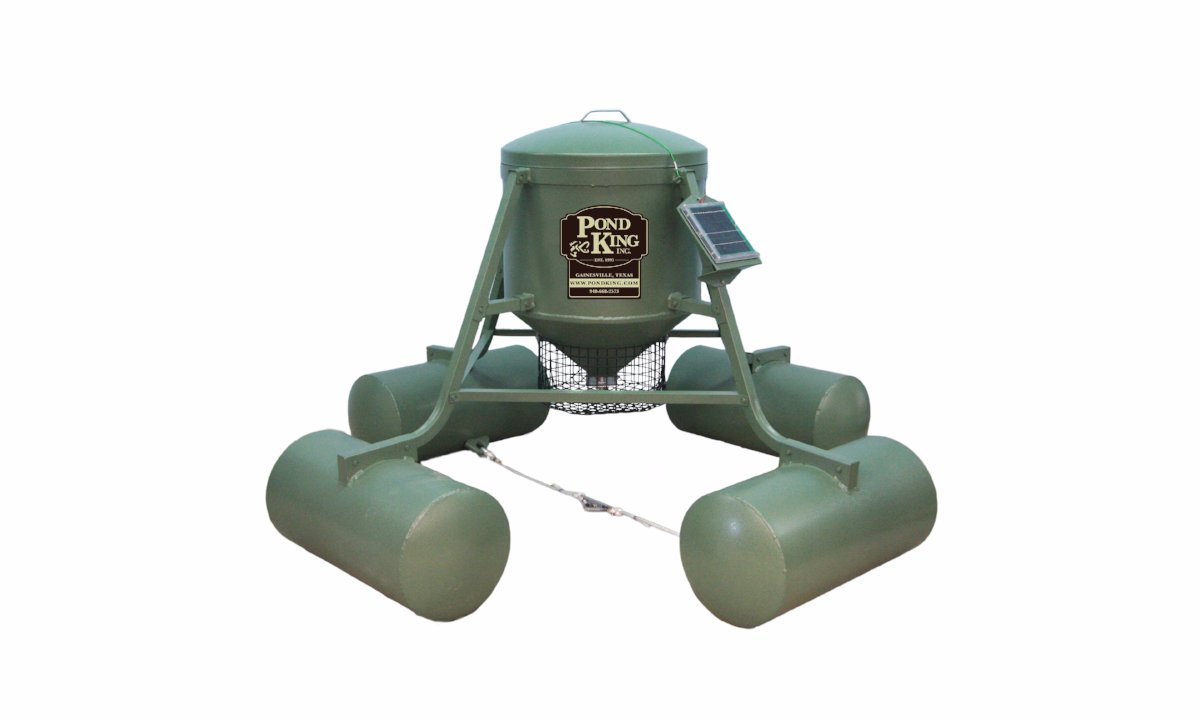
The Pond King Floating Fish Feeder solves a problem none of the other feeders in this guide even address: water that does not stay put. It floats on a 6-foot by 6-foot footprint, stands 45 inches tall, and holds 100 lb of feed in an all-aluminum, welded, powder-coated body and floats. Because it rides the water, feed always lands the same distance from the feeder whether the pond is high or low, and Pond King says plainly that this is why a floating feeder wastes less feed on ponds with changing levels than a fixed dock or bank feeder. You refill it by pulling it to the shoreline with a rope-and-pulley system or by boat, which is more work than walking up to a bank feeder, and it ships by freight on a pallet rather than by ground parcel.
The feeder dispenses most of its feed directly beneath itself, with some feed going about 3 feet from the center, so it feeds the fish gathered under and around it rather than painting a wide wedge across the pond. Its programmable timer allows up to 6 feedings a day at 1 to 30 seconds each, it throws pellets up to 3/4 inch, and the 12-volt battery and solar panel are included in the purchase, along with a varmint guard. Pond King recommends feeding twice a day, morning and evening, for 3 to 5 seconds per feeding, which dispenses about 1.5 lb per feeding or roughly 100 lb per month, and it repeats the rule every pond owner should memorize: if fish are not eating all the feed within 10 to 15 minutes, you are feeding too much. The body carries a 5-year structural integrity warranty, the timer a 5-year warranty, and the motor and remote parts a 1-year warranty.
✅ Pros
- Rides rising and falling water, so the feed pattern never changes
- 100 lb of true pellet capacity (rated in pellets, not corn)
- Solar panel, rechargeable battery, and varmint guard included
- All-aluminum welded body; 5-year structural warranty
- Can be placed over open water or submerged structure where fish hold
❌ Cons
- Refilling needs a rope-and-pulley pull or a boat trip
- Ships by freight on a pallet, not by ground parcel
- Feed lands mostly beneath the feeder, not across a wide zone
- Only 6 feedings a day, versus 9–24 on other feeders here
- Pond King ships only to physical addresses in the continental US
🧑🌾 From the field: Pond King’s own site publishes owner accounts, including a buyer who installed the floating feeder on a 5-acre pond in New York stocked with pellet-trained largemouth bass, hybrid bluegill, and channel catfish, and reported that the package arrived by freight without a problem and that the construction quality was top notch. Another buyer praised the company and the build quality of its feeders generally. These are manufacturer-published testimonials, so read them as such, but they agree with the design case: this is a heavy, well-built feeder for owners who would rather pay for aluminum once than replace a cheaper feeder every few years.
| Spec | Detail |
|---|---|
| Capacity | 100 lb of feed |
| Dimensions | 6 ft x 6 ft footprint, 45 in. tall |
| Feed pattern | Spin cast, mostly directly beneath the feeder, some feed to about 3 ft |
| Timer | Programmable, up to 6 feedings/day, 1–30 seconds each |
| Power | 12V battery with solar panel included |
| Pellet size | Up to 3/4-inch pellets |
| Construction | All-aluminum, welded, powder-coated body and floats; varmint guard included |
| Warranty | 5-year structural integrity; timer 5 years; motor and remote parts 1 year |
| Shipping | Freight on a pallet; continental US physical addresses only |
Verdict: The only feeder in this guide for ponds whose level moves. If your water is stable, a cheaper bank or dock feeder does the same job for less money and less refill effort.
Watch: directional fish feeders in action
Both videos below show Texas Hunter directional feeders, which are the best visual introduction to how a blower feeder throws feed, because a spinner feeder is harder to judge from a photo.
Directional Fish Feeders for Ponds and Lakes by Texas Hunter Products
An overview of Texas Hunter’s directional fish feeder line for ponds and lakes.
Directional Fish Feeder Activated
Short clip of a directional fish feeder running, showing the wedge pattern on the water.
Pond fish feeding vs. deer feeding: what changes
Many readers arrive here from deer feeding, and the two jobs look similar from the bank: a hopper, a timer, a motor, and feed on a schedule. Almost everything else is different, and buying a deer feeder for a pond without understanding the differences is how feed ends up on the ground, in the mud, or rotting uneaten.
First, the feed itself is different. Deer feeders throw shelled corn, protein pellets, or both, and deer eat on land where spilled feed stays available. Pond fish eat floating pellets, sinking pellets, or both, and uneaten feed sinks, decays, and loads the pond with nutrients. That is why pond-feeding advice always comes back to the same rule: feed only what fish eat in about 10 to 15 minutes, and cut back the moment feed is left over. Pond King gives that rule explicitly, and the Texas A&M AgriLife Extension Service’s ornamental pond guidance makes the same point from the other side, warning that overfeeding is a common problem and that maintenance feeding of about 1 percent of body weight per day is typically enough for healthy fish, with growth feeding around 3 percent.
Second, the delivery pattern is different. A deer broadcast feeder throws a 360-degree circle because deer approach from any direction. On a pond, a 360-degree circle wastes half the feed on the bank. That is why pond feeders are directional: Texas Hunter throws a 45-foot by 20-foot wedge, Moultrie throws a narrow 30-degree path, and Sweeney throws a 30-degree arc. Moultrie itself explains the distinction on its feeder-kit page: a broadcast kit casts a full circle for general coverage, while a directional kit narrows that cast into a single path suited to feeding along a trail or into a pond. If you already own a broadcast deer feeder, you can sometimes convert it with a directional kit rather than buying a whole new feeder, which is worth checking before you spend.
Third, the schedule is different. Deer feeding concentrates on dawn and dusk, when deer move. Pond fish do best on several small feedings spread through the day: Pond King recommends twice a day for most ponds but builds timers that allow six, Texas Hunter allows nine, and Sweeney allows twenty-four for koi. More, smaller feedings also protect water quality, because one huge feeding spikes ammonia and oxygen demand while several small ones spread the load. A pond-feeding article that tracks this in detail reports that splitting the daily ration into 5 to 8 small feedings reduces peak ammonia load on the biofilter and gives subordinate fish a better chance to eat.
Fourth, the power and placement problems are different. A deer feeder stands in a field where you can drive to it. A pond feeder stands on a dock, a sloped bank, or open water, where a dead battery means a boat trip or a wade, not a walk. That is why solar chargers matter more for pond feeders than for most deer feeders, and why a floating feeder exists at all: water levels move, and a feeder that cannot move with them ends up throwing feed from the wrong height or onto a mud flat.
Finally, the animals you are feeding behave differently. Pond King notes that unless they are trained from a juvenile age, largemouth bass will not eat pellets at all; you feed the forage fish, bluegill and catfish, and the bass benefit by eating bigger forage fish. Deer feeding has no equivalent: you feed the animal you want to attract. And while deer feeding raises questions about baiting rules that vary by state, pond feeding raises questions about stocking, species, and transport rules that also vary by state. We do not state any state’s rules here, because they change and they differ: check your own state wildlife agency before stocking or moving fish.
What a pond fish feeder really costs
The feeder is the cheapest part of pond feeding over time. Feed is the ongoing cost, and the feeder you choose changes how much feed you waste, which is where the real money goes.
| Cost item | What owners report | Notes |
|---|---|---|
| Feeder | Varies widely by size and construction, from a small hanging feeder to a large steel directional feeder | Check the retailer page for the current price; we omit prices we could not verify on a live page when this guide was written |
| Solar charger | Sold separately on Texas Hunter and Moultrie standard versions; included on Pond King feeders and the linked Sweeney 125 lb version | The add-on that most often pays for itself by ending battery-hauling trips |
| Batteries | 6V or 12V rechargeable, depending on feeder; replacement every few seasons | Solar charging extends battery life; a battery allowed to run flat repeatedly dies sooner |
| Fish feed | Pond King estimates about 100 lb per month at two feedings a day, 3–5 seconds each | Your usage depends on stocking density, pellet size, and season; buy feed in quantities you will use before it goes stale |
| Wasted feed | Uneaten feed is the hidden cost: it feeds algae, not fish | A directional pattern and a 10–15 minute rule cut waste more than any feeder upgrade |
| Freight (floating feeders) | Pond King’s floating feeder ships by freight on a pallet | Budget for freight and for a lift-gate residential delivery if you buy a floating feeder |
The takeaway: a feeder that throws feed precisely where fish eat, on a schedule fish can learn, and on solar power you never think about, is cheaper over three seasons than a cheap feeder that wastes feed, kills batteries, and needs replacing. Spend on the delivery pattern and the power system first, and on hopper size second.
How to choose a fish feeder for your pond
Match the feeder to the fish, not just the pond
Bluegill, channel catfish, and hybrid striped bass are the classic pellet-fed pond species, and they feed at the surface, which is why floating pellets and surface delivery work. Koi and goldfish need small, frequent meals and a gentle feeder. Largemouth bass generally will not eat pellets unless trained young, so if bass are your goal, feed the forage fish and let the bass eat them. If you are unsure what your fish will eat, start with a small floating pellet and watch: fish that eat within minutes are trained; fish that ignore pellets need time or a different approach, and no feeder fixes that.
Floating pellets, sinking pellets, or both?
Floating pellets let you see fish eat, judge portions, and stop before you overfeed, which is why most pond owners prefer them. Sinking pellets suit species that feed deeper and ponds where surface-feeding birds steal floating feed, but you cannot see what is eaten, so overfeeding is easier. Texas Hunter’s directional feeders handle floating pellets, sinking pellets, and shelled corn, and Sweeney’s directional feeder handles 1/8-inch to 1/2-inch pellets, so pellet choice rarely limits the feeder; it limits how you judge portions. Whichever you feed, match pellet size to fish mouth size: Pond King throws up to 3/4-inch pellets, which suits large catfish and bluegill, while koi keepers feed much smaller pellets through the Koi Cafe.
Power and timers: the two specs that decide whether you actually use it
A feeder with a dead battery is a decoration. Solar is the difference between a feeder you set in spring and ignore until fall and a feeder you service every few weeks, and it matters most on ponds you visit rarely. On timers, more feedings are not automatically better: what matters is that the timer can deliver small portions several times a day and that you can adjust duration in seconds, not just the number of feedings. Texas Hunter gives 1 to 60 seconds per feeding, Moultrie’s tripod gives 1 to 60 seconds, its FeedCaster gives 1 to 20 seconds, Pond King gives 1 to 30 seconds, and Sweeney’s premium timers allow up to 24 feedings a day. If your pond is a weekend property, prioritize solar and a timer you can set and forget. If you live on the pond and watch fish eat, a simpler timer is fine.
Where you put it matters as much as what you buy
Put a directional feeder where its pattern lands entirely on water, with the fish’s holding area inside the pattern: near structure for bluegill, over open water for hybrid striped bass, and near your dock if you want a fishing spot. Keep the feeder reachable for refills, because a feeder you dread refilling will run empty. On a fixed dock, remember that falling water levels change the throw geometry; on a bank, level the legs and stake the feeder so it cannot creep toward the water. And keep feed dry: a hopper lid that does not seal, or feed stored damp, clogs blowers and augers alike, which is the most common cause of a feeder that “stopped working” when nothing actually broke.
Resources
- Best Deer Feeders 2026: 16 Top-Rated Models Compared — our main buying guide, for readers who feed deer as well as fish
- Best Gravity Deer Feeders — gravity feeding compared with the powered feeders in this guide
- Best Tripod Deer Feeders — tripod designs, including Moultrie’s Quick-Lock system
- Best Deer Feeder Timer — timer features that carry over to pond feeders
- Best Protein Deer Feeders — protein pellets versus the fish pellets discussed here
- Keep Raccoons, Hogs, and Pigs Off Your Deer Feeder — varmint-proofing lessons that apply to pond feeders too
- Deer Feeder Solar Panel — solar power for feeders, the upgrade most pond owners should buy
- Best Deer Feeder With Camera App Control — app-controlled feeding, for readers who want remote control
- Moultrie Feeder Kits Explained — Moultrie’s own comparison of gravity, broadcast, directional, and auger kits
- Pond King Automatic Fish Feeders — floating and mounted feeder details and feeding guidance
- Texas Hunter Fish Feeders — the manufacturer’s directional feeder line
- Texas Parks & Wildlife Department — an example state wildlife agency; check your own state’s agency for stocking and transport rules before moving fish
Frequently asked questions
What is the best fish feeder for a pond?
For most private ponds, a directional feeder is the best choice, because it throws feed onto the water instead of scattering it on the bank. The Texas Hunter 70 lb Directional Fish Feeder is our top pick for ponds up to about half an acre; larger ponds suit its 175 lb and 250 lb versions, and ponds with fluctuating water levels suit the Pond King Floating Fish Feeder.
How much does a fish feeder for a pond cost to run?
The feeder itself is a one-time cost, but feed is the ongoing expense. Pond King estimates about 100 lb of feed per month at two feedings a day of 3 to 5 seconds each. Add battery replacements every few seasons, and a solar charger if your feeder does not include one. The biggest hidden cost is wasted feed, which is why a precise throw pattern and the 10 to 15 minute rule matter.
Directional vs. broadcast: which is better for a pond?
Directional is better for ponds in almost every case. A broadcast feeder throws a 360-degree circle, so feed thrown toward the bank lands on land and is wasted. A directional feeder throws a wedge or narrow path onto the water. Broadcast makes sense only when the feeder sits over open water, such as a floating feeder or a feeder mounted above the pond.
What size fish feeder do I need for a 1-acre pond?
A 1-acre pond suits the Texas Hunter 175 lb or 250 lb directional feeder, or the Pond King Floating Fish Feeder at 100 lb. The right size depends on stocking density and how often you want to refill: a heavily stocked pond eats through a 70 lb feeder fast, while a lightly stocked pond does not need 250 lb of feed sitting in a hopper for months.
Can I use a deer feeder as a fish feeder?
Sometimes. Moultrie’s directional tripod is explicitly sold for both fish and deer, and some broadcast deer feeders can take a directional kit. But a standard broadcast deer feeder throws feed in a circle, so much of it lands on the bank, and deer feeders are rated in corn, not fish pellets. A dedicated directional pond feeder is usually the better buy.
What do pond fish eat from an automatic feeder?
Most pond fish eat floating or sinking pellets sized to their mouths. Bluegill and channel catfish take floating pellets readily. Koi and goldfish eat small pellets, ideally in many small meals. Largemouth bass usually will not eat pellets unless trained from a young age; instead, feed the forage fish and let bass eat them.
How often should I feed pond fish?
Most ponds do well with two feedings a day, morning and evening. Pond King recommends that schedule, while its timers allow up to six feedings. Texas Hunter allows nine and Sweeney up to twenty-four for koi. Smaller, more frequent feedings are gentler on water quality than one large feeding. Always feed only what fish eat in about 10 to 15 minutes.
Do fish feeders need solar panels?
Not strictly, but solar is the upgrade most pond owners should buy. Pond feeders sit on docks, banks, or open water where hauling a battery home is a chore, and a dead battery means missed feedings. Pond King includes solar panels, and Sweeney’s linked directional version includes one; Texas Hunter and Moultrie sell solar as an add-on.
When should I stop feeding pond fish for winter?
Feed less as water cools and stop when fish stop eating actively. Extension guidance for ornamental ponds notes that fish should be fed sparingly above 85°F and that feeding should be reduced or stopped in cooler winter months when metabolism slows. Retailer feeding guides commonly use about 55°F as the spring start and fall stop point for koi and goldfish. Watch your fish rather than the calendar: if they ignore feed, stop feeding.
Will a fish feeder attract raccoons?
It can, especially a feeder that spills feed on a dock or bank. Lockable lids, lockable timer and battery doors, varmint guards, and a floating feeder that sits away from shore all help. The Texas Hunter line locks its lid, timer door, and battery door, and Pond King includes a varmint guard. Keeping the area clean matters as much as the feeder design: spilled feed is what brings pests.
Can a fish feeder run on a pond with no dock?
Yes. Bank-leg feeders such as the Texas Hunter adjustable-leg versions stand on a sloped shoreline, hanging feeders such as the Moultrie FeedCaster hang from a post or hook, and the Pond King Floating Fish Feeder needs no shore structure at all. Choose the mounting style that matches your shoreline before you choose a brand.
Do I need a permit to stock fish in my pond?
It depends on your state, the species, and where the fish come from. Rules vary widely and change, so we do not state any single state’s rules here. Check your own state wildlife agency before stocking, transporting, or introducing a new species, and buy fish from a licensed hatchery in your state when possible.
Final verdict
Buy the Texas Hunter 70 lb Directional Fish Feeder if you have a typical private pond with a dock or a stable bank, and add the solar charger. Step up to the 175 lb or 250 lb version if refills are your bottleneck, not throw distance, because the throw is the same. Buy the Moultrie 30-Gallon Quick-Lock Directional Tripod if budget matters or if you want one feeder design for deer and fish. Buy the Moultrie FeedCaster if your water is small and you want a hanging feeder on a dock. Buy the Sweeney Koi Cafe if your pond is ornamental and your fish are koi or goldfish. Buy the Sweeney 125 lb directional feeder if you feed expensive pellets and want auger precision. Buy the Pond King Floating Fish Feeder if your water level moves.
Whichever feeder you choose, set it to throw only what your fish eat in 10 to 15 minutes, put solar on it so it never misses a feeding, and check your own state wildlife agency before stocking or moving fish. A feeder is a tool for consistent feeding; the fish, the water, and the schedule do the rest.
Check the top pick on Amazon →
Last updated: October 25, 2026.
Products mentioned in this guide
See this product on Amazon
Check Price on Amazon →Confirm price and availability on AmazonSee this product on Amazon
Check Price on Amazon →Confirm price and availability on Amazon
Moultrie 40 lb Directional Hanging Feeder
Check Price on Amazon →Confirm price and availability on Amazon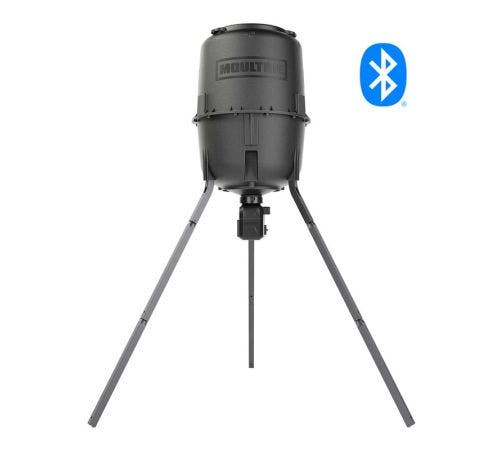
Moultrie Pro Hunter III Directional 250 lb Feeder
Check Price on Amazon →Confirm price and availability on AmazonAs an Amazon Associate, we earn from qualifying purchases.


