Best Spinner Deer Feeders (2026 Guide)
Disclosure: This post contains affiliate links. As an Amazon Associate, we earn from qualifying purchases at no extra cost to you.
On this page: Quick answer · At a glance · Pick in 30 seconds · How we picked · Moultrie 200 lb Standard · Pro Hunter III 250 · Pro Hunter III Directional · Wildgame Quick-Set 225 · American Hunter XDE-Pro · Boss Buck Stand & Fill 300 · Moultrie Connected 250 · Videos · Real cost · How to choose · Resources · FAQs · Verdict
Quick answer: the best spinner deer feeders
The best spinner deer feeders start with the Moultrie 200 lb Standard. It throws corn on a schedule you set from a phone app, runs on AA batteries so there is no 6V battery to buy or keep charged, and holds 200 lb of corn, which covers a month of visits on many properties. For most buyers, that combination of simple power, app control, and a mid-size hopper is the right place to start.
A spinner feeder, also called a spin-cast or timed feeder, is a feeder with a motor, a timer, and a spinning plate under the hopper. At the times you program, the motor spins the plate and throws corn or pellets out in a circle. That is the whole idea, and it is what separates a spinner from a gravity feeder, which lets deer eat freely from ports, and from a trough, which holds feed in the open. The comparison table below ranks seven timed spin-cast feeders, and the gravity models in this guide appear only as a contrast, never as ranked picks.
Read the reviews before you buy, because the differences that matter are not on the box. Feed counts per day, run lengths, battery type, and whether the timer is in the box decide whether a feeder fits your visit schedule. A feeder that throws four times a day is a different tool from one that throws ten times a day, and a feeder that runs on AA batteries asks for different care than one that needs a rechargeable 6V battery and a solar panel.
Three fast choices
Moultrie 200 lb Standard
The Moultrie 200 lb Standard is the spinner feeder to buy first because it runs on AA batteries, programs from a phone app, and holds enough corn for a month of visits on many properties.
Consider that its throw is shorter than 6V kits, so hang or mount it where deer already travel.
Moultrie Pro Hunter III 250
The Moultrie Pro Hunter III 250 is the timed feeder to buy when you want ten feeds a day, one to sixty second runs, and three spread speeds from a 250 lb hopper.
Consider that the rechargeable battery, solar panel, and feed are not in the box, so budget for them separately.
Boss Buck Stand & Fill 300
The Boss Buck Stand & Fill 300 is the spin feeder to buy when ladder refills are the part of feeding you dislike most, because it fills from the ground.
Consider that a 300 lb timed feeder still needs battery care and regular visits, even though filling it is easier.
These are use-case starting points, not claims of firsthand testing. Capacities below are maker claims, not measured refill intervals.
Best spinner deer feeders at a glance
Compare capacity and feed control first. The Deal column reuses only verified Amazon offers from this guide; a blank cell means no verified offer is listed here, never a guessed link.
| Product | Best for | Capacity | Type | Feed control | Deal |
|---|---|---|---|---|---|
| Moultrie 200 lb Standard | App control, AA power | 200 lb | Timed spin-cast | Up to 4 feeds a day, 1 to 20 seconds | Check Moultrie 200 lb price |
| Moultrie Pro Hunter III 250 | Most feed control | 250 lb | Timed spin-cast | Up to 10 feeds a day, 1 to 60 seconds | Check Pro Hunter III price |
| Moultrie Pro Hunter III Directional | Trails, ponds, and edges | Not stated separately | Timed spin-cast | Directional throw | Check Pro Hunter III Directional price |
| Wildgame Quick-Set 225 | Simple timed feeding | 225 lb | Timed spin-cast | Up to 4 feeds a day, fixed 5 to 20 seconds | Check Quick-Set 225 price |
| American Hunter XDE-Pro 30-Gallon | Many short feeds | 30 gallons | Timed spin-cast | Up to 16 feeds a day, 1 to 60 seconds | Check XDE-Pro price |
| Boss Buck Stand & Fill 300 | Ground-level filling | 300 lb | Timed spin-cast | Timed spin-cast with ground fill | Check Stand & Fill 300 price |
| Moultrie Connected 250 | App control from anywhere | 250 lb | Timed spin-cast | Cellular control through the app, subscription required | Check Connected 250 price |
See capacity at a glance
Advertised pounds, not measured refill intervals. The American Hunter XDE-Pro is sold by gallons, so it has no bar here; gallons are not converted to pounds in this guide. The Pro Hunter III Directional has no separately stated capacity in the sources checked, so it has no bar either.
Bar widths understate the stated capacities against the 300 lb maximum in this guide. They are a visual aid, not a measurement.
Pick a spinner feeder in 30 seconds
- Do you visit monthly or less? Pick a 250 lb or 300 lb hopper so a fill lasts between visits. Moultrie Pro Hunter III 250 or Boss Buck Stand & Fill 300.
- Do you hate charging batteries? Pick AA power and app programming. Moultrie 200 lb Standard.
- Do you want many short feeds a day? Pick the feeder with the most daily feeds and the shortest runs. American Hunter XDE-Pro offers up to 16 feeds a day.
- Do you fill alone, without a ladder? Pick ground-level filling. Boss Buck Stand & Fill 300.
This is a selection path, not an approval of any site or baiting practice. Check local rules before the first bag of corn goes in.
How we picked the best spinner deer feeders
We picked from timed spin-cast feeders with a verified offer and a maker-stated feed schedule. Every feeder in this guide has a motor, a timer, and a spinning plate, and every one is ranked on the same questions: how many feeds a day it can run, how long each run lasts, what powers it, how much it holds, and what owners report going wrong. Gravity feeders were kept out of the rankings on purpose. They are a different tool, and they appear here only where the contrast helps a buyer decide.
Three weaknesses in competing roundups shaped this guide. First, many roundups mix gravity and spinner feeders in one list, which hides the real choice between scheduled throwing and free-choice feeding. Second, many roundups print throw distances that no maker publishes, so this guide prints none; Boss Buck, for example, publishes no throw or spread distance, and neither do the other makers in this guide, so no distance appears here. Third, many roundups never say what is missing from the box, so each review below names the battery, solar panel, and feed situation plainly.
What we did not do matters too. Nobody on this site ran these feeders in a field test for this guide, and nothing here claims a hands-on result. Owner experience is paraphrased from retailer listings and the site’s own earlier guides, good and bad, and where owner reports are thin, the guide says so instead of filling the gap with invented praise. Capacities and feed schedules are maker claims, not measured refill intervals.
One timer note before the reviews. Moultrie Timer III is sold out at Amazon, and Moultrie Timer II is the in-stock option. That matters if you are buying a timer to replace a dead one, or if a feeder you already own needs a new control unit. Never buy a feeder on the assumption that a sold-out timer will come back; buy the feeder whose own timer and motor are in the box.
1. Moultrie 200 lb Standard — Best overall spinner deer feeder
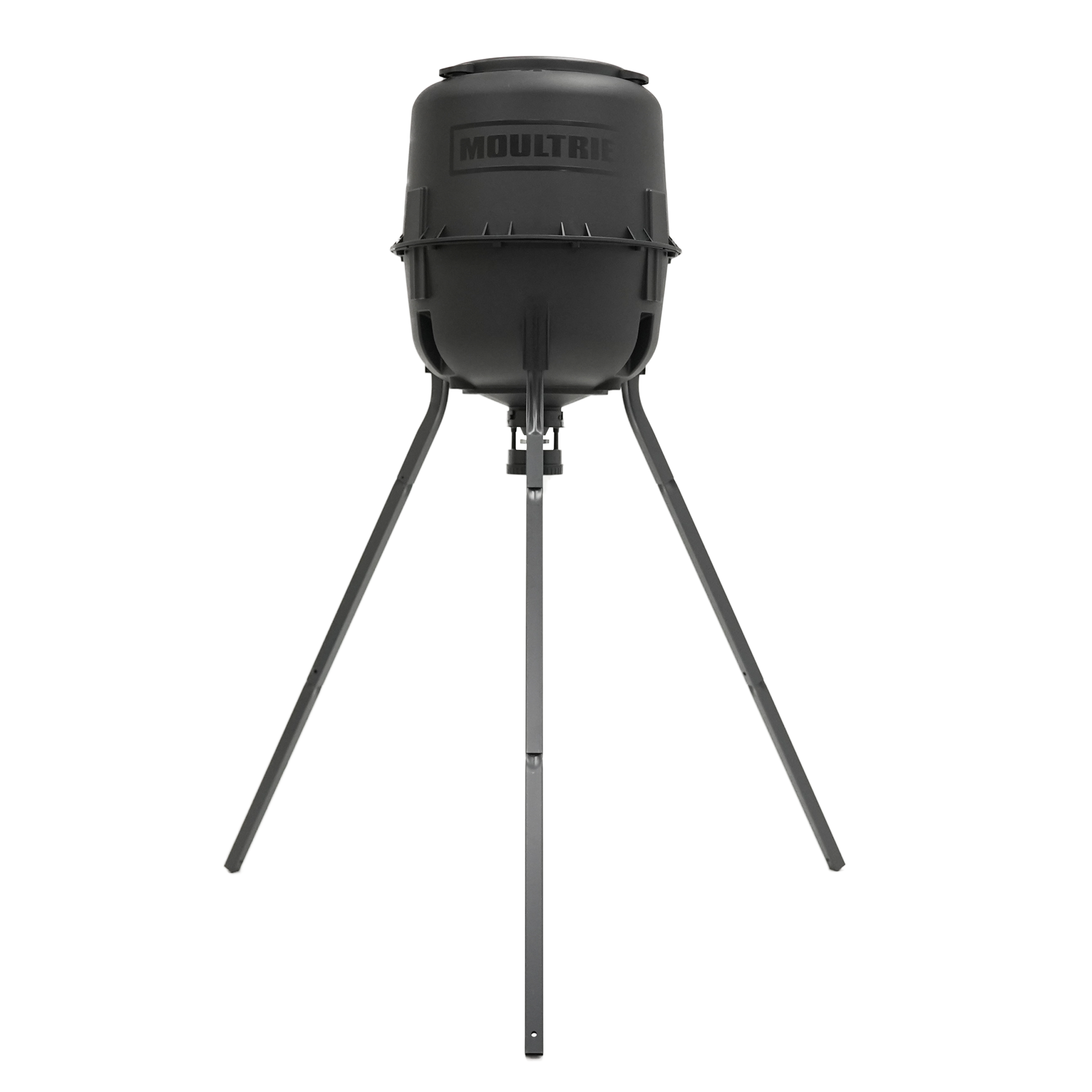
Our take: The Moultrie 200 lb Standard is the spinner feeder to buy first because it runs on AA batteries, programs from a phone app, and holds enough corn for a month of visits on many properties. It is the least demanding feeder in this guide to own: no rechargeable battery to remember, no solar panel to aim, and no control box to learn. You set up to four feeds a day, each lasting one to twenty seconds, and the feeder throws in a full circle.
The strengths are practical rather than flashy. AA power means a dead feeder is fixed with batteries from any store, not with a charger and a spare battery kept at home. Bluetooth app control means schedule changes happen from your phone at the site, without opening the control box in the rain. The 200 lb hopper is big enough that a monthly visit schedule works on many properties, and small enough that one person can fill it without help. Owner reports on retailer listings praise the app, which is the part of a feeder you touch most often.
The weaknesses are real and worth weighing. Consider that its throw is shorter than 6V kits, so hang or mount it where deer already travel. A shorter throw means the corn lands closer to the feeder, so placement matters more, not less. The feeder also has no factory varmint cage, so raccoons and hogs can work on it if they are already a problem on your land. Four feeds a day is enough for most schedules, but it is not the ten or sixteen that the more flexible feeders in this guide offer.
Pros
- Runs on AA batteries, so no rechargeable battery to buy or charge
- Bluetooth app control for schedule changes at the site
- 200 lb hopper suits a monthly visit schedule on many properties
- Full-circle throw spreads corn around the feeder
- Owner reports on retailer listings praise the app
Cons
- Throw is shorter than 6V kits, so placement matters more
- No factory varmint cage in the box
- Four feeds a day at most, fewer than the Pro Hunter III or XDE-Pro
- App control is Bluetooth range, not control from home
From the field: Retailer reviewers praise the app and the simple power setup, and the feeder earns its place as the site’s top overall pick across the money-page guide. The recurring watch-out is the shorter throw: owners who mount it over open ground where deer already travel report better results than owners who expect a long throw to pull deer in from a distance. Check the listing for the current in-box contents before ordering, because battery and accessory bundles change.
| Spec | Detail |
|---|---|
| Capacity | 200 lb |
| Feeds per day | Up to 4 |
| Run length | 1 to 20 seconds |
| Power | AA batteries |
| Control | Bluetooth app |
| Throw pattern | Full circle, 360 degree spread |
| Varmint cage | Not included |
Check Moultrie 200 lb Standard on Amazon
2. Moultrie Pro Hunter III 250 — Best spinner deer feeder for control
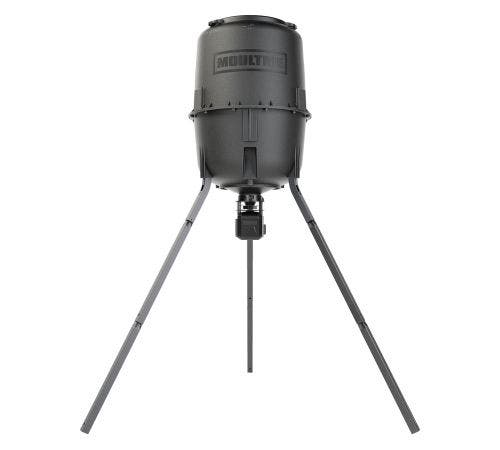
Our take: The Moultrie Pro Hunter III 250 is the timed feeder to buy when you want ten feeds a day, one to sixty second runs, and three spread speeds from a 250 lb hopper. No other feeder in this guide gives you that much control over the daily amount. Small changes are easy, so you can split a daily amount into several short feeds rather than one long one, and you can change the spread speed when the wind or the ground cover changes.
The strengths start with the schedule. Ten feeds a day at one to sixty seconds each means you can feed at dawn, midday, and dusk without overfeeding at any one time. Three spread speeds let you throw wider on open ground and tighter near cover. Bluetooth control through the app means schedule changes happen from your phone at the site, with no subscription. The 250 lb hopper and a fill height of six feet suit a property you visit every few weeks rather than every few days.
The weaknesses are the cost of ownership, not the feeder itself. Consider that the rechargeable battery, solar panel, and feed are not in the box, so budget for them separately. A rechargeable 6V battery needs charging and, in time, replacing, and a solar panel needs a clear view of the sky to keep it topped up. Remote control from home also needs a Moultrie EDGE 3 Series camera, so do not buy this feeder expecting cellular control out of the box. It is a Bluetooth feeder, and that limit should be clear before you order.
Pros
- Up to 10 feeds a day, 1 to 60 seconds each
- Three spread speeds for open ground or tight cover
- Bluetooth app control with no subscription
- 250 lb hopper suits visits every few weeks
- Fill height of 6 ft keeps the hopper reachable
Cons
- Rechargeable battery not in the box
- Solar panel not in the box
- Remote control from home needs a separate EDGE 3 Series camera
- More parts to maintain than an AA-powered feeder
- Owner reports on the Tractor Supply listing mention connection difficulties
From the field: App users rate this feeder highly on Tractor Supply, and the fine schedule control is the feature owners mention most. The other side of the same listing mentions connection difficulties and animal damage to the plastic, so inspect the feeder on arrival and check the control box seals before the first season. Owners who keep the battery charged and the panel clear report the steadiest results; owners who let the battery run flat report missed feeds, which is a maintenance problem, not a feeder defect.
| Spec | Detail |
|---|---|
| Capacity | 250 lb |
| Feeds per day | Up to 10 |
| Run length | 1 to 60 seconds |
| Spread speeds | Three |
| Power | Rechargeable 6V battery (not in the box) |
| Control | Bluetooth app, no subscription |
| Fill height | 6 ft |
| Not in the box | 6V battery, solar panel, feed |
Check Moultrie Pro Hunter III 250 on Amazon
3. Moultrie Pro Hunter III Directional — Best spinner deer feeder for trails and ponds
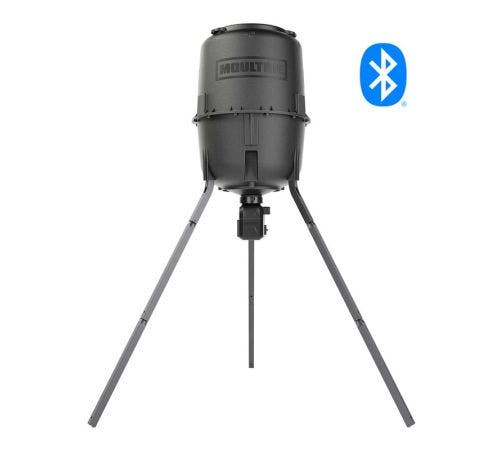
Our take: The Moultrie Pro Hunter III Directional is the feeder to buy when a full-circle throw would waste corn. It throws in one direction, so you can aim the feed at a trail, a pond edge, or a clearing, and keep it out of thick cover where deer will not feed and where corn rots unseen. That single change makes it the right pick for edges, where most feeders sit anyway.
The strengths follow from the direction. Aimed feed lands where you can see it, where deer already walk, and where a camera can watch it. That matters on a trail or a pond bank, where a circle throw would put half the corn into brush or water. The feeder shares the Pro Hunter III family, so the timed spin-cast design, the app control, and the hopper style are familiar to anyone who has run a Moultrie timed feeder before. For a lease with a defined trail system, that familiarity is a real advantage.
The weaknesses are gaps in the published detail, and this guide will not fill them with guesses. The listing we checked does not state a separate capacity figure for the directional version, so no capacity is printed here, and no throw distance is printed either, because Moultrie publishes none for this feeder. A directional feeder also needs aiming, which means the first setup takes longer than a circle feeder, and a wrong aim wastes the very corn the design is meant to save. Check the listing for the current capacity and in-box contents before ordering.
Pros
- Directional throw aims feed at a trail, pond edge, or clearing
- Less corn wasted in brush or water than a full-circle throw
- Feed lands where a camera can watch it
- Shares the Pro Hunter III timed spin-cast design
- Suits defined trail systems on a lease
Cons
- No separately stated capacity in the sources checked
- No throw distance published by the maker
- Aiming takes longer at first setup than a circle feeder
- A wrong aim wastes corn instead of saving it
- Owner reports are thin compared with the standard Pro Hunter III 250
From the field: Owner reports for the directional version are thin compared with the standard Pro Hunter III 250, and this guide will not invent them. What the evidence does support is the use case: owners who feed along trails and water report that aimed feed is easier to watch and easier to keep dry than feed thrown into cover. If your site is open ground with deer coming from every side, the standard circle version is the better buy, and the directional version earns its place only where the aim matters.
| Spec | Detail |
|---|---|
| Capacity | Not stated separately in the sources checked |
| Throw | Directional |
| Type | Timed spin-cast, Pro Hunter III family |
| Control | App control, as in the Pro Hunter III family |
| Throw distance | Not published by the maker |
Check Moultrie Pro Hunter III Directional on Amazon
4. Wildgame Quick-Set 225 — Best simple spinner deer feeder
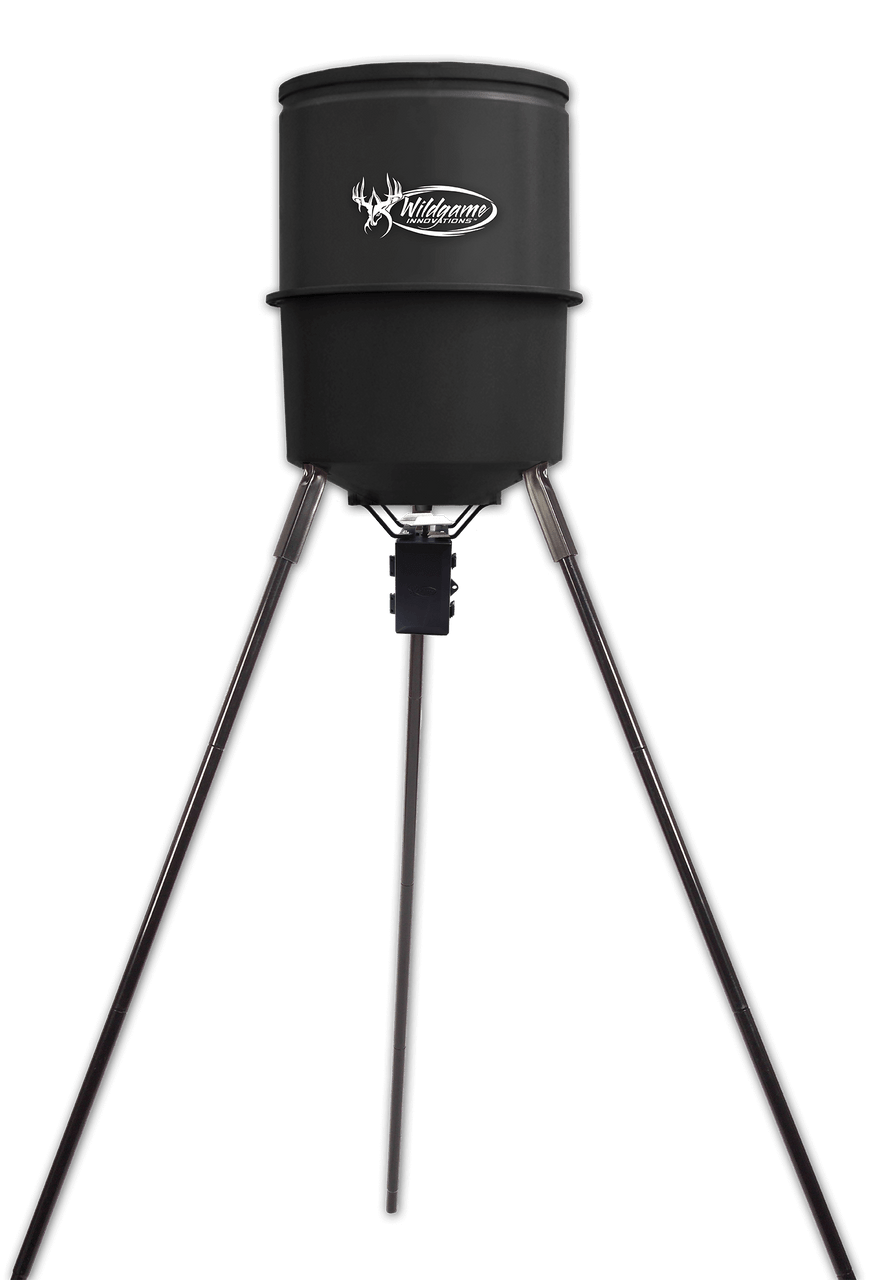
Our take: The Wildgame Quick-Set 225 is the feeder to buy when you want a set-and-forget schedule and a 225 lb hopper without learning an app or a menu. It runs up to four feeds a day at fixed run times of five, ten, fifteen, or twenty seconds, with corn or protein pellets. You give up fine adjustment, but a fixed schedule is enough for many small properties, and Wildgame says setup takes about fifteen minutes.
The strengths are simplicity and capacity for the money. Four feeds a day covers dawn and dusk with room for two more, and the fixed run times remove the fiddling that puts some buyers off programmable feeders. The 225 lb hopper holds more than the Moultrie 200 lb Standard, so refills stretch further on a property you visit weekly. Setup speed is the feature owners mention most on retailer listings, and on a small property that speed is worth more than a tenth feed a day.
The weaknesses are the limits of a fixed schedule. You cannot run a feed shorter than five seconds, so fine-tuning the daily amount is crude, and you cannot run more than four feeds a day, so a property that needs many small feeds will outgrow it. Wildgame sells solar panels and a rechargeable battery as separate items, and its page does not state whether a battery is included, so check the listing before ordering. There is no varmint guard fitted, so raccoons can work on the spinner if they are already a problem.
Pros
- Simple fixed schedule, no app or menu to learn
- 225 lb hopper holds more than the Moultrie 200 lb Standard
- Setup takes about fifteen minutes, according to Wildgame
- Runs corn or protein pellets
- Owner reports on retailer listings praise the fast setup
Cons
- No feed shorter than five seconds
- Four feeds a day at most
- Battery inclusion is not stated on the maker page, so check the listing
- Solar panel and rechargeable battery are separate items
- No varmint guard fitted
From the field: Owners on retailer listings praise the fast setup, and the feeder earns its place as the budget timed pick across the site’s guides. The recurring watch-out is the fixed schedule: owners who need a short morning scatter report that five seconds is the shortest run available, and they either accept it or move to a feeder with one-second control. Owners who check the battery situation before ordering report the fewest surprises, because the listing does not settle it for them.
| Spec | Detail |
|---|---|
| Capacity | 225 lb |
| Feeds per day | Up to 4 |
| Run length | Fixed 5, 10, 15, or 20 seconds |
| Feed type | Corn or protein pellets |
| Setup time | About 15 minutes, according to Wildgame |
| Battery | Not stated as included; check the listing |
| Varmint guard | Not fitted |
Check Wildgame Quick-Set 225 on Amazon
5. American Hunter XDE-Pro 30-Gallon — Best spinner deer feeder for many short feeds
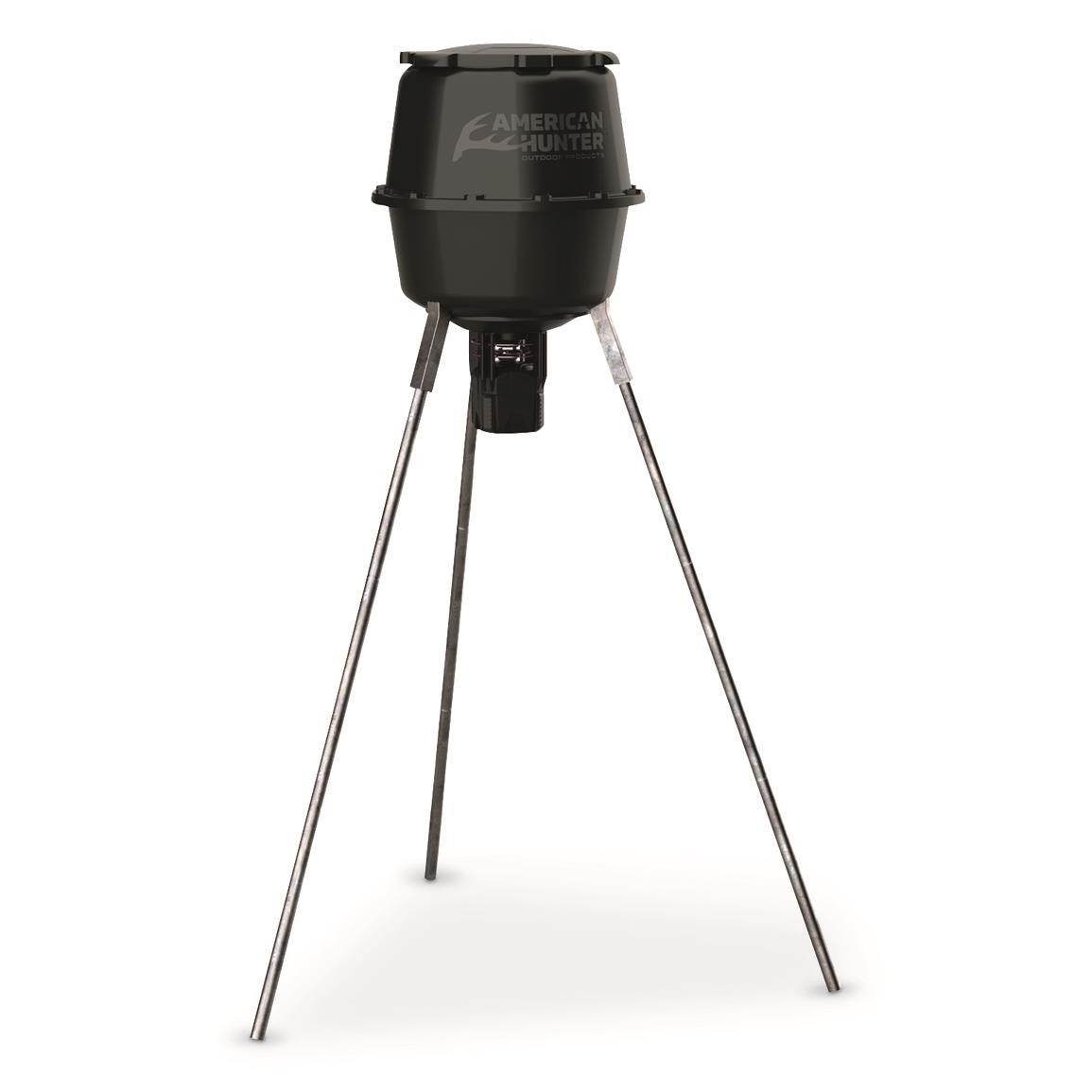
Our take: The American Hunter XDE-Pro 30-Gallon is the feeder to buy when you want many short feeds instead of a few long ones. It runs up to sixteen feeds a day at one to sixty seconds each, with two Q-Set preset programs for buyers who would rather pick a preset than program every feed. That is the most daily feeds of any feeder in this guide, and it suits a property where deer visit in waves through the day.
The strengths start with the schedule and end with the build. Sixteen feeds a day means you can scatter small amounts from dawn to dusk, which keeps fresh corn on the ground through the hours deer move. The two Q-Set presets give a fast start for buyers who do not want to program sixteen feeds by hand. The 30-gallon hopper is a metal hopper in the American Hunter style, and the feeder carries a varmint guard, which the budget timed feeders in this guide do not. Owner ratings on Sportsman’s Guide run 4.1 out of 5 across 23 reviews, which is a solid, unspectacular record for a feeder in this class.
The weaknesses are capacity math and size. The hopper is sold by gallons, not pounds, and this guide does not convert gallons to pounds, because corn and pellets weigh differently by volume and a conversion would be a guess. That means you cannot compare its capacity directly with the 200 lb or 250 lb feeders in this guide, and you should read the maker listing for the fill guidance. Sixteen feeds a day also means sixteen chances for a timer or battery fault to matter, so keep the battery charged and check the feeder after storms.
Pros
- Up to 16 feeds a day, the most in this guide
- Run lengths from 1 to 60 seconds
- Two Q-Set preset programs for a fast start
- 30-gallon hopper with a varmint guard
- 4.1 out of 5 across 23 reviews on Sportsman’s Guide
Cons
- Capacity is sold by gallons, not pounds, so it cannot be compared directly with lb feeders
- Sixteen feeds a day means more chances for a fault to matter
- Preset programs suit common schedules, not every property
- Owner reports are fewer than for the Moultrie and Wildgame timed feeders
From the field: The Sportsman’s Guide record of 4.1 out of 5 across 23 reviews is the clearest owner signal for this feeder, and it reads like a workhorse rather than a star: owners like the many-feeds schedule and the presets, and the complaints are the usual ones about batteries and setup, not about the feeder failing to throw. Owners who run many short feeds report steadier deer visits through the day than owners who run one or two long feeds, which is the use case this feeder is built for.
| Spec | Detail |
|---|---|
| Capacity | 30 gallons |
| Feeds per day | Up to 16 |
| Run length | 1 to 60 seconds |
| Programs | Two Q-Set preset programs |
| Varmint guard | Fitted |
| Owner signal | 4.1 out of 5 across 23 reviews, Sportsman’s Guide |
Check American Hunter XDE-Pro 30-Gallon on Amazon
6. Boss Buck Stand & Fill 300 — Best spinner deer feeder for ground-level filling
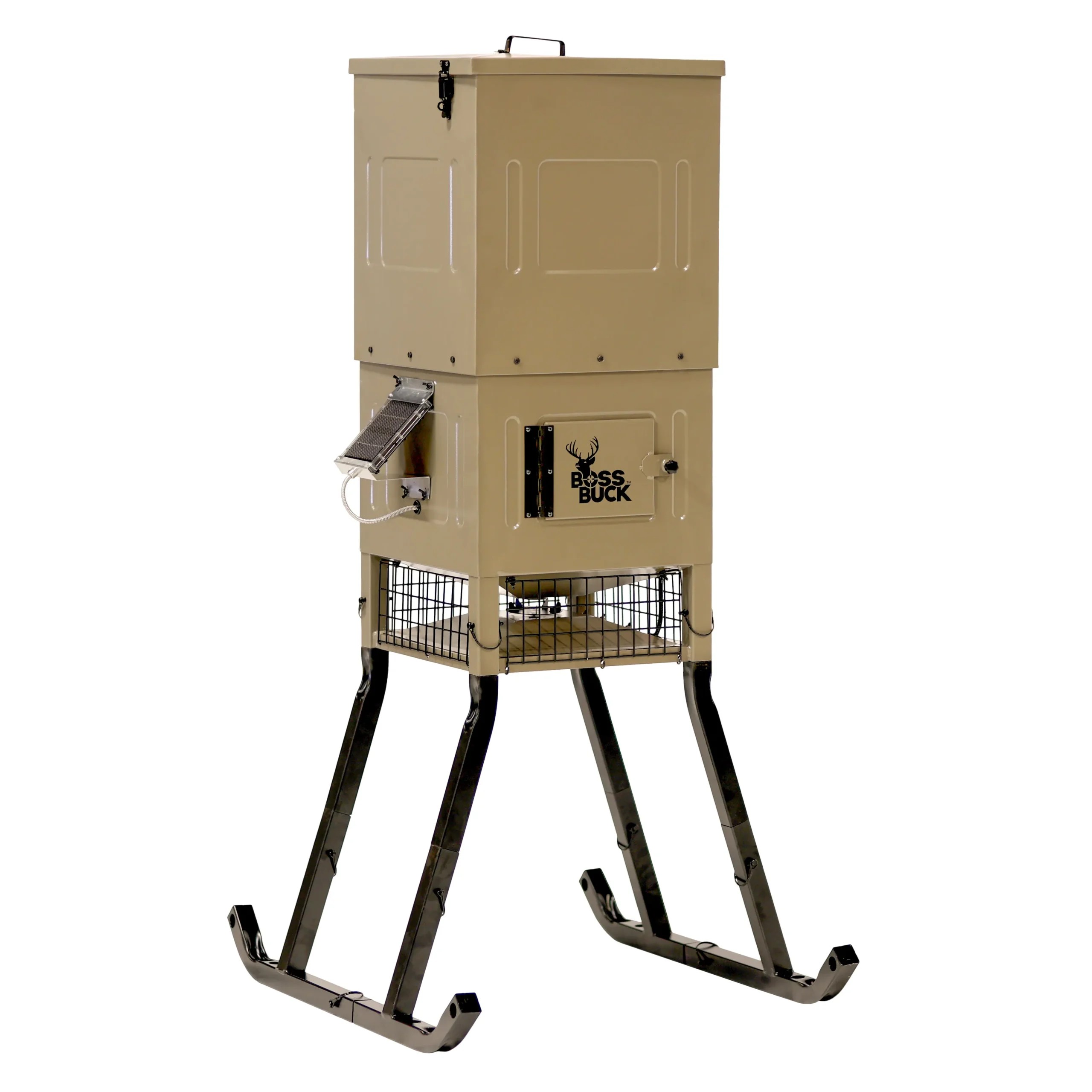
Our take: The Boss Buck Stand & Fill 300 is the spin feeder to buy when ladder refills are the part of feeding you dislike most, because it fills from the ground. It is a 300 lb timed spin-cast feeder in a steel body, and it is solar-powered, so the battery stays topped up without a charger run. For a permanent station you can drive to, that combination of big hopper, ground fill, and solar power is hard to beat.
The strengths are the station, not the schedule. A 300 lb hopper is the biggest in this guide, so refills stretch the furthest between visits. Ground-level filling means one person can fill it without climbing, which matters on a property you work alone, and it matters more as the season goes on and the ground gets soft. The steel body and the solar power suit a feeder that stays out all year, and the Boss Buck hopper family is a known quantity: the gravity hoppers run 200, 350, 600, and 1,200 lb, and the Stand & Fill spin feeders run 300 and 600 lb.
The weaknesses are weight, bulk, and the honest limits of the brand. Consider that a 300 lb timed feeder still needs battery care and regular visits, even though filling it is easier. A steel feeder is heavy to place, and once it is placed, it stays placed, so the site choice matters more than with a feeder you can move in an afternoon. Boss Buck publishes no throw or spread distance for any of its feeders, so this guide prints none; judge the feeder on its hopper, its fill, and its power, not on a distance figure no maker has stated.
Pros
- 300 lb hopper, the biggest in this guide
- Fills from the ground, no ladder needed
- Steel body suits a permanent station
- Solar-powered, so the battery stays topped up
- Boss Buck hopper family is well documented
Cons
- Heavy to place, and hard to move once placed
- Still needs battery care and regular visits
- No throw or spread distance published by the maker
- A big steel feeder is the wrong pick for a trial site
From the field: Owners who run Boss Buck feeders as permanent stations report the steadiest results, and the ground fill is the feature they mention most, because it turns a two-person refill into a one-person job. The recurring watch-out is the site choice: owners who place a heavy steel feeder and then wish it were fifty yards the other way report that moving it is a project, not an afternoon. Pick the site first, then place the feeder, and the feeder will reward the patience.
| Spec | Detail |
|---|---|
| Capacity | 300 lb |
| Type | Timed spin-cast, Stand & Fill |
| Fill | Ground level, no ladder |
| Body | Steel |
| Power | Solar-powered |
| Hopper family | Boss Buck gravity 200, 350, 600, 1,200 lb; Stand & Fill spin 300 and 600 lb |
| Throw distance | Not published by the maker |
Check Boss Buck Stand & Fill 300 on Amazon
7. Moultrie Connected 250 — Best spinner deer feeder for app control from anywhere
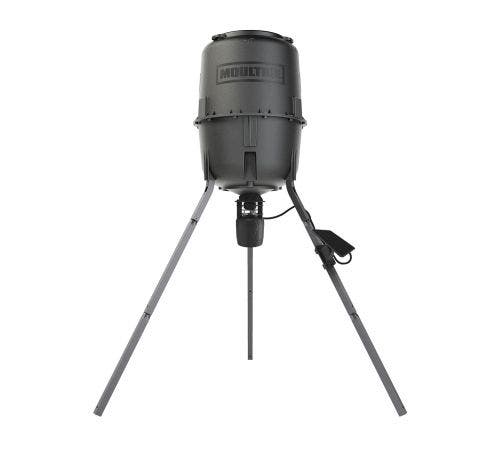
Our take: The Moultrie Connected 250 is the feeder to buy when you cannot visit the property and still want to change the schedule. It is a 250 lb timed spin-cast feeder with cellular control through the app, so feed times and feed amounts can be changed from anywhere, not just from Bluetooth range at the site. That is the real difference between this feeder and the Bluetooth feeders in this guide, and it is worth paying for only if distance is your problem.
The strengths are remote control and capacity. A 250 lb hopper covers weeks between visits, and cellular control means a missed visit does not mean a missed schedule change. If the weather turns, or if deer movement shifts, the schedule can move with it from home. The feeder is a Moultrie timed feeder at heart, so the spin-cast design and the hopper are familiar, and the cellular part is the add-on, not a different feeder. For a remote lease, that combination is the point of the purchase.
The weaknesses are the subscription and the signal. Cellular control needs a subscription, and this guide states that without printing any price, because subscription terms change and a printed figure would be out of date before the season ends. Cellular control also needs a cellular signal at the feeder, so a property with no signal gets no remote control, and the feeder becomes a heavy Bluetooth feeder at a cellular price. Check signal at the site before ordering, and read the current subscription terms on the maker listing.
Pros
- Cellular control through the app, from anywhere
- 250 lb hopper covers weeks between visits
- Schedule changes without a site visit
- Timed spin-cast design from the Moultrie family
- Suits a remote lease where visits are rare
Cons
- Cellular control needs a subscription
- Needs a cellular signal at the feeder site
- Without signal, it is a heavy feeder at a cellular price
- Owner reports are thin compared with the Bluetooth Moultrie feeders
- Subscription terms change, so read the current listing
From the field: Owner reports for the Connected 250 are thin compared with the Bluetooth Moultrie feeders, and this guide will not invent them. What the evidence does support is the use case: owners with remote leases report that the ability to change a schedule from home is the feature that justifies the subscription, and owners without signal at the site report that the feeder cannot do the job they bought it for. Signal first, subscription second, feeder third, in that order.
| Spec | Detail |
|---|---|
| Capacity | 250 lb |
| Control | Cellular through the app |
| Subscription | Required; terms on the maker listing |
| Type | Timed spin-cast |
| Signal | Cellular signal required at the feeder site |
Check Moultrie Connected 250 on Amazon
Gravity feeders: the contrast, not a ranked pick
No gravity feeder is ranked in this guide, and that is a deliberate choice. A gravity feeder lets deer eat freely from ports, with no motor, no timer, and no schedule. That suits a site where you want feed available at all times, and it suits a buyer who wants no batteries or programming. It does not suit a buyer who wants to hit a set daily amount, because deer eat what they want, and so does anything else that reaches the ports.
The contrast is sharpest on control and on waste. A spinner feeder throws a set amount at set times, so you know roughly how much corn leaves the hopper each day. A gravity feeder throws nothing and controls nothing, so use swings with deer numbers, weather, and raccoons. The gravity models on this site include the Banks Feedbank 300, the Moultrie 250 Gravity, and the Boss Buck 200 and 350 Gravity feeders, and the gravity guide compares them in full. If you want no electronics at all, read that guide first; if you want a schedule, stay with the seven feeders above.
One honest note on varmints and bears. No turkey-proof feeder is sold, and nothing is bear-proof per the Interagency Grizzly Bear Committee; the best any feeder offers is bear resistance, and a gravity feeder with open ports is the easiest target of all. A spinner feeder is not bear-proof either, but a timed throw at least keeps the feed off the ground between feeds, which is a real, if modest, advantage on hog and raccoon ground.
Watch: feeder height, timing, and timer setup
These three videos from the Best Deer Feeders channel cover the three things that decide whether a spinner feeder works on your property: height, timing, and timer setup. Watch them before you bolt anything to a tree or a tripod.
How High Should a Deer Feeder Be?
Feeder height decides how much of each spin-cast throw deer can reach, and how much ends up as ground scatter.
Best Time to Run a Deer Feeder (Morning vs Evening)
Timer schedules only pay off when the throw lands while deer are moving, so match feed times to local movement.
How to Set a Tripod Deer Feeder Timer
A short walkthrough of setting a tripod feeder timer, step by step, before the season starts.
What a spinner feeder really costs to run
The feeder is the cheapest part of feeding. Corn, batteries, and visits are the running cost, and a buyer who plans for them will not be surprised in October. The table below uses what owners report, not printed prices, because prices change by store and by season.
| Cost item | What owners report | Notes |
|---|---|---|
| Corn per fill | A 200 lb hopper takes four 50 lb bags; a 300 lb hopper takes six | Buy corn before the season, when supply is steadiest |
| Daily corn use | Set by feed count and run length, not by the hopper | Short runs twice a day use less than one long run |
| AA batteries | A season on one set for the Moultrie 200 lb Standard, according to the maker | Carry spares; a dead feeder throws nothing |
| Rechargeable 6V battery | Needs charging between visits and replacing in time | A solar panel keeps it topped up between visits |
| Solar panel | Bought once, aimed once, checked after storms | Not in the box for the Pro Hunter III 250 or the Quick-Set 225 |
| Timer replacement | Moultrie Timer III is sold out at Amazon; Timer II is the in-stock option | Never buy a feeder on the assumption a sold-out timer will return |
| Visits | A 250 lb hopper stretches visits to weeks; an 80 lb gravity hopper empties in days | Match hopper size to how often you can visit |
| Varmint loss | Raccoons and hogs take corn from unguarded spinners and open gravity ports alike | A cage or guard costs less than the corn it saves |
The takeaway is simple. A bigger hopper costs more once and less often, because it cuts visits, and a solar panel costs once and saves battery trips all season. The cheapest feeder to buy is rarely the cheapest feeder to run, and the feeder that throws on a schedule you can hold is cheaper than the feeder that throws corn raccoons eat at night.
How to choose a spinner deer feeder
How many feeds a day do you actually need?
Start with deer movement, not with the feeder. Two feeds a day, dawn and dusk, covers most properties, and four feeds a day covers a property where deer visit in waves. Ten or sixteen feeds a day suits a property where you want small amounts on the ground all day, or a protein site where steady availability matters. More feeds is not better on its own; more feeds is better only when you have a reason for each one. A feeder that throws four times a day and a feeder that throws ten times a day are different tools, and the right count is the one that matches your deer, not the biggest number on the box.
AA, rechargeable, or solar: which power suits your visits?
AA power suits a buyer who visits monthly and wants the simplest fix for a dead feeder: new batteries from any store. A rechargeable 6V battery suits a buyer who visits often enough to charge it, or who pairs it with a solar panel and forgets about it. Solar suits a permanent station with a clear view of the sky. The wrong power is the one you will not maintain, so pick the power that matches your visits, not the power that sounds most modern. A feeder with a flat battery throws nothing, whatever its feed count says on the box.
Spin-cast or gravity: which feeding style fits your land?
Spin-cast suits a buyer who wants a set daily amount, a schedule, and corn on the ground at set times. Gravity suits a buyer who wants feed available at all times and no batteries, no timer, and no programming. The trade is control against simplicity, and there is no wrong answer, only a wrong match. A gravity feeder on a property where raccoons rule will empty fast and teach nothing; a spinner on a property you visit once a season will run flat and throw nothing. Read the spin-versus-gravity comparison on this site before you commit, and pick the style that fits your visits and your varmints.
What should you check before the first fill?
Check the battery, the timer, the spinner plate, and the law, in that order. Run the feeder on the ground before you hang it, and watch a full feed cycle: the plate should spin freely, the corn should throw evenly, and the timer should stop when the run ends. Check that the hopper lid seals, because rain in the hopper means mold in the corn. Check local baiting rules, because a feeder that is legal on private land can be unlawful on state or federally managed land, and the rules change by state. Then fill it, set the schedule, and leave it alone for a week before you judge it.
Resources: more feeder guides on this site
- Best Automatic Deer Feeders: 7 Timed Feeders Compared
- Best Deer Feeder Timers: Moultrie and Wildgame Timers Compared
- Spin vs Gravity Deer Feeders: Key Differences Explained
- Best Tripod Deer Feeders: 7 Stable, High-Capacity Picks
- Best Deer Feeders 2026: 16 Top-Rated Feeders Reviewed
- Best Gravity Deer Feeders: 10 Models Compared
- How to Program a Deer Feeder Timer, Step by Step
- Best Time of Day to Run a Deer Feeder
- How Many Times a Day Should a Deer Feeder Go Off?
- Deer Feeder Batteries: Best 6V and 12V Picks
- Deer Feeder Solar Panel: 7 Smart 6V and 12V Buying Checks
- Best Deer Feeder Parts and Accessories: Motors, Timers, Batteries and Solar
- Best Deer Feeder Motor: 6V and 12V Replacements Compared
- How High Should a Deer Feeder Be Off the Ground?
- Where to Place a Deer Feeder for Best Results
Authority link: the Interagency Grizzly Bear Committee (IGBC) publishes the bear-resistant testing standard that no deer feeder has passed as bear-proof; see igbconline.org.
Frequently asked questions about spinner deer feeders
What is a spinner deer feeder?
A spinner deer feeder, also called a spin-cast or timed feeder, is a feeder with a motor, a timer, and a spinning plate under the hopper. At the times you program, the motor spins the plate and throws corn or pellets out in a circle. Gravity feeders have no motor and no schedule; deer eat freely from ports.
What is the best spinner deer feeder overall?
The best spinner deer feeder overall in this guide is the Moultrie 200 lb Standard. It runs on AA batteries, programs from a phone app, holds 200 lb of corn, and runs up to four feeds a day at one to twenty seconds each. It is the simplest feeder in this guide to own.
How many times a day should a spinner feeder go off?
Two feeds a day, dawn and dusk, covers most properties. Four feeds a day covers a property where deer visit in waves. Ten or sixteen feeds a day suits a property where you want small amounts on the ground all day. Match the count to deer movement, not to the biggest number on the box.
Do spinner feeders scare deer?
A spinner feeder makes a short sound when it throws, and deer learn the sound quickly on most properties. Owners report that deer return within minutes on a feeder they already visit, and that a new feeder takes a week or two before deer feed calmly under it. Set the schedule, then leave the feeder alone.
What is the difference between a spinner feeder and a gravity feeder?
A spinner feeder throws a set amount at set times, so you control the daily amount. A gravity feeder lets deer eat freely from ports, with no motor, no timer, and no schedule. Spinner feeders suit buyers who want control; gravity feeders suit buyers who want no batteries and no programming.
Is the Moultrie Timer III still available?
No. Moultrie Timer III is sold out at Amazon, and Moultrie Timer II is the in-stock option. Never buy a feeder on the assumption that a sold-out timer will come back; buy the feeder whose own timer and motor are in the box.
Can a spinner feeder throw protein pellets?
Yes, most timed spin-cast feeders in this guide run corn or protein pellets, including the Wildgame Quick-Set 225 and the Moultrie Pro Hunter III 250. Check the maker listing for your model, because pellet size and moisture affect how cleanly the plate throws.
How long does a 200 lb hopper last?
It depends on feed count and run length, not on the hopper alone. A 200 lb hopper running two short feeds a day can last a month of visits on many properties, while the same hopper running long feeds four times a day empties in a week or two. Short runs twice a day use less than one long run.
Do I need a solar panel for a spinner feeder?
You need a solar panel if your feeder runs on a rechargeable 6V battery and you visit rarely. The panel keeps the battery topped up between visits. AA-powered feeders like the Moultrie 200 lb Standard do not need one, and the Boss Buck Stand and Fill 300 is solar-powered in the box.
Are spinner feeders bear-proof?
No. Nothing is bear-proof per the Interagency Grizzly Bear Committee; the best any feeder offers is bear resistance. A spinner feeder is not bear-proof either, but a timed throw at least keeps feed off the ground between feeds, which is a modest advantage on hog and raccoon ground.
Can I use a spinner feeder for turkeys?
A spinner feeder throws corn that turkeys will eat, and no turkey-proof feeder is sold. If turkeys are taking your corn, the honest fix is a different setup, such as a gravity feeder with restricted ports or a feeder placed where turkeys feed less, not a feeder marketed as turkey-proof.
How high should a spinner feeder be off the ground?
Hang or mount a spinner feeder so the plate clears the ground and the throw lands where deer can reach it, and so you can fill it without a tall ladder. The Pro Hunter III 250 fills at six feet. Read the height guide on this site for the full answer, because slope and cover change the right height.
Final verdict: the best spinner deer feeders
Our pick: the Moultrie 200 lb Standard is the best spinner deer feeder for most buyers, because AA power, app control, and a 200 lb hopper cover a month of visits with the least maintenance. If you want the most control, buy the Moultrie Pro Hunter III 250, with ten feeds a day and three spread speeds. If you fill alone and hate ladders, buy the Boss Buck Stand & Fill 300. If you want many short feeds, buy the American Hunter XDE-Pro. If you need control from anywhere, buy the Moultrie Connected 250, after checking signal at the site and reading the current subscription terms.
Whichever feeder you buy, check local baiting rules before the first bag of corn goes in, run a full feed cycle on the ground before you hang it, and set the schedule for your deer, not for the biggest number on the box. A spinner feeder earns its keep when it throws the right amount at the right time, week after week, without a dead battery or a missed feed.
Last updated: November 2026.
Products mentioned in this guide
See this product on Amazon
Check Price on Amazon →Confirm price and availability on AmazonMoultrie Pro Hunter III 250 lb Deer Feeder
Check Price on Amazon →Confirm price and availability on AmazonBoss Buck Stand & Fill 300 Feeder
Check Price on Amazon →Confirm price and availability on AmazonMoultrie Pro Hunter III Directional 250 lb Feeder
Check Price on Amazon →Confirm price and availability on AmazonWildgame Innovations Quick-Set 225 Feeder
Check Price on Amazon →Confirm price and availability on AmazonAmerican Hunter XDE-Pro 30-Gallon Feeder
Check Price on Amazon →Confirm price and availability on AmazonMoultrie Connected 250 lb Deer Feeder
Check Price on Amazon →Confirm price and availability on AmazonAs an Amazon Associate, we earn from qualifying purchases.