
PVC Deer Feeder: How to Build a Gravity Tube Feeder
Disclosure: This post contains affiliate links. As an Amazon Associate, we earn from qualifying purchases at no extra cost to you.
The short answer
The best PVC deer feeder design is the wye tube: a 5-foot length of 4-inch PVC pipe with a wye fitting at the bottom, strapped vertically to a tree. Corn poured in the top gravity-feeds into the wye’s angled opening, and as deer eat, more flows down — no battery, no timer, no motor, about 25 lb of corn aboard, and under an hour from hardware-store run to hunting. It’s the cheapest legitimate feeder you can build, which is why the design shows up on every lease in corn country. This guide gives you the full build, the two simpler variants, an honest capacity table, and the fixes for the three ways PVC feeders fail (clogs, chewed pipe, and hogs).
Three fast choices
Pick by the job you need done. All three are gravity tubes — no battery, no timer, no motor.
Disclosure: Some shopping links may earn us a commission at no additional cost to you. As an Amazon Associate I earn from qualifying purchases.
Wye tube feeder
A 5 ft length of 4-inch PVC pipe with a wye fitting at the bottom, strapped vertically to a tree. Corn gravity-feeds into the wye’s angled opening — about 25 lb aboard, ~30–45 minutes to build.
Caution: fit the drainage grate in the wye’s bottom opening — rain that reaches the mouth has to drain out, not pool in the feed.
Notch tube feeder
A wedge notch cut just above a capped bottom does the feeding — gravity out of the notch, no fittings at all. About 15 minutes from pipe to hanging.
Caution: you give up the wye’s sheltered, self-metering mouth — the opening is your saw cut, sized by hand.
Ground-gap tube feeder
The pipe hangs with its open bottom about an inch above a flat base, and feed spills through the gap as deer clean the base. About 10 minutes to set up.
Caution: the pick for testing a new spot before committing — it also gives up the wye’s sheltered, self-metering mouth, and the feed sits on an open base.
The 3 PVC feeder designs, compared
| Design | How it feeds | Build time | Best for |
|---|---|---|---|
| Wye tube (this guide’s build) | Gravity into a wye fitting’s angled opening | ~30–45 min | The standard station feeder |
| Notch tube | Gravity out of a wedge notch cut near a capped bottom | ~15 min | The absolute simplest build — one pipe, two caps |
| Ground-gap tube | Feed spills through a ~1-inch gap under the pipe onto a flat base | ~10 min | Testing a new spot before committing |
All three are gravity feeders: feed is always available, nothing is scheduled, and nothing needs power. If you want timed feeding, that’s a different build entirely — see our drum feeder guide and the kit roundup. Within the PVC family, the wye design wins because the fitting does the metering for you: the opening is sheltered, sized by the fitting rather than your saw cut, and fitted with drainage.
Why PVC — and where it loses
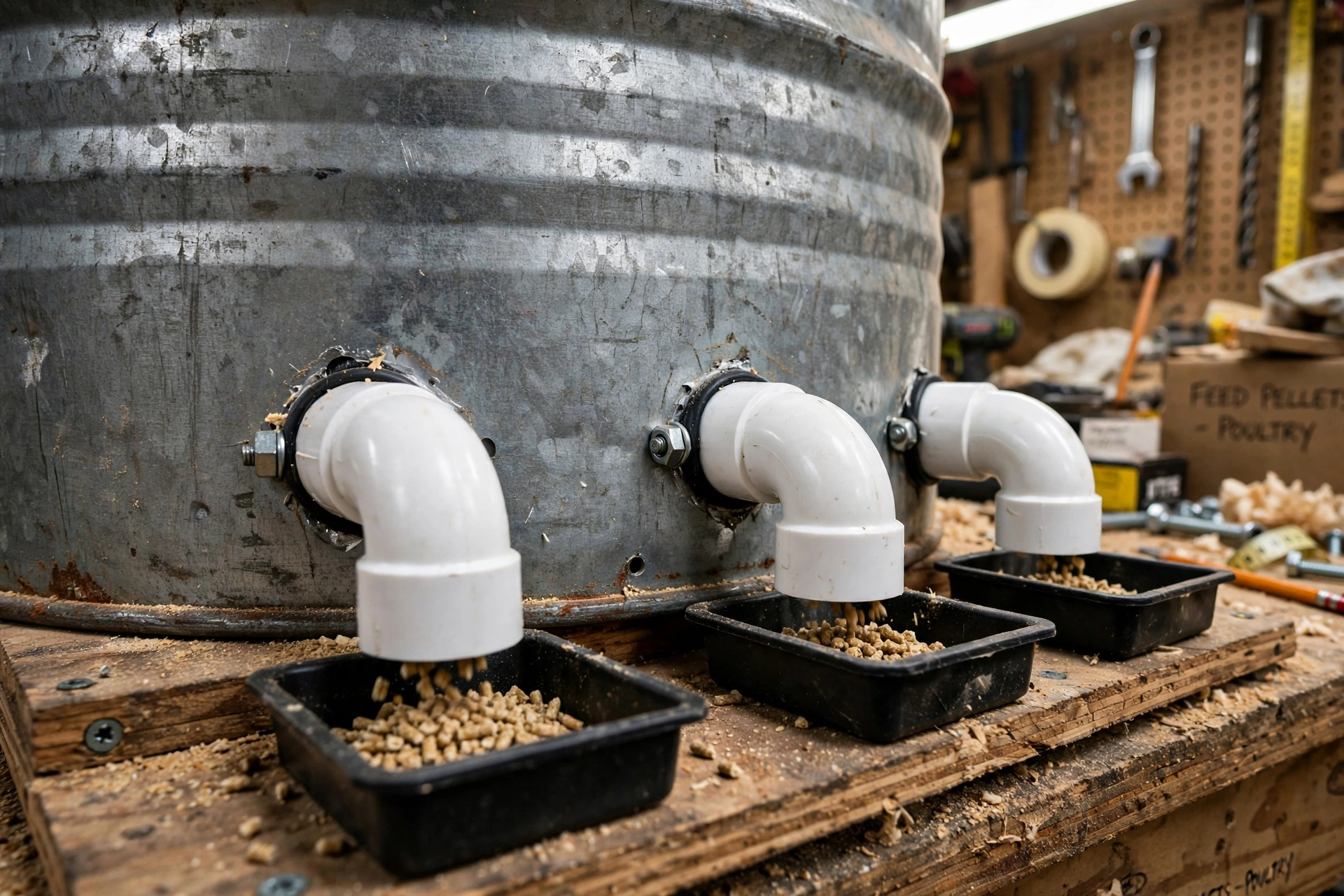
Where PVC wins: it can’t rust or rot, it’s light enough to carry three feeders into a lease on foot, every part is a hardware-store commodity, and a cracked fitting is a $3 replacement rather than a warranty claim. A tube feeder also has a tiny footprint — it hangs on a tree that a tripod feeder couldn’t stand under.
Where it loses, honestly: capacity is small (a 4-inch tube holds roughly a bag of corn, not a season of it); there is no portion control, so a popular feeder empties fast; squirrels and raccoons can chew PVC over time; and a determined hog can wreck a lightly strapped tube. PVC is the right feeder for supplemental corn stations, camera sites and testing new ground — not for a protein program, which wants a real gravity hopper from our gravity feeder guide.
Materials & tools
For the wye tube build (4-inch version):
- 5 ft of 4-inch PVC pipe — one 10 ft stick cut in half builds two feeders. Green sewer pipe is cheaper than white PVC and works the same.
- 4-inch PVC wye fitting — the heart of the build; its angled branch is the feed opening.
- 4-inch test cap or plug for the top — removable, for filling; do not glue it.
- A grate, screen or drilled cap for the wye’s bottom opening — lets rain drain instead of pooling in the feed.
- Two ratchet straps (or rope/wire) to mount the tube to a tree or post.
- Tools: hacksaw or PVC cutter, tape measure, marker, coarse sandpaper for cut edges. PVC cement is optional — most joints on this build are friction-fit so you can service them.
Builders commonly report the whole parts list at under $20–$50 depending on what’s already in the truck; the buttons below show live prices for the fittings most people order.
Check Price: 4″ PVC Wye → Check Price: Test Caps → Check Price: Ratchet Straps →
How much feed a PVC feeder holds
| Pipe | Length | Volume | Shelled corn (approx.) |
|---|---|---|---|
| 4-inch | 4 ft | ~2.6 gal | ~19 lb |
| 4-inch | 5 ft | ~3.3 gal | ~24 lb |
| 6-inch | 4 ft | ~5.9 gal | ~43 lb |
| 6-inch | 5 ft | ~7.3 gal | ~54 lb |
Our estimates, worked from pipe volume and shelled corn at roughly 7.3 lb per gallon — treat them as planning figures, not lab numbers. They line up with published builds: a widely shared 6-inch wye build is described as holding about 40 lb. Pellets pack slightly denser than corn; cracked corn and fines pack denser still but flow worse (see Problems).
The refill maths is the real spec: a busy 4-inch station can empty in days during season. If your property is a long drive away, build the 6-inch version, build two tubes on one tree, or graduate to the 55-gallon drum build (~350–400 lb of corn) — PVC’s low capacity is the trade you make for its price and portability.
Step-by-step: build the wye tube feeder
- Cut the pipe. Mark 5 ft on the 4-inch pipe and cut square with a hacksaw or PVC cutter. Sand the cut edges — burrs snag feed and hands.
- Dry-fit the wye. Push the wye onto the bottom end of the pipe. The wye’s angled branch will face outward and slightly up — that’s the mouth deer feed from. The straight-through bottom opening gets the drainage grate.
- Fit the drainage. Set the grate, screen or drilled cap into the wye’s bottom opening. This is the step most quick builds skip and regret: rain that reaches the mouth runs down and out instead of sitting in wet corn.
- Test the flow before you hang it. Stand the tube upright, pour in a few pounds of corn, and watch the wye fill. Corn should mound in the angled opening and stop — if it pours straight through, your branch angle or grate is wrong; if nothing arrives, check for a burr or a fitting seated crooked.
- Mount it. Strap the tube vertically to a tree or post with two ratchet straps — one high, one just above the wye. Set the wye mouth at roughly a deer’s chest height, about 3 to 3.5 feet off the ground: comfortable for deer, awkward for raccoons standing on the ground.
- Fill it. Fill the wye first so the mouth is primed, then pour corn down the top until the tube is full. A 5 ft tube takes about 24 lb — most of a standard bag.
- Cap the top. Press the test cap or plug on — snug, not glued. It sheds rain and lifts off for refills.
- Optional but smart: paint the tube a flat camo or bark colour (white PVC glows in the woods), and scatter a handful of corn on the ground below for the first week so deer find the station.
The two variants, briefly. Notch tube: glue a cap on the bottom of a 3–4 ft pipe, cut a wedge notch just above the cap as the feed opening, leave the top cap unglued, and strap it up — 15 minutes, no fittings at all. Ground-gap: strap the pipe vertically with its open bottom about an inch above a flat board or bucket lid; feed spills through the gap as deer clean the base. Both work; both give up the wye’s sheltered, self-metering mouth.
Mounting & placement
- Tree choice: a straight trunk at least 8 inches across, on a trail intersection, field edge or the corner of a food plot — where deer already travel, not where you wish they did.
- Two straps, always. A single strap lets a hog or a rubbing buck spin and dump the tube. Cinch the lower strap just above the wye so the fitting can’t slide.
- Height: wye mouth around 3–3.5 ft. Much lower and raccoons feed standing; much higher and fawns can’t reach — and you’ll hate refilling it.
- Drainage: never mount over a puddle line. The grate handles rain, not a flooded base.
- Legality: feeding and baiting rules vary by state and county, and some ban it outright in CWD zones. Check your regulations before you hang the first tube.
What to feed in a PVC feeder
Whole shelled corn is the default: it flows cleanly through a 4-inch tube, resists moisture better than cracked corn, and deer know it on sight. Protein pellets work in the 6-inch build and in dry weather, but pellets wick moisture and swell — in a humid climate they are the clog risk below. Avoid dusty feeds, sweet mixes and anything with molasses fines in a tube; they cake at the wye. Our protein feed guide covers choosing pellets if you go that route, and a trail camera over the station (the real reason many of these tubes exist) tells you within a week who’s eating and who’s just visiting.
Problems & fixes
- Feed stops flowing (bridging). Usually fines, swollen pellets or a spider web at the wye. Knock the tube, then rod the throat clear from the mouth with a stick. Prevention: whole corn, dry pellets only, and the drainage grate fitted from day one. Persistent feeding problems across feeder types are diagnosed in our feeder not working hub.
- Wet, mouldy corn at the mouth. The top cap wasn’t seated, or rain is blowing into the branch. Re-seat or replace the cap, angle the mouth slightly away from prevailing weather, and clear the spoiled feed — deer reject mouldy corn and it’s genuinely bad for them.
- Chewed pipe. Squirrels and raccoons gnaw PVC, especially around the mouth where feed dust collects. Wipe the mouth clean when you refill, and wrap the lower two feet in hardware cloth if chewing starts. A chewed-through tube is a parts replacement, not a crisis — that is PVC’s deal.
- Tube spun or dumped. One strap, or a strap over bark that loosened as the tree dried. Re-hang with two straps and check them each refill; in hog country, add a third strap low and consider a feeder pen.
- Deer won’t use it. Almost always placement or novelty, not the feeder. Scatter corn on the ground below for a week, confirm the station is on existing travel, and give it time — new objects in the woods get a suspicion period measured in days.
For the raccoon end of the problem, our varmint guard roundup covers the heavier artillery; for a PVC tube, height, a clean mouth and daylight-only availability (there’s no timer — accept it) are the realistic defenses.
PVC vs drum vs bucket builds
| Build | Capacity | Cost shape | Choose it when |
|---|---|---|---|
| PVC tube (this guide) | ~25–55 lb | Cheapest; fittings only | Supplemental stations, camera sites, testing new ground |
| 55-gallon drum | ~350–400 lb | Kit + drum + legs | Remote land, monthly refills, real feeding programs |
| Bucket feeder | ~35–40 lb (5 gal) | Bucket + a kit or gravity head | You want a lid and a handle and slightly more than a tube |
The three builds share one engine — gravity — and differ only in the hopper. Most properties end up with both ends of the table: a drum where the program is, PVC tubes where the cameras are.
Feeder build resources
- DIY 55-Gallon Drum Deer Feeder — the step up in capacity
- Best Deer Feeder Kits for 55-Gallon Drums
- Best Gravity Deer Feeders — factory versions of this idea
- Best Deer Feeder Parts & Accessories
- Best Deer Feeder Varmint Guards
- Deer Feeder Not Working?
- Deer Feeder Reviews — every feeder type compared
- Shop — feeders and parts in our catalogue
PVC feeder FAQs
What is a PVC deer feeder?
A PVC deer feeder is a gravity tube feeder built from PVC pipe — most often a 4 or 6-inch tube with a wye fitting or a cut notch at the bottom — strapped vertically to a tree. Feed poured in the top flows down by gravity to the opening as deer eat. There is no battery, timer or motor, which is why it is the cheapest feeder design that actually works.
How much corn does a PVC deer feeder hold?
About 24 lb of shelled corn in a 5-foot, 4-inch tube, and roughly 43–54 lb in a 6-inch tube of 4–5 feet. Those are planning estimates from pipe volume (shelled corn runs about 7.3 lb per gallon) and match published builds — a shared 6-inch wye build is described as holding about 40 lb.
What size PVC pipe is best for a deer feeder?
4-inch is the standard: cheap, available everywhere, and big enough for whole corn to flow freely. Step up to 6-inch when refill trips are the constraint — it more than doubles capacity per foot and handles protein pellets better. Smaller than 4 inches bridges and clogs too easily for corn.
How high off the ground should a PVC feeder be?
Set the feed opening — the wye mouth or notch — about 3 to 3.5 feet off the ground. That’s a comfortable eating height for deer, above what a raccoon can comfortably work from the ground, and low enough that filling the top of a 5-foot tube stays a no-ladder job.
How long does it take to build a PVC deer feeder?
Under an hour for the wye build, including the hardware-store run if you know your list. The notch variant takes about 15 minutes. None of the three designs in this guide needs more than a saw, a tape and a marker.
How much does a PVC deer feeder cost to build?
Builders commonly report under $20 for the basic wye build using pipe offcuts, and under $50 for a full setup bought new with straps and fittings. Pipe diameter is the cost driver — 6-inch fittings cost noticeably more than 4-inch. Either way it is the cheapest feeder format there is.
Will raccoons and squirrels chew a PVC feeder?
They can, over time — especially around the feed opening where corn dust collects. Wipe the mouth clean at refills, keep the opening at the 3-foot-plus height, and wrap the lower tube in hardware cloth if chewing starts. Occasional fitting replacement is part of the PVC bargain; the pipe itself usually survives for seasons.
Can you feed protein pellets in a PVC feeder?
Yes, with a caveat: pellets absorb moisture, swell and bridge in humid weather. In a dry climate or a covered station, a 6-inch tube handles pellets well. In wet country, run whole corn in the tube and keep protein in a purpose-built gravity feeder with a weather-shedding head.
How do you keep rain out of a PVC feeder?
Three details do it: a snug removable cap on top (never glued, so you can fill), the wye’s angled branch shedding direct rain, and a grate or drilled cap at the wye’s bottom so any water that does get in drains out instead of pooling in the feed. Mount away from drip lines where you can.
Do deer actually use PVC tube feeders?
Yes — tube feeders are a decades-old lease staple, and deer take to them quickly once they find corn at the mouth. Expect a few cautious days with any new object in the woods; scattering corn on the ground below the tube for the first week speeds up discovery.
PVC feeder vs bucket feeder: which is better?
A 5-gallon bucket holds a little more than a 4-inch tube (~35–40 lb) and comes with a lid and handle, but it needs a kit or gravity head to dispense. The PVC tube is cheaper, slimmer against a tree and simpler. Both lose to a 55-gallon drum on capacity — the choice is about refill frequency, not deer.
Is it legal to use a PVC deer feeder?
It depends entirely on where you are. Feeding and baiting rules vary by state and county, and some areas — including many CWD management zones — restrict or ban feeders of any kind. The design being homemade doesn’t change the rules; check your current state regulations before building.
Final verdict
Build the wye tube. It’s the version of this feeder that history kept: one pipe, one fitting, gravity for a motor, and a total parts bill that rounds to nothing. A PVC deer feeder won’t run a feeding program — nothing that holds 25 lb can — but as a supplemental corn station, a camera site, or a way to test a new corner of the lease before you commit a drum and a kit to it, nothing else comes close on cost per deer photographed. Build two; the second one is nearly free once the pipe is cut.
Capacity figures are planning estimates (method in the capacity section); build costs are commonly reported ranges, and the Amazon buttons show live prices. Feeding and baiting rules vary by state and county — check yours before building. Last updated: October 22, 2026.


